
Cette vue d’artiste de la planète Cha 1107-7626 est publiée par l’Observatoire européen austral. Cette planète vagabonde est située à environ 620 années-lumière de la Terre et ne gravite autour d’aucune étoile.
HANDOUT / AFP
2025 October 1

Explanation: Ten thousand years ago, before the dawn of recorded human history, a new light would suddenly have appeared in the night sky and faded after a few weeks. Today we know this light was from a supernova, or exploding star, and record the expanding debris cloud as the Veil Nebula, a supernova remnant. This sharp telescopic view is centered on a western segment of the Veil Nebula cataloged as NGC 6960 but less formally known as the Witch's Broom Nebula. Blasted out in the cataclysmic explosion, an interstellar shock wave plows through space sweeping up and exciting interstellar material. Imaged with narrow band filters, the glowing filaments are like long ripples in a sheet seen almost edge on, remarkably well separated into atomic hydrogen (red) and oxygen (blue-green) gas. The complete supernova remnant lies about 1400 light-years away towards the constellation Cygnus. This Witch's Broom actually spans about 35 light-years. The bright star in the frame is 52 Cygni, visible with the unaided eye from a dark location but unrelated to the ancient supernova remnant.

2025 September 30
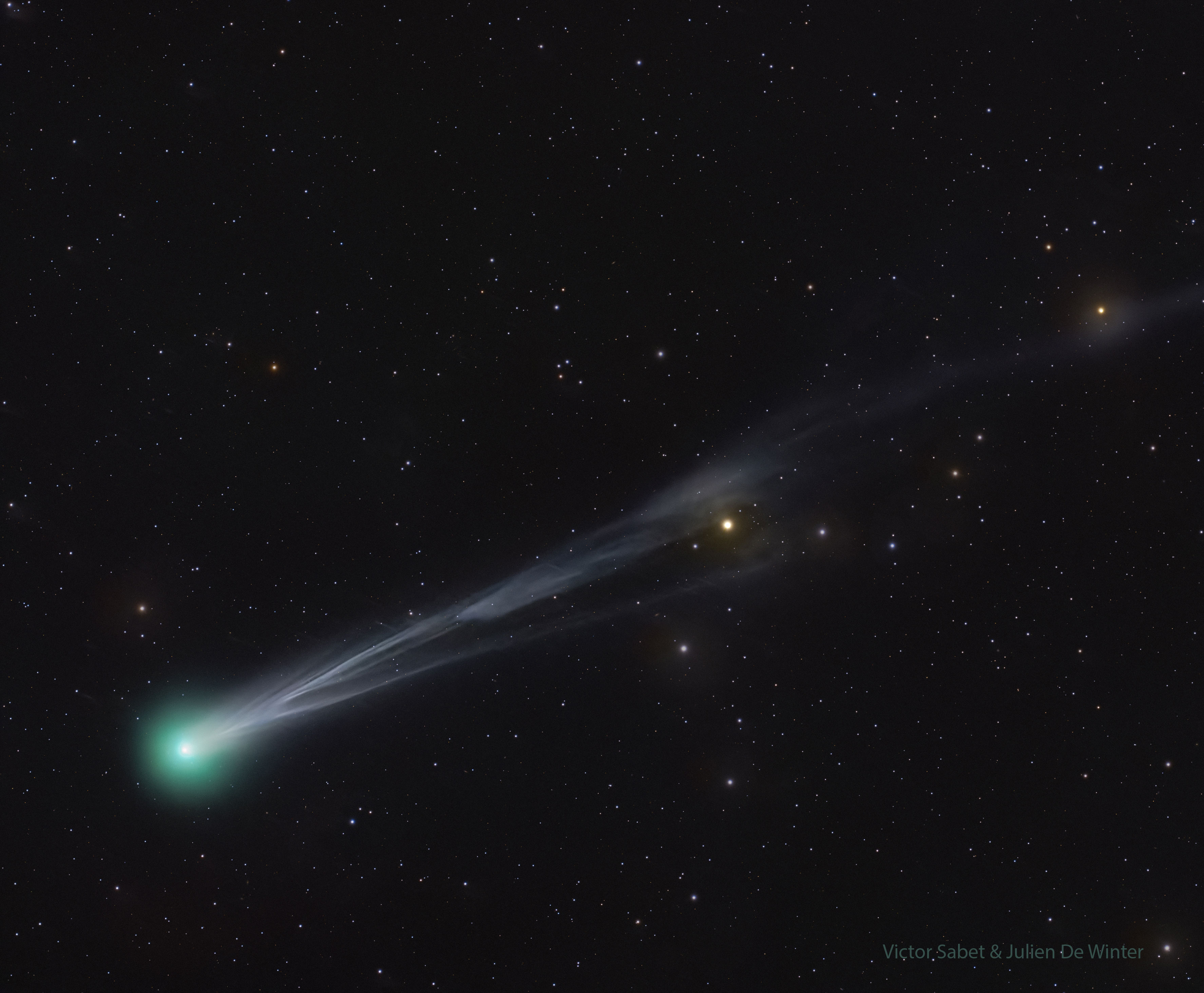
Explanation: Comet Lemmon is brightening and moving into morning northern skies. Besides Comet SWAN25B and Comet ATLAS, Comet C/2025 A6 (Lemmon) is now the third comet currently visible with binoculars and on long camera exposures. Comet Lemmon was discovered early this year and is still headed into the inner Solar System. The comet will round the Sun on November 8, but first it will pass its nearest to the Earth -- at about half the Earth-Sun distance -- on October 21. Although the brightnesses of comets are notoriously hard to predict, optimistic estimates have Comet Lemmon then becoming visible to the unaided eye. The comet should be best seen in predawn skies until mid-October, when it also becomes visible in evening skies. The featured image showing the comet's split and rapidly changing ion tail was taken in Texas, USA late last week.
2025 September 29
Explanation: It may look like these comets are racing, but they are not. Comets C/2025 K1 ATLAS (left) and C/2025 R2 SWAN (right) appeared near each other by chance last week in the featured image taken from France's Reunion Island in the southern Indian Ocean. Fainter Comet ATLAS is approaching our Sun and will reach its closest approach in early October when it is also expected to be its brightest -- although still only likely visible with long exposures on a camera. The brighter comet, nicknamed SWAN25B, is now headed away from our Sun, although its closest approach to Earth is expected in mid-October, when optimistic estimates have it becoming bright enough to see with the unaided eye. Each comet has a greenish coma of expelled gas and an ion tail pointing away from the Sun.
2025 September 17

Explanation: Can you spot famous celestial objects in this image? 18th-century astronomer Charles Messier cataloged only two of them: the bright Lagoon Nebula (M8) at the bottom, and the colorful Trifid Nebula (M20) at the upper right. The one on the left that resembles a cat's paw is NGC 6559, and it is much fainter than the other two. Even harder to spot are the thin blue filaments on the left, from supernova remnant (SNR G007.5-01.7). Their glow comes from small amounts of glowing oxygen atoms that are so faint that it took over 17 hours of exposure with just one blue color to bring up. Framing this scene of stellar birth and death are two star clusters: the open cluster M21 just above Trifid, and the globular cluster NGC 6544 at lower left.
2025 September 27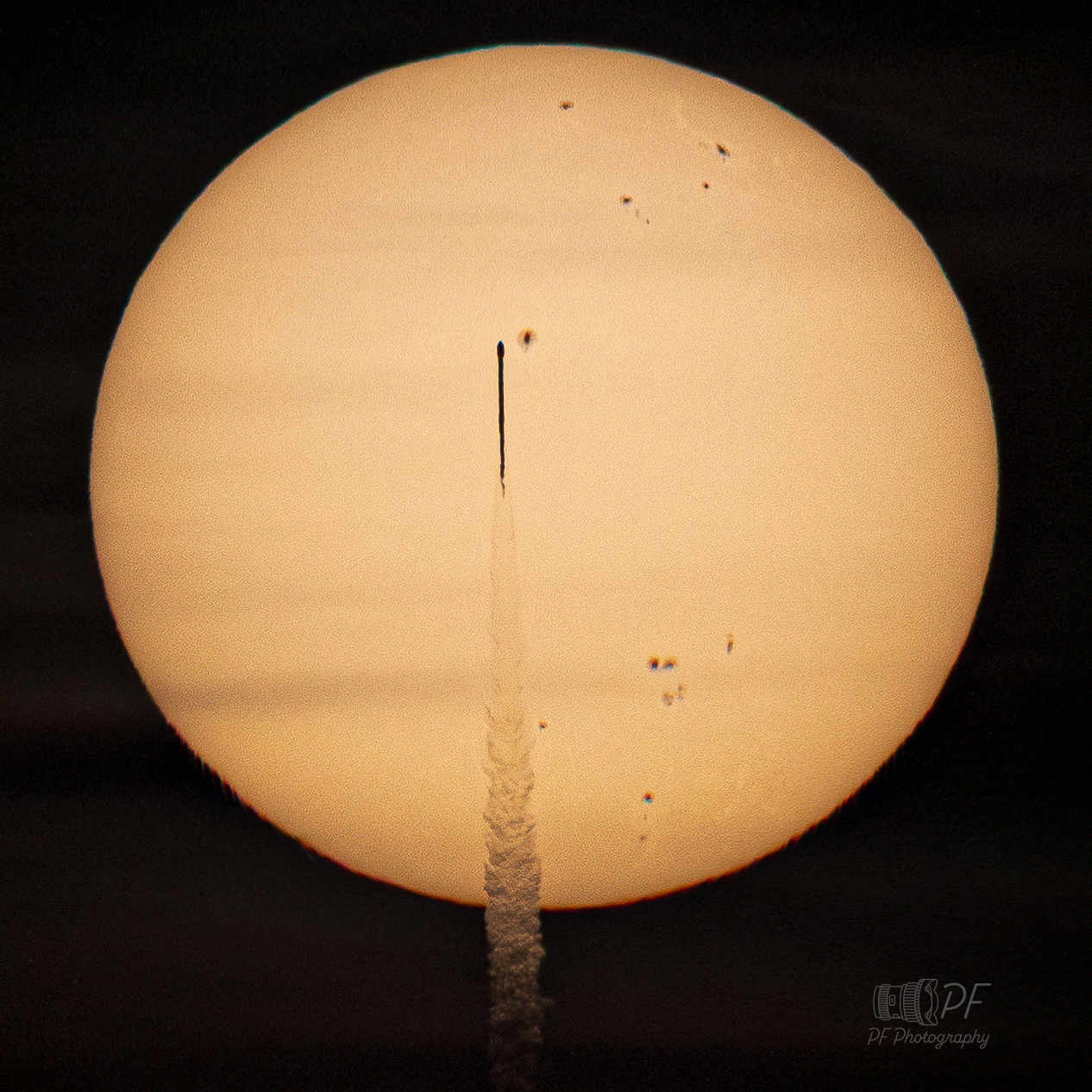
Explanation: On the morning of September 24 a rocket crosses the bright solar disk in this long range telescopic snapshot captured from Orlando, Florida. That's about 50 miles north of its Kennedy Space Center launch site. This rocket carried three new space weather missions to space. Signals have now been successfully acquired from all three - NASA's Interstellar Mapping and Acceleration Probe, NASA’s Carruthers Geocorona Observatory, and the National Oceanic and Atmospheric Administration (NOAA) Space Weather Follow-On Lagrange 1 (SWFO-L1) - as they begin their journey to L1, an Earth-Sun lagrange point. L1 is about 1.5 million kilometers in the sunward direction from planet Earth. Appropriately, major space weather influencers, aka dark sunspots in active regions across the Sun, are posing with the transiting rocket. In fact, large active region AR4225 is just right of the rocket's nose.
2025 September 26
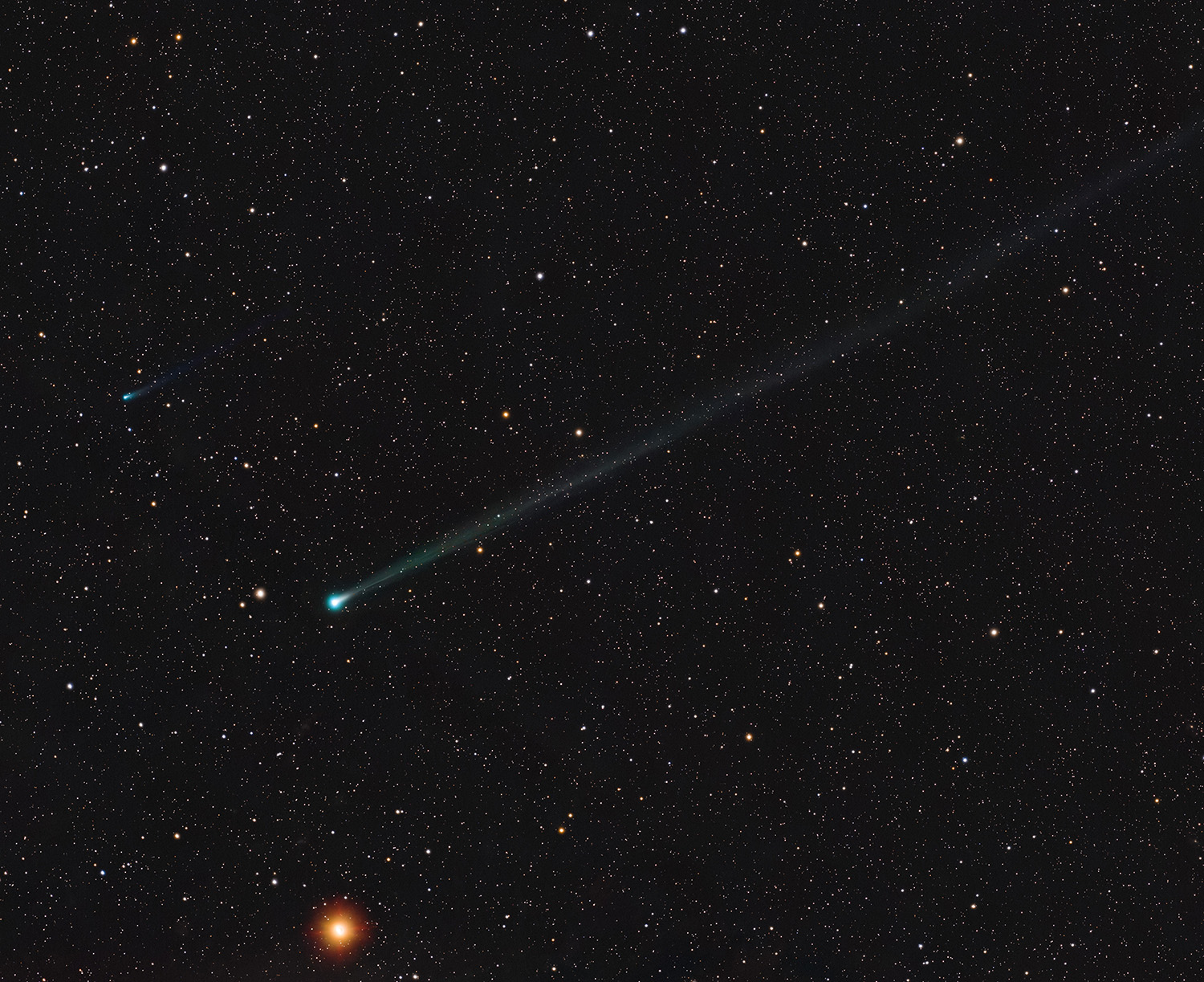
Explanation: A new visitor to the inner Solar System, comet C/2025 R2 (SWAN) sports a long ion tail extending diagonally across this almost 7 degree wide telescopic field of view recorded on September 21. A fainter fellow comet also making its inner Solar System debut, C/2025 K1 (ATLAS), can be spotted above and left of SWAN's greenish coma, just visible against the background sea of stars in the constellation Virgo. Both new comets were only discovered in 2025 and are joined in this celestial frame by ruddy planet Mars (bottom), a more familiar wanderer in planet Earth's night skies. The comets may appear to be in a race, nearly neck and neck in their voyage through the inner Solar System and around the Sun. But this comet SWAN has already reached its perihelion or closest approach to the Sun on September 12 and is now outbound along its orbit. This comet ATLAS is still inbound though, and will make its perihelion passage on October 8.

Sept jours de coma… et une expérience consciente Durant sept jours, le neurochirurgien reste plongé dans un état végétatif. Les examens neur...


:max_bytes(150000):strip_icc():focal(144x0:146x2)/000829300-1-166c18e3f54846d287baa774ae29b18e.jpg)