Nombre total de pages vues

10/01/2026

MICROPHOTOGRAPHIE - Une amibe dans sa coquille

Étrange objet que celui présenté ici par le photographe allemand scientifique Stefan Diller sous cet éclairage bleuté qui ajoute encore un peu au mystère. Et quelle surprise en apprenant qu'il ne s'agit pas d'un objet inanimé, mais d'une amibe. Un être vivant unicellulaire eucaryote de moins d'un millimètre.

Ce qui caractérise les amibes, c'est que leur corps change constamment de forme en se prolongeant en sortes de pieds factices, les pseudopodes. Ceux-ci leur permettent de ramper et de capturer des proies microscopiques. On peut trouver des amibes libres ou parasites. Et des amibes nues ou protégées d'une sorte de coquille. Une enveloppe dure et minéralisée comme celle que l'on reconnaît maintenant à l'amibe présentée sur ce cliché.

Les échantillons ont été empilés en Z et scannés par un microscope électronique à balayage à émission de champ Tescan Mira3 et colorisés à la volée avec un système d'imagerie multidétecteur à quatre canaux développé par Point electronic Halle.

Le champ de vision est de 100 microns de large.

ASTRONOMY - Jupiter with the Great Red Spot

 2026 January 10

See Explanation.  Clicking on the picture will download
the highest resolution version available.

Jupiter with the Great Red Spot
Image Credit & Copyright: Christopher Go

Explanation: Jupiter reaches its 2026 opposition today, January 10. That puts our Solar System's most massive planet opposite the Sun and near its closest and brightest for viewing from planet Earth. In fact, captured only 3 days ago this sharp telescopic snapshot reveals excellent details of the ruling gas giant's swirling cloudtops, in light zones and dark belts girdling the rapidly rotating outer planet. Jupiter's famous, persistent anticyclonic vortex, known as the Great Red Spot, is south of the equator at the lower right. But two smaller red spots are also visible, one near the top in the northernmost zone, and one close to Jupiter's south pole. And while Jupiter's Great Red Spot is known to be shrinking, it's still about the size of the Earth itself.

09/01/2026

MICROPHOTOGRAPHIE - Zoom sur une abeille mellifère


Le monde de l’infiniment petit est fascinant de beauté. Une beauté qui pourrait bien servir à sensibiliser le grand public à l’importance de la recherche, tant appliquée que fondamentale. Stephan Diller, un photographe scientifique de renommée internationale, en tout cas, en est convaincu.

Il nous offre ici un tout petit aperçu de son immense talent. De matière inerte à l'être vivant, il nous propose de le suivre dans un voyage merveilleux, à la découverte de quelques formes et apparats qui échappent au quotidien de nos regards.

L'abeille européenne -- ou Apis mellifera -- est parfois considérée comme l'un des premiers insectes à avoir été domestiqué. Elle reste en réalité semi-sauvage. Mais elle est effectivement aujourd'hui élevée à grande échelle pour la production de miel et les autres activités de pollinisation.

Cette microphotographie d'une incroyable netteté a été obtenue grâce à un balayage en 50.000 par 60.000 pixels sur 20 couches en Z. Elle a été imprimée sur une surface incroyable de 28 par 38 mètres pour être exposée au Carola's Garden de Leipzig (Allemagne) où le peintre Yadegar Asisi propose de découvrir un jardin avec le regard d'un insecte.

L'abeille a été balayée par un microscope électronique à balayage à émission de champ Tescan Mira3 et colorisée à la volée avec un système d'imagerie multidétecteur à quatre canaux développé par Point electronic Halle.

Le champ de vision est de 7.000 microns de large. 

ASTRONOMY - Ice Halos by Moonlight and Sunlight

 2026 January 9

See Explanation.  Clicking on the picture will download
the highest resolution version available.

Ice Halos by Moonlight and Sunlight
Image Credit & Copyright: Antonella Cicala

Explanation: Both Moon and Sun create beautiful ice halos in planet Earth's sky. In fact, the two brightest celestial beacons are each surrounded by a complex of ice halos in these photos of the sky above Chamonix-Mont-Blanc in France. The panels were recorded one night (left) and the following day at the end of December 2025. Similar ice halos appear in moonlight and sunlight because they are all formed through the geometry of flat, hexagonal ice crystals. The ice crystals reflect and refract light as they flutter in the cold atmosphere above the mountain resort. In the pictures both Moon and Sun are surrounded by a more commonly seen 22 degree circular halo. Bright and sometimes colorful patches at the intersections of the 22 degree circular halos with the indicated parselenic and parhelic arcs are also known as Moon dogs and Sun dogs.

08/01/2026

ASTRONOMIE - NGC2392 - la nébuleuse de l’Esquimau


ASTRONOMY - IC 342: Hidden Galaxy in Camelopardalis

 2026 January 8

See Explanation.  Clicking on the picture will download
the highest resolution version available.

IC 342: Hidden Galaxy in Camelopardalis
Image Credit & Copyright: Gaetan Maxant

Explanation: Similar in size to large, bright spiral galaxies in our neighborhood, IC 342 is a mere 10 million light-years distant toward the long-necked, northern constellation Camelopardalis. A sprawling island universe, IC 342 would otherwise be a prominent galaxy in our night sky, but it is hidden from clear view and only glimpsed through the veil of stars, gas and dust clouds along the plane of our own Milky Way galaxy. Even though IC 342's light is dimmed and reddened by intervening cosmic clouds, this sharp telescopic image traces the galaxy's own obscuring dust, young star clusters, and glowing star forming regions along spiral arms that wind far from the galaxy's core. IC 342 has undergone a recent burst of star formation activity and is close enough to have influenced the evolution of the local group of galaxies and the Milky Way.

07/01/2026

LES BELLES INVENTIONS DE LEONARD DE VINCI - L'ornithoptère

C'est, semble-t-il, l'un des premiers dessins que Léonard de Vinci ait consacré à ses machines volantes. Il préfigure d'autres versions de l'ornithoptère, cet aéronef dont la sustentation est assurée par des battements d'ailes suivant le principe du vol des oiseaux. Un système de levier transforme des mouvements alternés des pieds et des mains en battements d'ailes. Le dessin est extrait du Codex Atlanticus.

© Special Collections Toronto Public Library, CC by-nc 2.0

ASTRONOMY - Simeis 147: The Spaghetti Nebula Supernova Remnant

2026 January 7
A starfield surrounds a giant red nebula. The nebula has so 
many winding filaments that it has been dubbed the Spaghetti Nebula.
Please see the explanation for more detailed information.

Simeis 147: The Spaghetti Nebula Supernova Remnant
Image Credit & Copyright: Saverio Ferretti

Explanation: Its popular nickname is the Spaghetti Nebula. Officially cataloged as Simeis 147 and Sharpless 2-240, it is easy to get lost following the looping and twisting filaments of this intricate supernova remnantSeen toward the boundary of the constellations of the Bull (Taurus) and the Charioteer (Auriga), the impressive gas structure covers nearly 3 degrees on the sky, equivalent to 6 full moons. That's about 150 light-years at the stellar debris cloud's estimated distance of 3,000 light-years. The supernova remnant has an estimated age of about 40,000 years, meaning light from this powerful stellar explosion first reached the Earth when woolly mammoths roamed free. Besides the expanding remnant, this cosmic catastrophe left behind a pulsar, a fast-spinning neutron star that is the remnant of the original star's core. The featured image was captured last month from Forca CanapineItaly

06/01/2026

ASTRONOMY - Jupiter's Clouds in High Definition from Juno

 2026 January 6

The planet Jupiter is shown from an unusual angle. Most
prominent are a miasma of jumbled and swirling clouds including
many oval storms. 
Please see the explanation for more detailed information.

Jupiter's Clouds in High Definition from Juno
Image Credit: NASA/JPL-Caltech/SwRI/MSSS; Processing & LicenseThomas Thomopoulos

Explanation: How complex is Jupiter? NASA's Juno mission to Jupiter is finding the Jovian giant to be more complicated than expected. Jupiter's magnetic field has been discovered to be much different from our Earth's simple dipole field, showing several poles embedded in a complicated network more convoluted in the north than the south. Further, Juno's radio measurements show that Jupiter's atmosphere shows structure well below the upper cloud deck -- even hundreds of kilometers deep. Jupiter's newfound complexity is evident also in southern clouds, as shown in the texture and color enhanced featured image taken last month. There, planet-circling zones and belts that dominate near the equator decay into a complex miasma of continent-sized storm swirls. Juno continues in its looping elliptical orbit, swooping near the huge planet every month and exploring a slightly different sector each time around.

05/01/2026

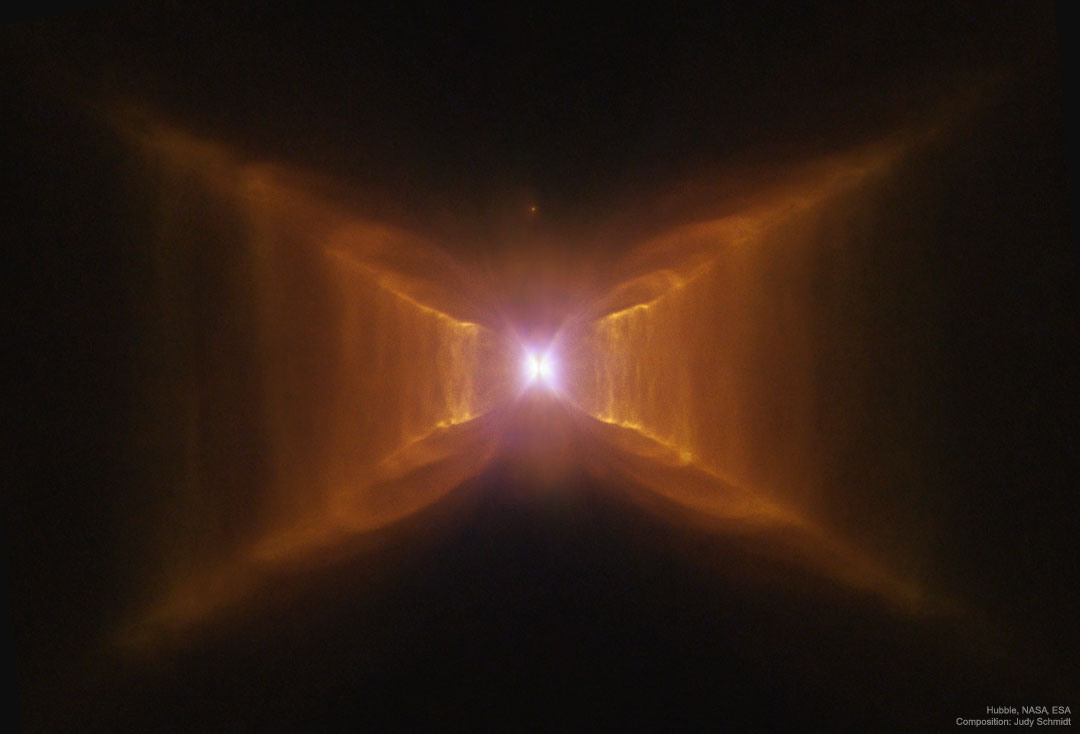
ASTRONOMY - The Red Rectangle Nebula from Hubble

 2026 January 5

A dark field surrounds a red nebula. The shape of the 
nebula appears like the letter

The Red Rectangle Nebula from Hubble
Image Credit: NASAESAHubbleProcessing & LicenseJudy Schmidt

Explanation: How was the unusual Red Rectangle nebula created? At the nebula's center is an aging binary star system that surely powers the nebula but does not, as yet, explain its colors. The unusual shape of the Red Rectangle is likely due to a thick dust torus which pinches the otherwise spherical outflow into tip-touching cone shapes. Because we view the torus edge-on, the boundary edges of the cone shapes seem to form an X. The distinct rungs suggest the outflow occurs in fits and starts. The unusual colors of the nebula are less well understood, however, and speculation holds that they are partly provided by hydrocarbon molecules that may actually be building blocks for organic life. The Red Rectangle nebula lies about 2,300 light years away towards the constellation of the Unicorn (Monoceros). The nebula is shown here in great detail as a reprocessed image from Hubble Space Telescope. In a few million years, as one of the central stars becomes further depleted of nuclear fuel, the Red Rectangle nebula will likely bloom into a planetary nebula.

ASTRONOMY - Meteor Dust

2026 January 12 Meteor Dust Image Credit & Copyright:  Xu Chen Explanation:  What's happening to this meteor? It is shedding its out...