"L'Estate"
21/06/2026

Astronomy - DAYTIME MOON MEETS EVENING STAR
2026 June 20
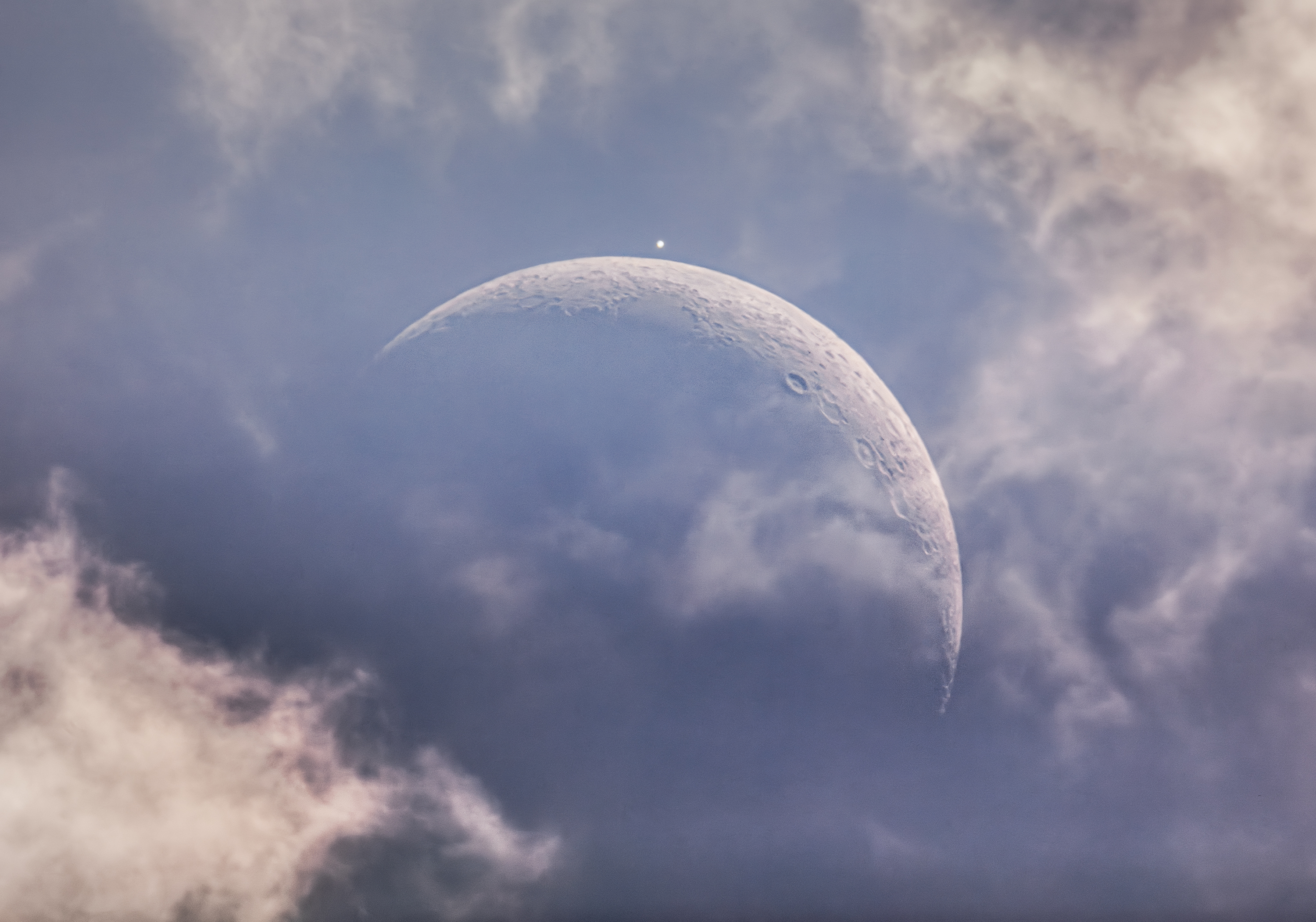
Image Credit & Copyright: Debra Ceravolo
Explanation: Venus is now appearing on the celestial stage as Earth's brilliant evening star, performing with the Moon, other wandering planets, and bright stars in western skies. For evening sky gazers on June 17, the celestial beacon rose after sunset close by a young, slender, crescent Moon. But from some locations the Moon could be seen to occult or pass in front of Venus. And from a backyard observatory in southern British Columbia, Canada, the lunar occultation was played out in daylight. This stunning telescopic snapshot captured a scene in dramatically cloudy skies, following Venus' hour long disappearance, as the evening star emerged beyond the bright lunar limb.
17/06/2026
La vie et la mort - Y-A-T-IL UNE VIE APRèS LA MORT ? (3/5)

Sept jours de coma… et une expérience consciente
Durant sept jours, le neurochirurgien reste plongé dans un état végétatif. Les examens neurologiques indiquent une activité cérébrale minimale, incompatible avec la formation de souvenirs complexes ou d’expériences conscientes élaborées.
Durant sept jours, le neurochirurgien reste plongé dans un état végétatif. Les examens neurologiques indiquent une activité cérébrale minimale, incompatible avec la formation de souvenirs complexes ou d’expériences conscientes élaborées.
Pourtant, à son réveil, Eben Alexander décrit un vécu détaillé et structuré. Il affirme avoir eu la sensation de quitter son corps et d’évoluer dans un univers lumineux, paisible, dominé par un sentiment d’amour profond et inconditionnel. Selon lui, cette expérience était d’une clarté et d’une intensité supérieures à celles de la réalité ordinaire. Ce qui interpelle particulièrement la communauté scientifique est la cohérence de son récit, rapporté dès son réveil, avant toute exposition à des récits similaires ou à des interprétations spirituelles.
CommentEconomiser
.../>
15/06/2026
Astronomy - TRIPLE SHOCKWAVE FROM SUN CROSSING ROCKET
2026 June 15
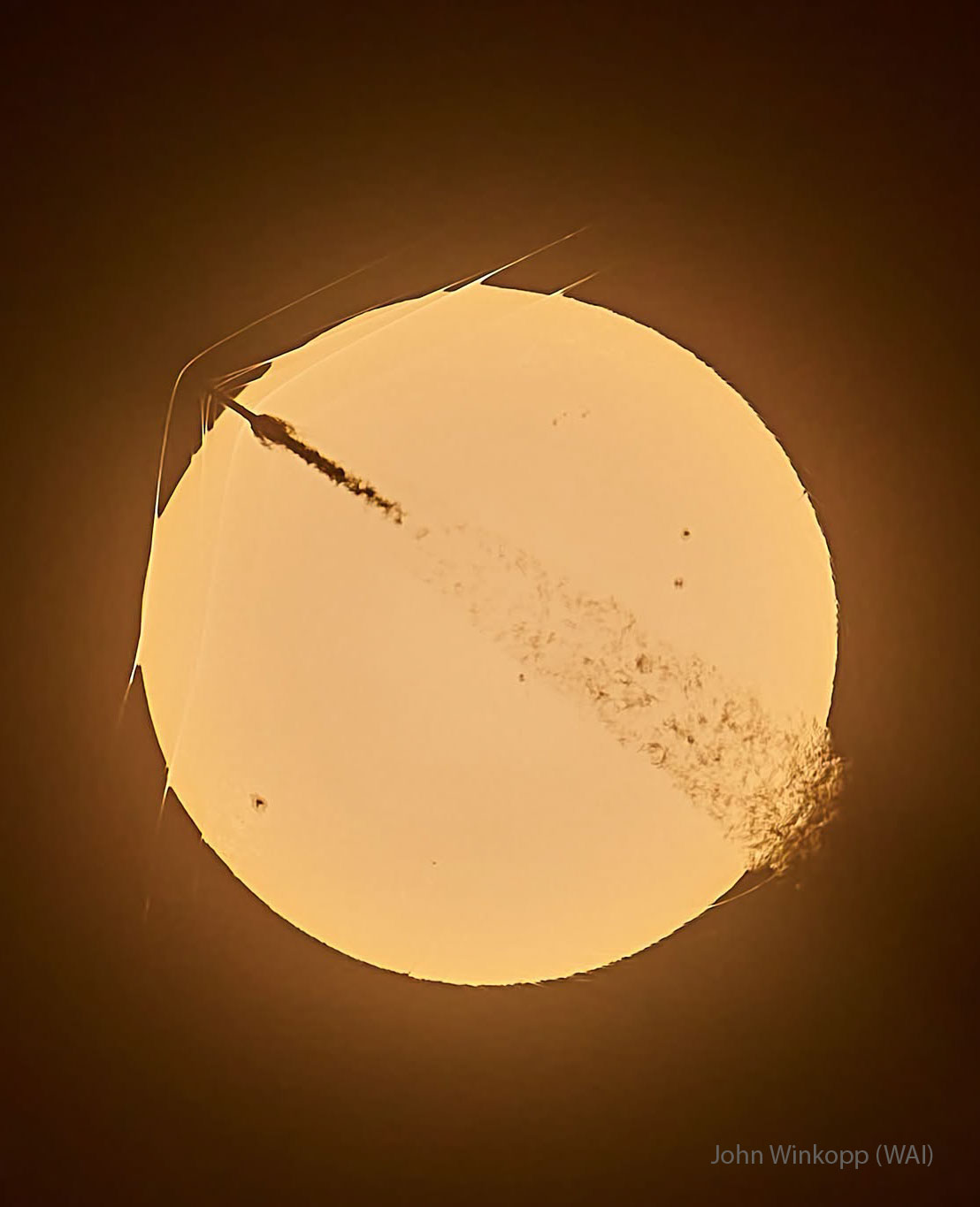
Image Credit & Copyright: John Winkopp (WAI Media)
Explanation: What's happening to this Sun-crossing rocket? The SpaceX Falcon 9 rocket, visible on the upper left, launched only about one minute before this amazing image was captured. As it rose to low Earth orbit from Cape Canaveral, Florida, USA, in late May, the rocket became supersonic before it crossed the disk of the distant Sun -- from the perspective of the well-placed photographer. The spacecraft's high speed caused bow-shaped compressed-air shockwaves to form across leading surfaces, with at least three visible even outside the Sun's disk because they refract sunlight. The trailing exhaust caused turbulence visible on the lower right. None of this was damaging to the robotic Starlink 10-53 mission, which delivered 29 communications satellites to low Earth orbit as planned. And if that isn't amazing enough - the Sun had spots!
14/06/2026
La vie et la mort - Y-A-T-IL UNE VIE APRES LA MORT ? (2/5)

Avant cet événement, Eben Alexander ne laissait aucune place au doute. Pour lui, les expériences de mort imminente relevaient soit d’hallucinations, soit de reconstructions mentales provoquées par un cerveau en détresse. Comme beaucoup de ses confrères, il considérait ces récits comme incompatibles avec les connaissances neuroscientifiques. Tout bascule le 10 novembre 2008. Victime de violents maux de tête, il est hospitalisé d’urgence à Lynchburg, en Virginie. Le diagnostic est grave : une méningite bactérienne rare causée par une souche d’Escherichia coli. L’infection détruit rapidement son néocortex, la zone du cerveau associée à la pensée consciente, au raisonnement et à la perception sensorielle.
Son état se dégrade en quelques heures. Eben Alexander tombe dans un coma profond. Les médecins évoquent un pronostic extrêmement sombre : peu de chances de survie, et presque aucune d’un retour à une vie normale.
CommentEconomiser
.../>
13/06/2026
La vie et la mort - Y-A-T-IL UNE VIE APRES LA MORT ? (1/5)

Un neurochirurgien de renom : « Il y a une vie après la mort et j'en ai la preuve. »
Et si tout ce que vous pensiez savoir sur la mort était… incomplet ? Pendant des décennies, la science a soutenu une idée largement admise : la conscience humaine serait entièrement produite par l’activité du cerveau. La conscience n’existe que grâce au cerveau. Pas de cerveau actif ? Pas de pensée. Pas d’émotion. Pas d’âme.
Pourtant, le témoignage d’un neurochirurgien américain respecté est venu ébranler cette certitude. Et s'il existait en réalité une continuité, une forme de conscience qui refuse de s’éteindre ? Et si la mort n'était pas un point final ? C’est la question vertigineuse qu’a soulevée un homme que rien ne prédestinait à tenir un tel discours. Un homme de science, de rigueur, de certitudes médicales. Jusqu’au jour où sa propre vie a basculé.
En 2008, Eben Alexander, spécialiste du cerveau formé à Harvard, affirme avoir vécu une expérience consciente alors que son cerveau était, selon les médecins, quasiment hors d’état de fonctionner. Depuis, il soutient publiquement l’idée qu’il pourrait exister une forme de vie ou de conscience après la mort.
CommentEconomiser
.../>
Géoglyphes - LE CHIEN DE NAZCA

Les géoglyphes de Nazca, encore appelés lignes de Nazca, sont de grandes figures tracées dans le désert de Nazca, dans le sud du Pérou. Réalisés pour la plupart entre -200 et 600 ap. J.-C., ils sont le fait de la civilisation Nazca, une culture pré-inca qui se développa entre 300 av. J.-C. et 800 de notre ère. On se perd en conjectures et spéculations parfois douteuses quant à la signification que ces figures avaient pour les Nazcas.
Le sol sur lequel se dessinent ces géoglyphes est couvert de cailloux que l'oxyde de fer colore en rouge. Et c'est en les ôtant, parfois sur des kilomètres, que les Nazcas ont révélé un sol gypseux grisâtre, faisant apparaître des figures réparties le long d'une ligne de 50 km reliant les villes de Nazca et de Palpa, dans la région d'Ica.
© Creative Commons Attribution-Share Alike 2.5 Spain
Astronomy - VENUS AND JUPITER: CONJUNCTION FROM AVEBURY
2026 June 12
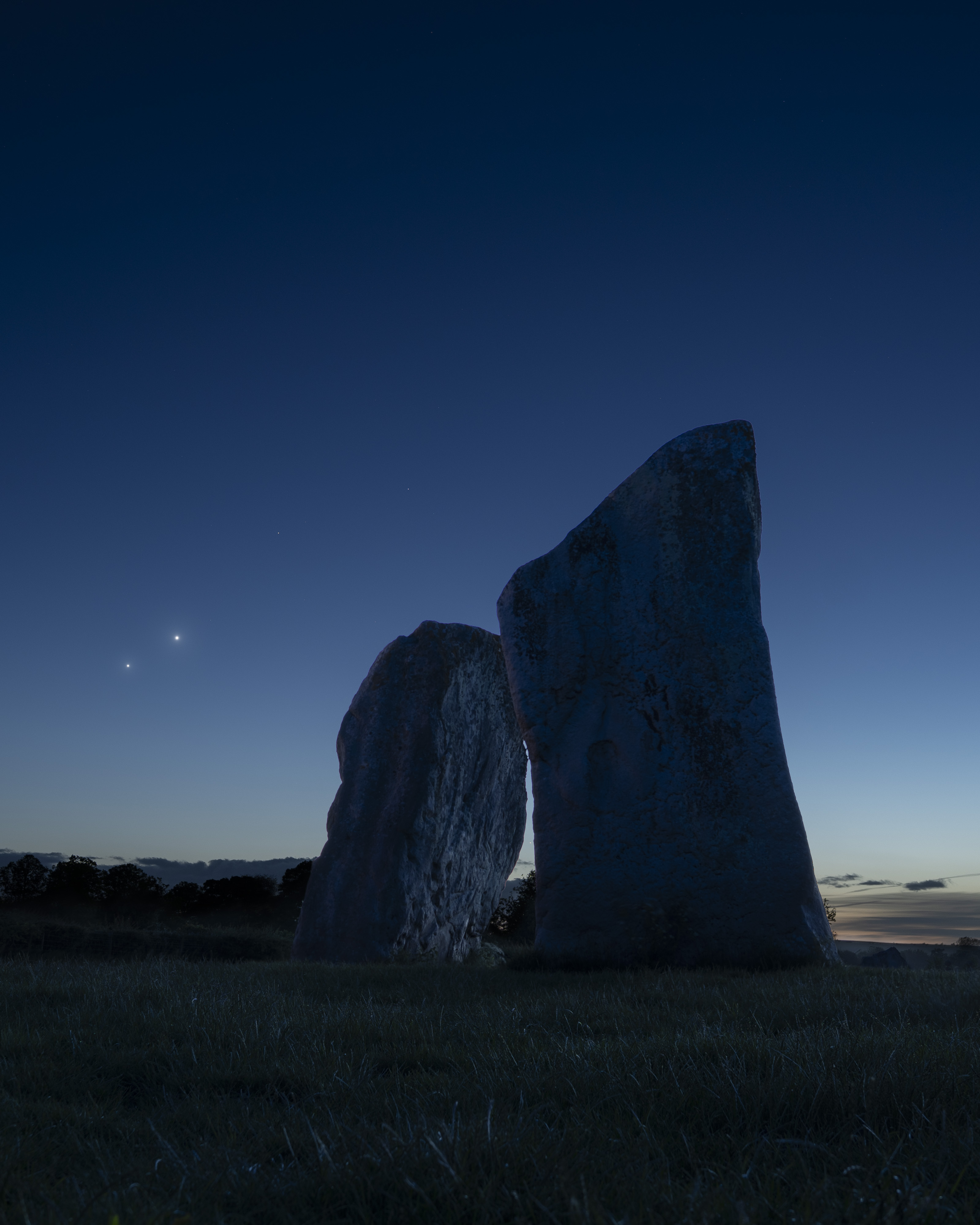
Image Credit & Copyright: Josh Dury
Explanation: To see Venus and Jupiter together this month, you won't need binoculars or even a telescope. Just look up after sunset and you'll find them emerging as the sky grows dark near the western horizon. In fact, on June 9 the two brightest planets were in close conjunction, separated on the sky by less than 2 degrees from our perspective. Since (brighter) inner planet Venus orbits the Sun faster than outer planet Jupiter, it catches up with and passes the outer planet along the ecliptic roughly every 13 months. But every three years or so their resulting conjunction can be viewed far enough from the Sun to be easily seen in Earth's twilight skies. On June 9, the two celestial beacon's close "cosmic kiss" was captured here next to two large standing stones, the remains of a cove near the center of a 4,000 year old stone circle at Avebury, UK. Larger than Stonehenge, the Avebury henge and stone circle complex is also recognized as one of the most significant neolithic ceremonial sites on planet Earth.
11/06/2026
Astronomy - THE MARMAID NEBULA SUPERNOVA REMNANT
2026 June 11
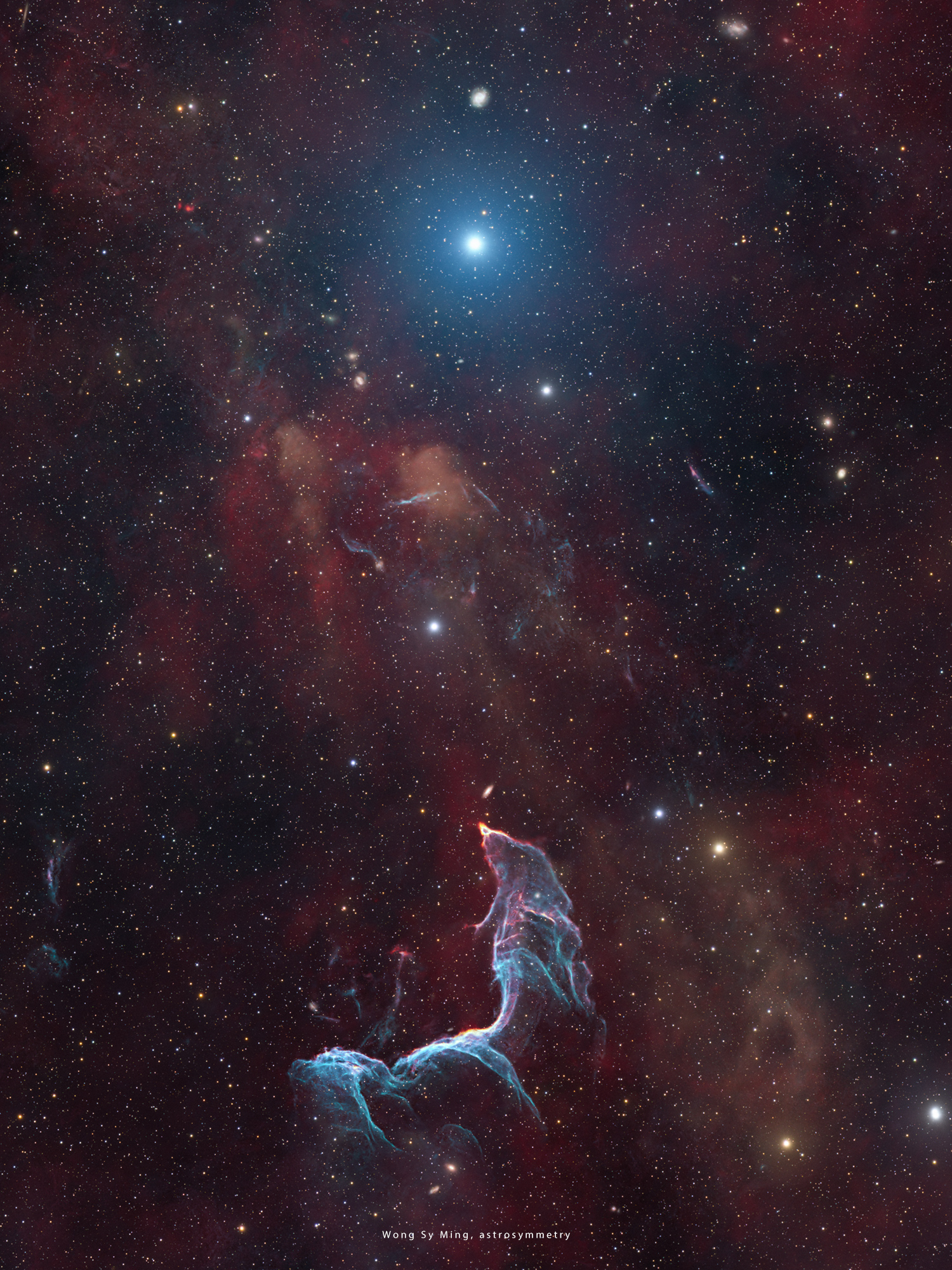
Image Credit & Copyright: Data acquisition: Sy Ming Wong; Processing: Guangyan Gao
Text: Cecilia Chirenti (NASA GSFC, UMCP, CRESST II)
Explanation: Could the Little Mermaid turn into stardust instead of seafoam? It would seem so in this beautiful nebula. The featured image shows the Mermaid Nebula, also known as the Betta Fish Nebula, which is part of the G296.5+10.0 Supernova Remnant. The blue color visible here originates from doubly ionized oxygen (OIII), while the deep red is emitted by hydrogen gas. Estimated to be located a few thousand light-years away and about 10,000 years old, this nebula was formed when a massive star exploded as a supernova. It left behind a peculiar pulsar, a young radio-quiet neutron star that spins around about twice every second. The bright stars shown in the image are unassociated with the nebula. The pulsar can be detected in the X-rays but it does not have a confirmed detection in the optical (visible light) so far. As a result, the pulsar itself is not visible in this image.
10/06/2026
Astronomy - THE EAGLE NEBULA AND FRIENDS
2026 June 10
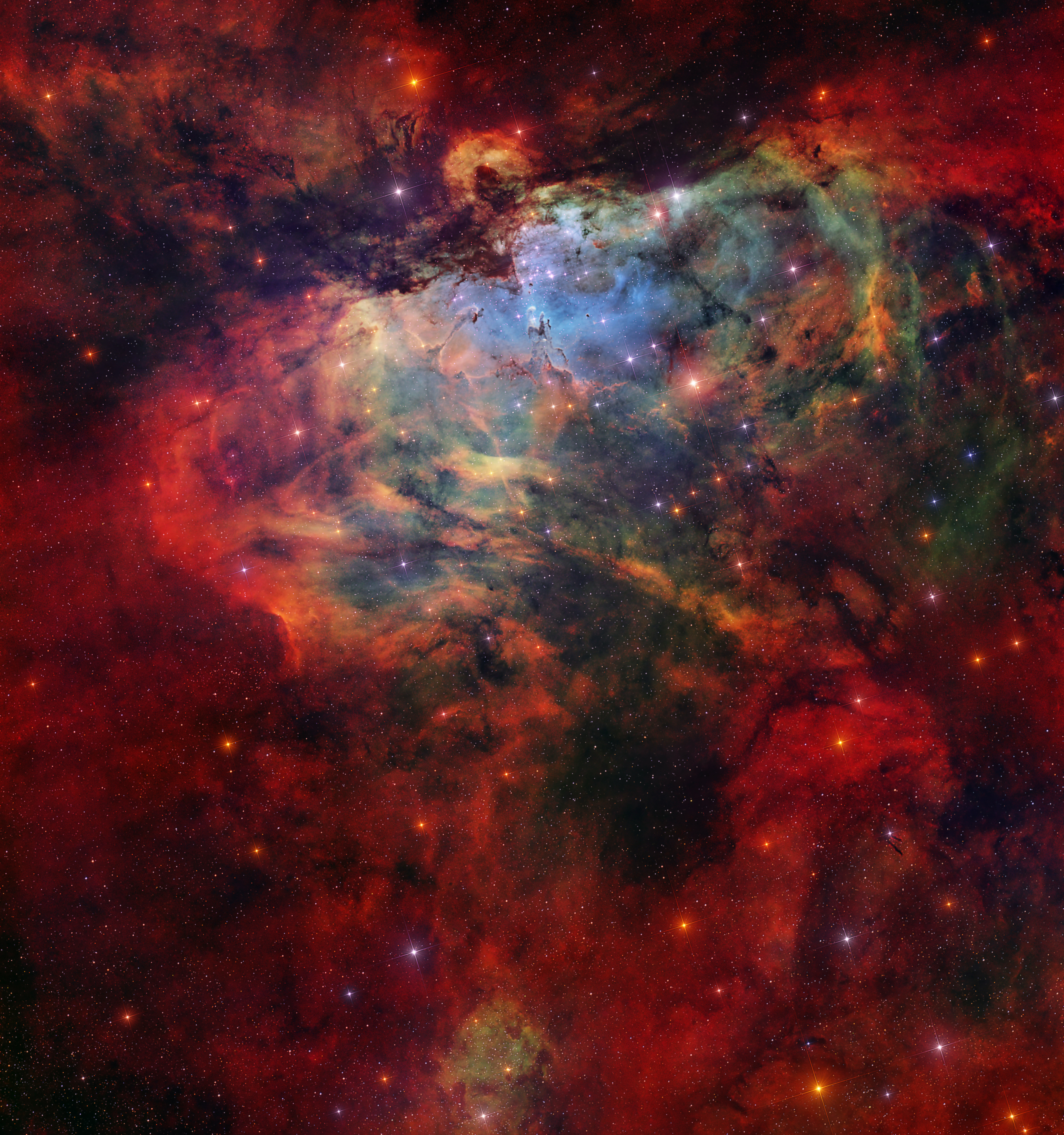
Image Credit & Copyright: Emmanuel Delgadillo
Text: Keighley Rockcliffe (NASA GSFC, UMBC CSST, CRESST II)
Explanation: What looks as if it is going to swallow the great Pillars of Creation? The Eagle Nebula (M16) is not a bird, a plane, or Superman. M16 is actually a combination of several celestial objects. NGC 6611 is the young star cluster that appears to peak out beneath the Eagle’s “wings”. The ultraviolet light from these stars ionizes the surrounding gas, creating the emission nebula IC 4703. The Stellar Spire is seen reaching towards the Pillars of Creation from the left. Both are structures of cold gas and dust that are optimal for star formation. Some astronomers previously thought the Pillars of Creation had been evaporated away by a supernova. Because M16 is 6,000 light years away, we would not be able to see the Pillars’ destruction for thousands more years. However, there is no conclusive evidence of the theorized supernova, so the Pillars of Creation will likely continue to create stars for millions of years.
Inscription à :
Articles (Atom)
Astronomy - M27 : THE DUMBBELL NEBULA
2026 June 22 M27: The Dumbbell Nebula Image Credit & Copyright: Francesco Antonucci Explanation: Is this what will become of our Sun? Q...

-
2026 January 1 Auroral Corona Image Credit & Copyright : Roi Levi Explanation: Cycle 25 solar maximum made 2025 a great year for ...
-
Imaginez un monde où le cancer n’est plus une sentence, mais une simple étape à franchir. Grâce à une découverte révolutionnaire, ce rêve es...


