Nombre total de pages vues

28/02/2026

Astronomy - LUNAR OCCULTATION OF MERCURY

 2026 February 28

See Explanation.  Clicking on the picture will download
the highest resolution version available.

Lunar Occultation of Mercury
Image Credit & CopyrightFabrizio Melandri

Explanation: Fans of the western sky after sunset have lately enjoyed this month's remarkable array of bright planets. Witnessed from some locations, on February 18 planet Mercury even appeared to slide behind the Moon, an event known as a lunar occultation. These two snapshots, taken in early evening skies show before and after telescopic views of the rare disappearance of innermost planet behind young Moon. The top panel finds bright Mercury just visible at the northern (right) edge of the earthshine-illuminated lunar disk. In the bottom panel the bright planet has emerged in darker skies beyond the Moon's sunlit crescent. As seen south of Sallisaw, Oklahoma, planet Earth, this lunar occultation of Mercury lasted only about 3 minutes (video). But you can still check out a parade of planets tonight.

27/02/2026

Astronomy - SHARPLESS 249AND THE JELLYFISH NEBULA

 2026 February 27

See Explanation.  Clicking on the picture will download
the highest resolution version available.

Sharpless 249 and the Jellyfish Nebula
Image Credit & CopyrightKatelyn Beecroft

Explanation: Normally faint and elusive, the Jellyfish Nebula is caught in this alluring telescopic field of view. Floating in the interstellar sea, the nebula is anchored right and left by two bright stars, Mu and Eta Geminorum, at the foot of the celestial twins. The Jellyfish Nebula itself is right of center, seen as a brighter arcing ridge of emission with dangling tentacles. In fact, this cosmic jellyfish is part of bubble-shaped supernova remnant IC 443, the expanding debris cloud from a massive star that exploded. Light from the explosion first reached planet Earth over 30,000 years ago. Like its cousin in astrophysical waters the Crab Nebula supernova remnant, the Jellyfish Nebula is known to harbor a neutron star, the ultradense remnant of the collapsed stellar core. An emission nebula cataloged as Sharpless 249 fills the field at the upper left. The Jellyfish Nebula is about 5,000 light-years away. At that distance, this image would be about 300 light-years across.

Microphotographie - LES ANTENNES : ORGANE VITALPOUR LES ABEILLES

Les antennes des abeilles sont des organes étonnants. On y trouve une dizaine d'articulations et elles portent plusieurs milliers de récepteurs sensoriels. Ces derniers captent notamment les molécules odorantes auxquelles les abeilles sont particulièrement sensibles. Elles leur permettent de repérer des sources de nectar. Mais aussi de communiquer avec leurs congénères.

Parmi les autres informations que les abeilles tirent de leurs antennes : le goût, le taux d'humidité ou encore la température. Toutes sortes d'informations sur l'environnement dans lequel elles évoluent. À tel point que sans antenne, une abeille ne peut pas vivre.

Cette abeille a été balayée par un microscope électronique à balayage à émission de champ Tescan Mira3 et colorisée à la volée avec un système d'imagerie multidétecteur à quatre canaux développé par Point electronic Halle.

Le champ de vision est d'environ 1.750 microns de large. 

26/02/2026

Astronomy - WEBB AND HUBBLE - IC 5332

 2026 February 26

See Explanation.  Clicking on the picture will download
the highest resolution version available.

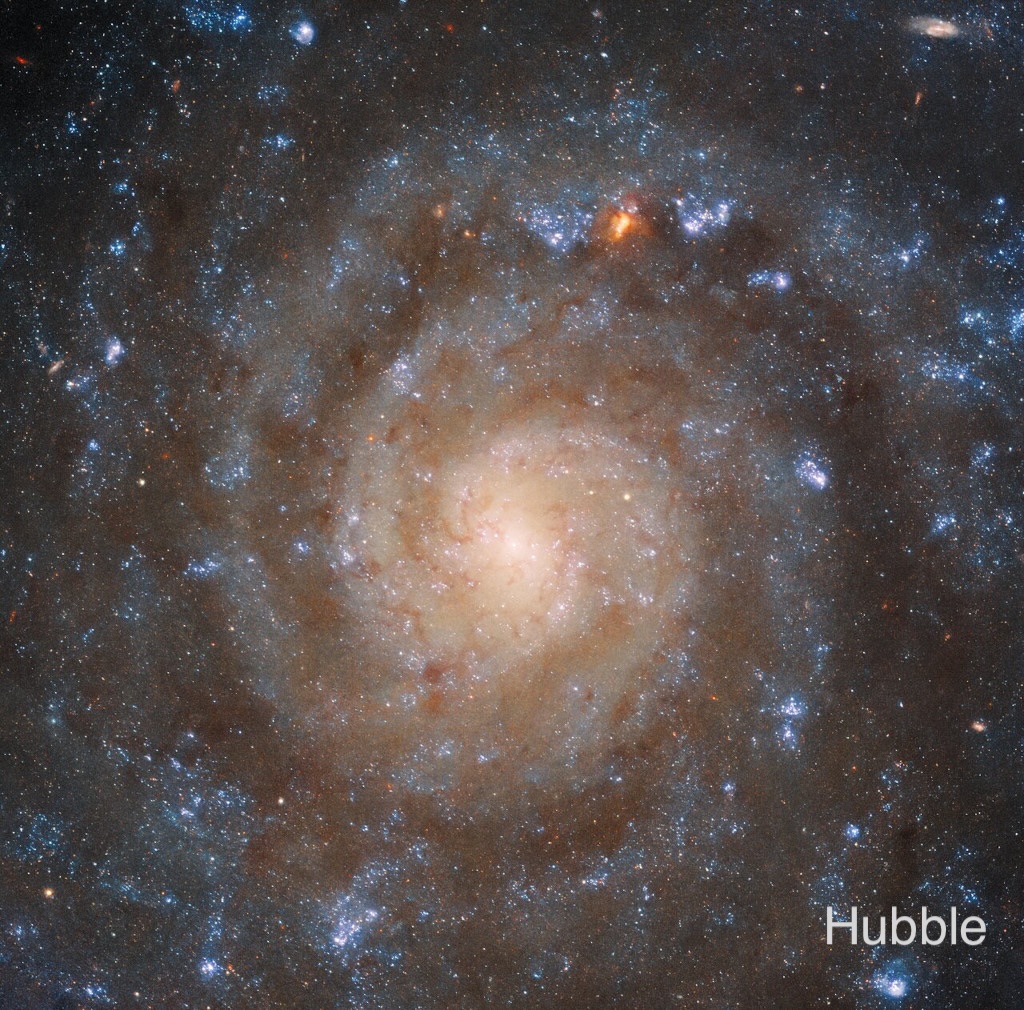
Webb and Hubble: IC 5332
Image Credit: ESA/WebbNASACSA, J. Lee and the PHANGS-JWST and PHANGS-HST Teams
Text: Cecilia Chirenti (NASA GSFCUMCPCRESST II)

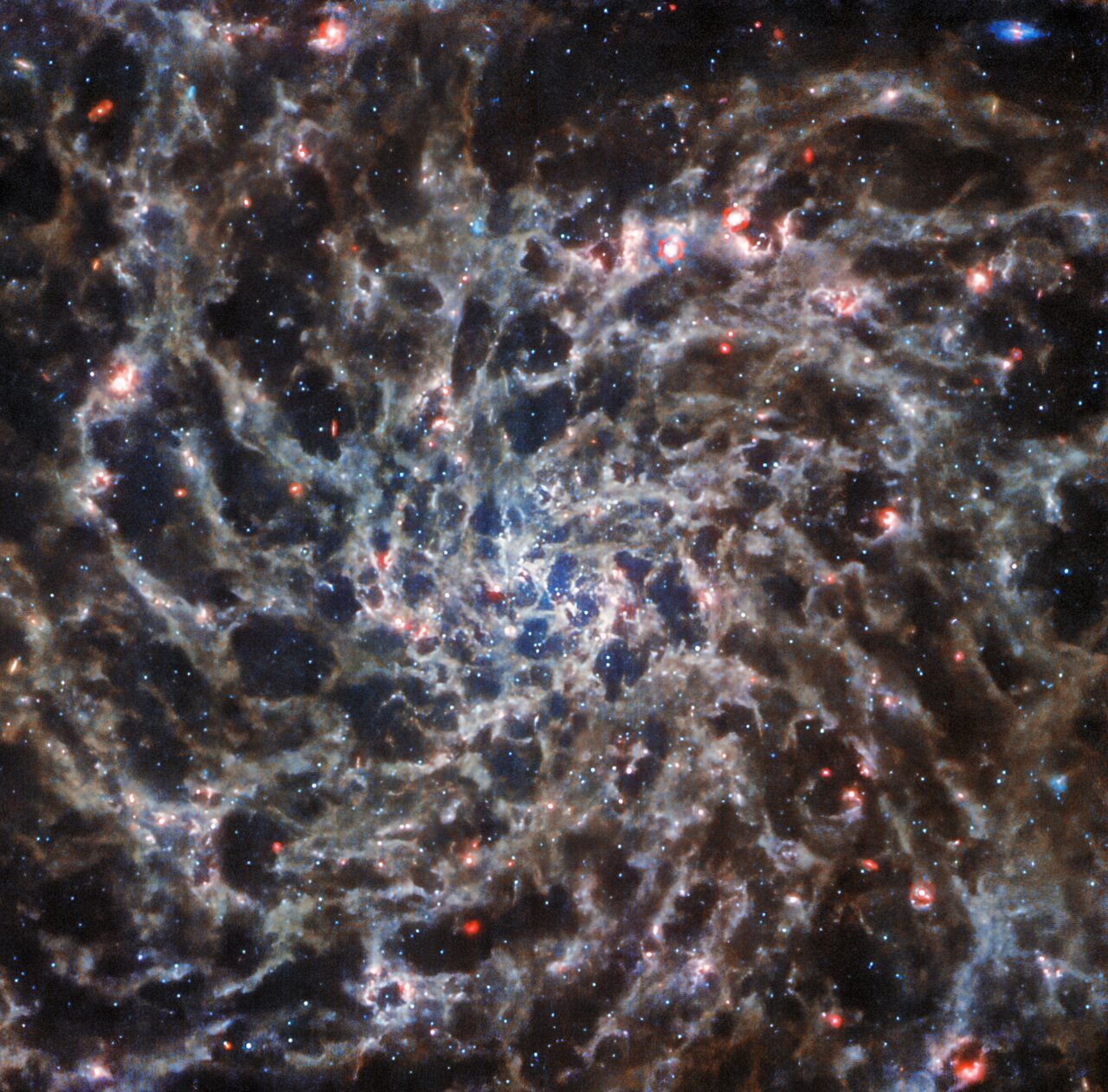
Explanation: What does the universe look like through infrared goggles? Our eyes can only see visible light, but astronomers want to see more. Today’s APOD shows spiral galaxy IC 5332 as seen by two NASA telescopes: Webb in mid-infrared and Hubble in ultraviolet and visible light. To toggle between the two space-based views just slide your cursor over the image (or follow this link). The Hubble image highlights the spiral arms of the galaxy separated by dark regions, whereas the Webb image reveals a finer, more tangled structure. Interstellar dust scatters and absorbs light from the stars in the galaxy, causing the dark dust lanes in the Hubble image, and then emits heat in infrared light, so dust glows in this Webb image. The Mid-InfraRed Instrument on Webb needs to operate at a chilling temperature of -266ºC (or - 447ºF), otherwise it would detect infrared radiation from the telescope itself. Combining these observations, astronomers connect the “small scale” of gas and stars to the truly large scale of galactic structure and evolution.

25/02/2026

Astronomy - THE EGG NEBULA FROM THE HUBBLE TELESCOPE

 2026 February 25

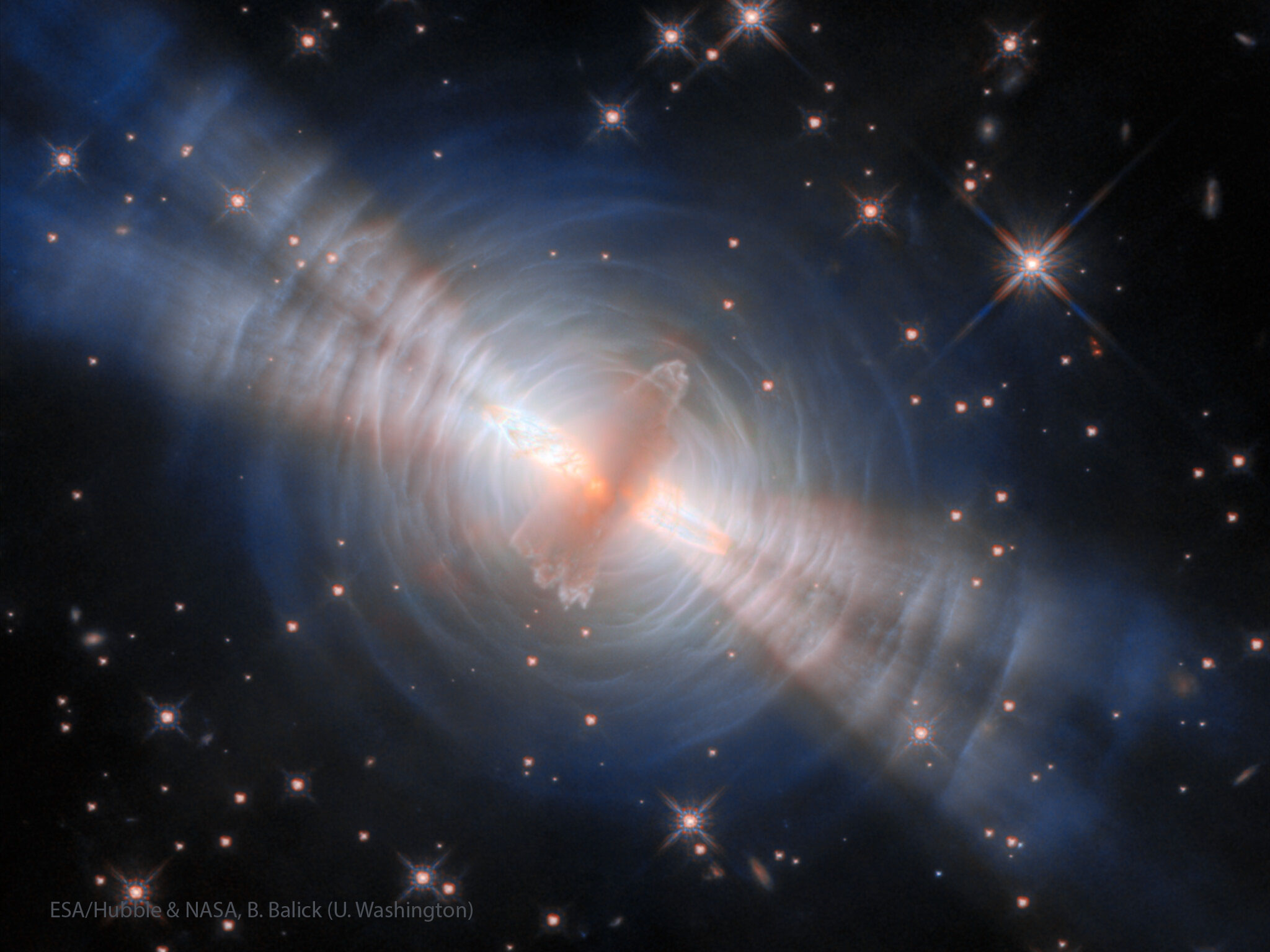
A starfield is shown with an unusual orange object in the center.
Surrounding this object are blue rings and four thick jets.
Please see the explanation for more detailed information.

The Egg Nebula from the Hubble Telescope
Image Credit & Copyright: ESA/Hubble & NASAB. Balick (U. Washington)

Explanation: Ever wonder what it would look like to crack open the Sun? The Egg Nebula, a dying Sun-like star, can unscramble this question. Pictured is a combination of several visible and infrared images of the nebula (also known as RAFGL 2688 or CRL 2688) taken with the Hubble Space Telescope. The star has shed its outer layers, and a bright, hot core (or "yolk") now illuminates the milky "egg white" shells of gas and dust surrounding the center. The central lobes and rings are structures of gas and dust recently ejected into space, with the dust being dense enough to block our view of the stellar core. Light beams emanate from that blocked core, escaping through holes carved in the older ejected material by newer, faster jets expelled from the star’s poles. Astronomers are still trying to figure out what causes the disks, lobes, and jets during this short (only a few thousand years!) phase of the star’s evolution, making this an egg-cellent image to study!

23/02/2026

LINGUISTIQUE - Les origines de la langue basque - (2/2)

Photographie aérienne du site de l'Irulegi. En B, la zone de fouilles avec l'emplacement de la main d'Irulegi dans le bâtiment 6 000. © Cambridge University Press

Les origines du basque enfin éclaircies ? 

Reprenons : les Vascons formaient un peuple de l'âge du fer dans la région des Pyrénées occidentales, où est situé le site d'Irulegi. Les origines de leur dialecte sont encore obscures.

Mais il est un autre groupe ethnolinguistique aux origines inconnues, que l'on rapproche souvent des Vascons : le peuple Basque, dont la langue est un cas unique, un « isolat », c'est-à-dire qu'on ne peut pas démontrer sa filiation avec d'autres langues parlées aujourd'hui.

Or, si les inscriptions sur la main d'Irulegi sont, sans nul doute, d'origine vascone, elles présentent également de grandes similitudes avec le basque moderne, ce qui pourrait indiquer une continuité ou une influence linguistique entre Vascons et Basques !

Pour preuve : le mot « sorioneku », proche du terme basque « zorioneko » qui signifie « bonne fortune ». Une signification cohérente avec l'emplacement de la main - dans l'entrée de la maison - et sa forme, qui suggèrent qu'il aurait pu s'agir d'un porte-bonheur accroché au-dessus de la porte afin de préserver la bonne fortune de ses occupants.

Une découverte exceptionnelle qui n'a pas fini de livrer tous ses secrets, mais qui pourrait bouleverser ce que l'on sait du peuple basque et de son dialecte, dernier vestige des langues préhistoriques et parlée dans la région bien avant l'arrivée des langues indo-européennes dont sont issus, par exemple, le grec ancien et le latin.

FuturaSciences

ASTRONOMY - Pleiades: The Seven Sisters Star Cluster

 2026 February 23

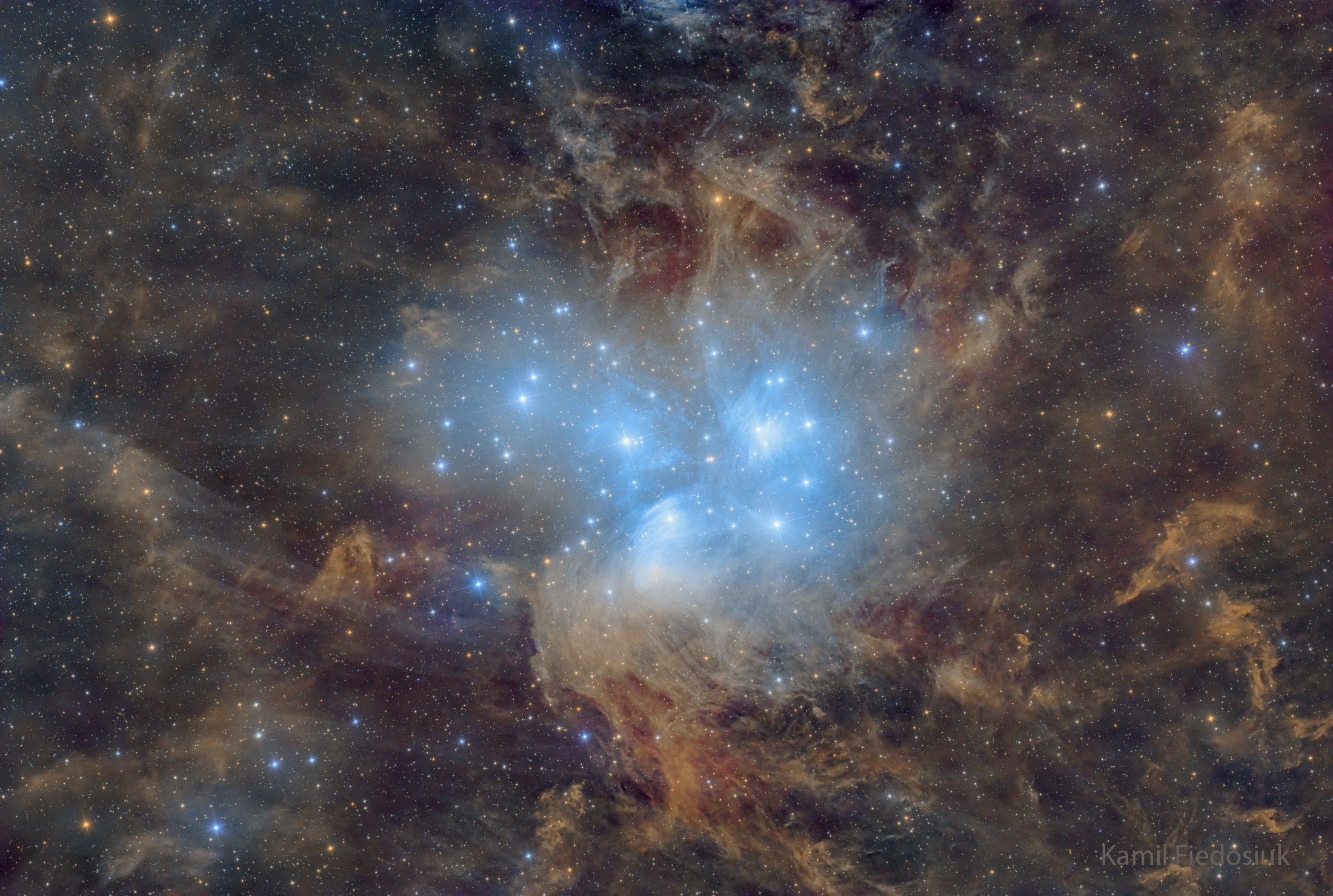
A cluster of blue stars is seen against a starfield
of brown and clumpy dust. The stars illuminate some of 
the nearby dust which causes the dust to glow blue.
Please see the explanation for more detailed information.

Pleiades: The Seven Sisters Star Cluster
Image Credit & Copyright: Kamil Fiedosiuk

Explanation: Have you ever seen the Pleiades star cluster? Even if you have, you probably have never seen it as large and clear as this. Perhaps the most famous star cluster on the sky, the bright stars of the Pleiades can be seen with the unaided eye even from the depths of a light-polluted city. With a long exposure from a dark location, though, the dust cloud surrounding the Pleiades star cluster becomes very evident. The featured 18-hour exposure, taken from Bory TucholskiePoland covers a sky area several times the size of the full moon. Also known as the Seven Sisters and M45the Pleiades lies about 400 light years away toward the constellation of the Bull (Taurus). A common legend with a modern twist is that one of the brighter stars faded since the cluster was named, leaving only six of the sister stars visible to the unaided eye. The actual number of Pleiades stars visible, however, may be more or less than seven, depending on the darkness of the surrounding sky and the clarity of the observer's eyesight.

20/02/2026

ASTRONOMY - B93: A Dark Interstellar Ghost

2026 February 20
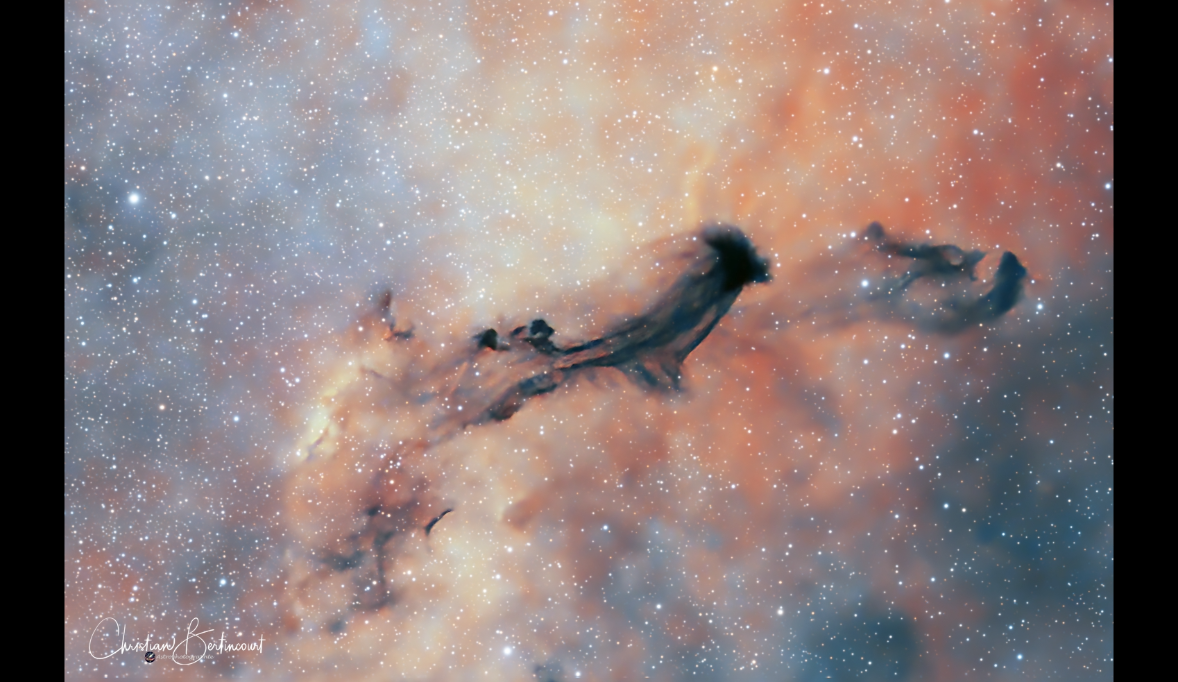
A starfield with a light, orange-tinged background 
has a dark nebula that looks like a flying ghost visible
near the middle. 
Please see the explanation for more detailed information.

B93: A Dark Interstellar Ghost
Image Credit & Copyright: Christian Bertincourt; Text: Keighley Rockcliffe (NASA GSFCUMBC CSSTCRESST II)

Explanation: "A ghost in the Milky Way…” says Christian Bertincourt, the astrophotographer behind this striking image of Barnard 93 (B93). The 93rd entry in Barnard’s Catalogue of Dark Nebulae, B93 lies within the Small Sagittarius Star Cloud (Messier 24), where its darkness stands in stark contrast to bright stars and gas in the background. In some ways, B93 is really like a ghost, because it contains gas and dust that was dispersed by the deaths of stars, like supernovas. B93 appears as a dark void not because it is empty, but because its dust blocks the light emitted by more distant stars and glowing gas. Like other dark nebulas, some gas from B93, if dense and massive enough, will eventually gravitationally condense to form new stars. If so, then once these stars ignite, B93 will transform from a dark ghost into a brilliant cradle of newborn stars. 

19/02/2026

ASTRONOMY - IC 2574: Coddington's Nebula

 2026 February 19

See Explanation.  Clicking on the picture will download
the highest resolution version available.

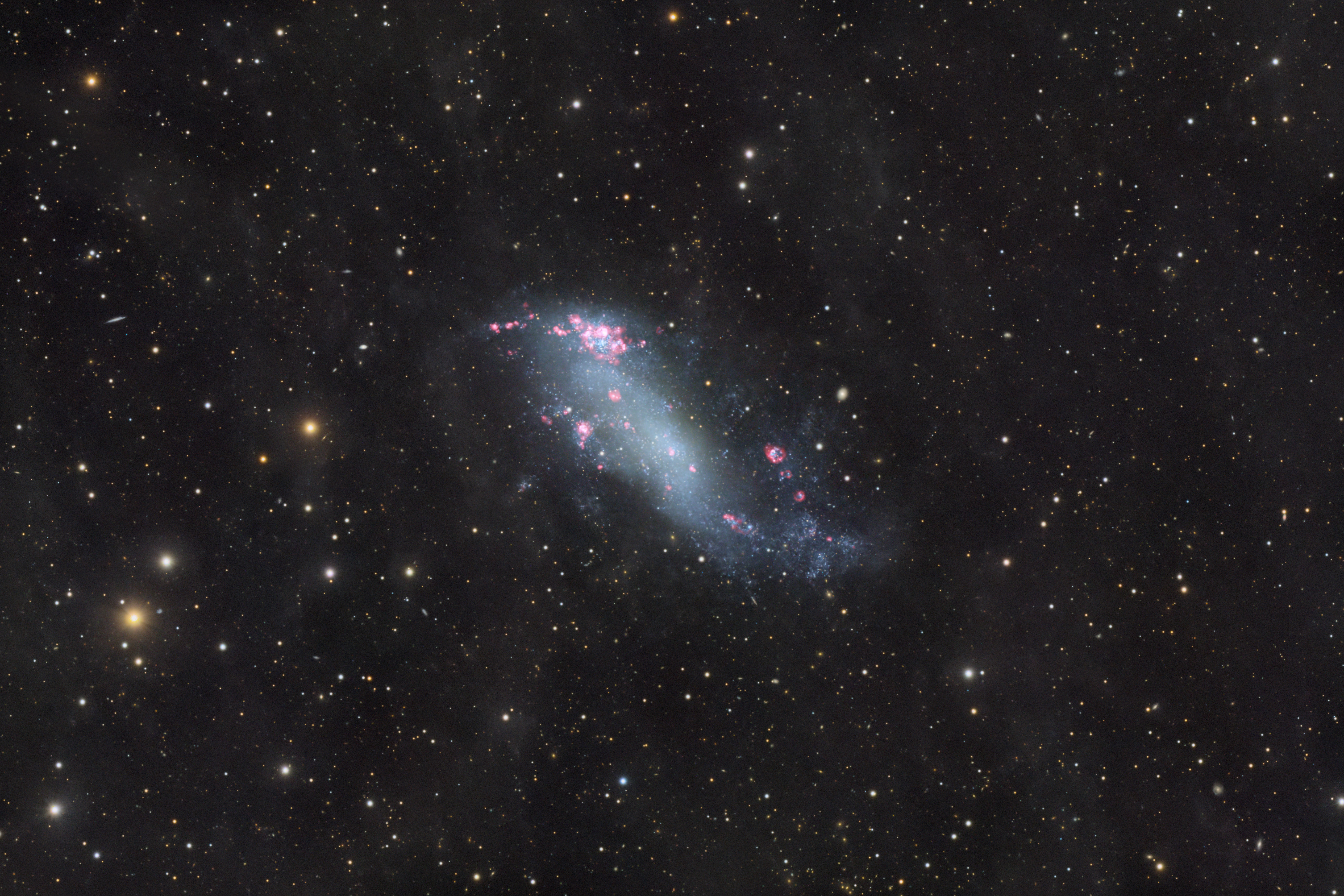
IC 2574: Coddington's Nebula
Image Credit & CopyrightDane Vetter

Explanation: Grand spiral galaxies often seem to get all the glory, flaunting their young, bright, blue star clusters in beautiful, symmetric spiral arms. But small, irregular galaxies form stars too. In fact, dwarf galaxy IC 2574 shows clear evidence of intense star forming activity in its telltale reddish regions of glowing hydrogen gas. Just as in spiral galaxies, the turbulent star-forming regions in IC 2574 are churned by stellar winds and supernova explosions spewing material into the galaxy's interstellar medium and triggering further star formation. A mere 12 million light-years distant, IC 2574 is part of the M81 group of galaxies, seen toward the northern constellation Ursa Major. Also known as Coddington's Nebula, the faint but intriguing island universe is about 50,000 light-years across, discovered by American astronomer Edwin Coddington in 1898.

18/02/2026

ASTRONOMY - Orion's Cradle

 2026 February 18

A starfield is shown filled with red glowing gas. On
the right is a blue-glowing complex nebula, while on the left
there is a long encircling arc of red gas. 
Please see the explanation for more detailed information.

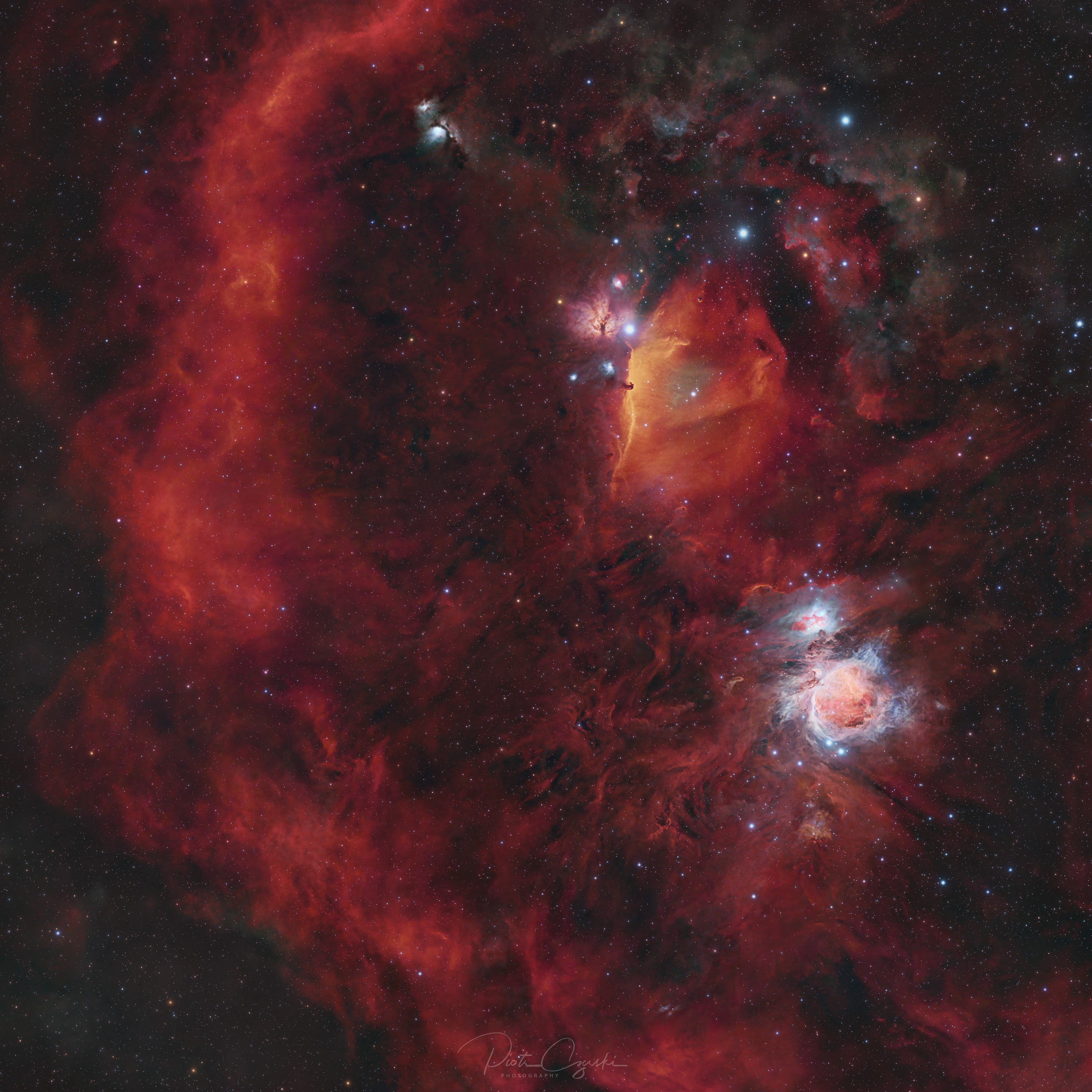
Orion's Cradle
Image Credit & Copyright: Piotr Czerski

Explanation: Cradled in red-glowing hydrogen gas, stars are being born in Orion. These stellar nurseries lie at the edge of the giant Orion molecular cloud complex, some 1,500 light-years away. This detailed view spans about 12 degrees across the center of the well-known constellation, with the Great Orion Nebula, the closest large star-forming region, visible toward the lower right. The deep mosaic also includes, near the top center, the Flame Nebula and the Horsehead Nebula. Image data acquired with a hydrogen-alpha filter adds other remarkable features to this wide-angle cosmic vista: pervasive tendrils of energized atomic hydrogen gas and portions of the surrounding Barnard's Loop. While the Orion Nebula and many stars in Orion are easy to see with the unaided eye, emission from the extensive interstellar gas is faint and much harder to record, even in telescopic views of the nebula-rich complex.

Musique classique - PEER GYNT / EDVARD GRIEG - DANS L'ANTRE DU ROI DE LA MONTAGNE

" Dans l'Antre du Roi de la Montagne"