Nombre total de pages vues
23/11/2020
Batteries : faut-il les vider intégralement pour qu'elles durent plus longtemps ?
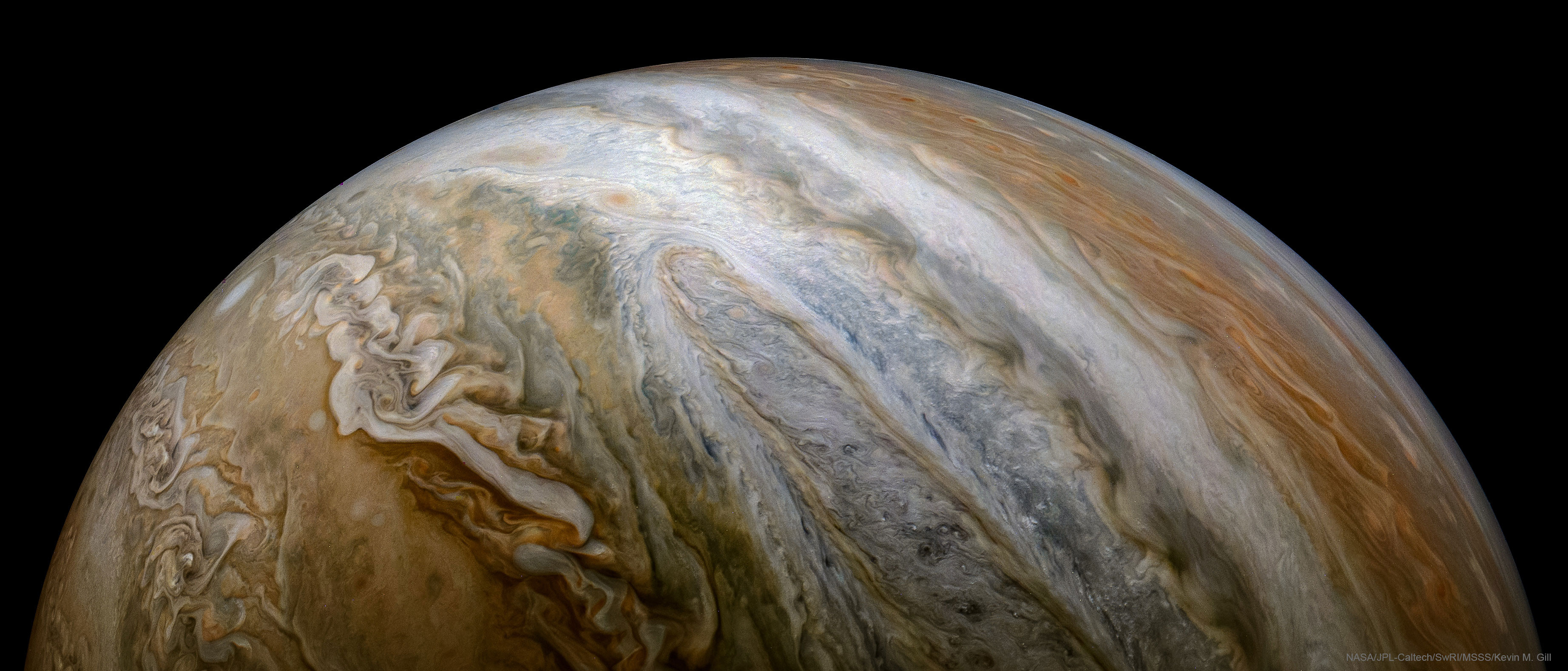
Astronomy - A Jupiter Vista from Juno
2020 November 23
Image Credit: NASA/JPL-Caltech/SwRI/MSSS; Processing & License: Kevin M. Gill;
Explanation: Why do colorful cloud bands encircle Jupiter? Jupiter's top atmospheric layer is divided into light zones and dark belts that go all the way around the giant planet. It is high horizontal winds -- in excess of 300 kilometers per hour -- that cause the zones to spread out planet-wide. What causes these strong winds remains a topic of research. Replenished by upwelling gas, zonal bands are thought to include relatively opaque clouds of ammonia and water that block light from lower and darker atmospheric levels. One light-colored zone is shown in great detail in the featured vista taken by the robotic Juno spacecraft in 2017. Jupiter's atmosphere is mostly clear and colorless hydrogen and helium, gases that are not thought to contribute to the gold and brown colors. What compounds create these colors is another active topic of research -- but is hypothesized to involve small amounts of sunlight-altered sulfur and carbon. Many discoveries have been made from Juno's data, including that water composes an unexpectedly high 0.25 percent of upper-level cloud molecules near Jupiter's equator, a finding important not only for understanding Jovian currents but for the history of water in the entire Solar System.
22/11/2020
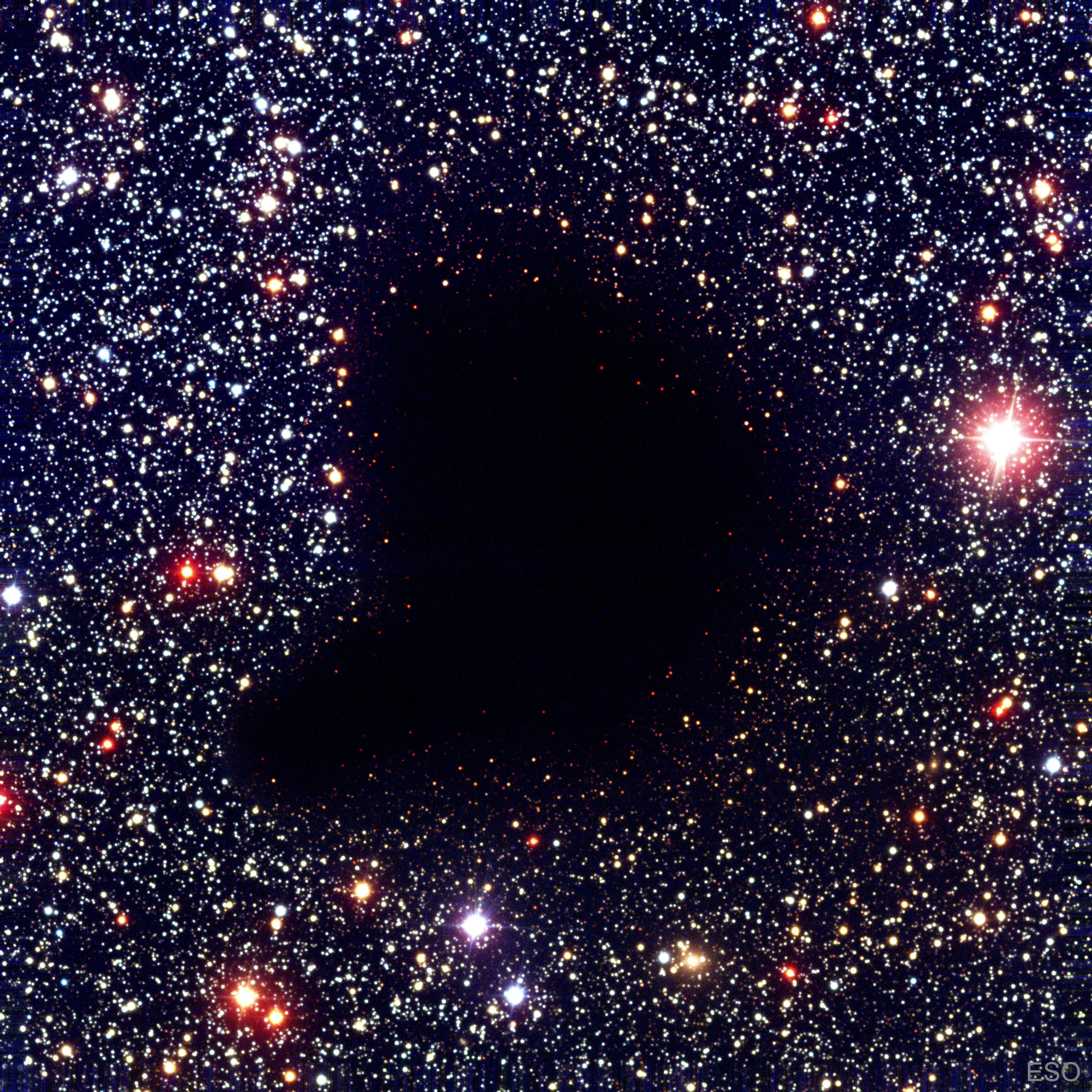
Astronomy - Dark Molecular Cloud Barnard 68
2020 November 22
Image Credit: FORS Team, 8.2-meter VLT Antu, ESO
Explanation: Where did all the stars go? What used to be considered a hole in the sky is now known to astronomers as a dark molecular cloud. Here, a high concentration of dust and molecular gas absorb practically all the visible light emitted from background stars. The eerily dark surroundings help make the interiors of molecular clouds some of the coldest and most isolated places in the universe. One of the most notable of these dark absorption nebulae is a cloud toward the constellation Ophiuchus known as Barnard 68, pictured here. That no stars are visible in the center indicates that Barnard 68 is relatively nearby, with measurements placing it about 500 light-years away and half a light-year across. It is not known exactly how molecular clouds like Barnard 68 form, but it is known that these clouds are themselves likely places for new stars to form. In fact, Barnard 68 itself has been found likely to collapse and form a new star system. It is possible to look right through the cloud in infrared light.
20/11/2020
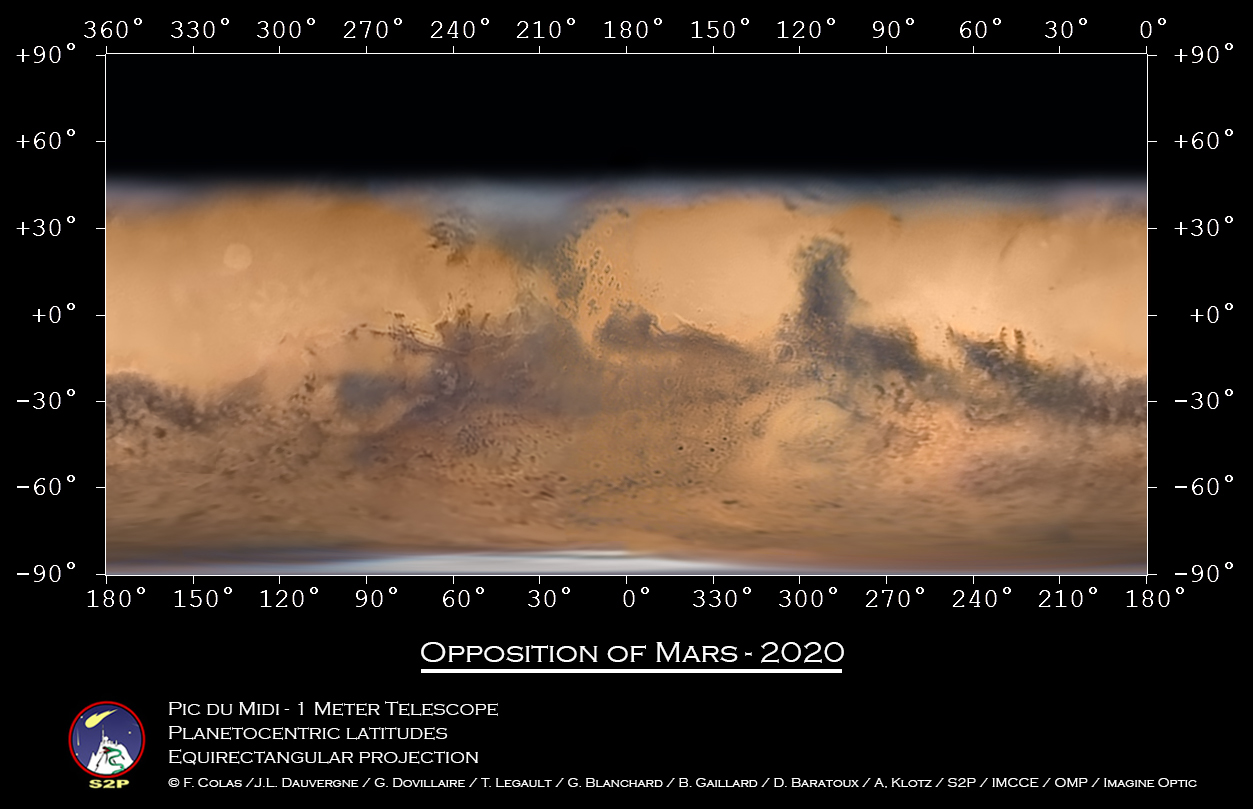
Astronomy - Global Map: Mars at Opposition
2020 November 20
Image Credit & Copyright: F. Colas / J.L. Dauvergne / G. Dovillaire / T. Legault /
G. Blanchard / B. Gaillard / D. Baratoux / A, Klotz / S2P / IMCCE / OMP / Imagine Optic
Explanation: This may be the best global Mars map made with a telescope based on planet Earth. The image data were captured by a team of observers over six long nights at the Pic du Midi mountaintop observatory between October 8 and November 1, when the fourth rock from the Sun had not wandered far from its 2020 opposition and its biggest and brightest appearance in Earth's night sky. The large telescope used, 1 meter in diameter with a 17 meter focal length, was also used in support of NASA's Apollo lunar landing missions. After about 30 hours of processing, the data were combined to produced this remarkably sharp projected view of the martian surface extending to about 45 degrees northern latitude. The image data have also been mapped onto a rotating sphere and rotating stereo, views. Fans of Mars can easily pick out their favorite markings on the Red Planet by eyeing a labeled version of this global map of Mars.
13/11/2020
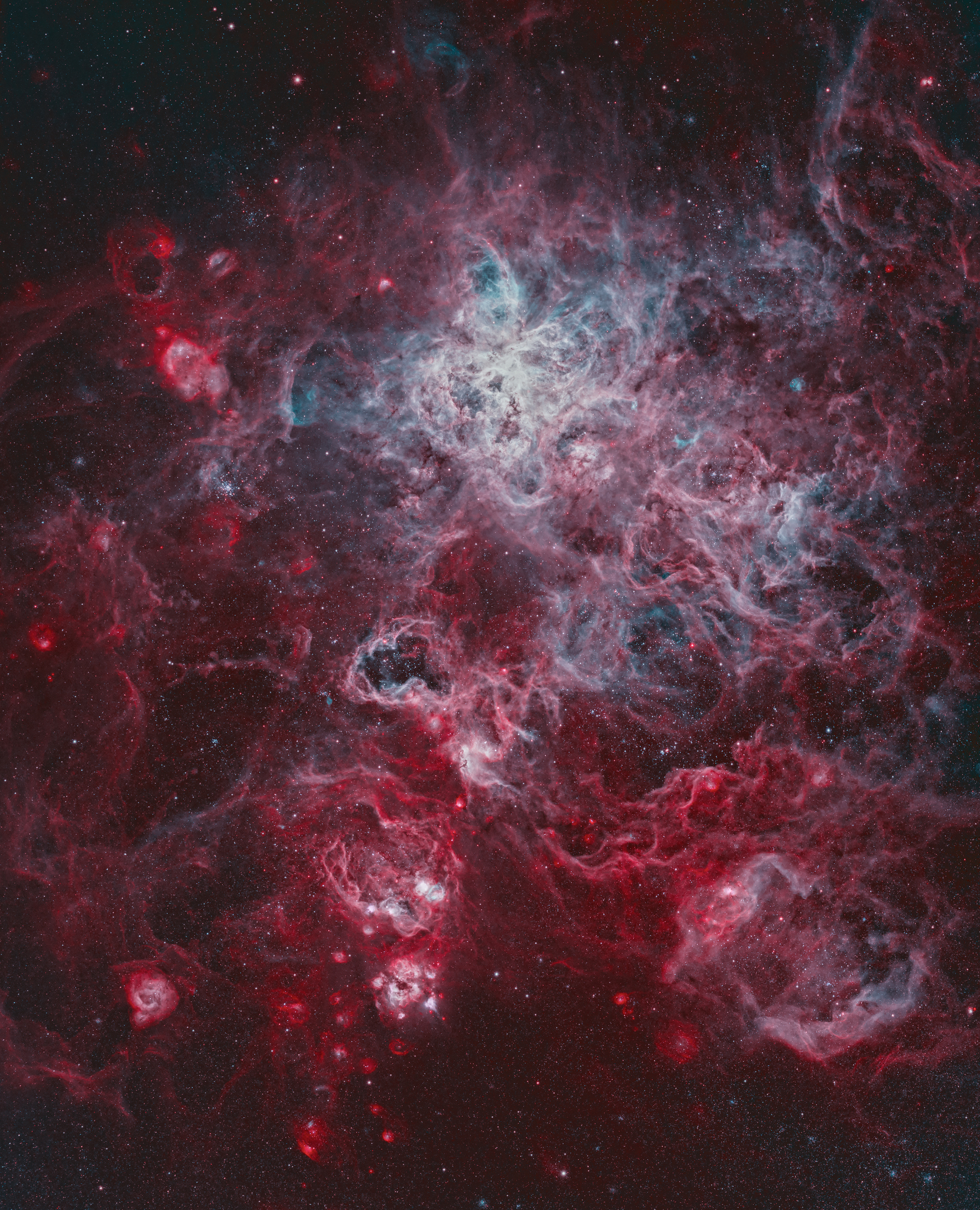
Astronomy - The Tarantula Zone
2020 November 13
Image Credit & Copyright: Ignacio Diaz Bobillo
Explanation: The Tarantula Nebula, also known as 30 Doradus, is more than a thousand light-years in diameter, a giant star forming region within nearby satellite galaxy the Large Magellanic Cloud. About 180 thousand light-years away, it's the largest, most violent star forming region known in the whole Local Group of galaxies. The cosmic arachnid sprawls across the top of this spectacular view, composed with narrowband filter data centered on emission from ionized hydrogen and oxygen atoms. Within the Tarantula (NGC 2070), intense radiation, stellar winds and supernova shocks from the central young cluster of massive stars, cataloged as R136, energize the nebular glow and shape the spidery filaments. Around the Tarantula are other star forming regions with young star clusters, filaments, and blown-out bubble-shaped clouds. In fact, the frame includes the site of the closest supernova in modern times, SN 1987A, right of center. The rich field of view spans about 2 degrees or 4 full moons, in the southern constellation Dorado. But were the Tarantula Nebula closer, say 1,500 light-years distant like the local star forming Orion Nebula, it would take up half the sky.
12/11/2020
Astronomy - Comet ATLAS and Orion's Belt
2020 November 12
Image Credit & Copyright: Charles Bracken
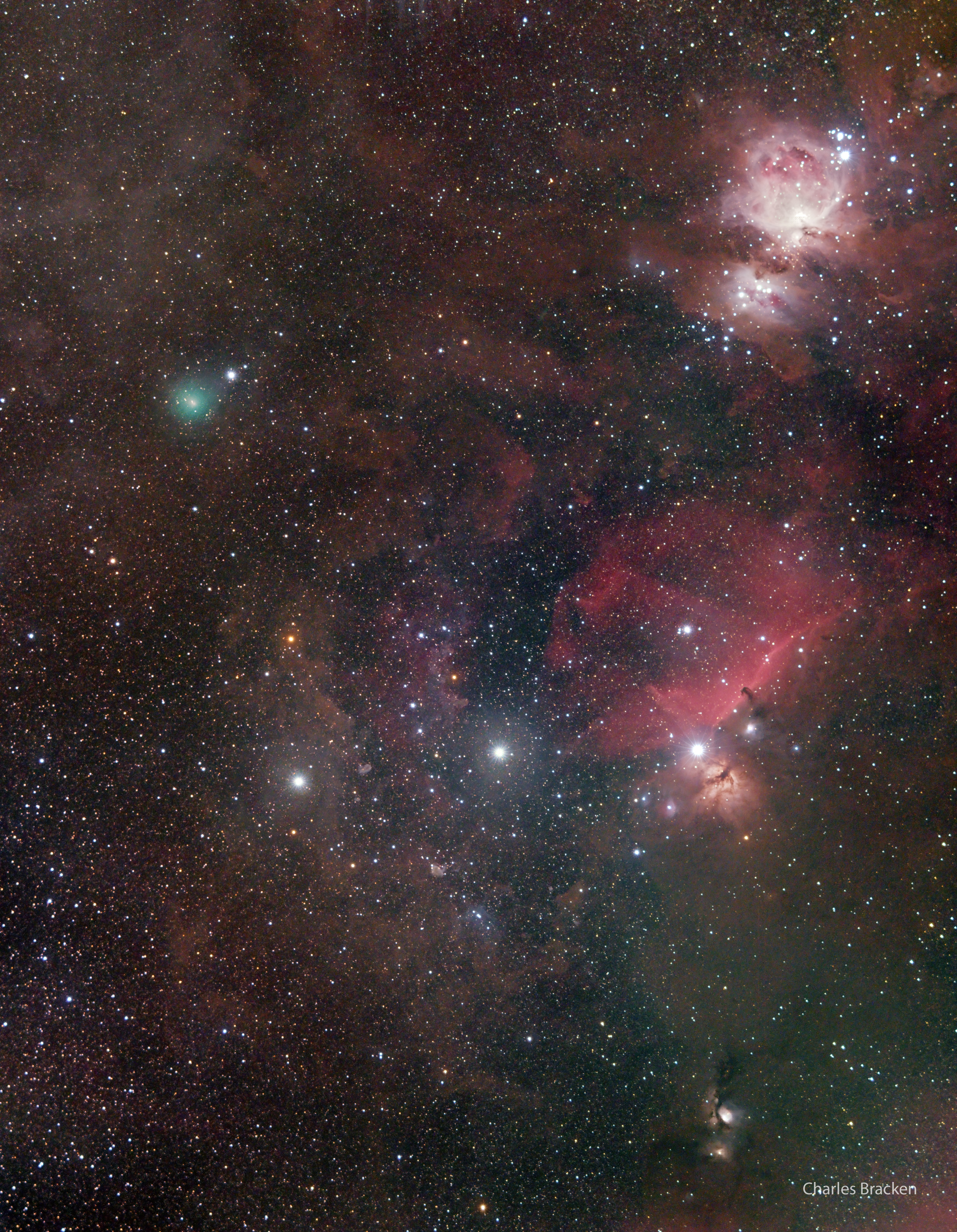
Explanation: With its closest approach to planet Earth scheduled for November 14, this Comet ATLAS (C/2020 M3) was discovered just this summer, another comet found by the NASA funded Asteroid Terrestrial-impact Last Alert System. It won't get as bright as Comet NEOWISE but it can still be spotted using binoculars, as it currently sweeps through the familiar constellation of Orion. This telephoto field from November 8, blends exposures registered on the comet with exposures registered on Orion's stars. It creates an effectively deep skyview that shows colors and details you can't quite see though, even in binoculars. The comet's telltale greenish coma is toward the upper left, above Orion's three belt stars lined-up across the frame below center. You'll also probably spot the Orion Nebula, and famous Horsehead Nebula in the stunning field of view. Of course one of Orion's belt stars is nearly 2,000 light-years away. On November 14, this comet ATLAS will fly a mere 2.9 light-minutes from Earth.
11/11/2020
Astronomy - Colors of the moon
2020 November 11
Image Credit & Copyright: Marcella Giulia Pace
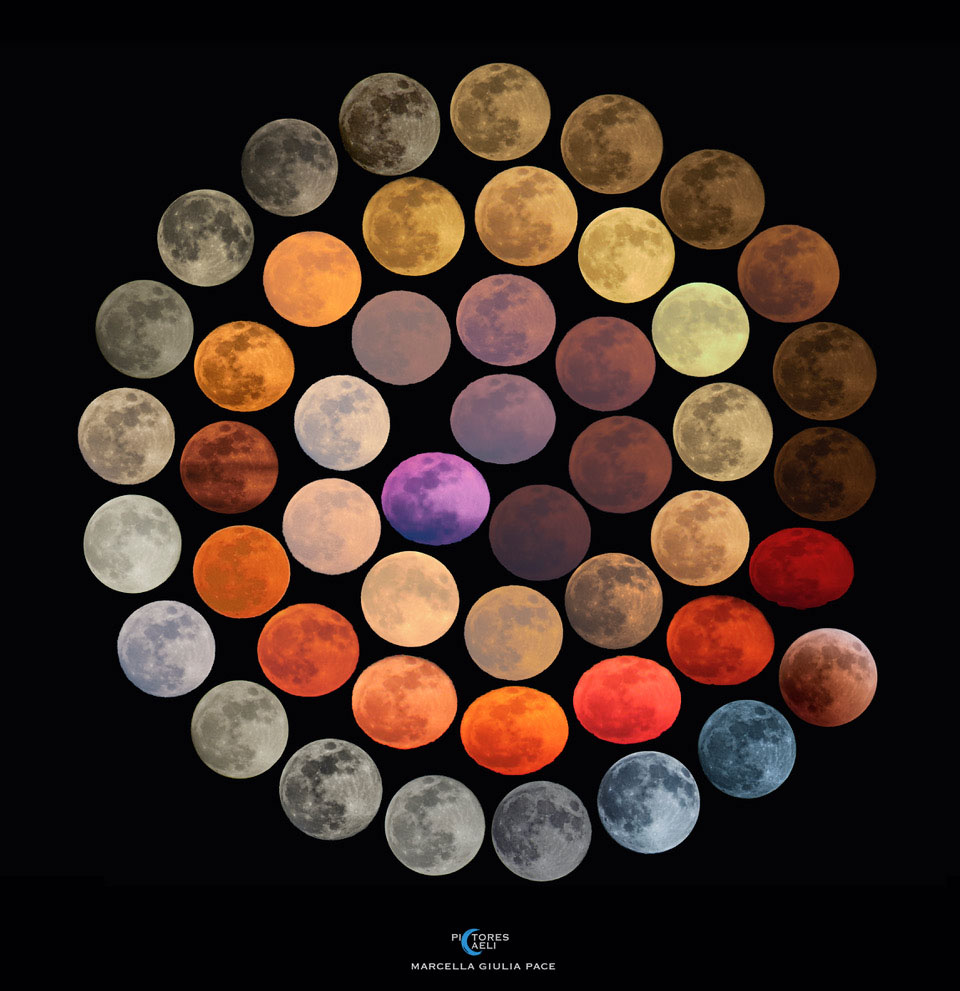
Explanation: What color is the Moon? It depends on the night. Outside of the Earth's atmosphere, the dark Moon, which shines by reflected sunlight, appears a magnificently brown-tinged gray. Viewed from inside the Earth's atmosphere, though, the moon can appear quite different. The featured image highlights a collection of apparent colors of the full moon documented by one astrophotographer over 10 years from different locations across Italy. A red or yellow colored moon usually indicates a moon seen near the horizon. There, some of the blue light has been scattered away by a long path through the Earth's atmosphere, sometimes laden with fine dust. A blue-colored moon is more rare and can indicate a moon seen through an atmosphere carrying larger dust particles. What created the purple moon is unclear -- it may be a combination of several effects. The last image captures the total lunar eclipse of 2018 July -- where the moon, in Earth's shadow, appeared a faint red -- due to light refracted through air around the Earth. The next full moon will occur at the end of this month (moon-th) and is known in some cultures as the Beaver Moon.
10/11/2020
Astronomie - The Central Soul Nebula Without Stars
2020 November 10
Image Credit & Copyright: Jason Guenzel
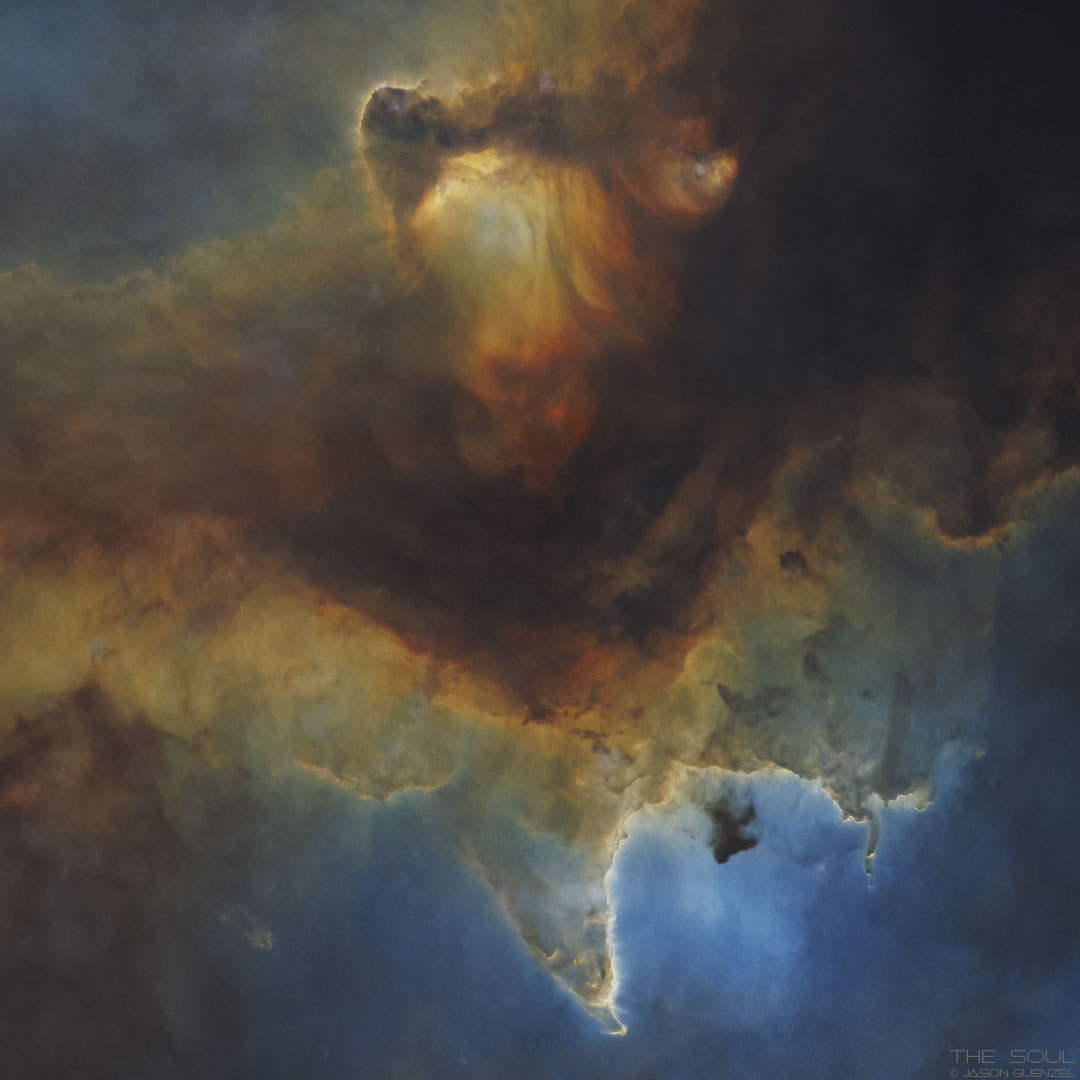
Explanation: This cosmic close-up looks deep inside the Soul Nebula. The dark and brooding dust clouds near the top, outlined by bright ridges of glowing gas, are cataloged as IC 1871. About 25 light-years across, the telescopic field of view spans only a small part of the much larger Heart and Soul nebulae. At an estimated distance of 6,500 light-years the star-forming complex lies within the Perseus spiral arm of our Milky Way Galaxy, seen in planet Earth's skies toward the constellation Cassiopeia. An example of triggered star formation, the dense star-forming clouds in the Soul Nebula are themselves sculpted by the intense winds and radiation of the region's massive young stars. In the featured image, stars have been digitally removed to highlight the commotion in the gas and dust.
09/11/2020
Adstronomy - In Green Company: Aurora over Norway
2020 November 9
Image Credit & Copyright: Max Rive
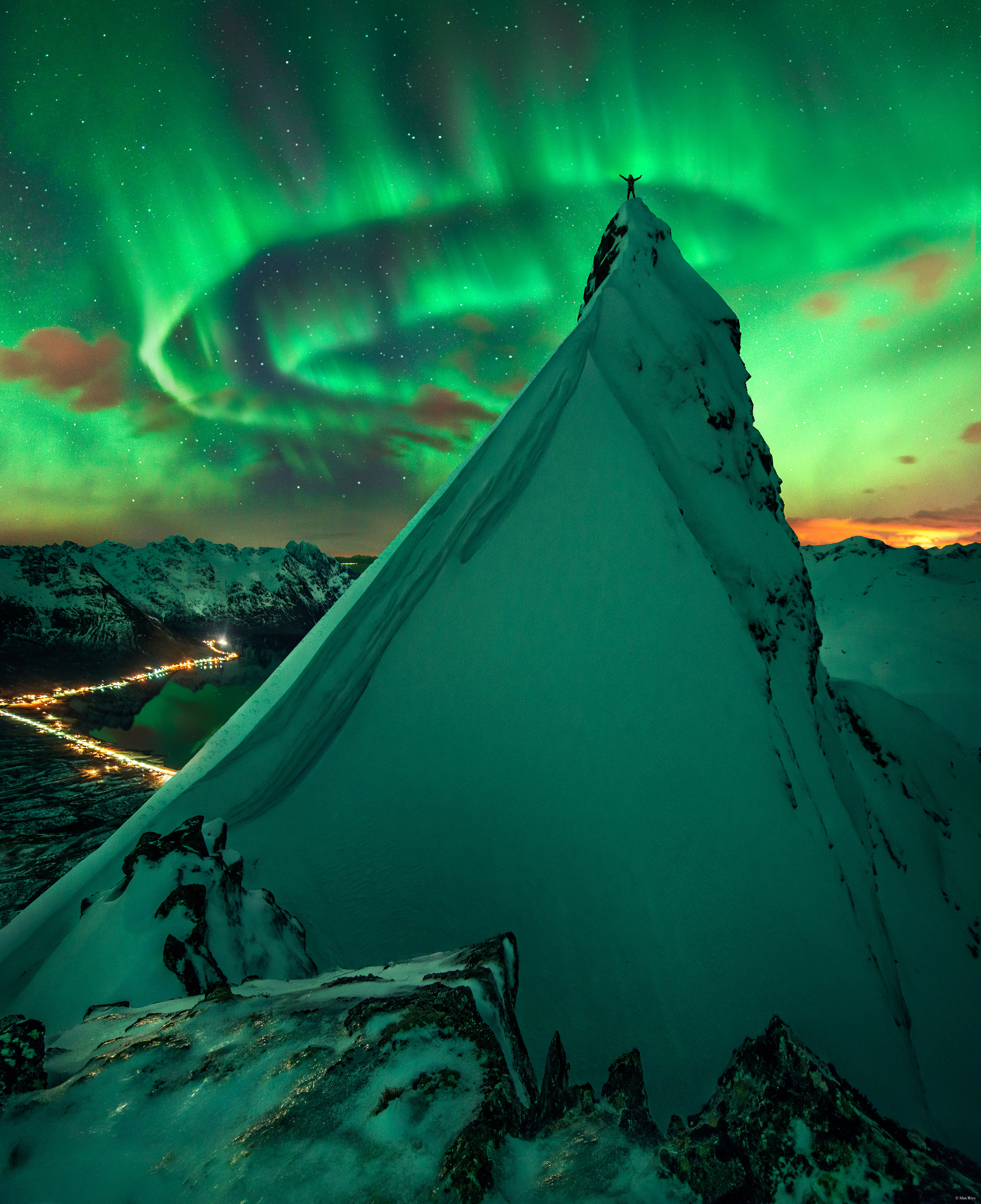
Explanation: Raise your arms if you see an aurora. With those instructions, two nights went by with, well, clouds -- mostly. On the third night of returning to same peaks, though, the sky not only cleared up but lit up with a spectacular auroral display. Arms went high in the air, patience and experience paid off, and the creative featured image was captured as a composite from three separate exposures. The setting is a summit of the Austnesfjorden fjord close to the town of Svolvear on the Lofoten islands in northern Norway. The time was early 2014. Although our Sun has just passed the solar minimum of its 11-year cycle, surface activity should pick up over the next few years with the promise of triggering more spectacular auroras on Earth.
08/11/2020
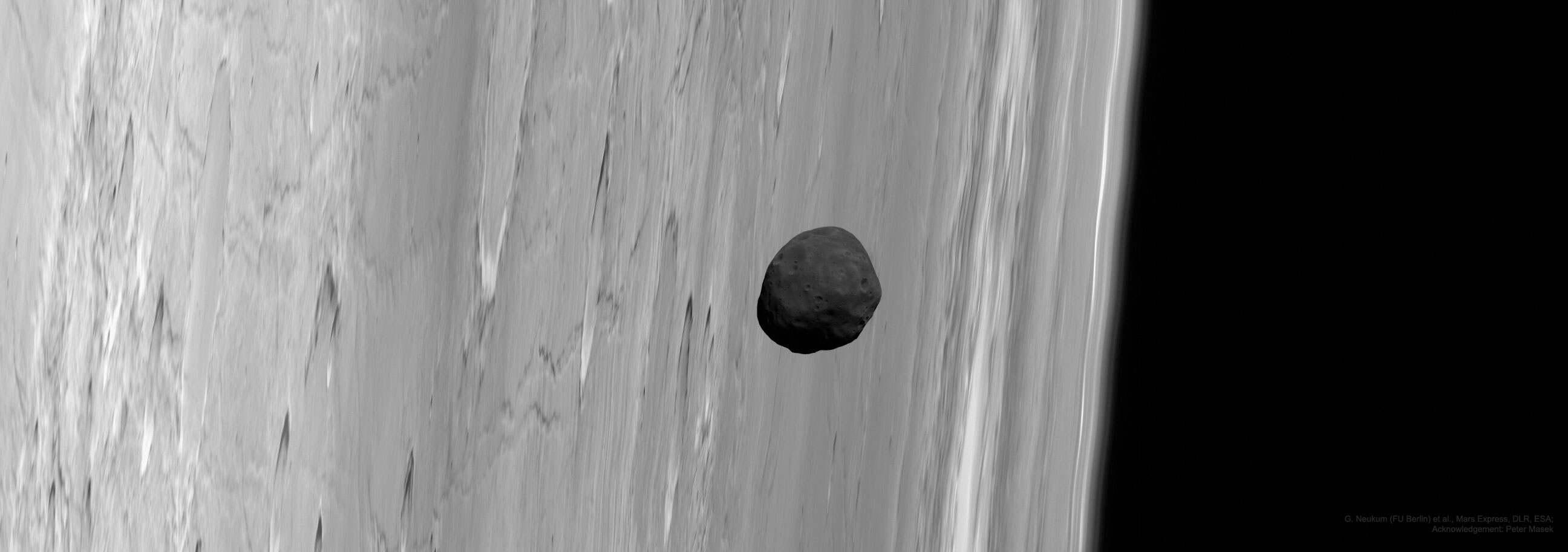
2020 November 8
Image Credit: G. Neukum (FU Berlin) et al., Mars Express, DLR, ESA; Acknowledgement: Peter Masek
Explanation: Why is Phobos so dark? Phobos, the largest and innermost of two Martian moons, is the darkest moon in the entire Solar System. Its unusual orbit and color indicate that it may be a captured asteroid composed of a mixture of ice and dark rock. The featured picture of Phobos near the limb of Mars was captured in 2010 by the robot spacecraft Mars Express currently orbiting Mars. Phobos is a heavily cratered and barren moon, with its largest crater located on the far side. From images like this, Phobos has been determined to be covered by perhaps a meter of loose dust. Phobos orbits so close to Mars that from some places it would appear to rise and set twice a day, but from other places it would not be visible at all. Phobos' orbit around Mars is continually decaying -- it will likely break up with pieces crashing to the Martian surface in about 50 million years.
Santé/Médecine - LES SYMPTOMES DE LA FIBROMYALGIE: 2. UNE GRANDE SENSIBILITE A LA DOULEUR - (4/12)
La fibromyalgie peut aussi augmenter la sensibilité à la douleur. Dans les cas les plus sévères, un simple toucher ou même un effleurement p...
-
2025 May 11 The Surface of Venus from Venera 14 Image Credit: Soviet Planetary Exploration Program , Venera 14 ; Processing & Copyri...
-
Imaginez un monde où le cancer n’est plus une sentence, mais une simple étape à franchir. Grâce à une découverte révolutionnaire, ce rêve es...