Nombre total de pages vues

17/12/2020

ASTRONOMY - Gemini's Meteors

 2020 December 17

See Explanation.  Clicking on the picture will download
the highest resolution version available.

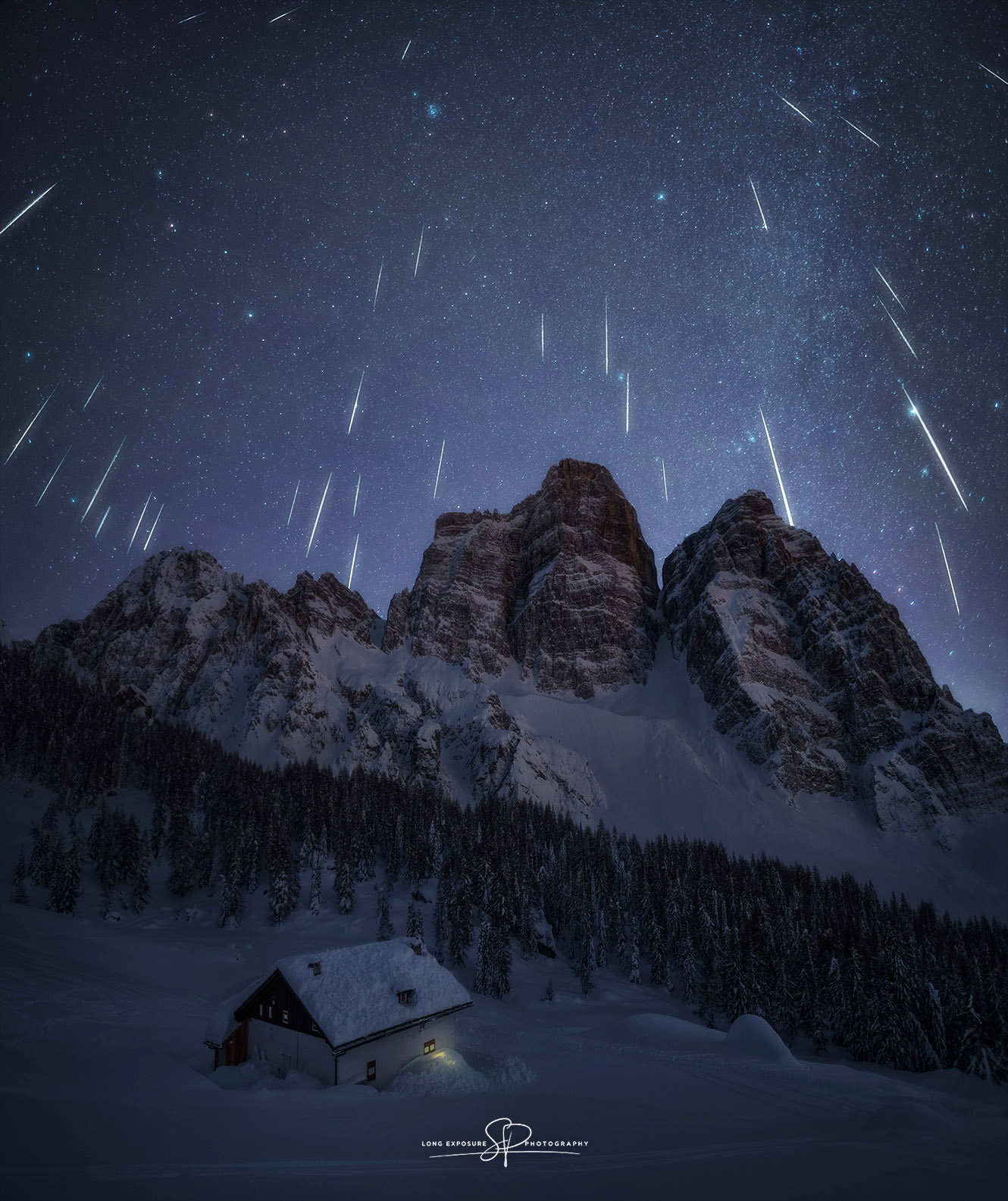
Gemini's Meteors
Image Credit & Copyright: Stefano Pellegrini

Explanation: Taken over the course of an hour shortly after local midnight on December 13, 35 exposures were used to create this postcard from Earth. The composited night scene spans dark skies above the snowy Italian Dolomites during our fair planet's annual Geminid meteor shower. Sirius, alpha star of Canis Major and the brightest star in the night, is grazed by a meteor streak on the right. The Praesepe star cluster, also known as M44 or the Beehive cluster, itself contains about a thousand stars but appears as a smudge of light far above the southern alpine peaks near the top. The shower's radiant is off the top of the frame though, near Castor and Pollux the twin stars of Gemini. The radiant effect is due to perspective as the parallel meteor tracks appear to converge in the distance. As Earth sweeps through the dust trail of asteroid 3200 Phaethon, the dust that creates Gemini's meteors enters Earth's atmosphere traveling at about 22 kilometers per second.

PRATIQUE - Comment retrouver des petits objets


AERONAUTIQUE - La voiture volante


Hildebrands, une célèbre marque de chocolat allemand dans les années 1900, nous imaginait chacun en possession d'une voiture volante. Ces dessins suggèrent différents types d'appareils, allant des ailes de chauve-souris à la baignoire surmontant quatre ailes improbables. Ils nous font aujourd'hui sourire par leur optimisme mais sont surtout révélateurs de l'époque des pionniers de l'aviation qui laissait présager un futur aérien...
© Hildebrands

16/12/2020

ASTRONOMY - Sonified: The Matter of the Bullet Cluster

 2020 December 16

Sonified: The Matter of the Bullet Cluster
Image Credit: X-ray: NASA/CXC/SAO; Optical: NASA/STScI, Magellan/U.Arizona; Lensing Map: NASA/STScI, ESO WFI, Magellan/U.Arizona; Sonification: NASA/CXC/SAO/K.Arcand, SYSTEM Sounds (M. Russo, A. Santaguida)

Explanation: What's the matter with the Bullet Cluster? This massive cluster of galaxies (1E 0657-558) creates gravitational lens distortions of background galaxies in a way that has been interpreted as strong evidence for the leading theory: that dark matter exists within. Different analyses, though, indicate that a less popular alternative -- modifying gravity-- could explain cluster dynamics without dark matter, and provide a more likely progenitor scenario as well. Currently, the two scientific hypotheses are competing to explain the observations: it's invisible matter versus amended gravity. The duel is dramatic as a clear Bullet-proof example of dark matter would shatter the simplicity of modified gravity theories. The featured sonified image is a Hubble/Chandra/Magellan composite with red depicting the X-rays emitted by hot gas, and blue depicting the suggested separated dark matter distribution. The sonification assigns low tones to dark matter, mid-range frequencies to visible light, and high tones to X-rays. The battle over the matter in the Bullet cluster is likely to continue as more observations, computer simulations, and analyses are completed.

15/12/2020

SPACE ART - David Hardy


Autoportrait de l’artiste David Hardy peignant sur Io, lune de Jupiter. Crédit : David Hardy

11/12/2020

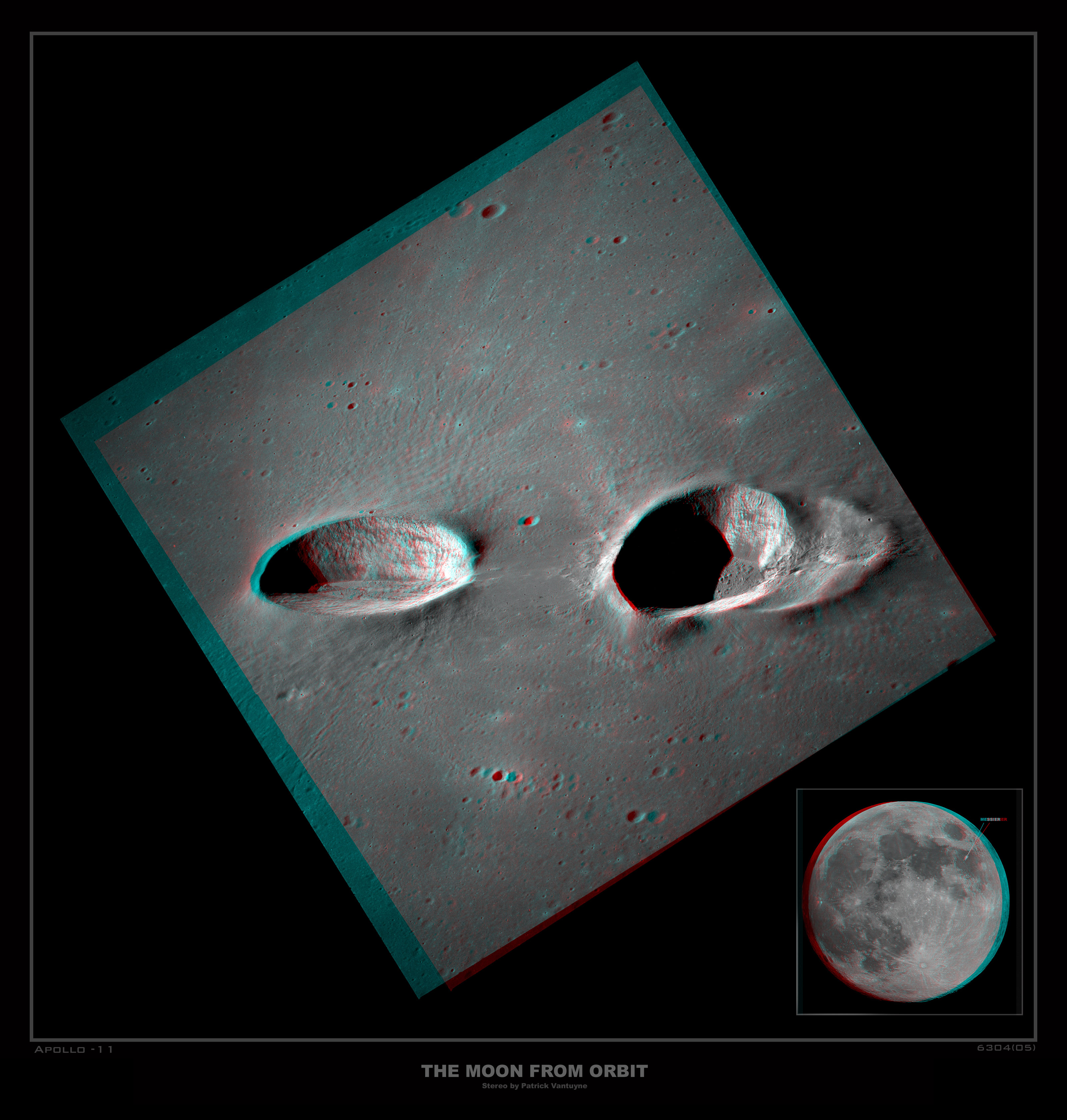
ASTRONOMY - Messier Craters in Stereo

 2020 December 11

See Explanation.  Clicking on the picture will download
the highest resolution version available.

Messier Craters in Stereo
Image Credit: Apollo 11NASA; Stereo Image Copyright Patrick Vantuyne

Explanation: Many bright nebulae and star clusters in planet Earth's sky are associated with the name of astronomer Charles Messier from his famous 18th century catalog. His name is also given to these two large and remarkable craters on the Moon. Standouts in the dark, smooth lunar Sea of Fertility or Mare Fecunditatis, Messier (left) and Messier A have dimensions of 15 by 8 and 16 by 11 kilometers respectively. Their elongated shapes are explained by the extremely shallow-angle trajectory followed by an impactor, moving left to right, that gouged out the craters. The shallow impact also resulted in two bright rays of material extending along the surface to the right, beyond the picture. Intended to be viewed with red/blue glasses (red for the left eye), this striking stereo picture of the crater pair was recently created from high resolution scans of two images (AS11-42-6304AS11-42-6305) taken during the Apollo 11 mission to the Moon.

09/12/2020

PRATIQUE - La pelle remplit le seau


ASTRONOMY - Arecibo Telescope Collapse

 2020 December 9

Arecibo Telescope Collapse
Video Credit: Arecibo ObservatoryNSF

Explanation: This was one great scientific instrument. Starting in 1963, the 305-meters across Arecibo Telescope in Puerto Rico USA reigned as the largest single-dish radio telescope in the world for over 50 years. Among numerous firsts and milestones, data from Arecibo has been used to measure the spin of Mercurymap the surface of Venus, discover the first planets outside of our Solar System, verify the existence of gravitational radiationsearch for extraterrestrial intelligence, and, reportedly, locate hidden military radar by tracking their reflections from the Moon. Past its prime and in the process of being decommissioned, the Arecibo Telescope suffered a catastrophic structural collapse early this month, as seen in the featured composite video.

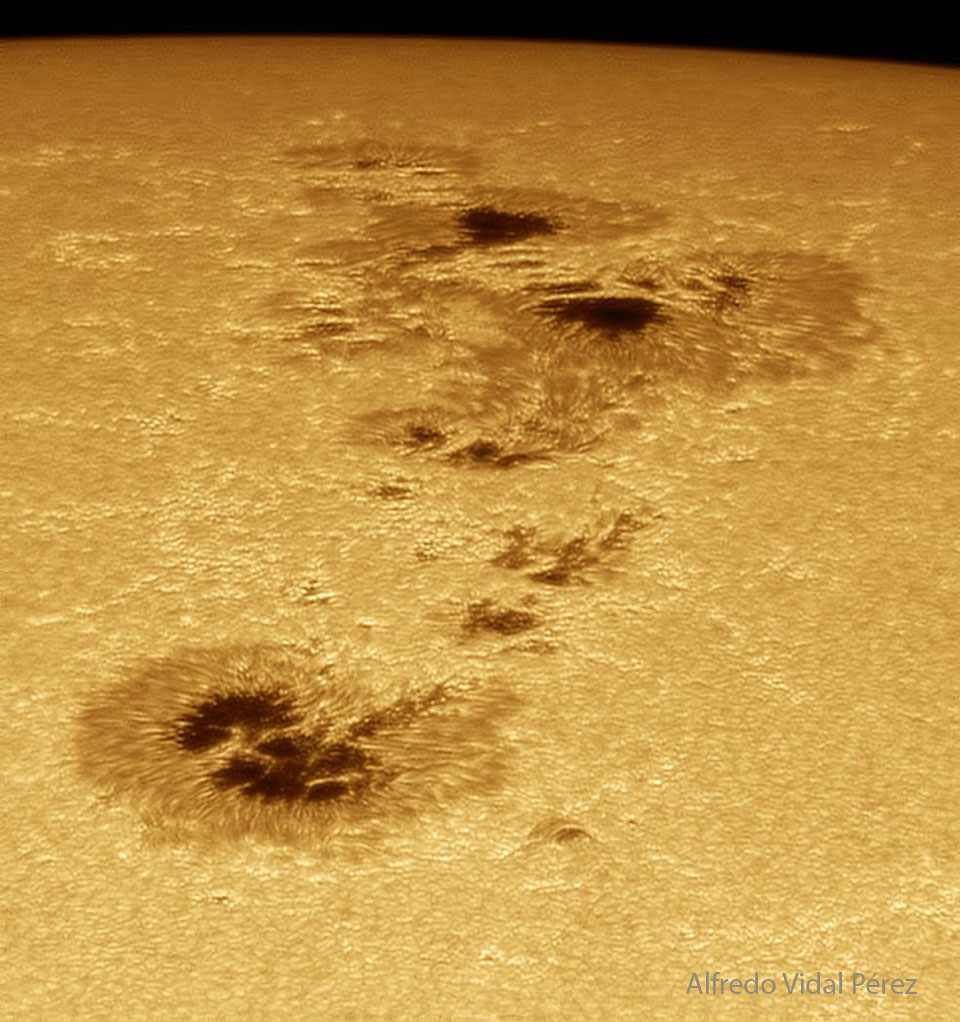
Astronomy - AR 4478 : GIANT SUNSPOT GROUP

 2026 June 28 AR 4478: Giant Sunspot Group Image Credit & Copyright: Alfredo Vidal Pérez Explanation: Right now, one of the largest suns...