Nombre total de pages vues
17/12/2021
AERONAUTIQUE - Avions de légende - Le Stampe SV-4
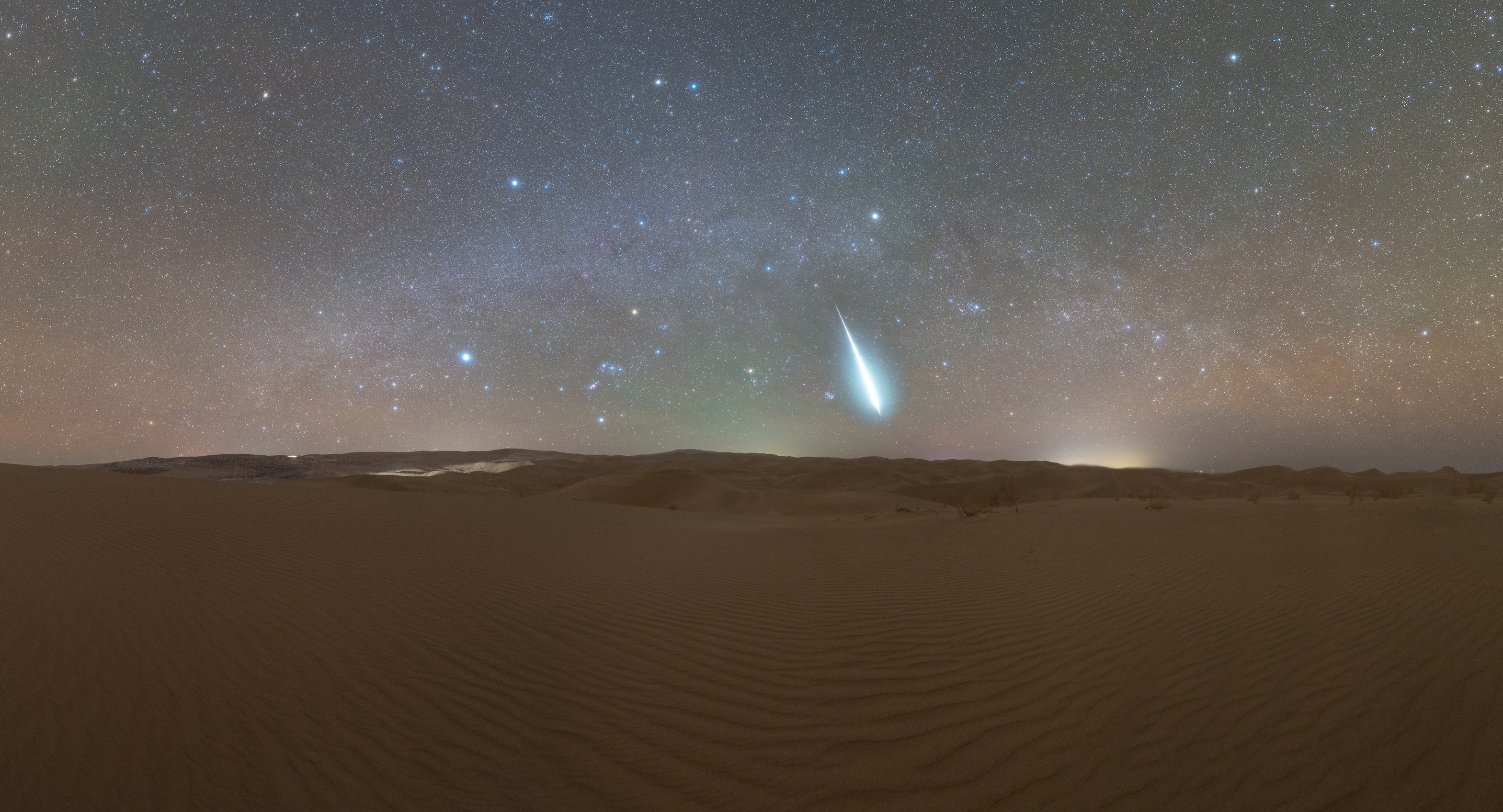
ASTRONOMY - Geminid of the North
2021 December 17
Image Credit & Copyright: Alvin Wu
Explanation: An arid expanse of the Tengger Desert in north-central China, planet Earth fills the foreground of this starry scene. A widefield panoramic view, it was recorded shortly after moonset in the local predawn hours of December 14. Pictured in the still dark sky, stars of the northern winter hexagon surround a luminous Milky Way. Seen near the peak of the annual meteor shower, the startling flash of a bright Geminid fireball meteor was also captured on that night. Above the western horizon and just below bright star Capella, its dagger-like trail points back to the meteor shower's radiant in Gemini. Of course, the constellation Gemini is easy to spot. Its twin bright stars, bluish Castor and yellowish Pollux are near top center in the frame.
15/12/2021
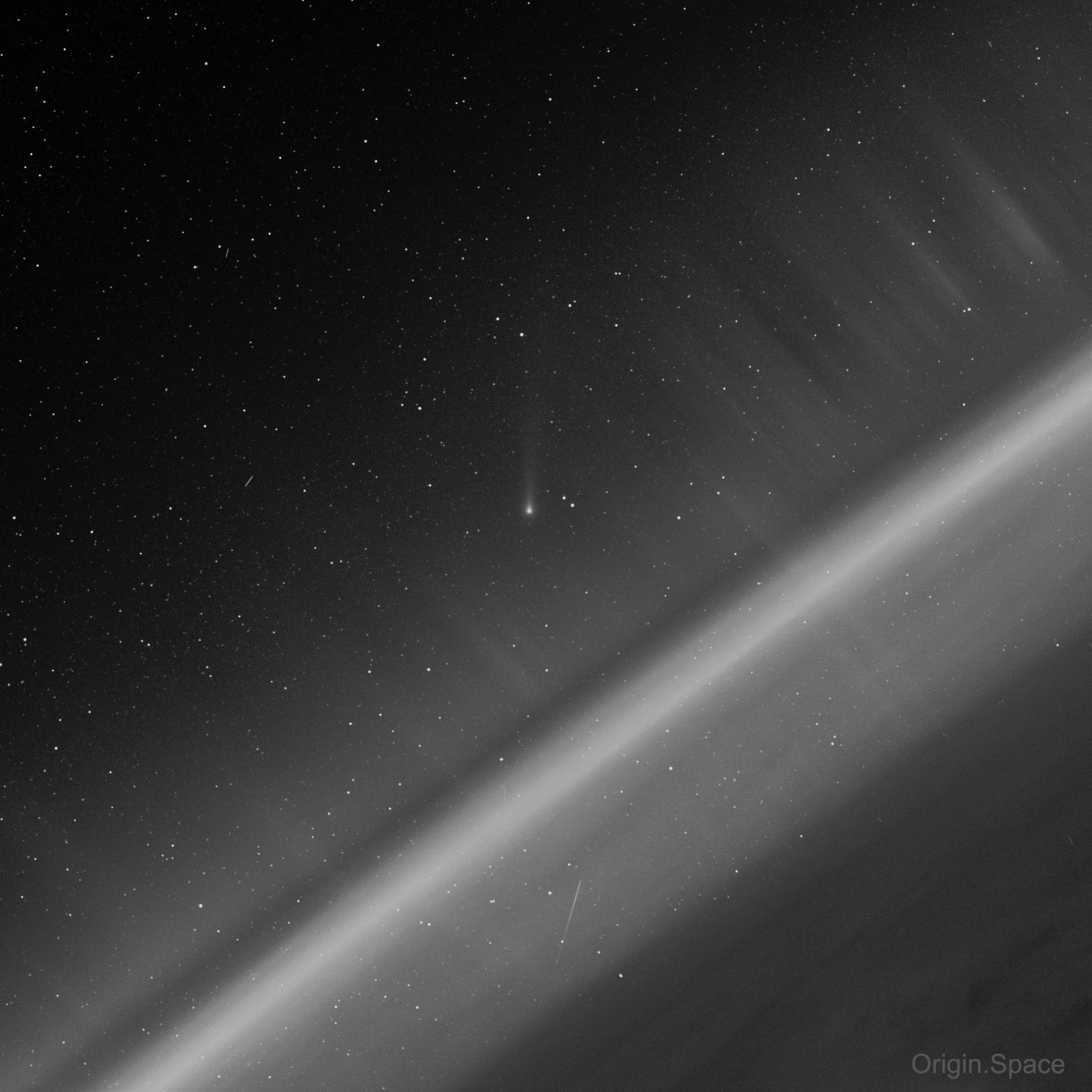
ASTRONOMY - Comet Leonard from Space
2021 December 15
Image Credit & Copyright: Zhuoxiao Wang, Yangwang-1 Space Telescope, Origin.Space
Explanation: What does Comet Leonard look like from space? Today's featured image from Origin.Space's Yangwang-1 space telescope shows not only the currently bright comet -- but several other space delights as well. Taken in optical and ultraviolet light, C/2021 A1 (Leonard) is visible with an extended tail near the image center as it appeared five days ago. The Earth is visible on the lower right, while layers of the Earth's atmosphere glow diagonally from the lower left to the upper right. The trails of two satellites can be seen in front of a myriad of distant stars that dot the background on the upper left. The faint bands of light running diagonally from the lower right to the upper left are auroras. Finally, the image also caught a meteor streaking just below the airglow. To see Comet Leonard yourself from the Earth's surface during the next few days, look toward the western horizon just after sunset or just before sunrise.
14/12/2021
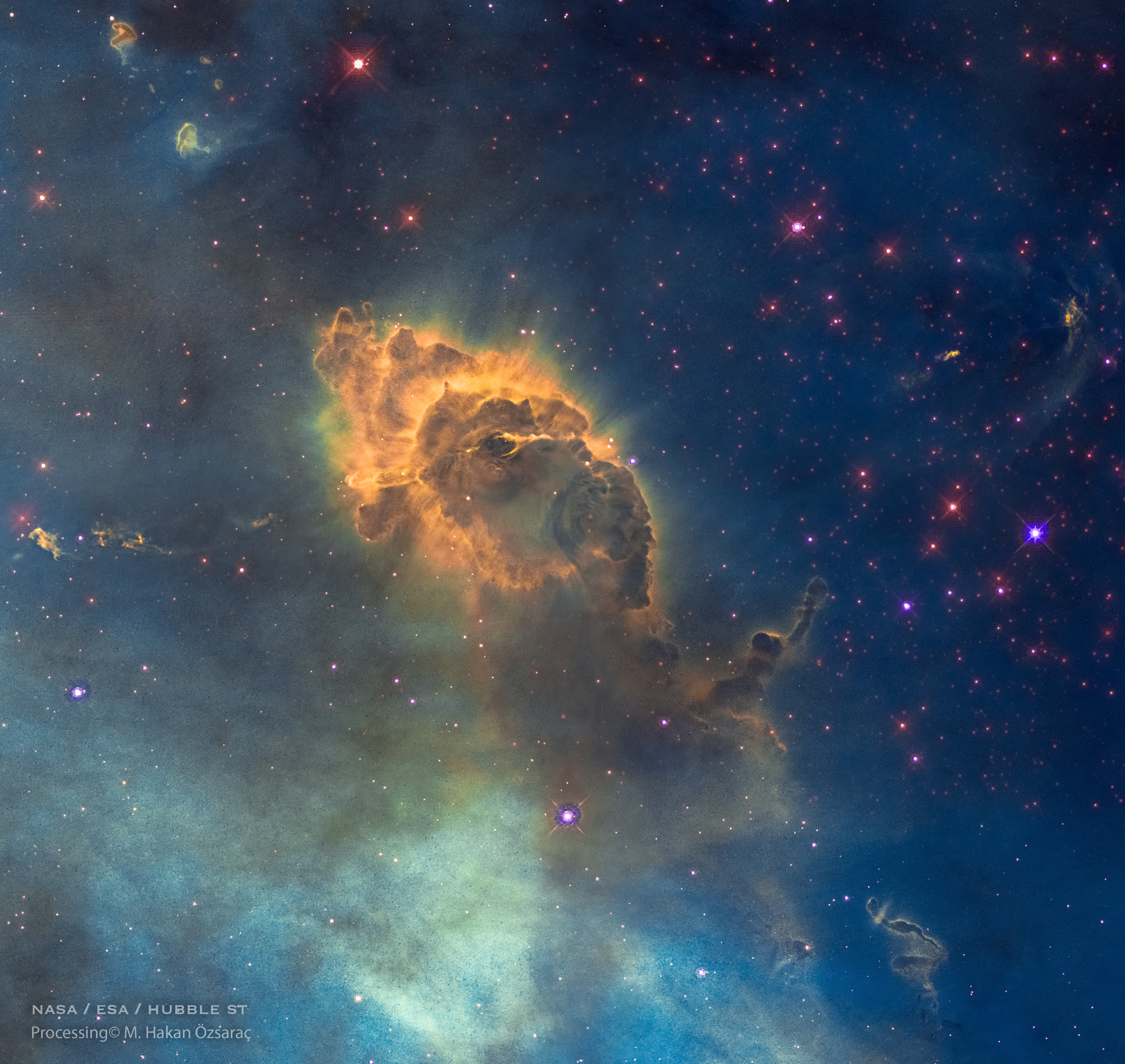
ASTRONOMY - HH 666: Carina Dust Pillar with Jet
2021 December 14
Image Credit: NASA, ESA, Hubble; Processing & Copyright: Mehmet Hakan Özsaraç
Explanation: To some, it may look like a beehive. In reality, the featured image from the Hubble Space Telescope captures a cosmic pillar of dust, over two-light years long, inside of which is Herbig-Haro 666 -- a young star emitting powerful jets. The structure lies within one of our galaxy's largest star forming regions, the Carina Nebula, shining in southern skies at a distance of about 7,500 light-years. The pillar's layered outline are shaped by the winds and radiation of Carina's young, hot, massive stars, some of which are still forming inside the nebula. A dust-penetrating view in infrared light better shows the two, narrow, energetic jets blasting outward from a still hidden infant star.
AERONAUTIQUE - Avions de légende - Le Messerschmitt Bf 109
13/12/2021
ASTRONOMIE - Cette nuit, une pluie d'étoiles
Bien qu'il fasse froid, les longues nuits de décembre sont resplendissantes (surtout cette année avec des planètes alignées et une comète) et réservent de beaux spectacles célestes. Parmi eux figurent les Géminides. Une pluie d'étoiles filantes qui s'étend du 19 novembre jusqu'à la veillée de Noël, et est unanimement considérée comme l'une des plus belles, si ce n'est LA plus belle de l'année ! Lors de son pic d'activité, attendu vers le 13-14 décembre, le nombre de météores plongeant dans l'atmosphère peut dépasser les 60 en une heure !
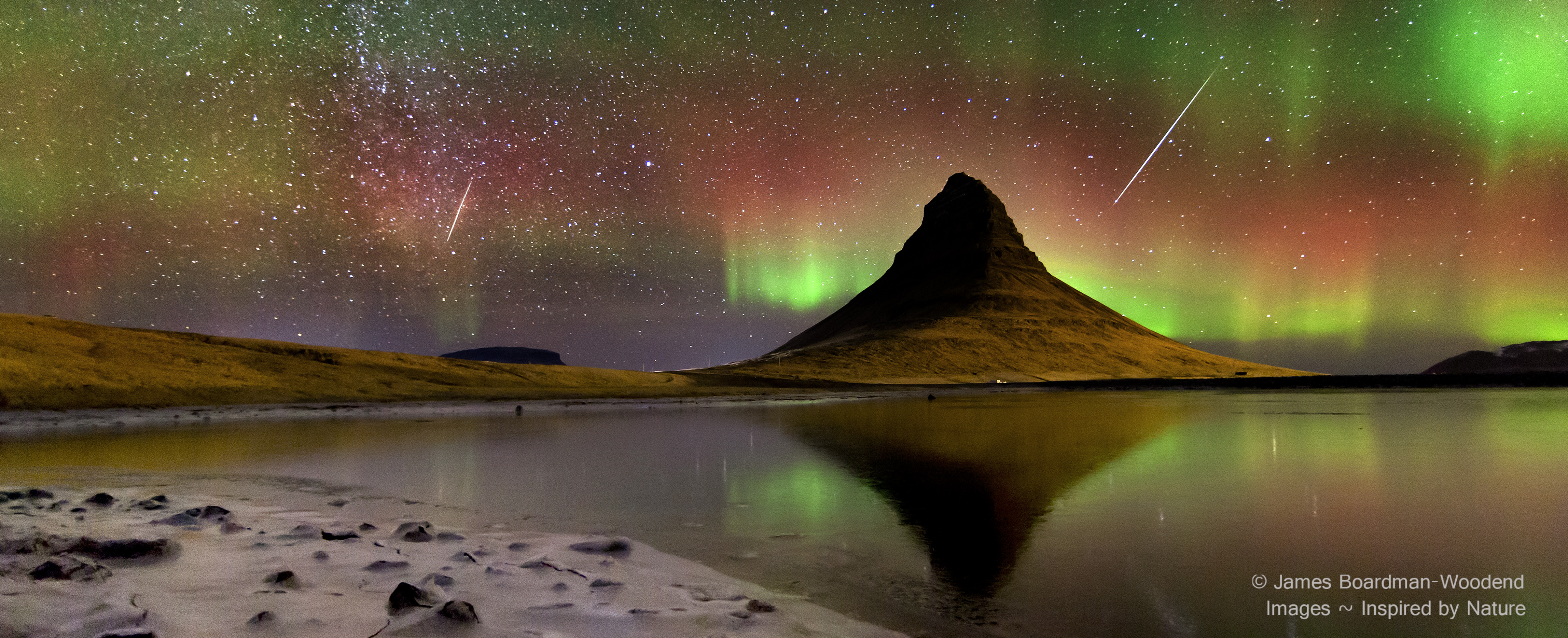
ASTRONOMY - Meteors and Auroras over Iceland
2021 December 13
Image Credit & Copyright: James Boardman-Woodend; Annotation: Judy Schmidt
Explanation: What's going on behind that mountain? Quite a bit. First of all, the mountain itself, named Kirkjufell, is quite old and located in western Iceland near the town of Grundarfjörður. In front of the steeply-sloped structure lies a fjord that had just begun to freeze when the above image was taken -- in mid-December of 2012. Although quite faint to the unaided eye, the beautiful colors of background aurorae became quite apparent on the 25-second exposure. What makes this image of particular note, though, is that it also captures streaks from the Geminids meteor shower -- meteors that might not have been evident were the aurora much brighter. Far in the distance, on the left, is the band of our Milky Way Galaxy, while stars from our local part of the Milky Way appear spread across the background. Tonight the Geminids meteor shower peaks again and may well provide sky enthusiasts with their own memorable visual experiences.
12/12/2021
AERONAUTIQUE - Avions de légende - Le Spitfire
ASTRONOMY - Comet Leonard Before Star Cluster M3
2021 December 12
Image Credit & Copyright: Dan Bartlett
Explanation: Comet Leonard is now visible to the unaided eye -- but just barely. Passing nearest to the Earth today, the comet is best seen this week soon after sunset, toward the west, low on the horizon. Currently best visible in the north, by late December the comet will best be seen from south of Earth's equator. The featured image of Comet C/2021 A1 (Leonard) was taken a week ago from California, USA. The deep exposure shows in great detail the comet's green gas coma and developing dust tail. The comet -- across our inner Solar System and only light-minutes away -- was captured passing nearly in front of globular star cluster M3. In contrast, M3 is about 35,000 light-years away. In a week, Comet Leonard will pass unusually close to Venus, but will continue on and be at its closest to the Sun in early January.
10/12/2021
ASTRONOMY - Eclipse on a Polar Day
Image Credit & Copyright: Stephanie Ziyi Ye
Explanation: During polar day, in Arctic and Antarctic summer, the Sun stays above the horizon for periods of 24 hours or more. Recorded on December 4, this fisheye timelapse image tracks the Sun in multiple frames as it completes a circle in the summer sky above Union Glacier, Antarctica. Of course on that date, Union Glacier's sky did grow dark even though the Sun was above the horizon. Captured during the brief period of totality, an eclipsed Sun is at bottom center of the composite view. Near the edge of the total eclipse path across planet Earth, the Moon's shadow darkens the sky above.
Astronomy - TRIPLE SHOCKWAVE FROM SUN CROSSING ROCKET
2026 June 15 Triple Shockwave from Sun Crossing Rocket Image Credit & Copyright: John Winkopp ( WAI Media ) Explanation: What's ha...
-
2026 January 1 Auroral Corona Image Credit & Copyright : Roi Levi Explanation: Cycle 25 solar maximum made 2025 a great year for ...
-
Imaginez un monde où le cancer n’est plus une sentence, mais une simple étape à franchir. Grâce à une découverte révolutionnaire, ce rêve es...