La fin du soleil
Futura
2022 April 17
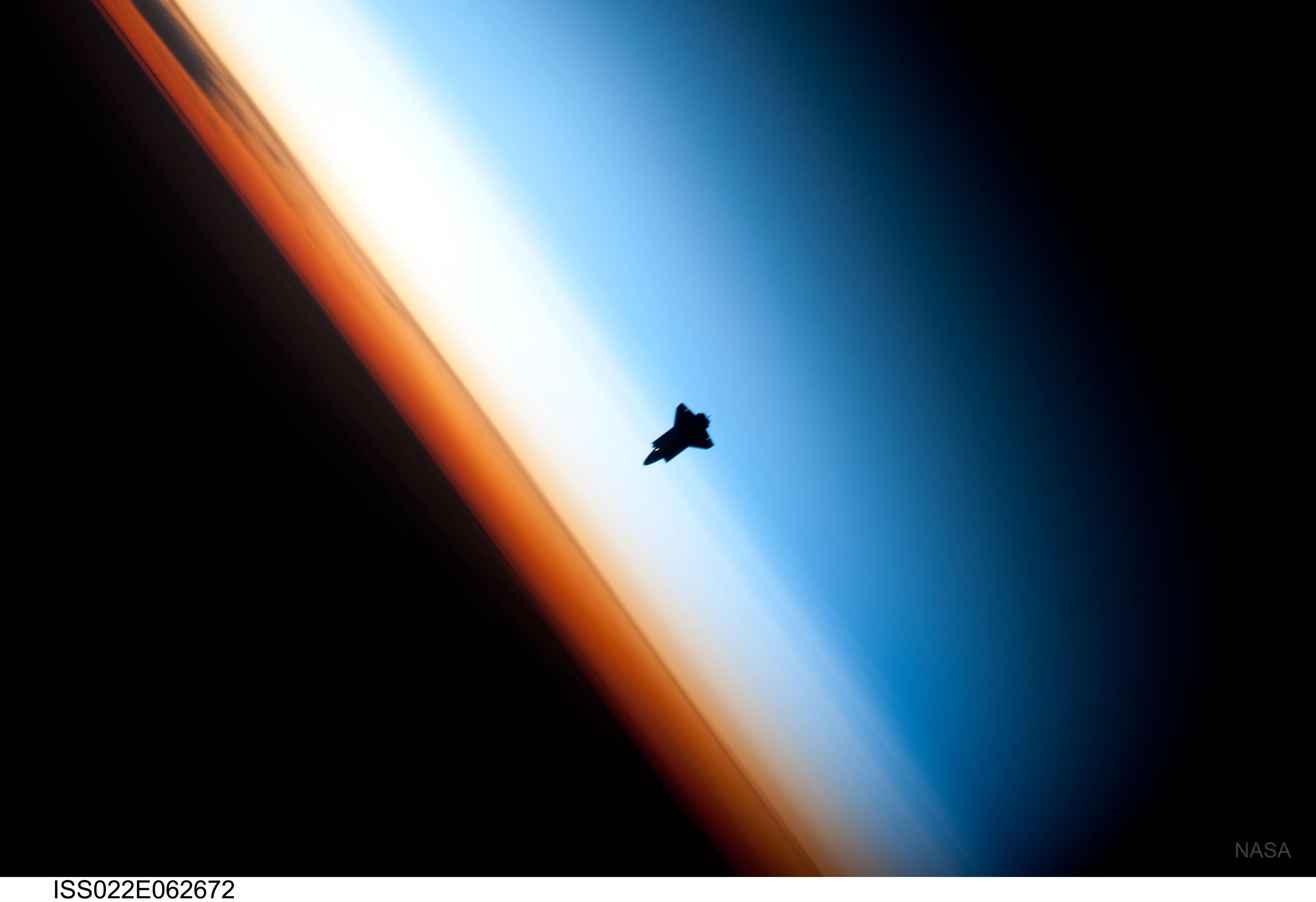
Explanation: What's that approaching? Astronauts on board the International Space Station in 2010 first saw it far in the distance. Soon it enlarged to become a dark silhouette. As it came even closer, the silhouette appeared to be a spaceship. Finally, the object revealed itself to be the Space Shuttle Endeavour, and it soon docked as expected with the Earth-orbiting space station. Pictured here, Endeavour was imaged near Earth's horizon as it approached, where several layers of the Earth's atmosphere were visible. Directly behind the shuttle is the mesosphere, which appears blue. The atmospheric layer that appears white is the stratosphere, while the orange layer is Earth's Troposphere. Together, these thin layers of air -- collectively spanning less than 2 percent of Earth's radius -- sustain us all in many ways, including providing oxygen to breath and a barrier to dangerous radiations from space.

2022 April 16
Explanation: Taken with a camera fixed to a tripod, many short exposures were aligned with the stars to unveil this beautiful, dark night sky. Captured near the rural village of Albany`a at the northeastern corner of Spain, the three stars of Orion's belt stretch across top center in the starry frame. Alnitak, the easternmost (left) of the belt stars is seen next to the more diffuse glow of the Flame Nebula and the dark notch of the famous Horsehead. Easily visible to the naked-eye The Great Nebula of Orion is below the belt stars. A mere 1,500 light-years distant, it is the closest large stellar nursery to our fair planet. Best seen in photographs, the broad and faint arc of Barnard's Loop seems to embrace Orion's brighter stars and nebulae though. In the northern spring the familiar northern winter constellation is setting. Near the western horizon toward lower right Orion's apparently bright blue supergiant Rigel just touches the branches of a pine tree.
2022 April 15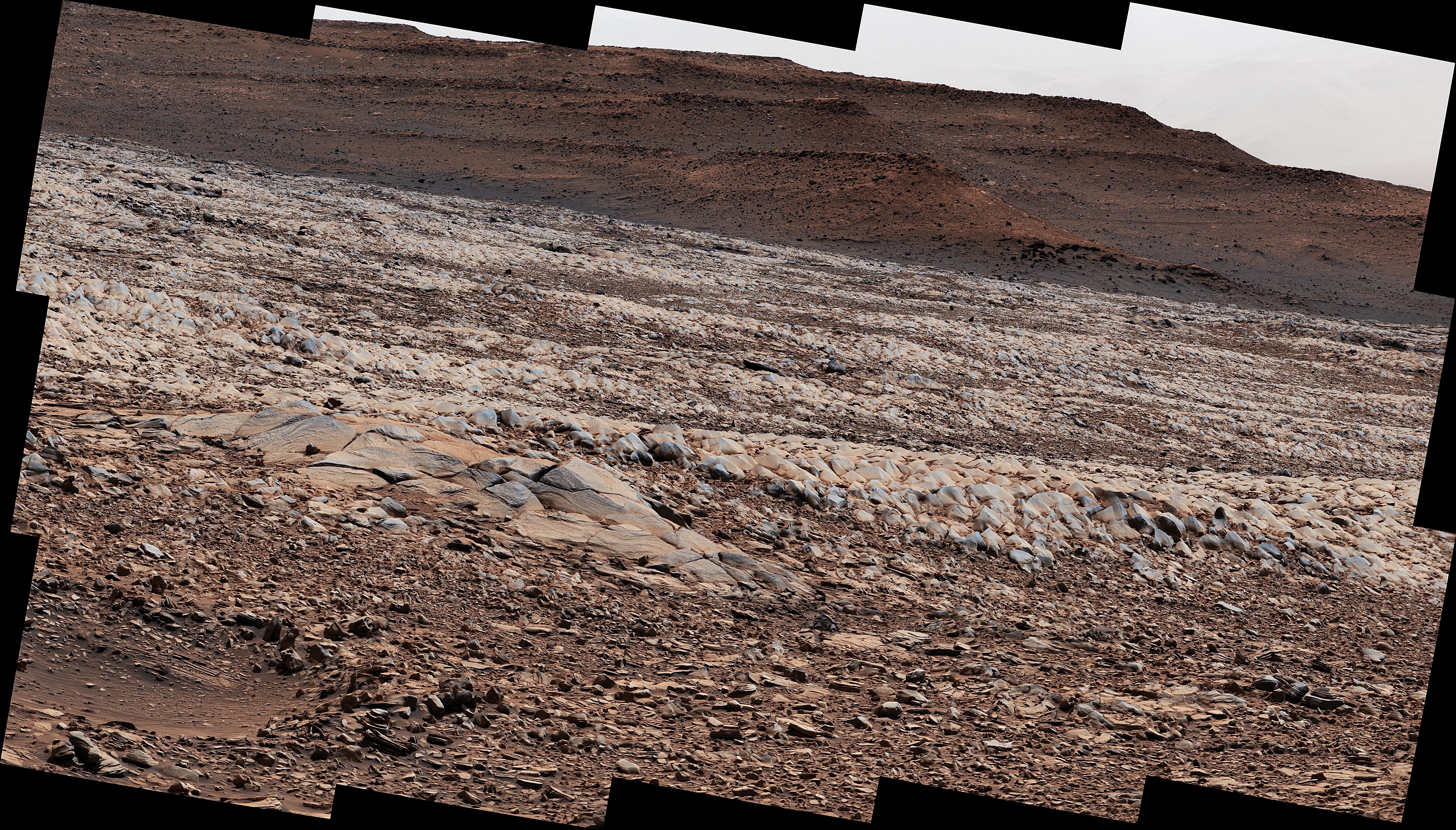
Explanation: Wind-sharpened rocks known as ventifacts, cover this broad sloping plain in the foot hills of Mount Sharp, Gale crater, Mars. Dubbed gator-back rocks their rugged, scaly appearance is captured in these digitally stitched Mastcam frames from the Curiosity rover on mission sol 3,415 (March 15, 2022). Driving over gator-back rocks before has resulted in damage to the rover's wheels, so Curiosity team members decided to turn around and take another path to continue the rover's climb. Curiosity has been on an ascent of Gale crater's central 5.5 kilometer high mountain since 2014. As it climbs, it's been able to study layers shaped by water on Mars billions of years ago.
2022 April 14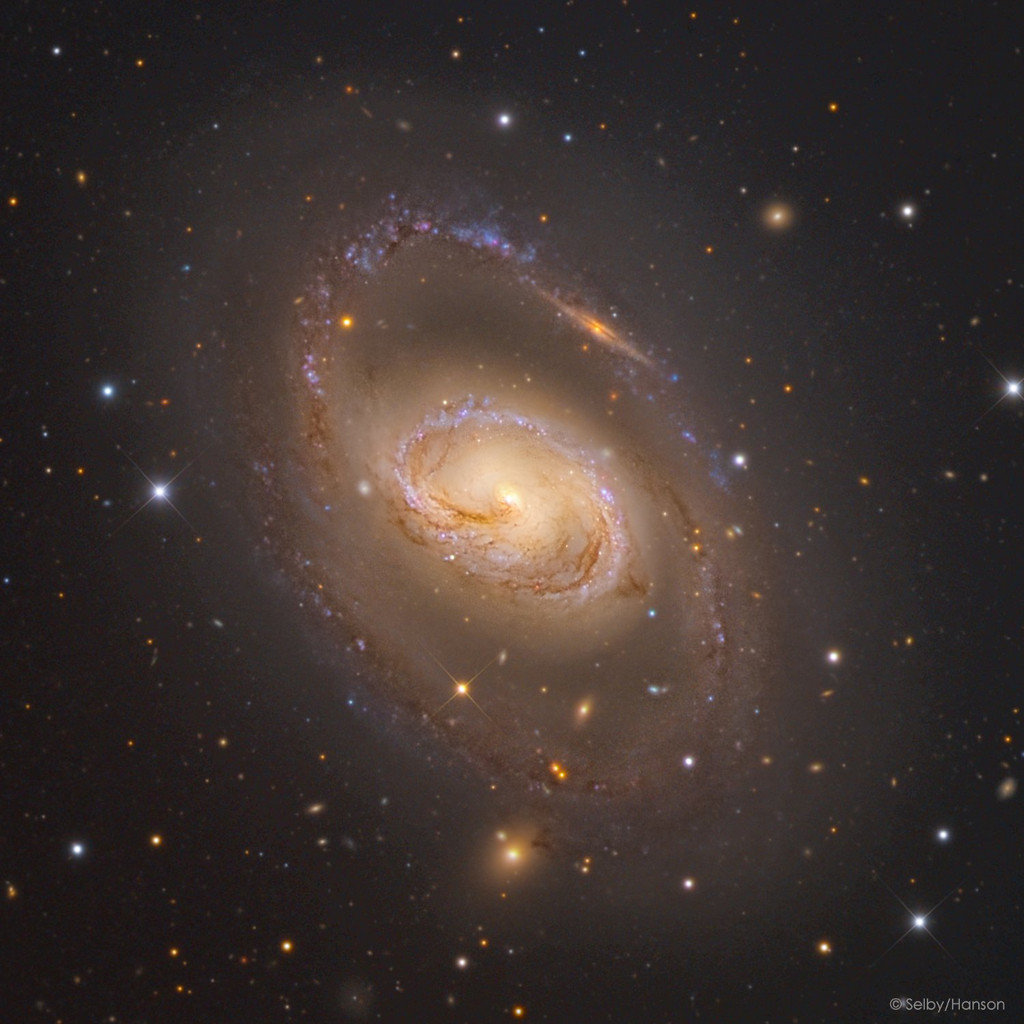
Explanation: Spiral arms seem to swirl around the core of Messier 96 in this colorful, detailed portrait of a beautiful island universe. Of course M96 is a spiral galaxy, and counting the faint arms extending beyond the brighter central region it spans 100 thousand light-years or so. That's about the size of our own Milky Way. M96 is known to be 38 million light-years distant, a dominant member of the Leo I galaxy group. Background galaxies and smaller Leo I group members can be found by examining the picture. The most intriguing one is itself a spiral galaxy seen nearly edge on behind the outer spiral arm near the 1 o'clock position from center. Its bright central bulge cut by its own dark dust clouds, the edge-on background spiral appears to be about 1/5 the size of M96. If that background galaxy is similar in actual size to M96, then it would be about 5 times farther away.
2022 April 13
2022 April 12
2022 April 10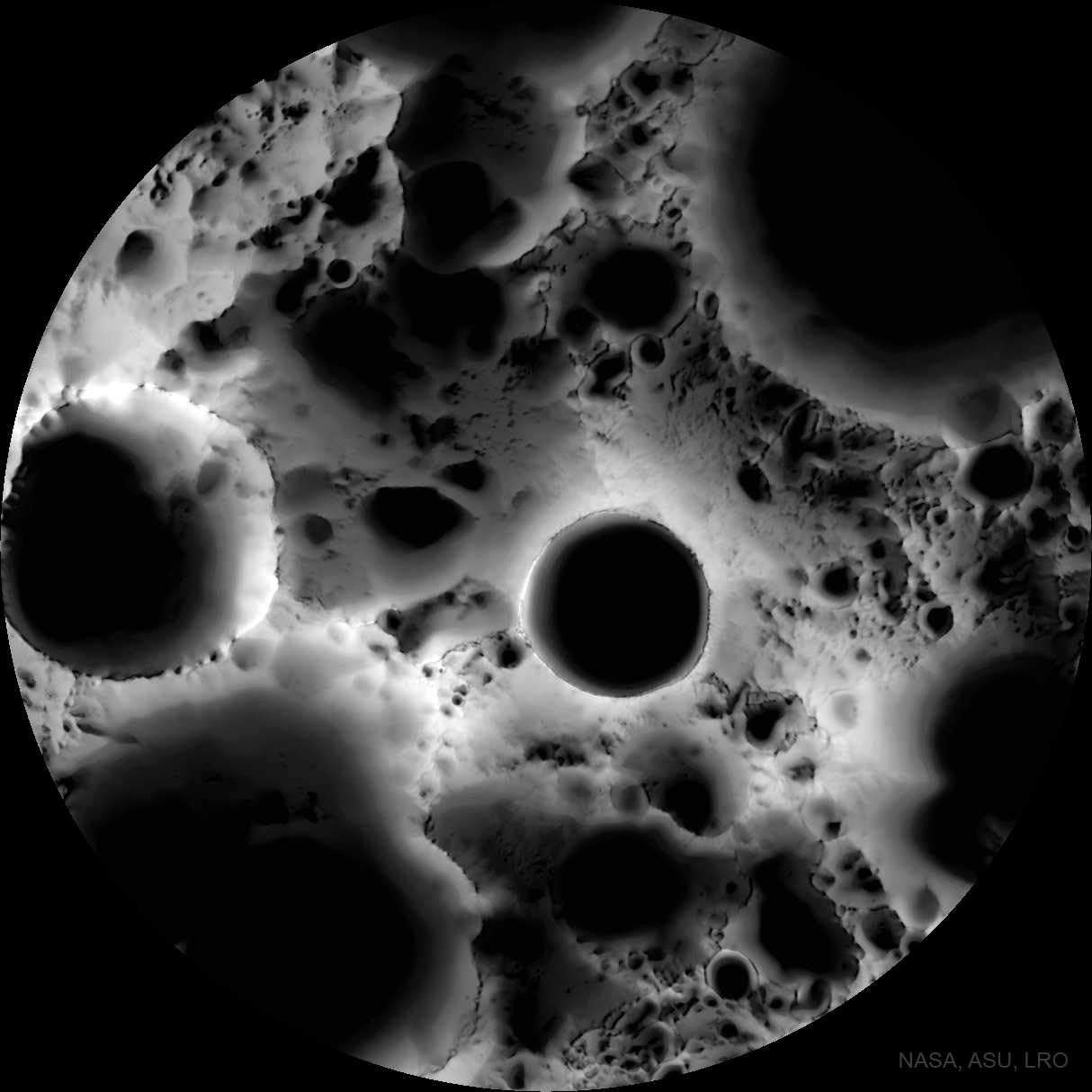
Explanation: Was this image of the Moon's surface taken with a microscope? No -- it's a multi-temporal illumination map made with a wide-angle camera. To create it, the Lunar Reconnaissance Orbiter spacecraft collected 1,700 images over a period of 6 lunar days (6 Earth months), repeatedly covering an area centered on the Moon's south pole from different angles. The resulting images were stacked to produce the featured map -- representing the percentage of time each spot on the surface was illuminated by the Sun. Remaining convincingly in shadow, the floor of the 19-kilometer diameter Shackleton crater is seen near the map's center. The lunar south pole itself is at about 9 o'clock on the crater's rim. Crater floors near the lunar south and north poles can remain in permanent shadow, while mountain tops can remain in nearly continuous sunlight. Useful for future outposts, the shadowed crater floors could offer reservoirs of water-ice, while the sunlit mountain tops offer good locations to collect solar power.
2022 April 8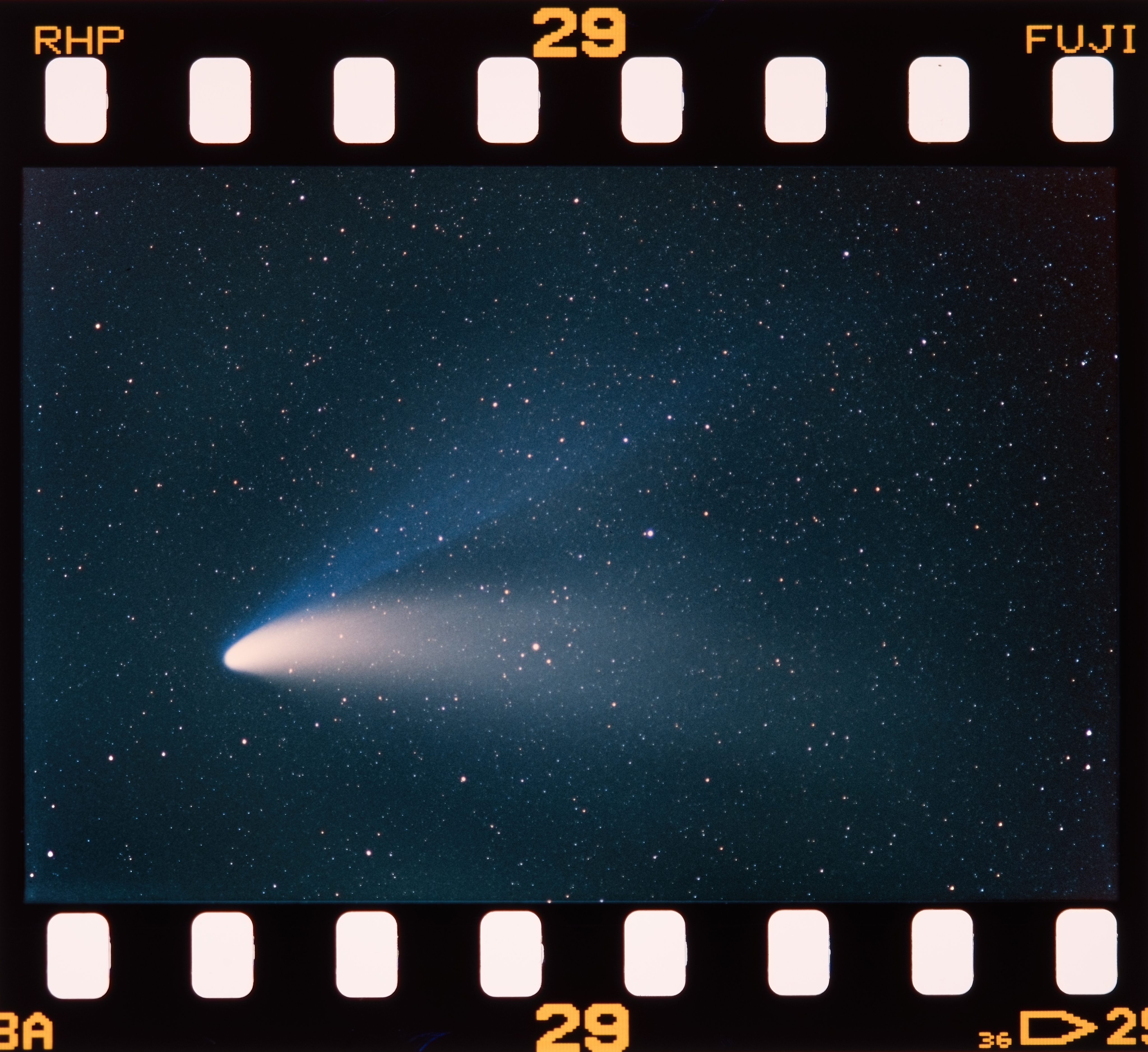
Explanation: Only twenty-five years ago, Comet Hale-Bopp rounded the Sun and offered a dazzling spectacle in planet Earth's night skies. Digitized from the original astrophoto on 35mm color slide film, this classic image of the Great Comet of 1997 was recorded a few days after its perihelion passage on April 1, 1997. Made with a camera and telephoto lens piggy-backed on a small telescope, the 10 minute long, hand-guided exposure features the memorable tails of Hale-Bopp, a whitish dust tail and blue ion tail. Here, the ion tail extends well over ten degrees across the northern sky. In all, Hale-Bopp was reported as visible to the naked eye from late May 1996 through September 1997. Also known as C/1995 O1, Hale-Bopp is recognized as one of the most compositionally pristine comets to pass through the inner Solar System. A visitor from the distant Oort cloud, the comet's next perihelion passage should be around the year 4380 AD. Do you remember Hale-Bopp?
2026 September 2 Solar Eclipses and Culture Image Credit & Copyright: Javier Castro Text: Keighley Rockcliffe ( NASA GSFC , UMBC CSS...