"Les étoiles disparues de la baie des trépassés"
Stelvision
2022 May 4

Explanation: The early morning planet parade continues. Visible the world over, the planets Jupiter, Venus, Mars and Saturn have been lining up in the pre-dawn sky since mid-April. In the featured image taken last month, these planets were captured over the Step Pyramid of Djoser, a UNESCO World Heritage Site. Located in the Saqqara necropolis of Egypt, the pyramid was constructed in the 27th century BC and is one of the oldest pyramids known. The two-image composite includes a foreground image taken during evening blue hour, and a background image captured from the same location the following morning. The morning planet line-up is slowly changing. At the end of last month, planets Jupiter and Venus switched places, while at the end of this month, Jupiter and Mars will switch after passing within one-degree of each other. Of course, this picturesque planetary angular alignment is a coincidence, as all of these worlds continue to orbit the Sun as they have for billions of years, well before even the ancient Pyramid of Djoser was built.
2022 May 3
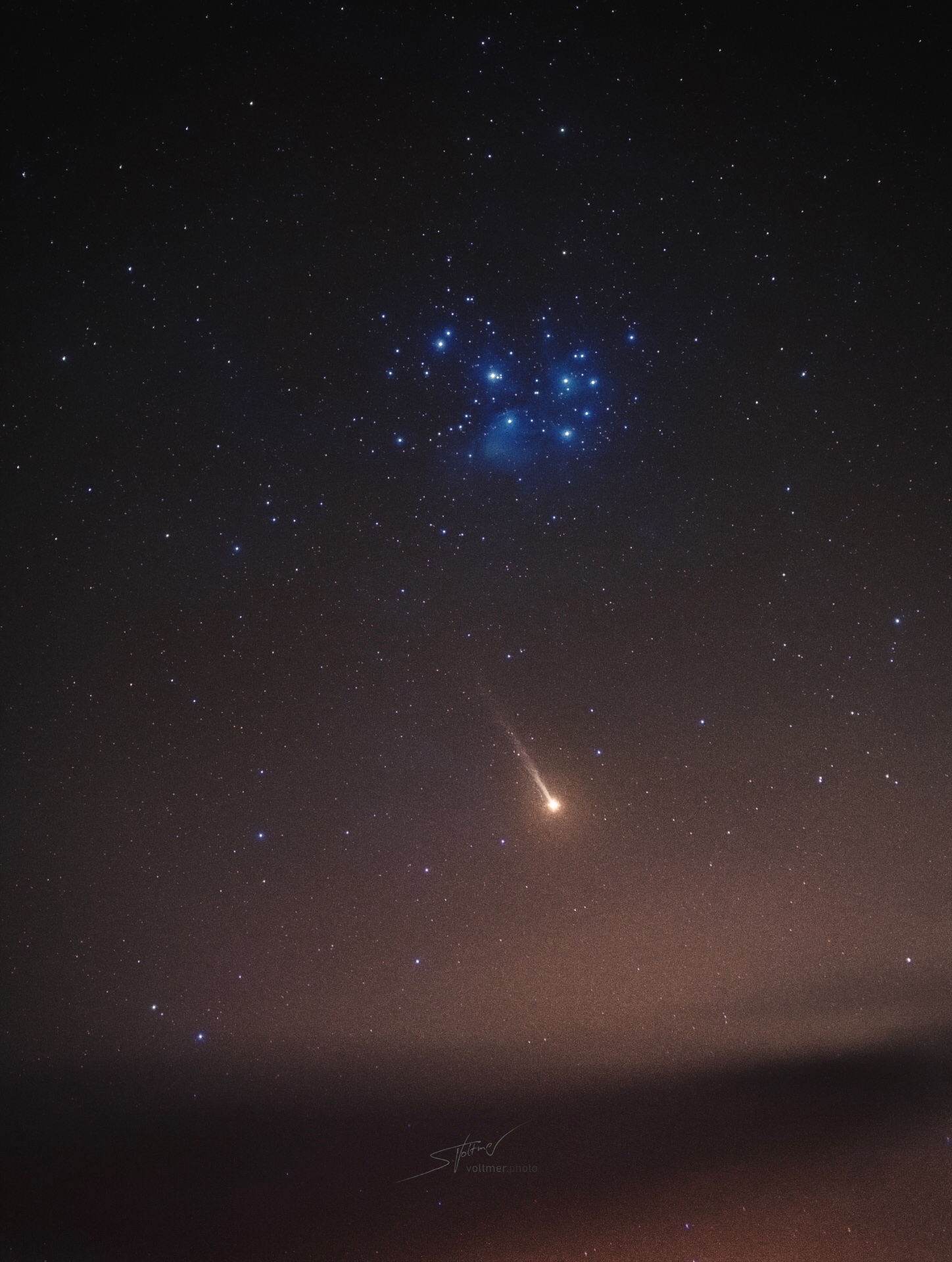
Explanation: That's no comet. Below the Pleiades star cluster is actually a planet: Mercury. Long exposures of our Solar System's innermost planet may reveal something unexpected: a tail. Mercury's thin atmosphere contains small amounts of sodium that glow when excited by light from the Sun. Sunlight also liberates these molecules from Mercury's surface and pushes them away. The yellow glow from sodium, in particular, is relatively bright. Pictured, Mercury and its sodium tail are visible in a deep image taken last week from La Palma, Spain through a filter that primarily transmits yellow light emitted by sodium. First predicted in the 1980s, Mercury's tail was first discovered in 2001. Many tail details were revealed in multiple observations by NASA's robotic MESSENGER spacecraft that orbited Mercury between 2011 and 2015. Tails, of course, are usually associated with comets.
2022 May 2
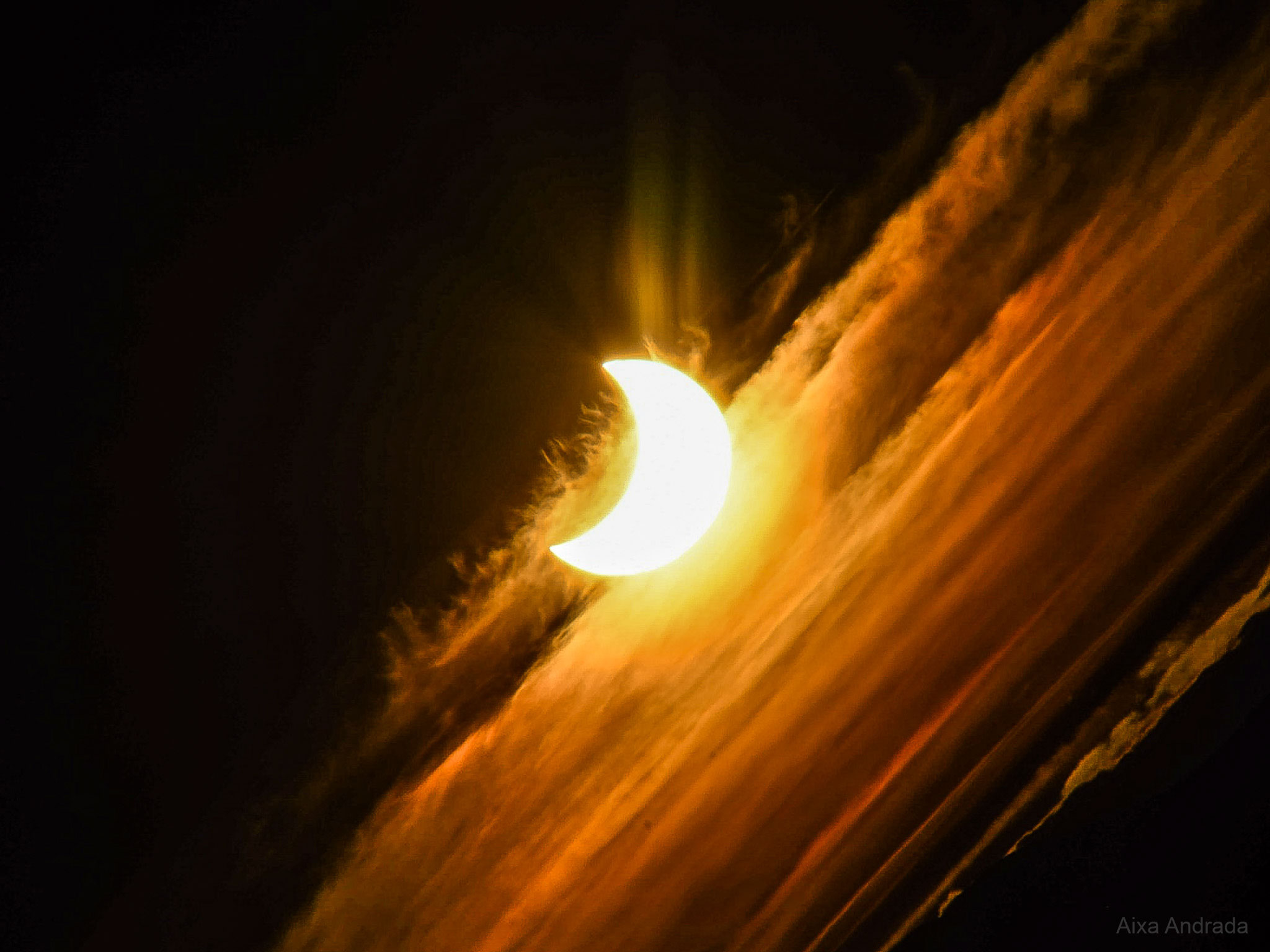
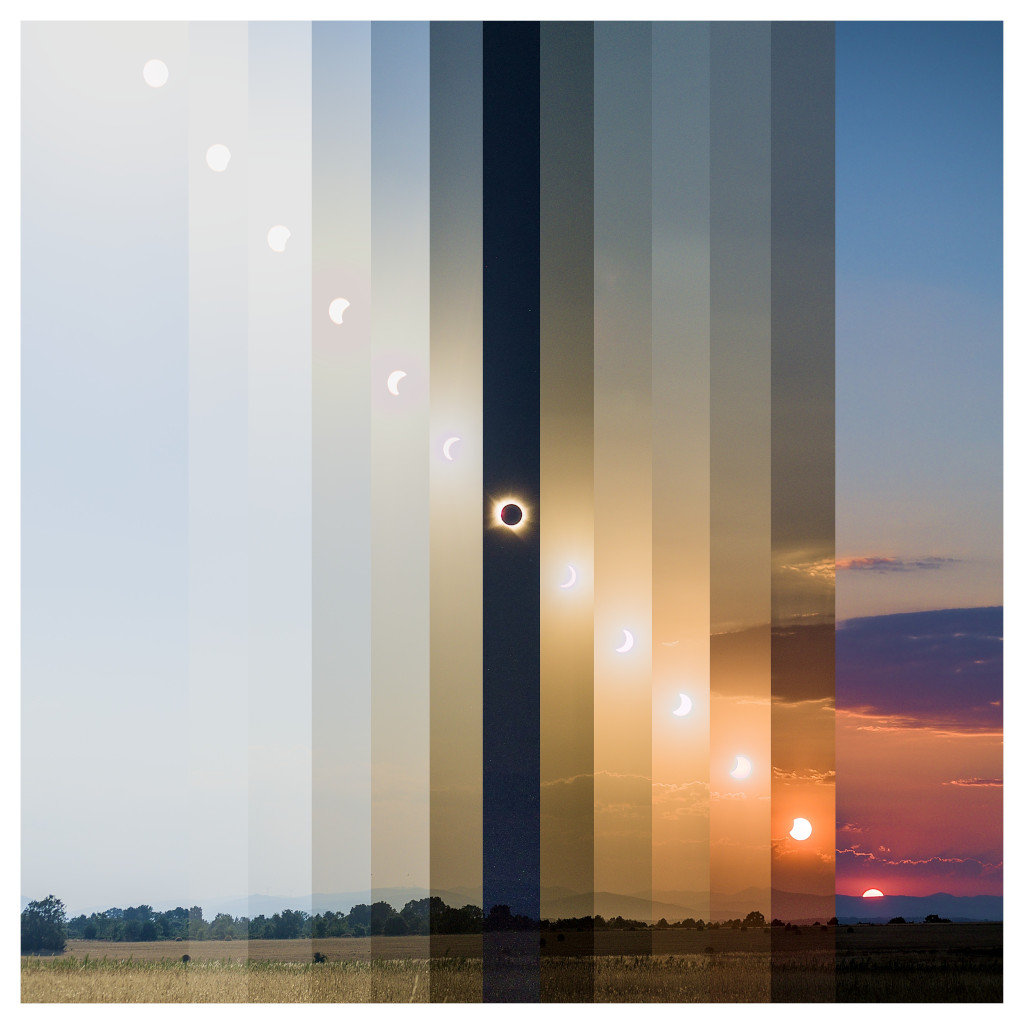
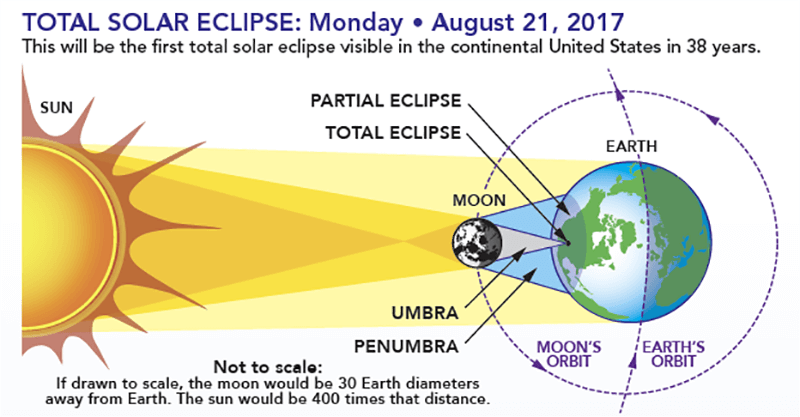
Explanation: What's happened to the Sun? Two days ago, parts of South America were treated to a partial solar eclipse -- where the Moon blocked out part of the Sun. The featured image shows an image of the partially eclipsed Sun through clouds as it was setting over Patagonia, Argentina. In the tilted image, Earth is toward the right. During the eclipse, the Moon moved partly between Earth and the Sun. Although a visually impressive sight, the slight dimming of surroundings during this partial eclipse was less noticeable than dimming created by a thick cloud. In about two weeks, all of South America and part of North America will experience a total lunar eclipse -- where the Earth moves completely between the Moon and the Sun. In about two years, a total solar eclipse will cross North America.
2022 May 1
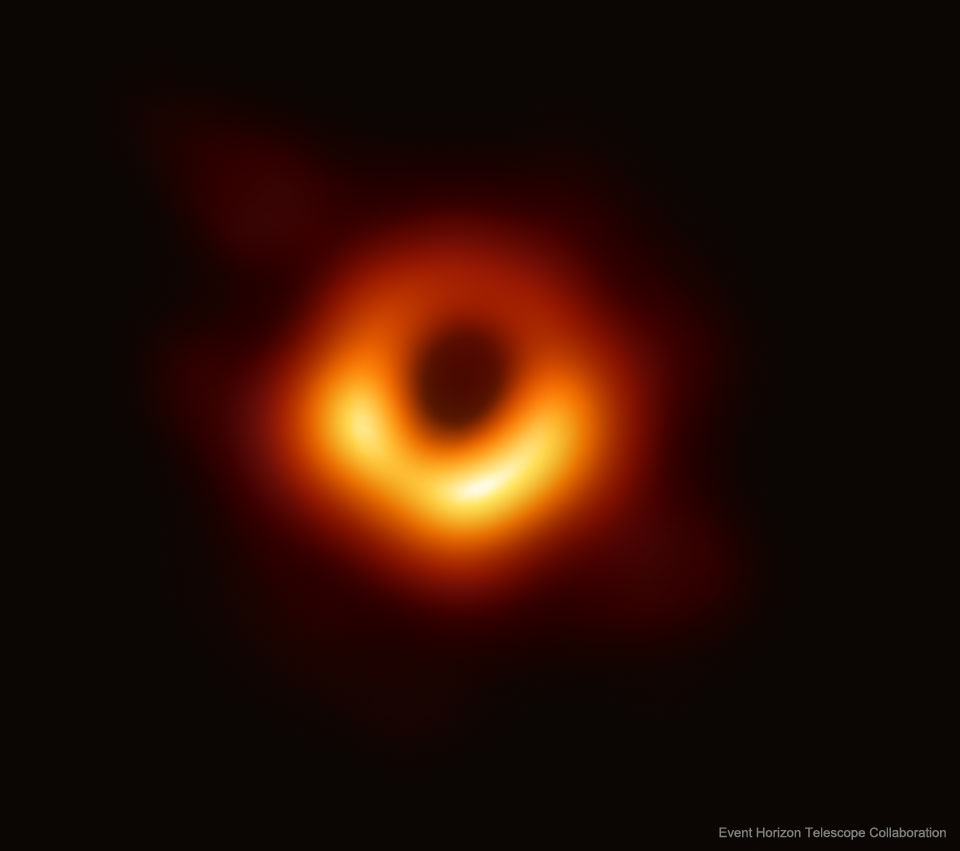
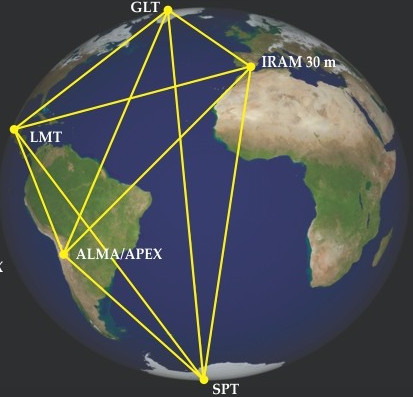
Explanation: What does a black hole look like? To find out, radio telescopes from around the Earth coordinated observations of black holes with the largest known event horizons on the sky. Alone, black holes are just black, but these monster attractors are known to be surrounded by glowing gas. This first image resolves the area around the black hole at the center of galaxy M87 on a scale below that expected for its event horizon. Pictured, the dark central region is not the event horizon, but rather the black hole's shadow -- the central region of emitting gas darkened by the central black hole's gravity. The size and shape of the shadow is determined by bright gas near the event horizon, by strong gravitational lensing deflections, and by the black hole's spin. In resolving this black hole's shadow, the Event Horizon Telescope (EHT) bolstered evidence that Einstein's gravity works even in extreme regions, and gave clear evidence that M87 has a central spinning black hole of about 6 billion solar masses. Since releasing this featured image in 2019, the EHT has expanded to include more telescopes, observe more black holes, track polarized light,and is working to observe the immediately vicinity of the black hole in the center of our Milky Way Galaxy.
2022 April 28
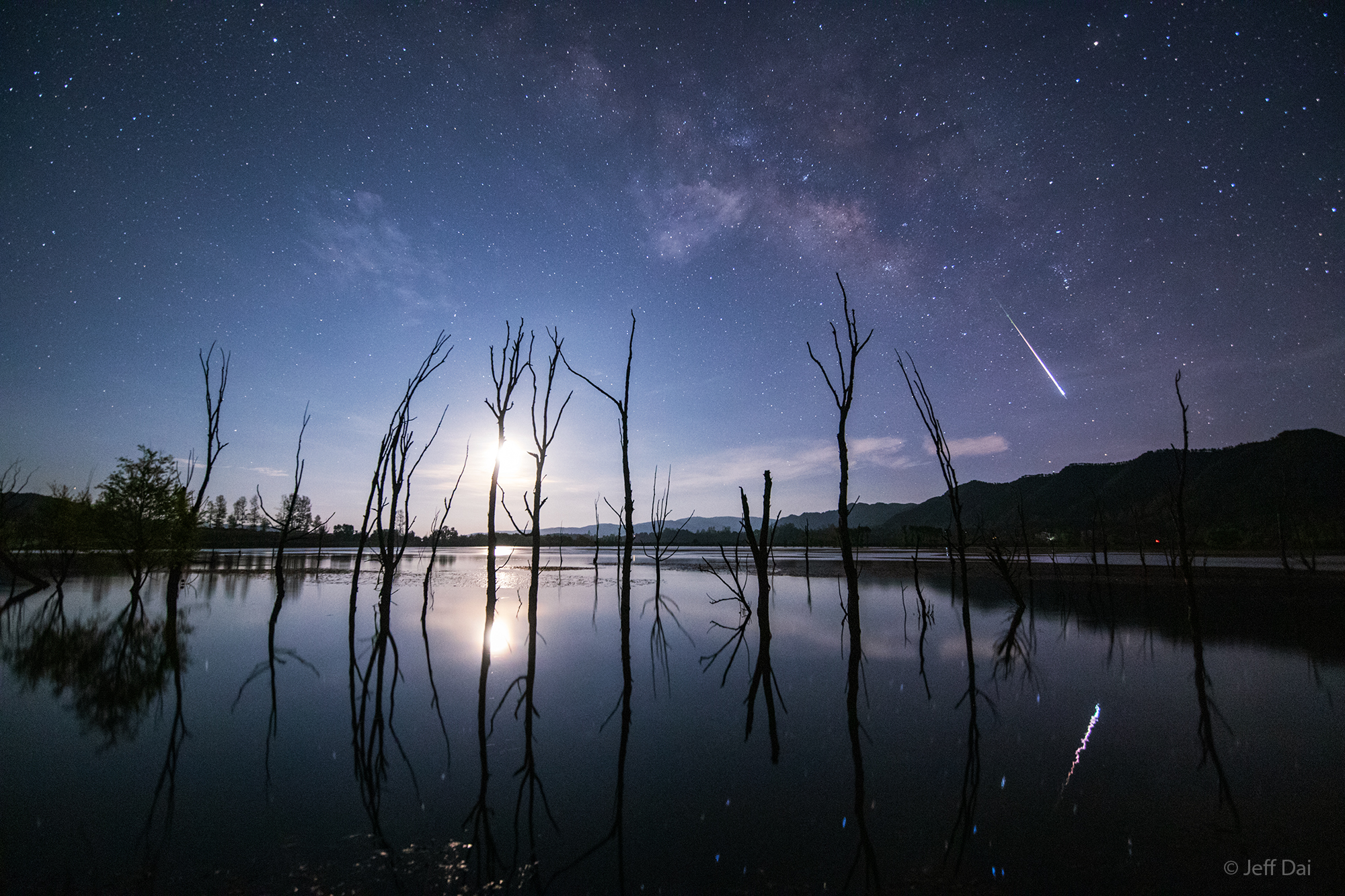
Explanation: In the early hours of April 24 this bright Lyrid meteor flashed along the central Milky Way. For a moment, it cast a bright reflection across Lake Nian, Yunnan province, China. The annual Lyrid meteor shower, one of the oldest known, is active in late April, as our fair planet plows through dust left along the orbit of long-period comet Thatcher. The trail of the bright fireball points back toward the shower's radiant in the constellation Lyra high in the northern springtime sky and off the top of the frame. Just rising in that starry sky, light from a third quarter moon also cast a glow on the peaceful waters of the lake.
2022 April 27

Explanation: What is that large dark spot on Jupiter? It's the shadow of Ganymede, Jupiter's largest moon. When Jupiter's moons cross between the Jovian giant and the Sun, they created shadows just like when the Earth's moon crosses between the Earth and the Sun. Also like on Earth, if you were in a dark shadow on Jupiter, you would see a moon completely eclipse the Sun. Unlike on Earth, moon shadows occur most days on Jupiter -- what's more unusual is that a spacecraft was close enough to record one with a high-resolution image. That spacecraft, Juno, was passing so close to Jupiter in late February that nearby clouds and the dark eclipse shadow appear relatively large. Juno has made many discoveries about our Solar System's largest planet, including, recently, rapidly expanding circular auroras.
2026 September 2 Solar Eclipses and Culture Image Credit & Copyright: Javier Castro Text: Keighley Rockcliffe ( NASA GSFC , UMBC CSS...