Nombre total de pages vues
30/07/2022
LA VOIE LACTEE SUR TERRE - Plateau de Valensole, France
29/07/2022
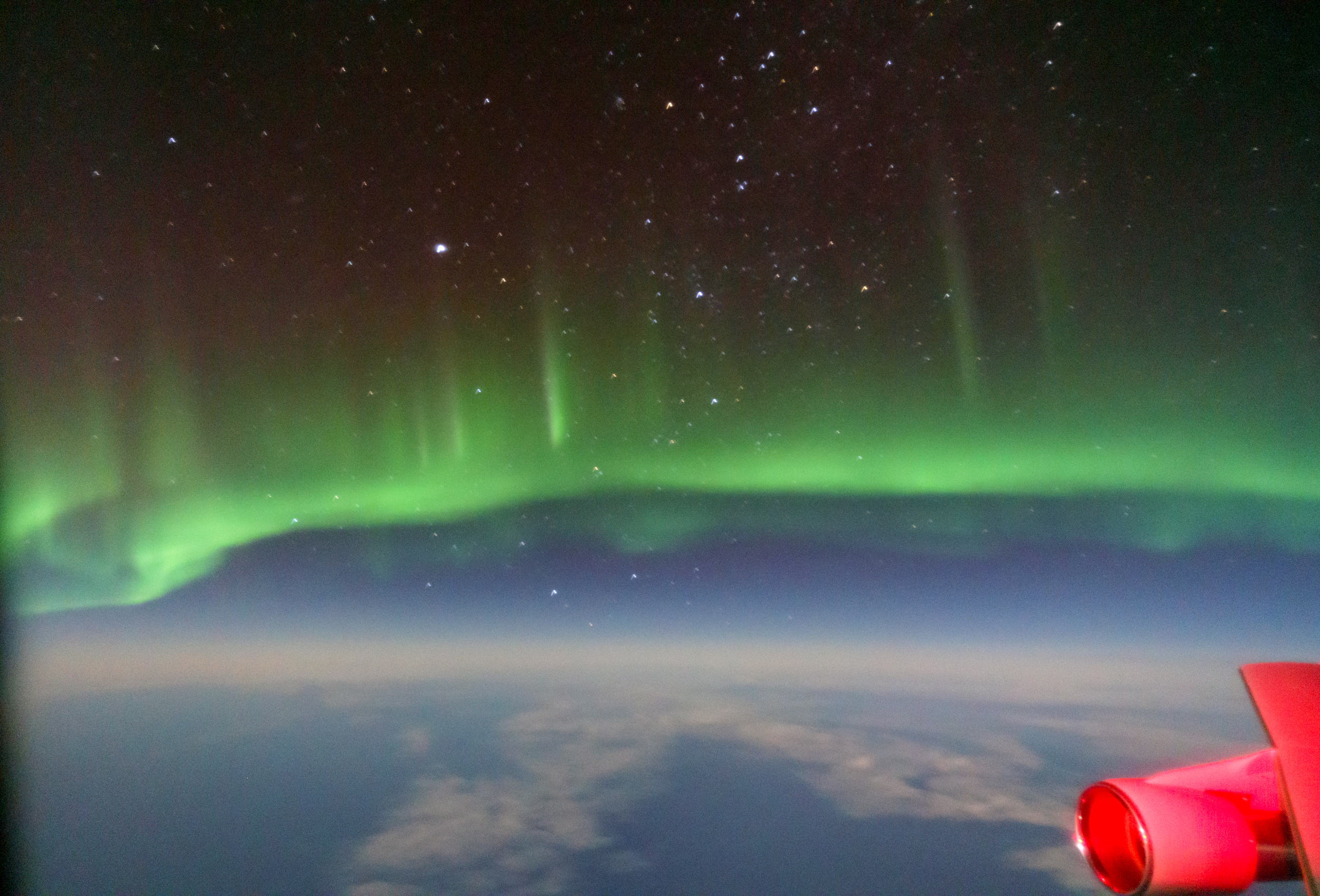
ASTRONOMY - SOFIA's Southern Lights
2022 July 29
Image Credit & Copyright: Ian Griffin (Otago Museum)
Explanation: SOFIA, the Stratospheric Observatory for Infrared Astronomy, is a Boeing 747SP aircraft modified to carry a large reflecting telescope into the stratosphere. The ability of the airborne facility to climb above about 99 percent of Earth's infrared-blocking atmosphere has allowed researchers to observe from almost anywhere over the planet. On a science mission flying deep into the southern auroral oval, astronomer Ian Griffin, director of New Zealand’s Otago Museum, captured this view from the observatory's south facing starboard side on July 17. Bright star Canopus shines in the southern night above curtains of aurora australis, or southern lights. The plane was flying far south of New Zealand at the time at roughly 62 degrees southern latitude. Unfortunately, after a landing at Christchurch severe weather damaged SOFIA requiring repairs and the cancellation of the remainder of its final southern hemisphere deployment.
28/07/2022
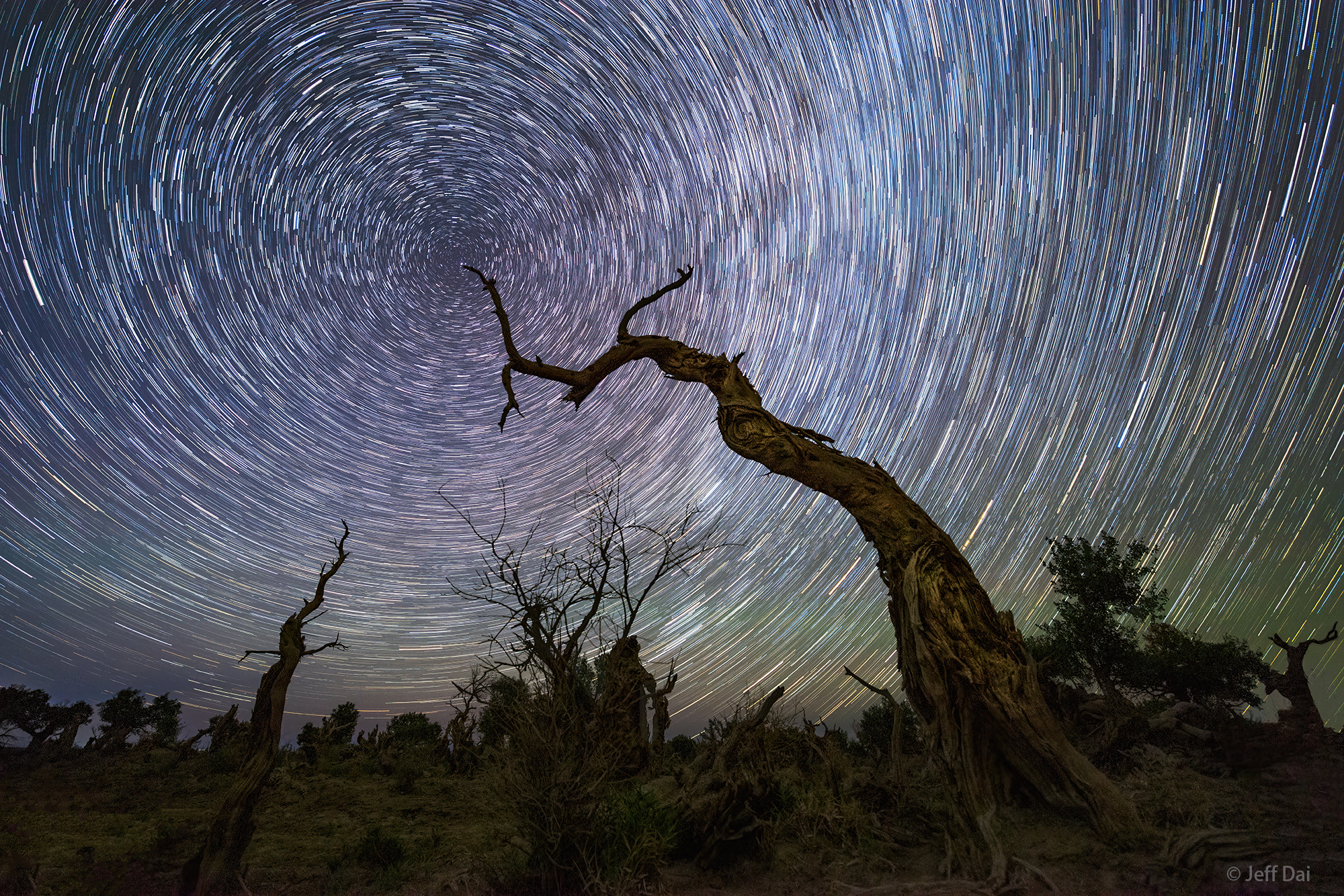
ASTRONOMY - North Celestial Tree
2022 July 28
Image Credit & Copyright: Jeff Dai (TWAN)
Explanation: An ancient tree seems to reach out and touch Earth's North Celestial Pole in this well-planned night skyscape. Consecutive exposures for the timelapse composition were recorded with a camera fixed to a tripod in the Yiwu Desert Poplar Forests in northwest Xinjiang, China. The graceful star trail arcs reflect Earth's daily rotation around its axis. By extension, the axis of rotation leads to the center of the concentric arcs in the night sky. Known as the North Star, bright star Polaris is a friend to northern hemisphere night sky photographers and celestial navigators alike. That's because Polaris lies very close to the North Celestial Pole on the sky. Of course it can be found at the tip of an outstretched barren branch in a postcard from a rotating planet.
27/07/2022
LA VOIE LACTEE SUR TERRE - Suisse : le Cervin sommet mythique des alpinistes
ASTROPHOTOGRAPHIE - La comète Catalina et ses deux queues
ASTRONOMY - Comet NEOWISE Rising over the Adriatic Sea
2022 July 26
Video Credit & Copyright: Paolo Girotti
Explanation: This sight was worth getting out of bed early. Two years ago this month, Comet C/2020 F3 (NEOWISE) rose before dawn to the delight of northern sky enthusiasts awake that early. Up before sunrise on July 8th, the featured photographer was able to capture in dramatic fashion one of the few comets visible to the unaided eye this century, an inner-Solar System intruder that has become known as the Great Comet of 2020. The resulting video detailed Comet NEOWISE from Italy rising over the Adriatic Sea. The time-lapse video combines over 240 images taken over 30 minutes. The comet was seen rising through a foreground of bright and undulating noctilucent clouds, and before a background of distant stars. Comet NEOWISE remained unexpectedly bright until 2020 August, with its ion and dust tails found to emanate from a nucleus spanning about five kilometers across.
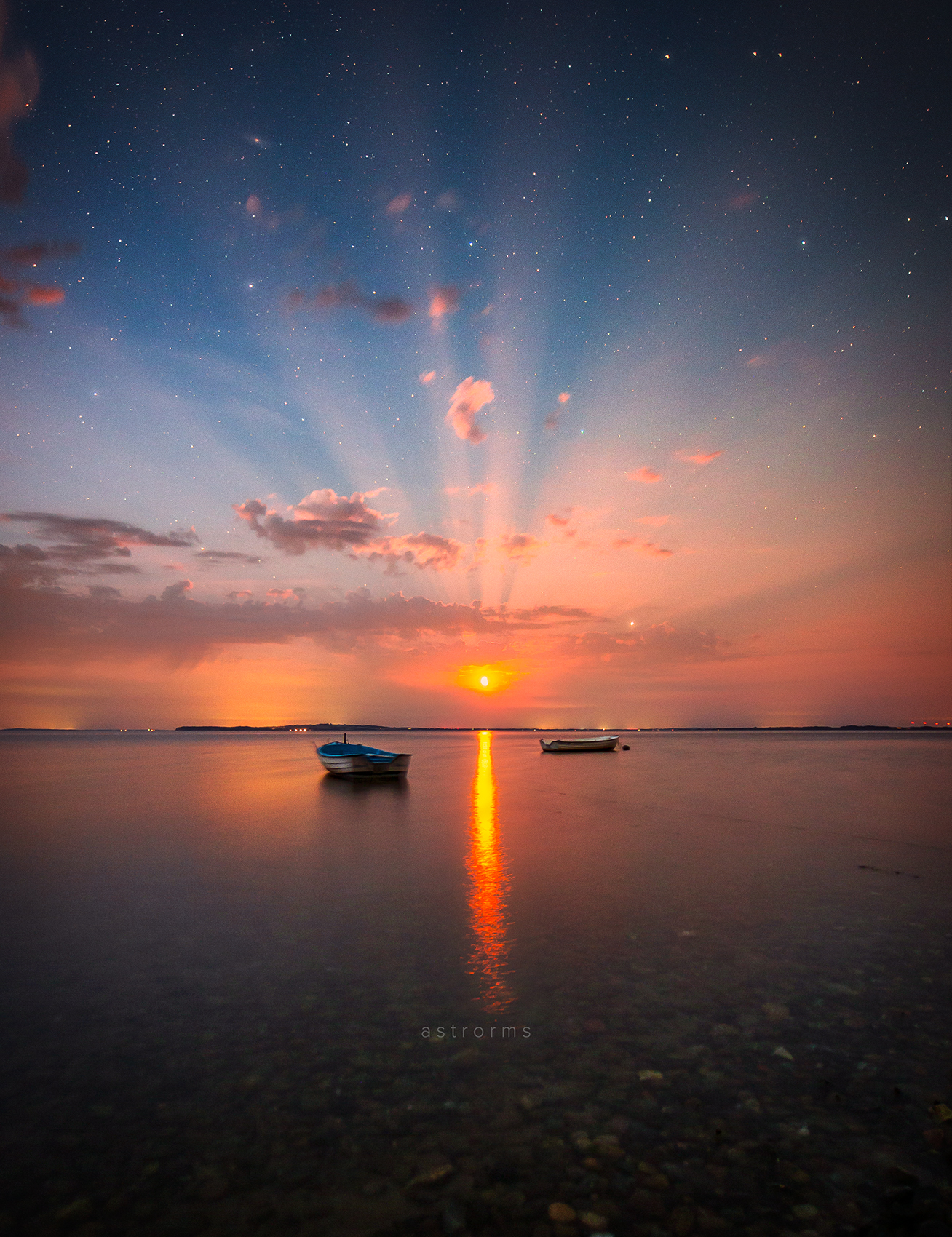
ASTRONOMY - Crepuscular Moon Rays over Denmark
2022 July 27
Image Credit & Copyright: Ruslan Merzlyakov (astrorms)
Explanation: This moon made quite an entrance. Typically, a moonrise is quiet and serene. Taking a few minutes to fully peek above the horizon, Earth's largest orbital companion can remain relatively obscure until it rises high in the nighttime sky. About a week ago, however, and despite being only half lit by the Sun, this rising moon put on a show -- at least from this location. The reason was that, as seen from Limfjord in Nykøbing Mors, Denmark, the moon rose below scattered clouds near the horizon. The result, captured here in a single exposure, was that moonlight poured through gaps in the clouds to created what are called crepuscular rays. These rays can fan out dramatically across the sky when starting near the horizon, and can even appear to converge on the other side of the sky. Well behind our Moon, stars from our Milky Way galaxy dot the background, and our galaxy's largest orbital companion -- the Andromeda galaxy -- can be found on the upper left.
26/07/2022
MICROPHOTOGRAPHIE - Une tête de fourmi psychédélique
25/07/2022
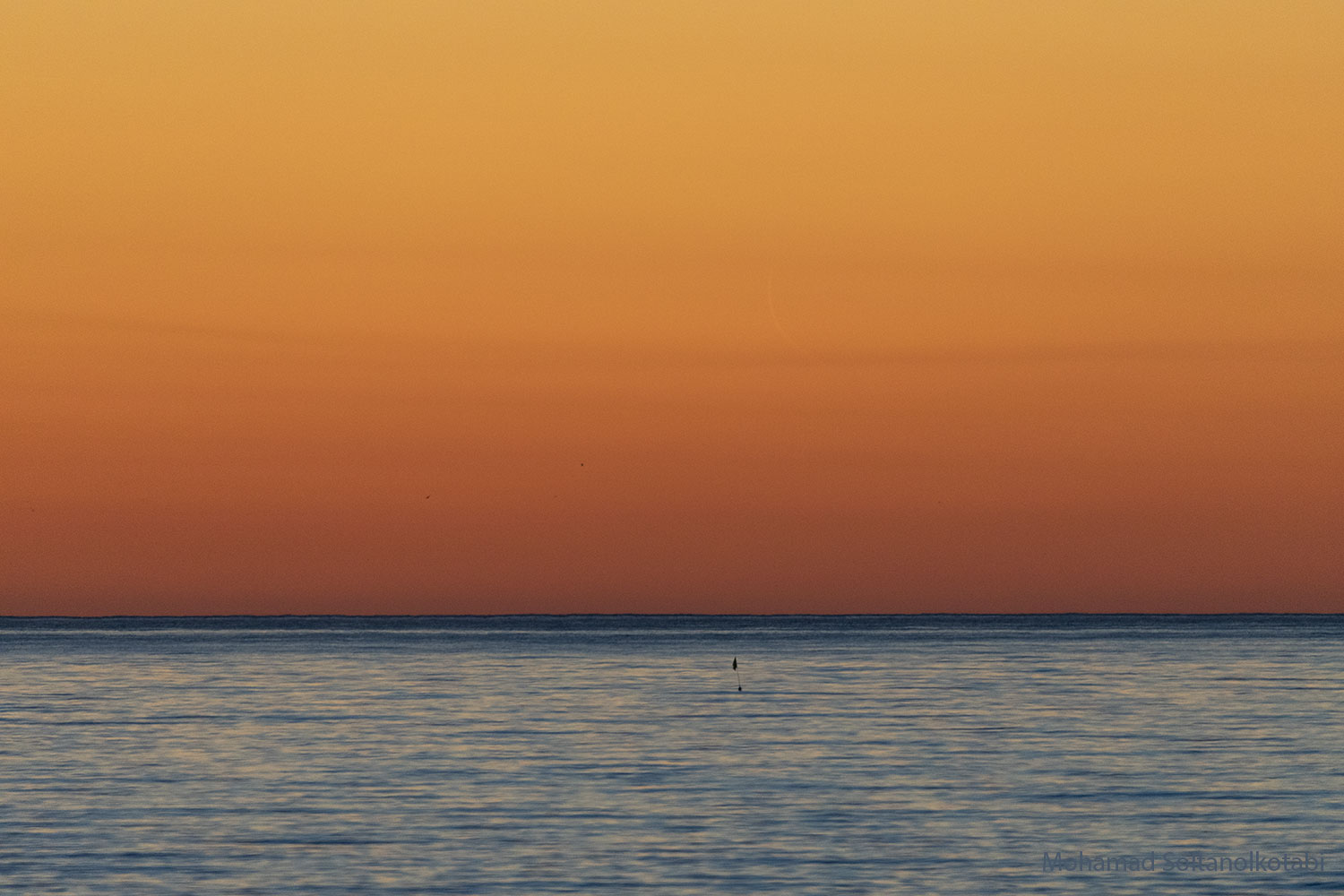
ASTRONOMY - Find the new moon
2022 July 25
Image Credit & Copyright: Mohamad Soltanolkotabi
Explanation: Can you find the Moon? This usually simple task can be quite difficult. Even though the Moon is above your horizon half of the time, its phase can be anything from crescent to full. The featured image was taken in late May from Sant Martí d'Empúries, Spain, over the Mediterranean Sea in the early morning. One reason you can't find this moon is because it is very near to its new phase, when very little of the half illuminated by the Sun is visible to the Earth. Another reason is because this moon is near the horizon and so seen through a long path of Earth's atmosphere -- a path which dims the already faint crescent. Any crescent moon is only visible near the direction the Sun, and so only locatable near sunrise of sunset. The Moon runs through all of its phases in a month (moon-th), and this month the thinnest sliver of a crescent -- a new moon -- will occur in three days.
23/07/2022
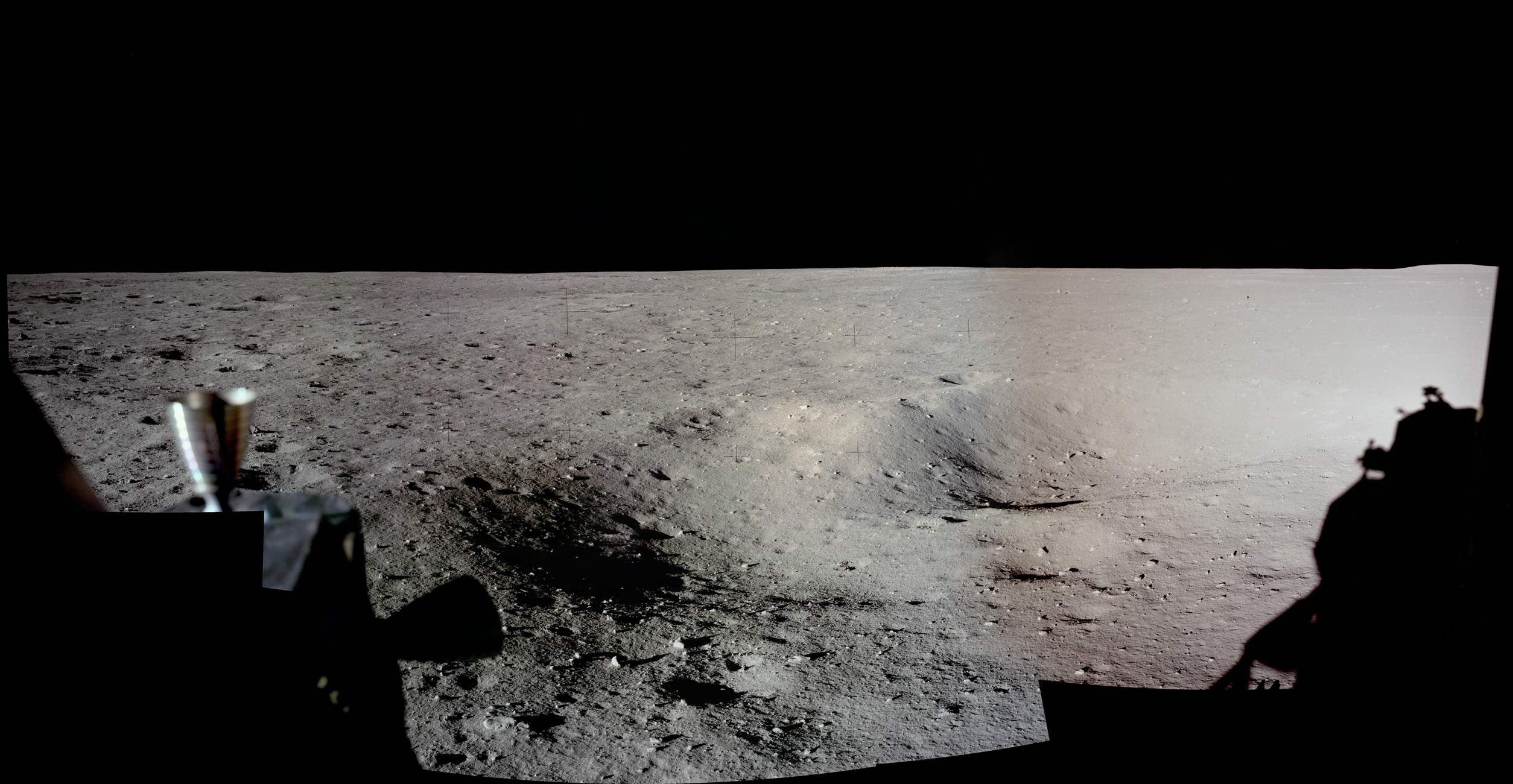
ASTRONOMY - Apollo 11 Landing Panorama
2022 July 23
Neil Armstrong, Apollo 11, NASA
Explanation: Have you seen a panorama from another world lately? Assembled from high-resolution scans of the original film frames, this one sweeps across the magnificent desolation of the Apollo 11 landing site on the Moon's Sea of Tranquility. The images were taken by Neil Armstrong looking out his window of the Eagle Lunar Module shortly after the July 20, 1969 landing. The frame at the far left (AS11-37-5449) is the first picture taken by a person on another world. Toward the south, thruster nozzles can be seen in the foreground on the left, while at the right, the shadow of the Eagle is visible to the west. For scale, the large, shallow crater on the right has a diameter of about 12 meters. Frames taken from the Lunar Module windows about an hour and a half after landing, before walking on the lunar surface, were intended to initially document the landing site in case an early departure was necessary.
SANTé/MEDECINE - Tout savoir sur le coeur humain - 3 - Coupe dans le ventricule gauche
La paroi du ventricule gauche est particulièrement épaisse car ce compartiment du cœur doit projeter du sang dans l'aorte, une grosse a...
-
2022 September 26 All the Water on Planet Earth Illustration Credit: Jack Cook, Adam Nieman, Woods Hole Oceanographic Institution ; Data ...
-
2025 May 11 The Surface of Venus from Venera 14 Image Credit: Soviet Planetary Exploration Program , Venera 14 ; Processing & Copyri...