Positions respectives de la planète Jupiter et de la Lune le 8 octobre 2022 vers 20h (heure de Paris). Le cercle bleu représente un champ de 6 degrés typique d’une paire de jumelles 10×50.
Nombre total de pages vues
08/10/2022
ASTRONOMIE - Ce soir une belle étreinte entre la Lune et Jupiter
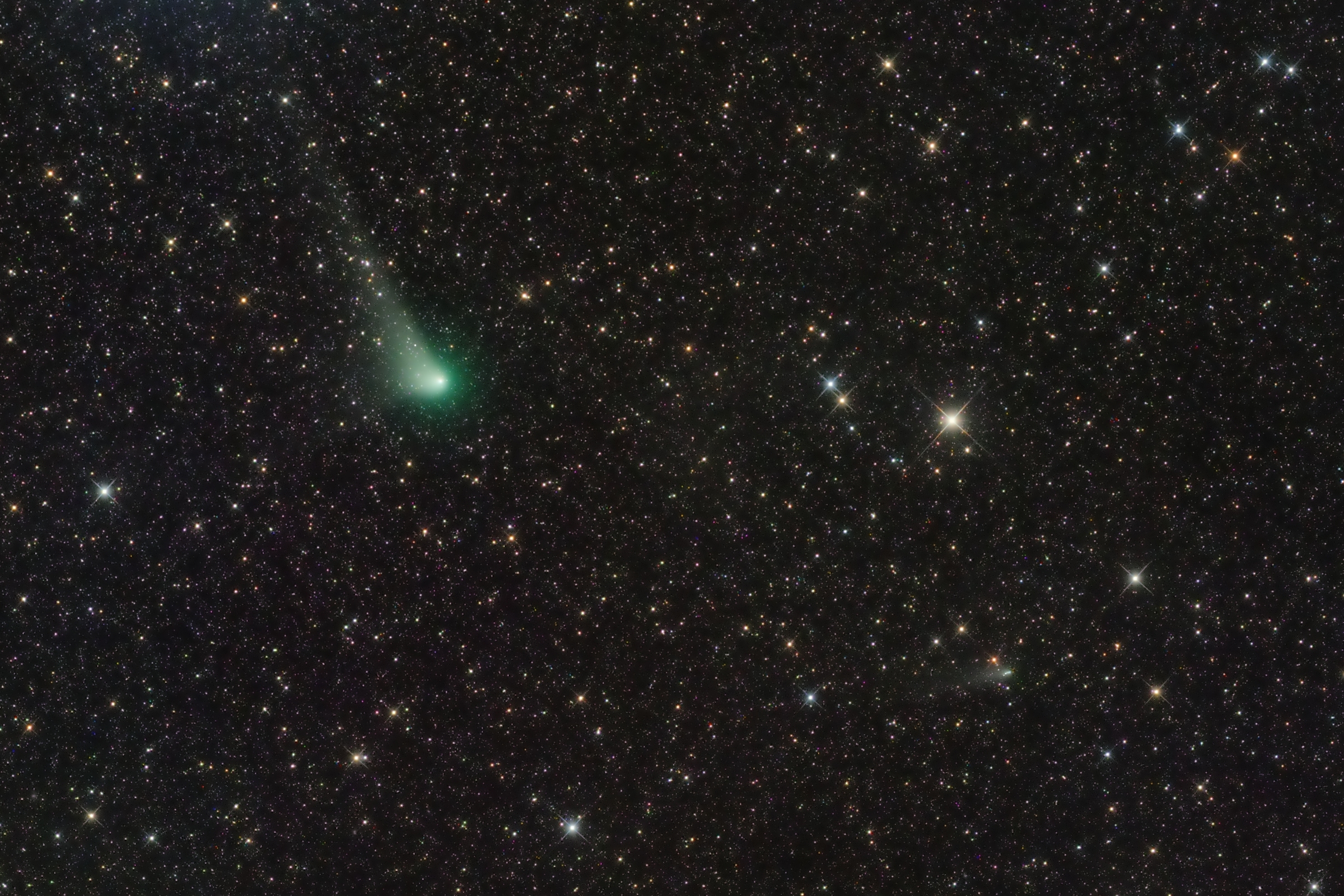
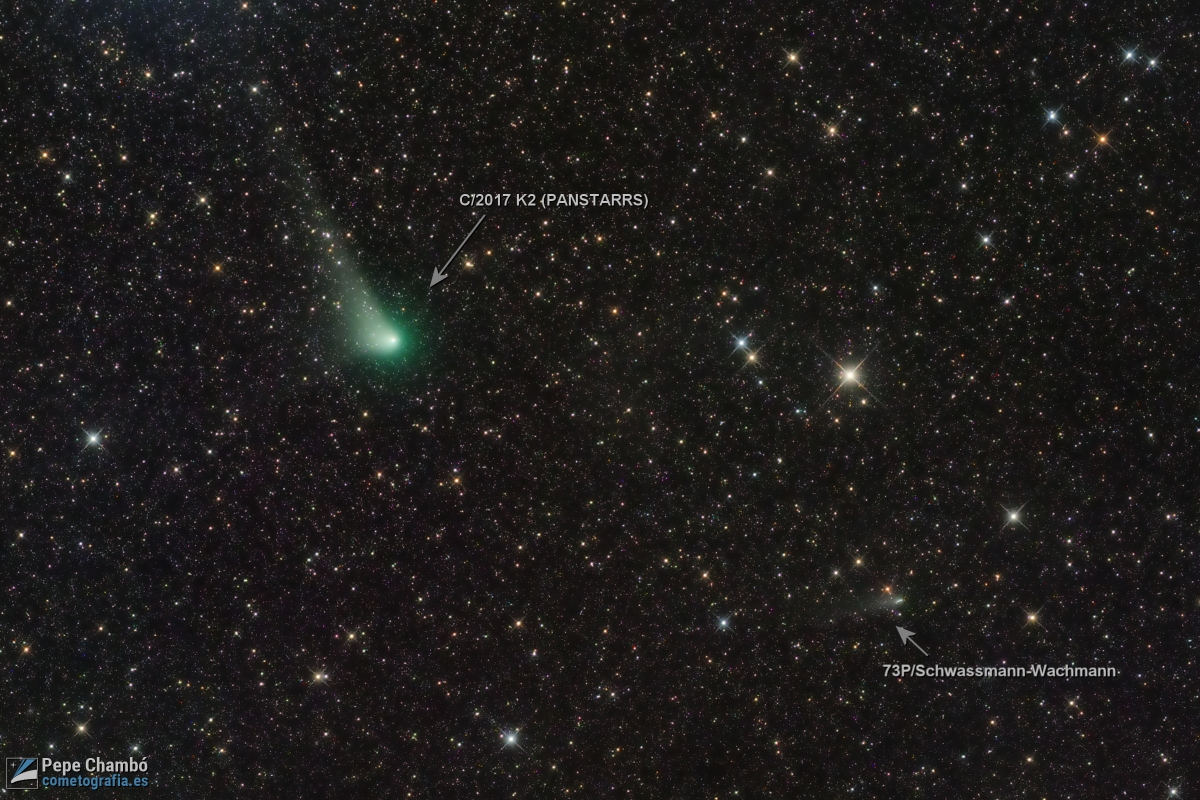
ASTRONOMY - Two Comets in Southern Skies
2022 October 8
Image Credit & Copyright: Jose J. Chambo (Cometografia)
Explanation: Heading for its closest approach to the Sun or perihelion on December 20, comet C/2017 K2 (PanSTARRS) remains a sight for telescopic observers as it sweeps through planet Earth's southern hemisphere skies. First time visitor from the remote Oort cloud this comet PanSTARRS sports a greenish coma and whitish dust tail about half a degree long at the upper left in a deep image from September 21. It also shares the starry field of view toward the constellation Scorpius with another comet, 73P/Schwassmann-Wachmann 3, seen about 1 degree below and right of PanSTARRS. Astronomers estimate that first time visitor comet C/2017 K2 (PanSTARRS) has been inbound from the Oort cloud for some 3 million years along a hyperbolic orbit. Schwassmann-Wachmann 3 is more familiar though. The periodic comet loops through its own elliptical orbit, from just beyond the orbit of Jupiter to the vicinity of Earth's orbit, once every 5.4 years. Just passing in the night, this comet PanSTARRS is about 20 light-minutes from Earth in the September 21 image. Seen to be disintegrating since 1995, Schwassmann-Wachmann 3 was about 7.8 light-minutes away.
07/10/2022
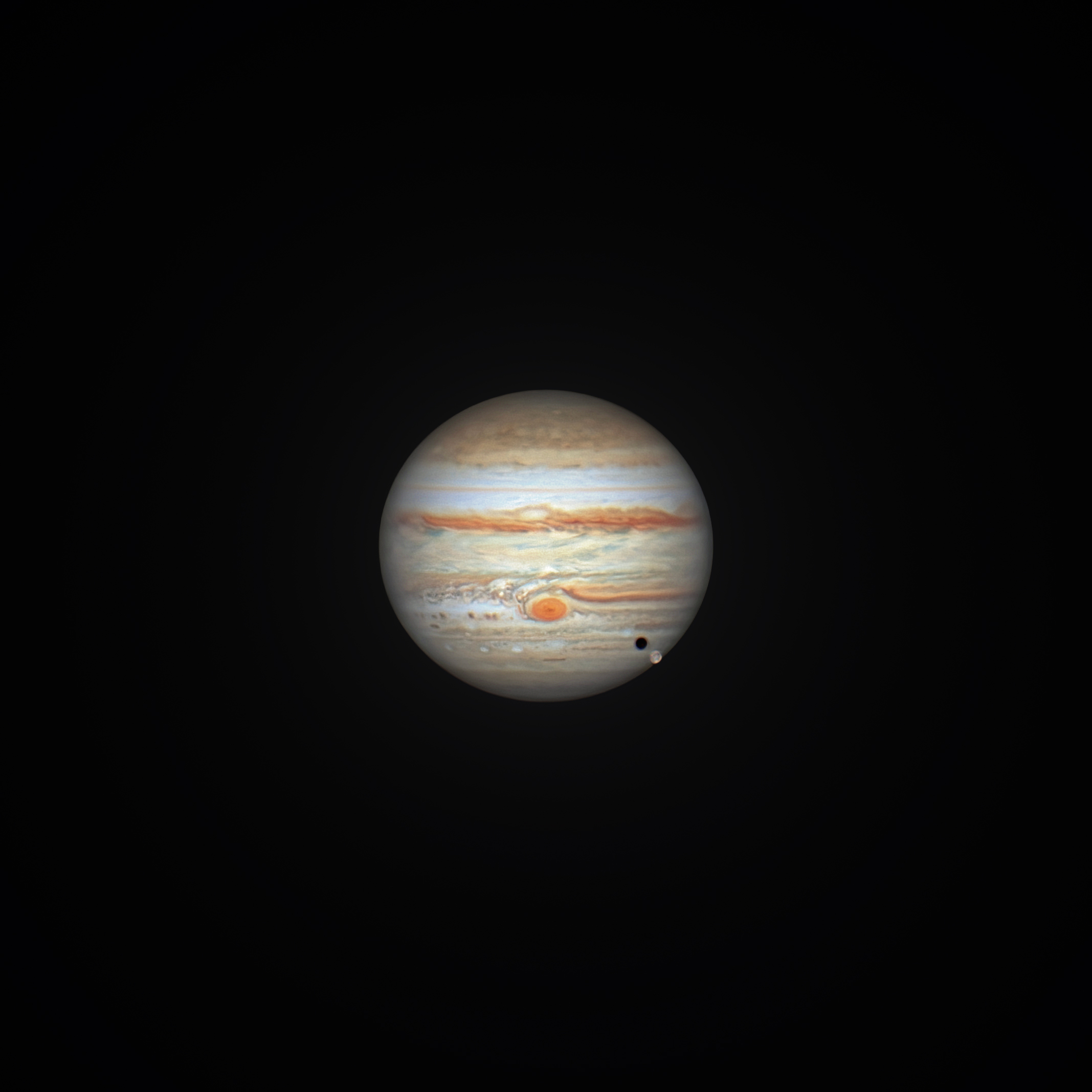
ASTRONOMY - In Ganymede's Shadow
Image Credit & Copyright: Andrew McCarthy
Explanation: At opposition, opposite the Sun in Earth's sky, late last month Jupiter is also approaching perihelion, the closest point to the Sun in its elliptical orbit, early next year. That makes Jupiter exceptionally close to our fair planet, currently resulting in excellent views of the Solar System's ruling gas giant. On September 27, this sharp image of Jupiter was recorded with a small telescope from a backyard in Florence, Arizona. The stacked video frames reveal the massive world bounded by planet girdling winds. Dark belts and light zones span the gas giant, along with rotating oval storms and its signature Great Red Spot. Galilean moon Ganymede is below and right in the frame. The Solar System's largest moon and its shadow are in transit across the southern Jovian cloud tops.
06/10/2022
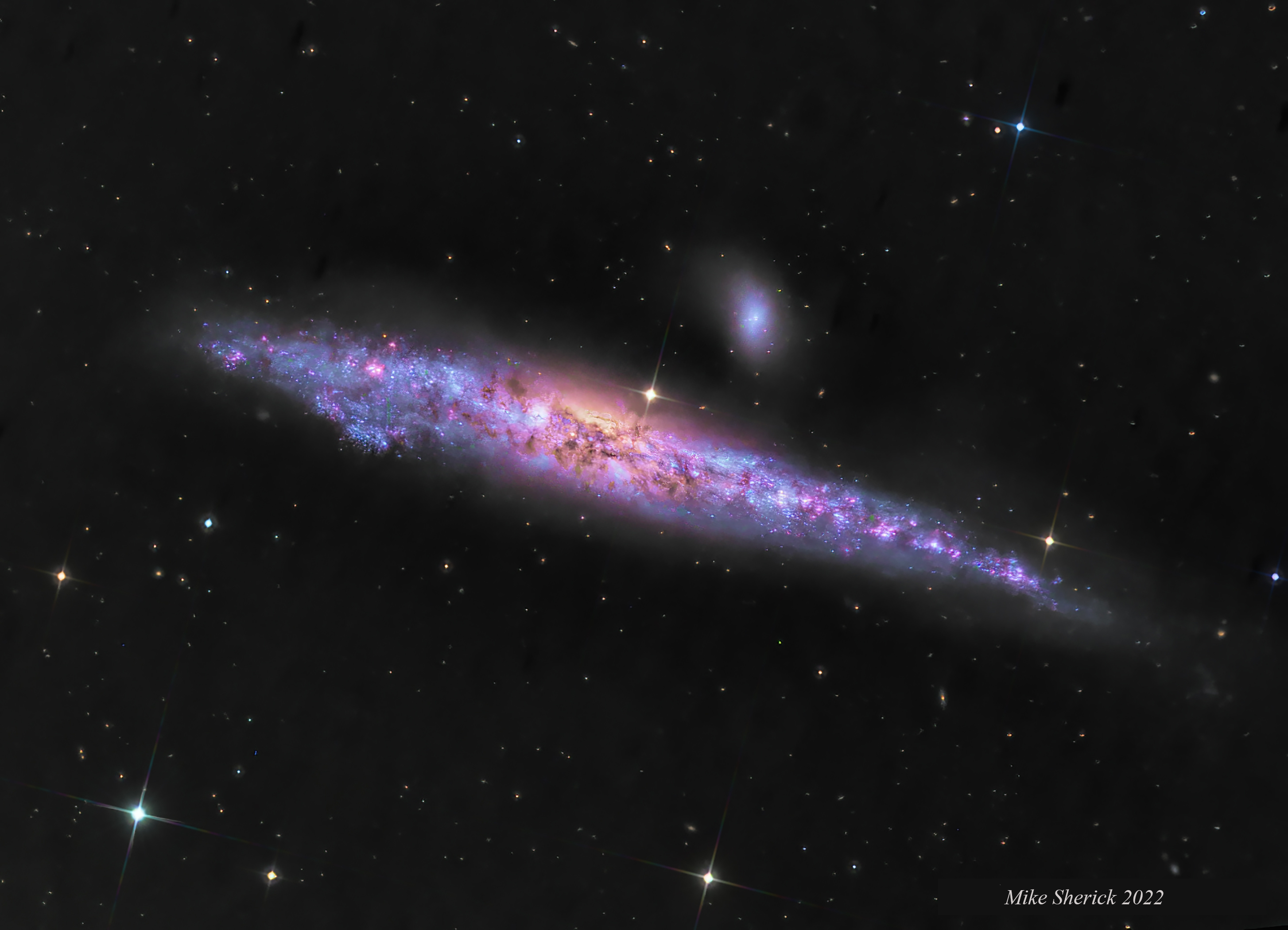
ASTRONOMY - NGC 4631: The Whale Galaxy
2022 October 6
Image Credit & Copyright: Michael Sherick
Explanation: NGC 4631 is a big beautiful spiral galaxy. Seen edge-on, it lies only 25 million light-years away in the well-trained northern constellation Canes Venatici. The galaxy's slightly distorted wedge shape suggests to some a cosmic herring and to others its popular moniker, The Whale Galaxy. Either way, it is similar in size to our own Milky Way. In this sharp color image, the galaxy's yellowish core, dark dust clouds, bright blue star clusters, and red star forming regions are easy to spot. A companion galaxy, the small elliptical NGC 4627 is just above the Whale Galaxy. Faint star streams seen in deep images are the remnants of small companion galaxies disrupted by repeated encounters with the Whale in the distant past. The Whale Galaxy is also known to have spouted a halo of hot gas glowing in X-rays.
05/10/2022
ASTRONOMY - Expanding Plume from DART's Impact
2022 October 5
Video Credit: Les Makes Observatory, J. Berthier, F. Vachier, A. Klotz, P. Thierry, T. Santana-Ros, ESA NEOCC, D. Föhring, E. Petrescu, M. Micheli
Explanation: What happens if you crash a spaceship into an asteroid? In the case of NASA's DART spaceship and the small asteroid Dimorphos, as happened last week, you get quite a plume. The goal of the planned impact was planetary protection -- to show that the path of an asteroid can be slightly altered, so that, if done right, a big space rock will miss the Earth. The high brightness of the plume, though, was unexpected by many, and what it means remains a topic of research. One possibility is that 170-meter wide Dimorphos is primarily a rubble pile asteroid and the collision dispersed some of the rubble in the pile. The featured time-lapse video covers about 20 minutes and was taken from the Les Makes Observatory on France's Reunion Island, off the southeast coast of southern Africa. One of many Earth-based observatories following the impact, the initial dot is primarily Dimorphos's larger companion: asteroid Didymos. Most recently, images show that the Didymos - Dimorphos system has developed comet-like tails.
04/10/2022
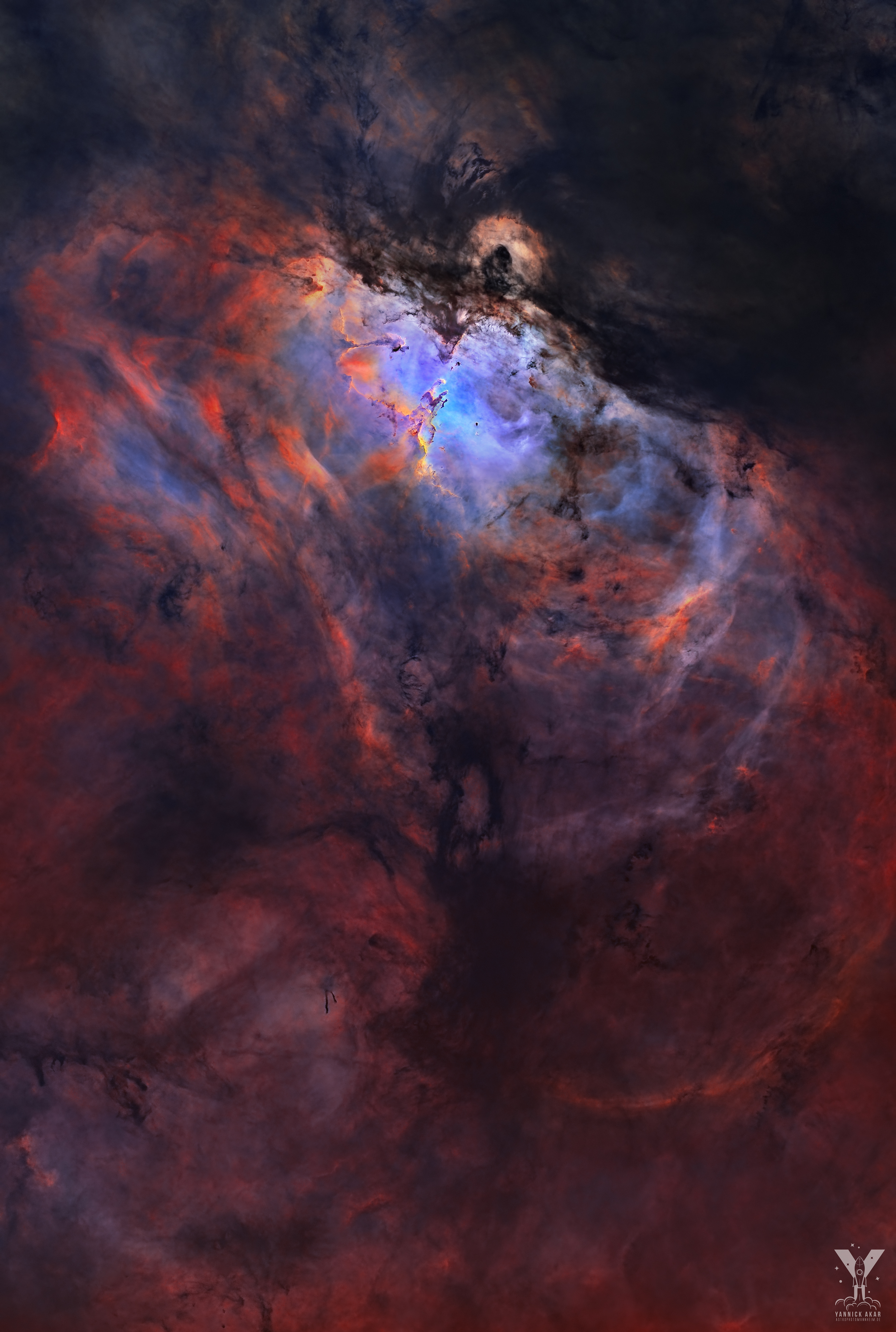
ASTRONOMY - Star-Forming Eagle Nebula without Stars
2022 October 4
Image Credit & Copyright: Yannick Akar
Explanation: The whole thing looks like an eagle. A closer look at the Eagle Nebula's center, however, shows the bright region is actually a window into the center of a larger dark shell of dust. Through this window, a brightly-lit workshop appears where a whole open cluster of stars is being formed. In this cavity tall pillars and round globules of dark dust and cold molecular gas remain where stars are still forming. Paradoxically, it is perhaps easier to appreciate this impressive factory of star formation by seeing it without its stars -- which have been digitally removed in the featured image. The Eagle emission nebula, tagged M16, lies about 6500 light years away, spans about 20 light-years, and is visible with binoculars toward the constellation of the Serpent (Serpens). Creating this picture involved over 22 hours of imaging and combining colors emitted specifically by hydrogen (red), and oxygen (blue).
03/10/2022
VOIE LACTEE SUR TERRE - Pologne/Slovaquie : les sommets du Kopa Kondracka dans les Tatras
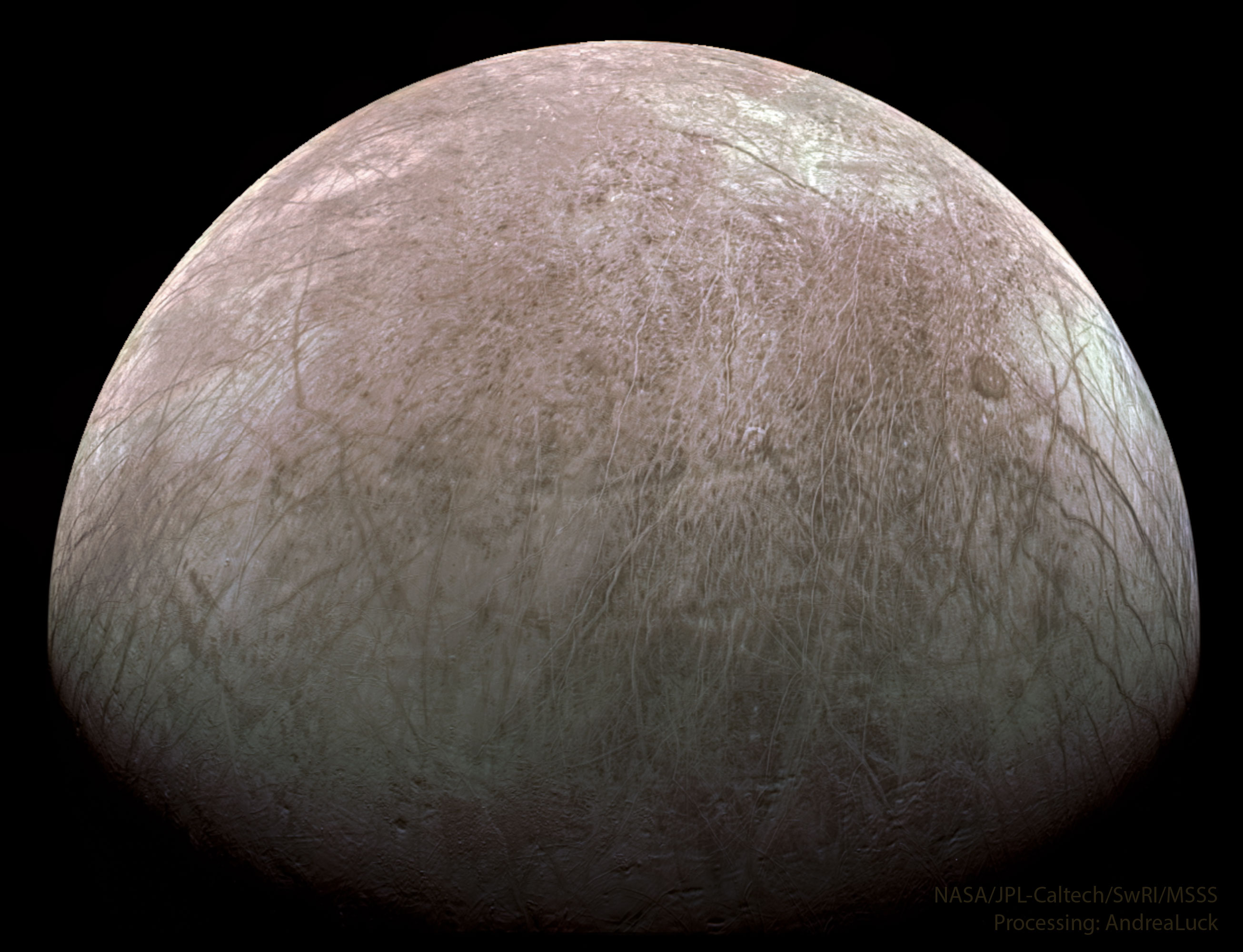
ASTRONOMY - Jupiter's Europa from Spacecraft Juno
2022 October 3
Image Credit & License: NASA, JPL-Caltech, SwRI, MSSS; Processing: Andrea Luck
Explanation: What mysteries might be solved by peering into this crystal ball? In this case, the ball is actually a moon of Jupiter, the crystals are ice, and the moon is not only dirty but cracked beyond repair. Nevertheless, speculation is rampant that oceans exist under Europa's fractured ice-plains that could support life. Europa, roughly the size of Earth's Moon, is pictured here in an image taken a few days ago when the Jupiter-orbiting robotic spacecraft Juno passed within 325 kilometers of its streaked and shifting surface. Underground oceans are thought likely because Europa undergoes global flexing due to its changing gravitational attraction with Jupiter during its slightly elliptical orbit, and this flexing heats the interior. Studying Juno's close-up images may further humanity's understanding not only of Europa and the early Solar System but also of the possibility that life exists elsewhere in the universe.
02/10/2022

ASTRONOMY - Supernova Cannon Expels Pulsar J0002
2022 October 2
Image Credit: F. Schinzel et al. (NRAO, NSF), Canadian Galactic Plane Survey (DRAO), NASA (IRAS);
Composition: Jayanne English (U. Manitoba)
Explanation: What could shoot out a neutron star like a cannon ball? A supernova. About 10,000 years ago, the supernova that created the nebular remnant CTB 1 not only destroyed a massive star but blasted its newly formed neutron star core -- a pulsar -- out into the Milky Way Galaxy. The pulsar, spinning 8.7 times a second, was discovered using downloadable software Einstein@Home searching through data taken by NASA's orbiting Fermi Gamma-Ray Observatory. Traveling over 1,000 kilometers per second, the pulsar PSR J0002+6216 (J0002 for short) has already left the supernova remnant CTB 1, and is even fast enough to leave our Galaxy. Pictured, the trail of the pulsar is visible extending to the lower left of the supernova remnant. The featured image is a combination of radio images from the VLA and DRAO radio observatories, as well as data archived from NASA's orbiting IRAS infrared observatory. It is well known that supernovas can act as cannons, and even that pulsars can act as cannonballs -- what is not known is how supernovas do it.
01/10/2022
ENERGIE - 100 millions de degrés. Plus chaud que le soleil
Santé/Médecine - CANCER : UN MEDICAMENT COURANT POURRAIT CONSTITUER UN ESPOIR
Un médicament contre l'hypertension artérielle couramment utilisé pourrait avoir une deuxième fonction inattendue : aider à lutter con...
-
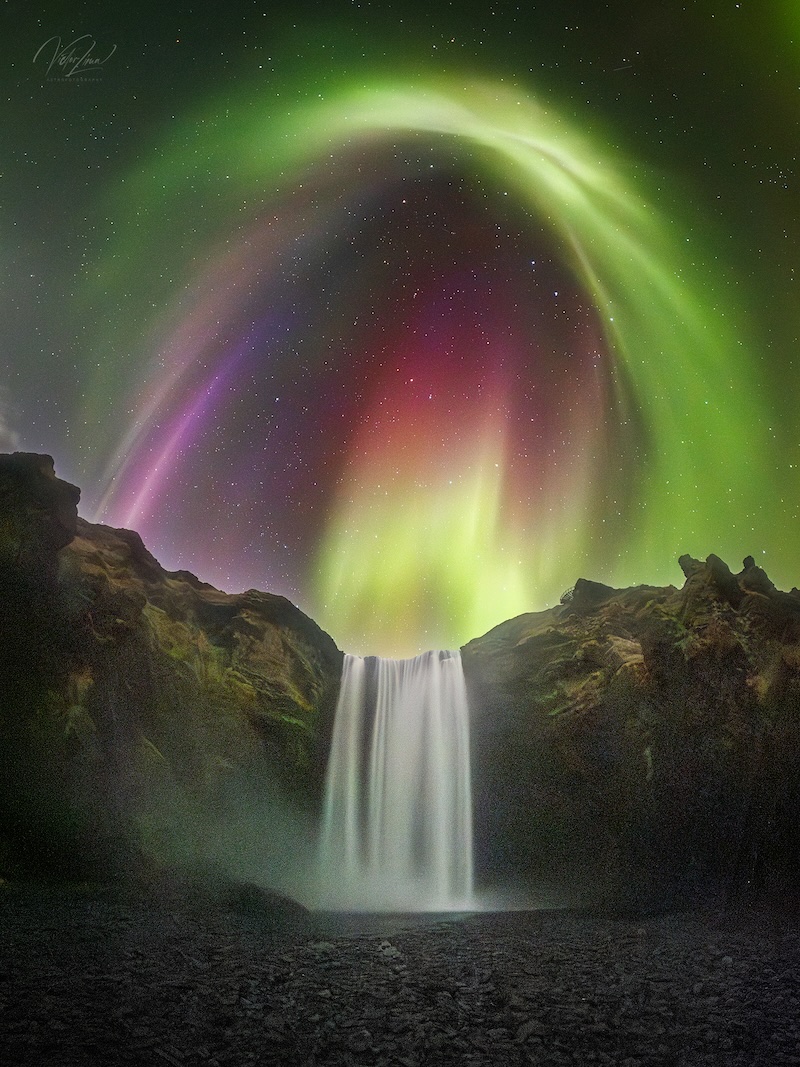
2026 January 1 Auroral Corona Image Credit & Copyright : Roi Levi Explanation: Cycle 25 solar maximum made 2025 a great year for ...
-
Imaginez un monde où le cancer n’est plus une sentence, mais une simple étape à franchir. Grâce à une découverte révolutionnaire, ce rêve es...