Nombre total de pages vues

17/11/2022

SANTé/MéDECINE - Tabagisme et cigarette électronique


Selon le baromètre 2017 de Santé publique, 76,3 % des ex-fumeurs qui vapotent ou qui ont vapoté quotidiennement pendant au moins un mois déclarent que l’e‑cigarette les a aidés à arrêter de fumer. Passer de la cigarette à la cigarette électronique pourrait donc permettre le sevrage nicotinique. Mais si ce sevrage est rendu possible, comment doit-il être opéré pour avoir toutes les chances de fonctionner ?

Pour mettre fin à la dépendance nicotinique, encore faut-il en comprendre le fonctionnement, puisqu’il s’agit d’une dépendance physique dont les symptômes de sevrage peuvent être sévères ! Une fois consommée, la nicotine se fixe sur certains récepteurs du cerveau et provoque :
-une multiplication des récepteurs ;
-la libération de substances chimiques naturelles qui rend calme et alerte ;
-une sensation de bien-être ;
-un semblant de regain d’énergie.

Plus les récepteurs sont nombreux, plus le cerveau a tendance à réclamer de la nicotine, jusqu’à atteindre un niveau de besoin moyen au bout de quelques mois. L’utilisation de la cigarette électronique permet un calcul précis de la dose de nicotine ingérée. C’est en cela qu’elle est intéressante pour les fumeurs qui souhaitent se sevrer à l’aide d’outils qui sont hors du système de santé.

C’est la baisse progressive du taux de nicotine consommé quotidiennement qui permet la réussite d’un sevrage nicotinique. Et cette baisse progressive est assez simple à opérer à l’aide d’une cigarette électronique.

Lire plus sur :

ASTRONOMY - Planet Earth from Orion

 2022 November 17

See Explanation.  Clicking on the picture will download
the highest resolution version available.

Planet Earth from Orion
Image Credit: NASAArtemis 1

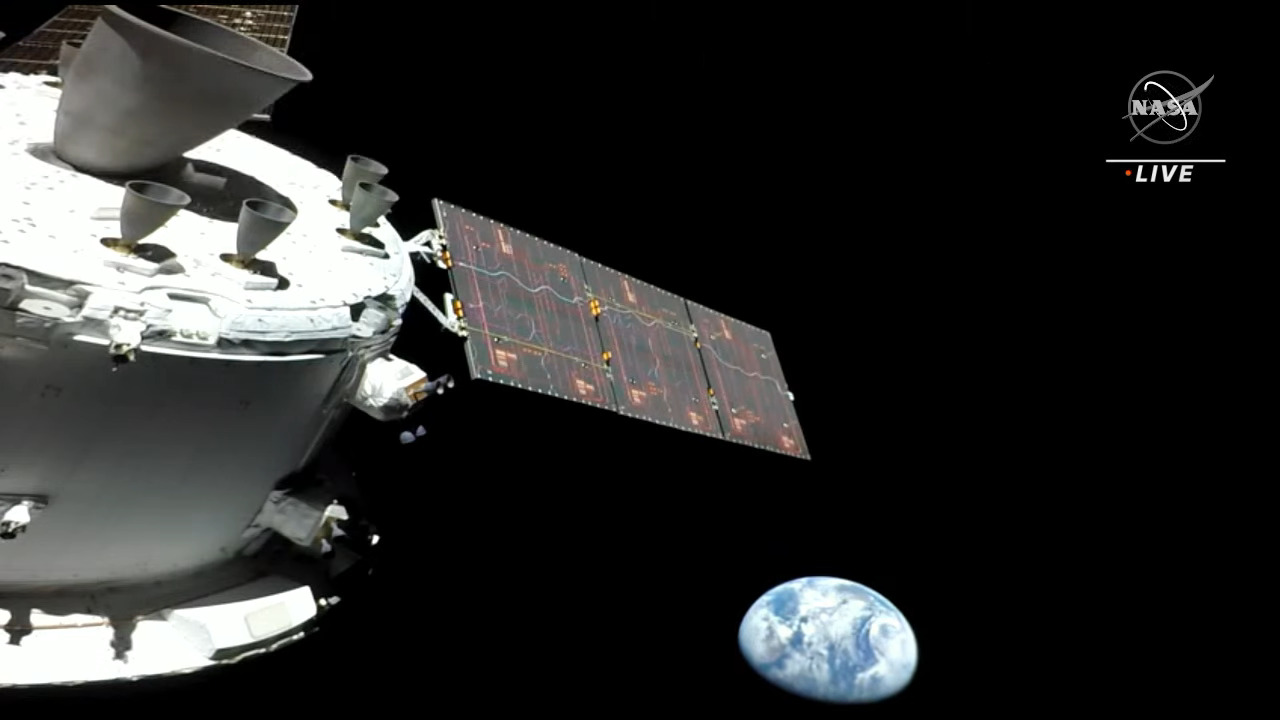
Explanation: A Space Launch System rocket left planet Earth on Wednesday, November 16 at 1:47am EST carrying the Orion spacecraft on the Artemis 1 mission, the first integrated test of NASA’s deep space exploration systems. Over an hour after liftoff from Kennedy Space Center's historic Launch Complex 39B, one of Orion's external video cameras captured this view of its new perspective from space. In the foreground are Orion's Orbital Maneuvering System engine and auxillary engines, at the bottom of the European Service Module. Beyond one of the module's 7-meter long extended solar array wings lies the spacecraft's beautiful home world. The Artemis 1 mission will last almost four weeks, testing capabilities to enable human exploration of the Moon and Mars. The uncrewed Orion spacecraft is expected to fly by the Moon on November 21, performing a close approach to the lunar surface on its way to a retrograde orbit 70,000 kilometers beyond the Moon.  

16/11/2022

MACROPHOTOGRAPHIE - Un lucane doré aux puissantes mandibules

Cette photo aux allures étincelantes représente un Allotopus rosenbergi, un coléoptère doré appartenant à la famille des Lucanidae. Son surnom « lucane cerf-volant », ou en anglais stag beetle, provient des grandes mandibules que possèdent la plupart des mâles, visibles sur la photo, et qui évoquent les bois des cerfs. Elles sont utilisées pour se battre pour des sites d'accouplement, ou pour de la nourriture. D'une taille de 4 à 8 cm, ces insectes sont cependant très peu agressifs envers les humains. Vivant uniquement en Asie du Sud-Est, principalement en Indonésie, le lucane cerf-volant est très recherché par les collectionneurs pour son apparence mordorée due à un exosquelette ambré et irisé qui recouvre son corps. 

FuturaSciences

ASTRONOMY - In the Arms of NGC 1097

 2022 November 16

See Explanation.  Clicking on the picture will download
the highest resolution version available.

In the Arms of NGC 1097
Image Credit & CopyrightMike SelbyMark Hanson

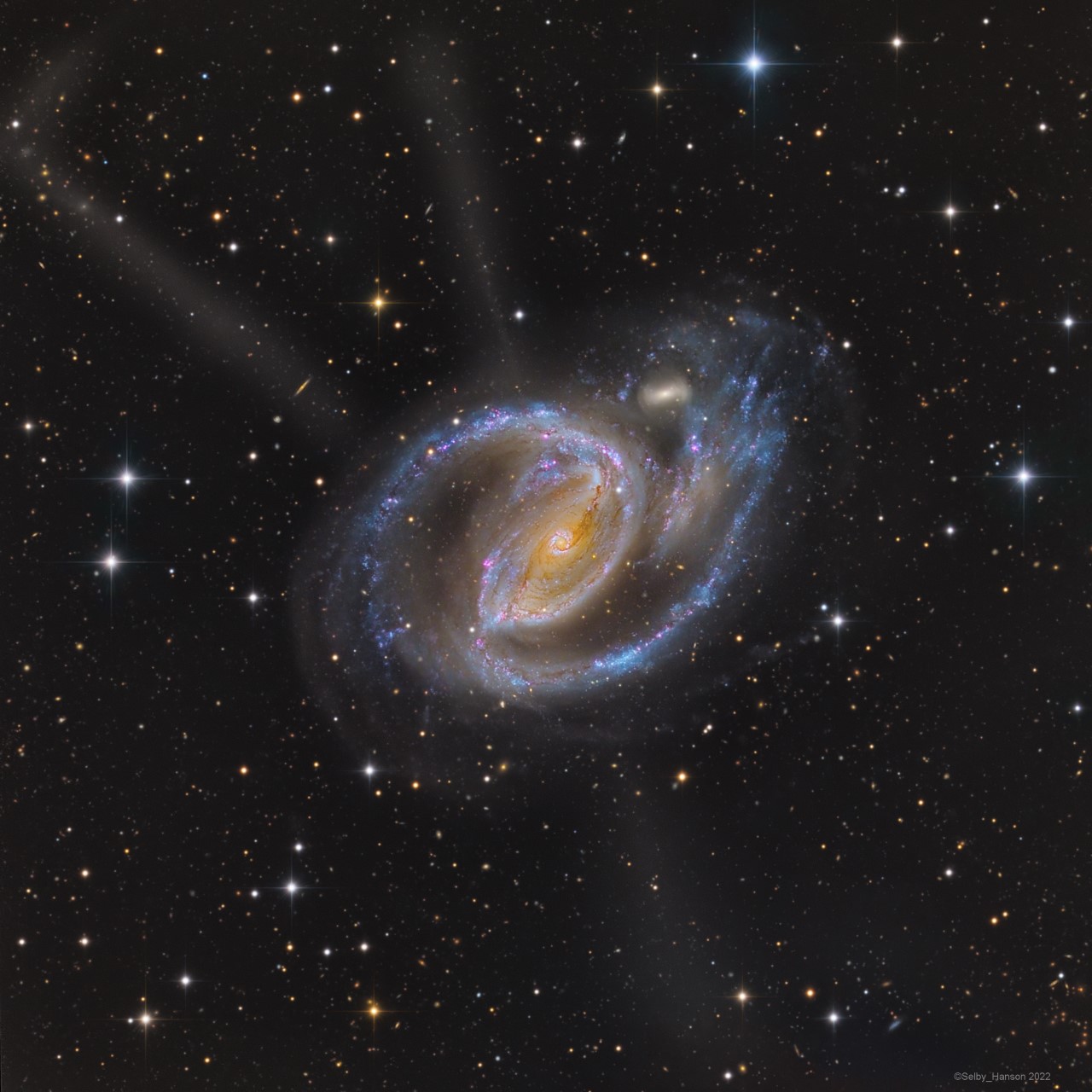
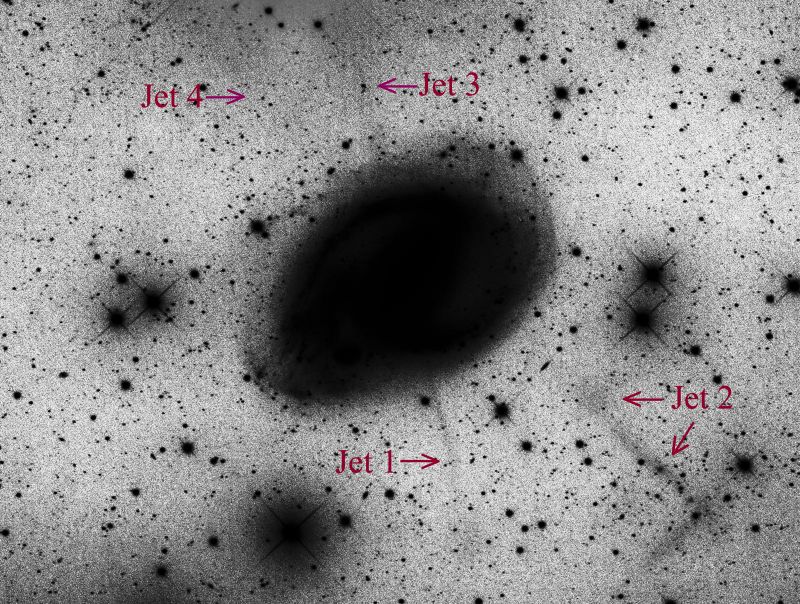
Explanation: Spiral galaxy NGC 1097 shines in southern skies, about 45 million light-years away in the heated constellation Fornax. Its blue spiral arms are mottled with pinkish star forming regions in this colorful galaxy portrait. They seem to have wrapped around a small companion galaxy above and right of center, about 40,000 light-years from the spiral's luminous core. That's not NGC 1097's only peculiar feature, though. This very deep exposure hints of faint, mysterious jets, seen to extend well beyond the bluish arms. In fact, four faint jets are ultimately recognized in optical images of NGC 1097. The jets trace an X centered on the galaxy's nucleus, but probably don't originate there. Instead, they could be fossil star streams, trails left over from the capture and disruption of a much smaller galaxy in the large spiral's ancient past. A Seyfert galaxy, NGC 1097's nucleus also harbors a supermassive black hole.

BIOMIMETISME - LA NATURE INSPIRE LA SCIENCE - Le Shinkansen : le train au bec d'oiseau

Le martin-pêcheur est un petit oiseau aquatique qui porte un bec long et fin pour pêcher des petits poissons, insectes ou batraciens dans l'eau. Ce bec a inspiré les ingénieurs japonais pour la conception du Shinkansen, le train à grande vitesse qui sillonne l'archipel nippon. Son avant profilé, bien visible sur les rames de la série 700, permet de réduire l'effet piston lorsqu'il entre à vive allure dans un tunnel, la vitesse de pointe du Shinkansen série 700 étant située entre 270 et 285 km/h.

Quand il s'y engouffre, le train génère une onde de choc bruyante qui ressemble à un bang et qui peut endommager la structure de l'ouvrage en plus de produire des nuisances sonores. Dans la nature, le bec du martin-pêcheur lui permet de fendre l'eau en faisant un minimum de remous, et s'avère tout aussi efficace pour attraper des proies volantes.

FuturaSciences

14/11/2022

ASTRONOMY - NGC 7380: The Wizard Nebula

 2022 November 14

The featured image shows the a red-glowing
Wizard Nebula with gas and dust pillars in a starry
background. 
Please see the explanation for more detailed information.

NGC 7380: The Wizard Nebula
Image Credit & Copyright: Ioan Popa

Explanation: What powers are being wielded in the Wizard Nebula? Gravitation strong enough to form stars, and stellar winds and radiations powerful enough to create and dissolve towers of gas. Located only 8,000 light years away, the Wizard nebula, featured here, surrounds developing open star cluster NGC 7380. Visually, the interplay of stars, gas, and dust has created a shape that appears to some like a fictional medieval sorcerer. The active star forming region spans 100 about light years, making it appear larger than the angular extent of the Moon. The Wizard Nebula can be located with a small telescope toward the constellation of the King of Aethiopia (Cepheus). Although the nebula may last only a few million years, some of the stars being formed may outlive our Sun.

13/11/2022

ASTRONOMY - Flying saucer crash lands in Utah desert

 2022 November 13

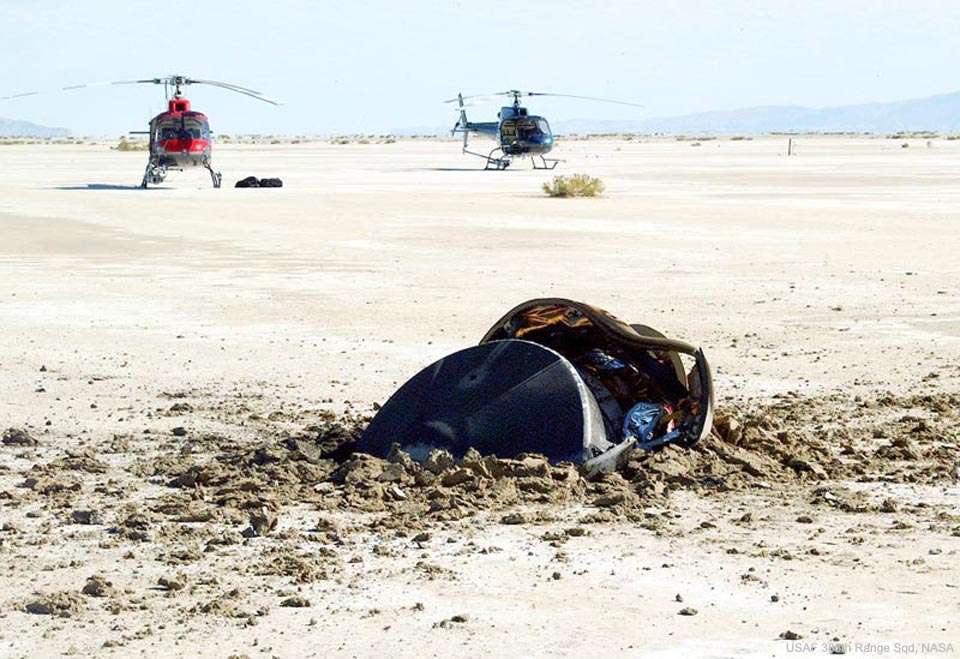
The featured image shows the disk from NASA's 
Genesis Mission embedded in sand with two helicopters
visible in the distance. 
Please see the explanation for more detailed information.

Flying Saucer Crash Lands in Utah Desert
Image Credit: USAF 388th Range Sqd., Genesis MissionNASA

Explanation: A flying saucer from outer space crash-landed in the Utah desert after being tracked by radar and chased by helicopters. The year was 2004, and no space aliens were involved. The saucer, pictured here, was the Genesis sample return capsule, part of a human-made robot Genesis spaceship launched in 2001 by NASA itself to study the Sun. The unexpectedly hard landing at over 300 kilometers per hour occurred because the parachutes did not open as planned. The Genesis mission had been orbiting the Sun collecting solar wind particles that are usually deflected away by Earth's magnetic field. Despite the crash landing, many return samples remained in good enough condition to analyze. So far, Genesis-related discoveries include new details about the composition of the Sun and how the abundance of some types of elements differ across the Solar System. These results have provided intriguing clues into details of how the Sun and planets formed billions of years ago.

12/11/2022

ASTRONOMY - Eclipse in the city

 2022 November 12

See Explanation.  Clicking on the picture will download
the highest resolution version available.

Eclipse in the City
Image Credit & CopyrightStan Honda

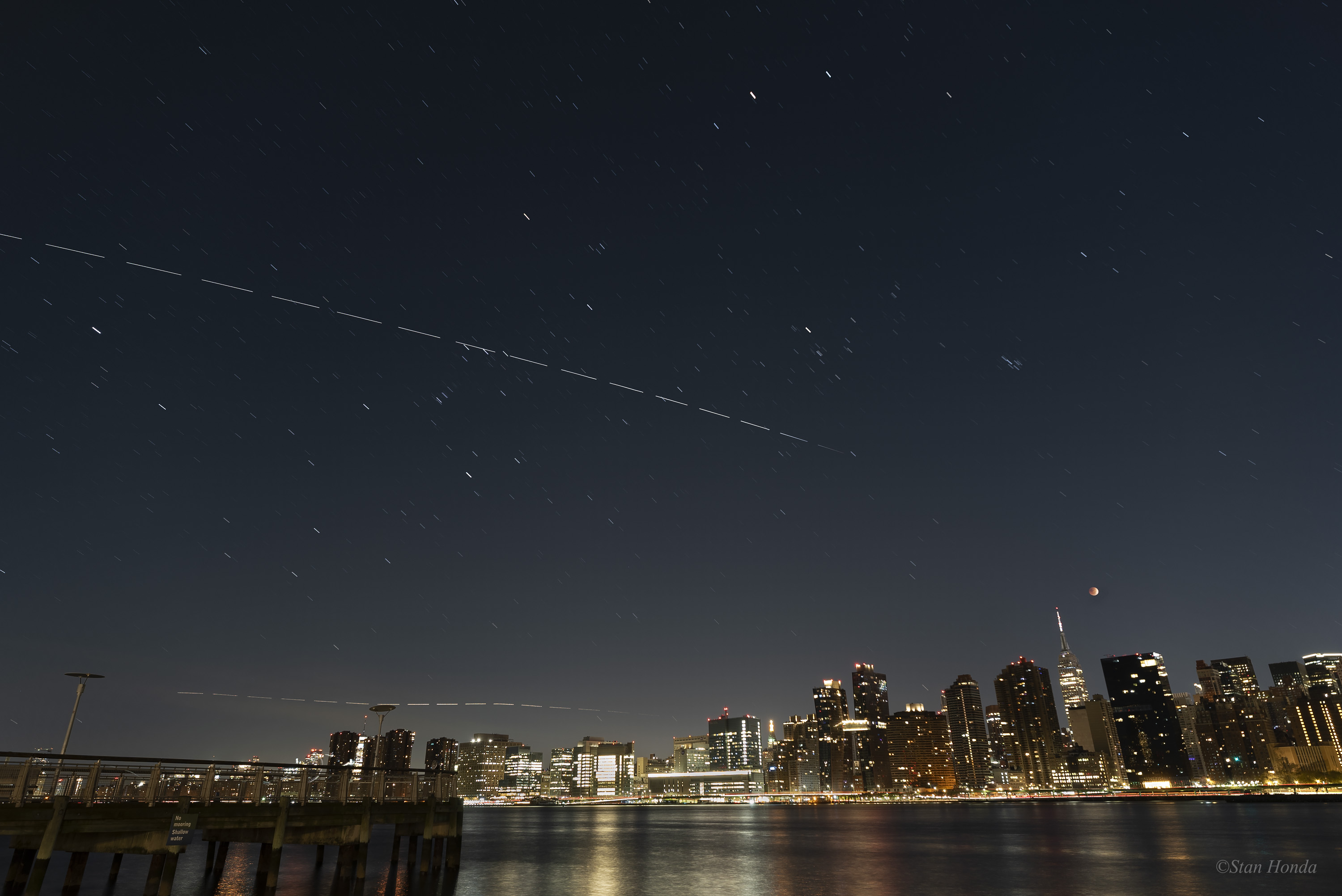
Explanation: A darker Moon sets over Manhattan in this night skyscape. The 16 frame composite was assembled from consecutive exposures recorded during the November 8 total lunar eclipse. In the timelapse sequence stars leave short trails above the urban skyline, while the Moon remains immersed in Earth's shadow. But the International Space Station was just emerging from the shadow into the sunlit portion of its low Earth orbit. As seen from New York City, the visible streak of this ISS flyover starts near a star in Taurus and tracks right to left, through the belt of Orion and over Sirius, alpha star of Canis Major. Gaps along the bright trail of the fast moving orbital outpost (and an aircraft flying closer to the horizon) mark the time between individual exposures in the sequence. The trail of bright planet Mars is at the top of the frame. Pleiades star cluster trails are high over the eclipsed Moon and Empire State Building.

AVIATION IMAGINEE - L'avion du futur selon Douglas Rolfe

Avez-vous déjà imaginé votre transport du futur ? C’est l’idée du magazine Popular Science qui a laissé à Douglas Rolfe tout le loisir de créer son avion personnel. Le résultat est plutôt réaliste et bluffant, ce qui peut s’expliquer par le fait qu'en 1944 l’aviation avait déjà fait un grand bon avec la Première et la Seconde Guerre mondiale.

© Douglas Rolfe, juillet 1944, revue Popular Science
FuturaSciences

11/11/2022

ASTRONOMY - Blood Moon, Ice Giant

 2022 November 11

See Explanation.  Clicking on the picture will download
the highest resolution version available.

Blood Moon, Ice Giant
Image Credit & CopyrightRyan Han

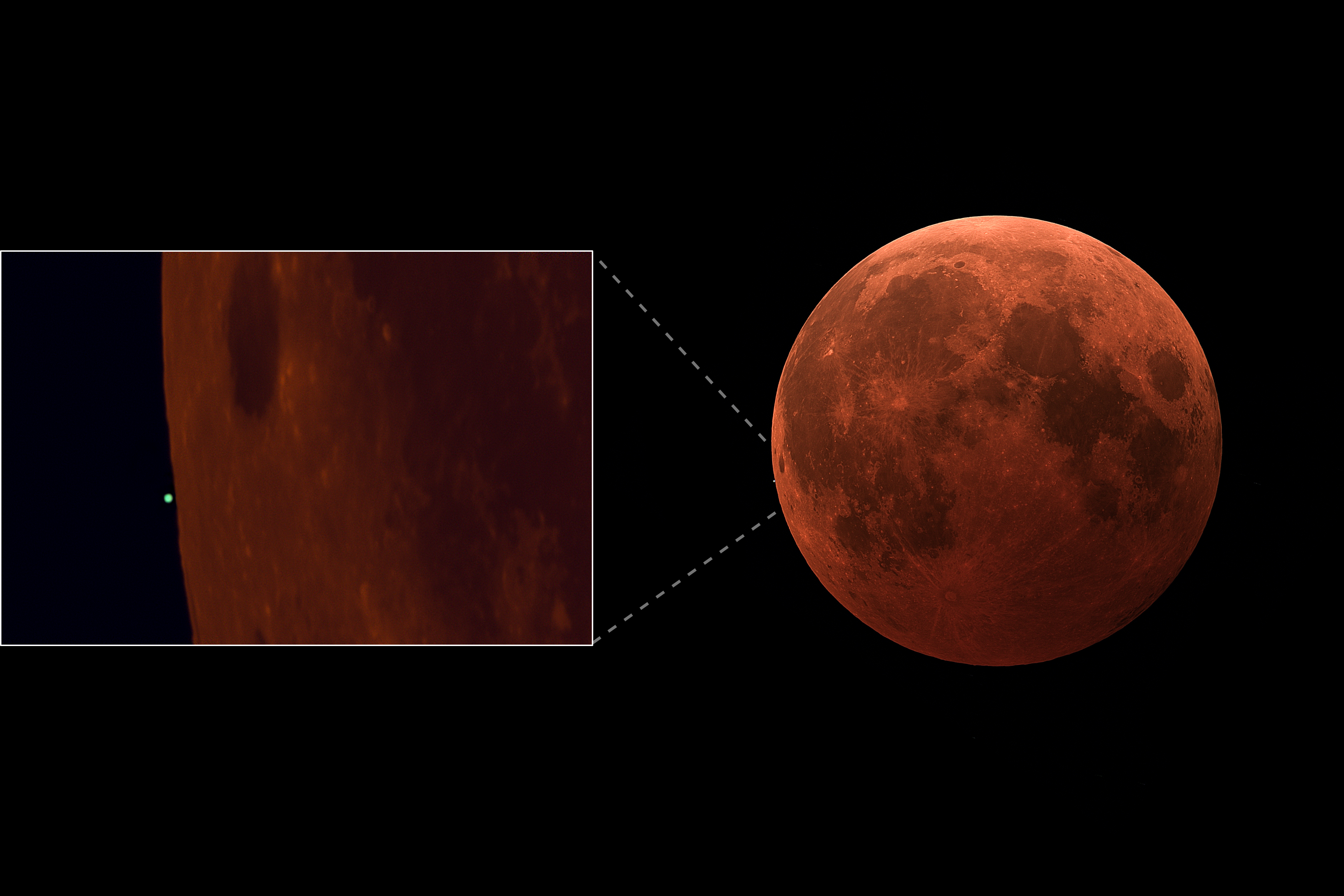
Explanation: On November 8 the Full Moon turned blood red as it slid through Earth's shadow in a beautiful total lunar eclipse. During totality it also passed in front of, or occulted, outer planet Uranus for eclipse viewers located in parts of northern America and Asia. For a close-up and wider view these two images were taken just before the occultation began, captured with different telescopes and cameras from the same roof top in Shanghai, China. Normally very faint compared to a Full Moon, the tiny, pale, greenish disk of the distant ice giant is just to the left of the Moon's edge and about to disappear behind the darkened, red lunar limb. Though only visible from certain locations across planet Earth, lunar occultations of planets are fairly common. But for this rare "lunar eclipse occultation" to take place, at the time of the total eclipse the outer planet had to be both at opposition and very near the ecliptic plane to fall in line with Sun, Earth, and Moon.

Santé/Médecine - CANCER : UN MEDICAMENT COURANT POURRAIT CONSTITUER UN ESPOIR

  Un médicament contre l'hypertension artérielle couramment utilisé pourrait avoir une deuxième fonction inattendue : aider à lutter con...