Avec ses couleurs vives et psychédéliques, cette fractale semble tout droit sortie de l'univers de Pink Floyd. La figure géométrique sombre ressemble à des branches épineuses de sapin.
© Futura
2023 April 3
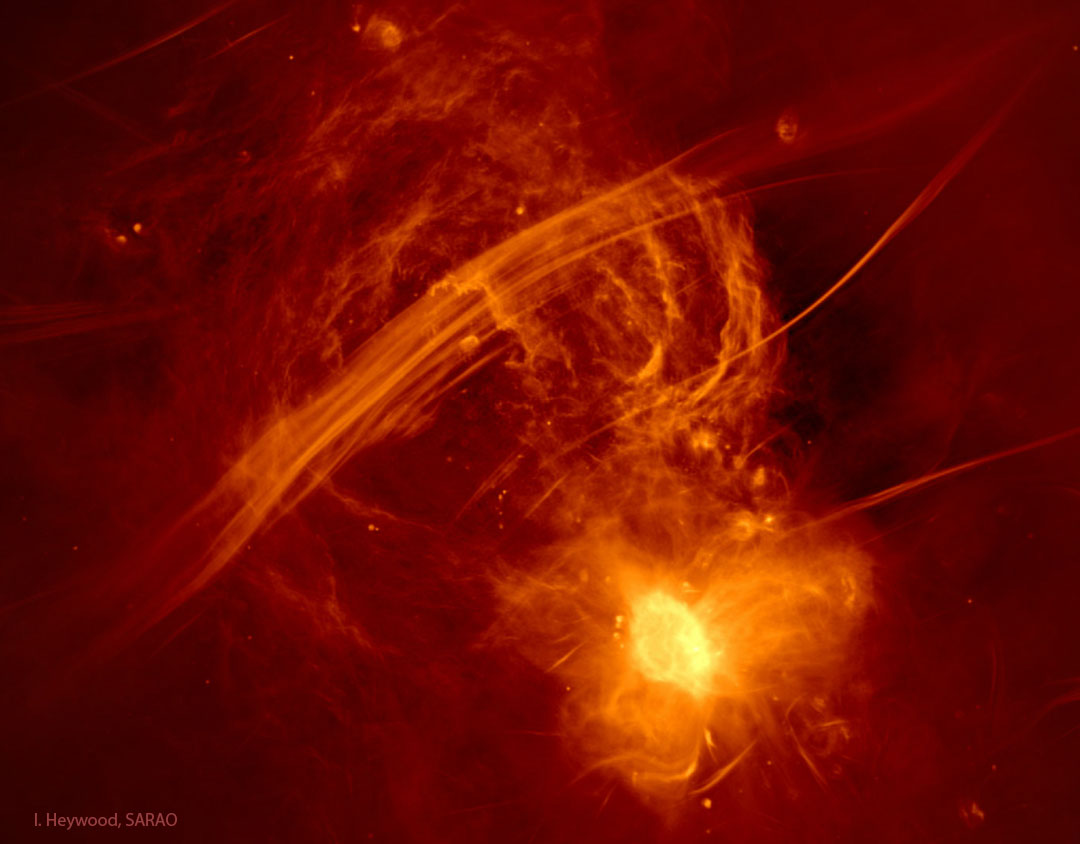
Explanation: What causes this unusual curving structure near the center of our Galaxy? The long parallel rays slanting across the top of the featured radio image are known collectively as the Galactic Center Radio Arc and point out from the Galactic plane. The Radio Arc is connected to the Galactic Center by strange curving filaments known as the Arches. The bright radio structure at the bottom right surrounds a black hole at the Galactic Center and is known as Sagittarius A*. One origin hypothesis holds that the Radio Arc and the Arches have their geometry because they contain hot plasma flowing along lines of a constant magnetic field. Images from NASA's Chandra X-ray Observatory appear to show this plasma colliding with a nearby cloud of cold gas.

2023 April 2
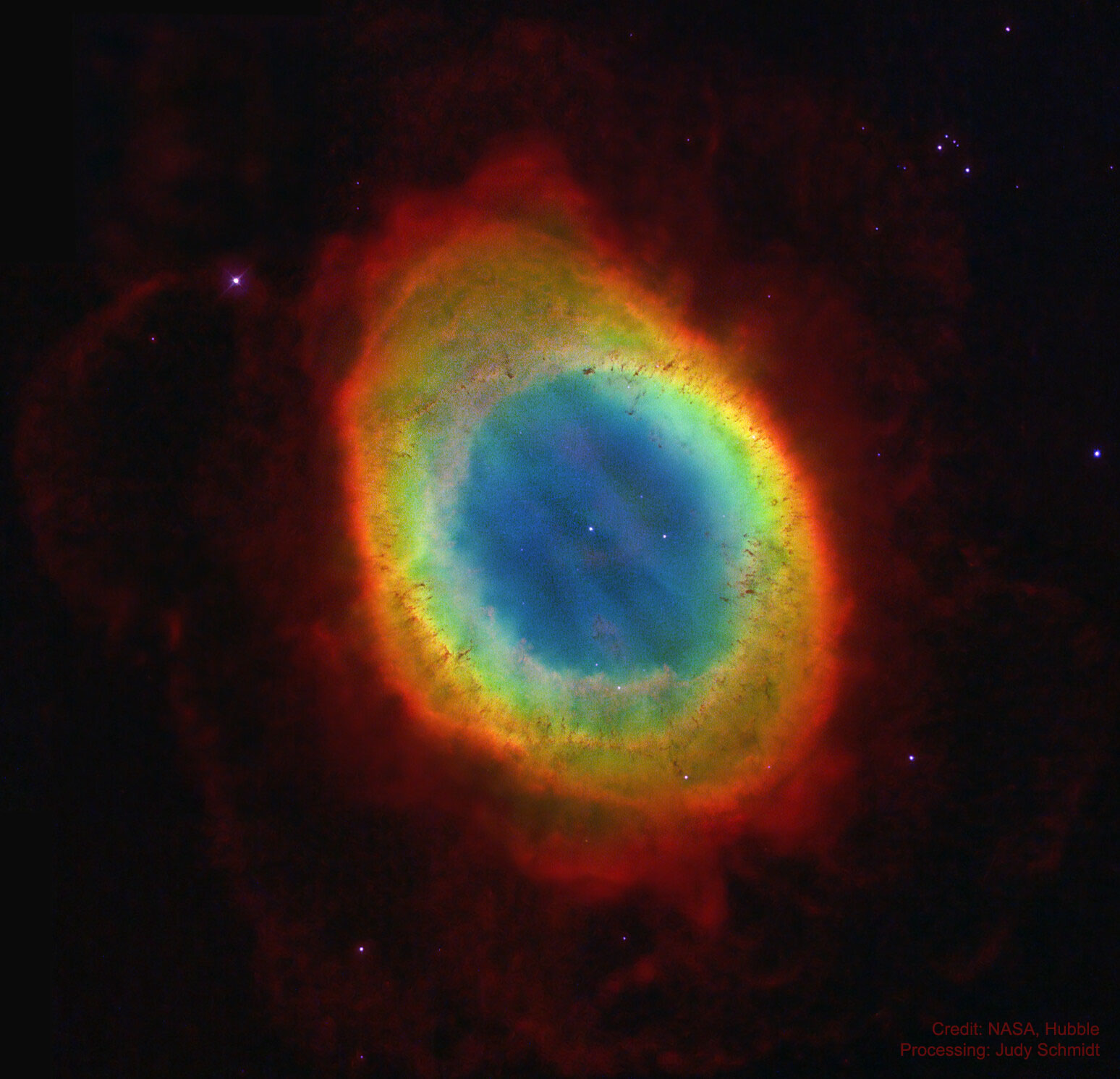
Explanation: It was noticed hundreds of years ago by stargazers who could not understand its unusual shape. It looked like a ring on the sky. Except for the rings of Saturn, the Ring Nebula (M57) may be the most famous celestial circle. We now know what it is, and that its iconic shape is due to our lucky perspective. The recent mapping of the expanding nebula's 3-D structure, based in part on this clear Hubble image,indicates that the nebula is a relatively dense, donut-like ring wrapped around the middle of an (American) football-shaped cloud of glowing gas. Our view from planet Earth looks down the long axis of the football, face-on to the ring. Of course, in this well-studied example of a planetary nebula, the glowing material does not come from planets. Instead, the gaseous shroud represents outer layers expelled from the dying, once sun-like star, now a tiny pinprick of light seen at the nebula's center. Intense ultraviolet light from the hot central star ionizes atoms in the gas. The Ring Nebula is about one light-year across and 2,500 light-years away.
2023 April 1
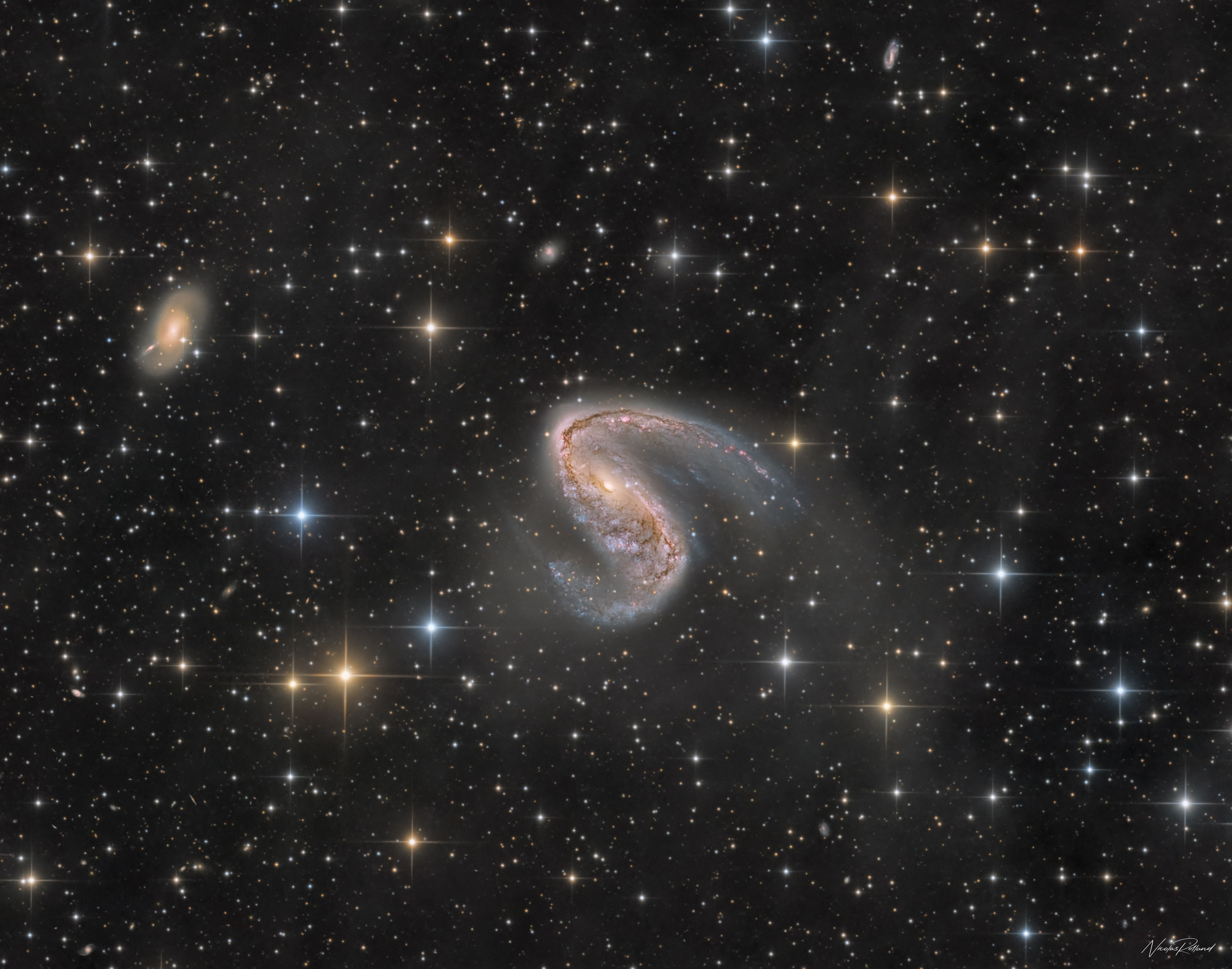
Explanation: Distorted galaxy NGC 2442 can be found in the southern constellation of the flying fish, (Piscis) Volans. Located about 50 million light-years away, the galaxy's two spiral arms extending from a pronounced central bar give it a hook-shaped appearance in this deep colorful image, with spiky foreground stars scattered across the telescopic field of view. The image also reveals the distant galaxy's obscuring dust lanes, young blue star clusters and reddish star forming regions surrounding a core of yellowish light from an older population of stars. But the star forming regions seem more concentrated along the drawn-out (upper right) spiral arm. The distorted structure is likely the result of an ancient close encounter with the smaller galaxy seen near the top left of the frame. The two interacting galaxies are separated by about 150,000 light-years at the estimated distance of NGC 2442.

2023 March 31
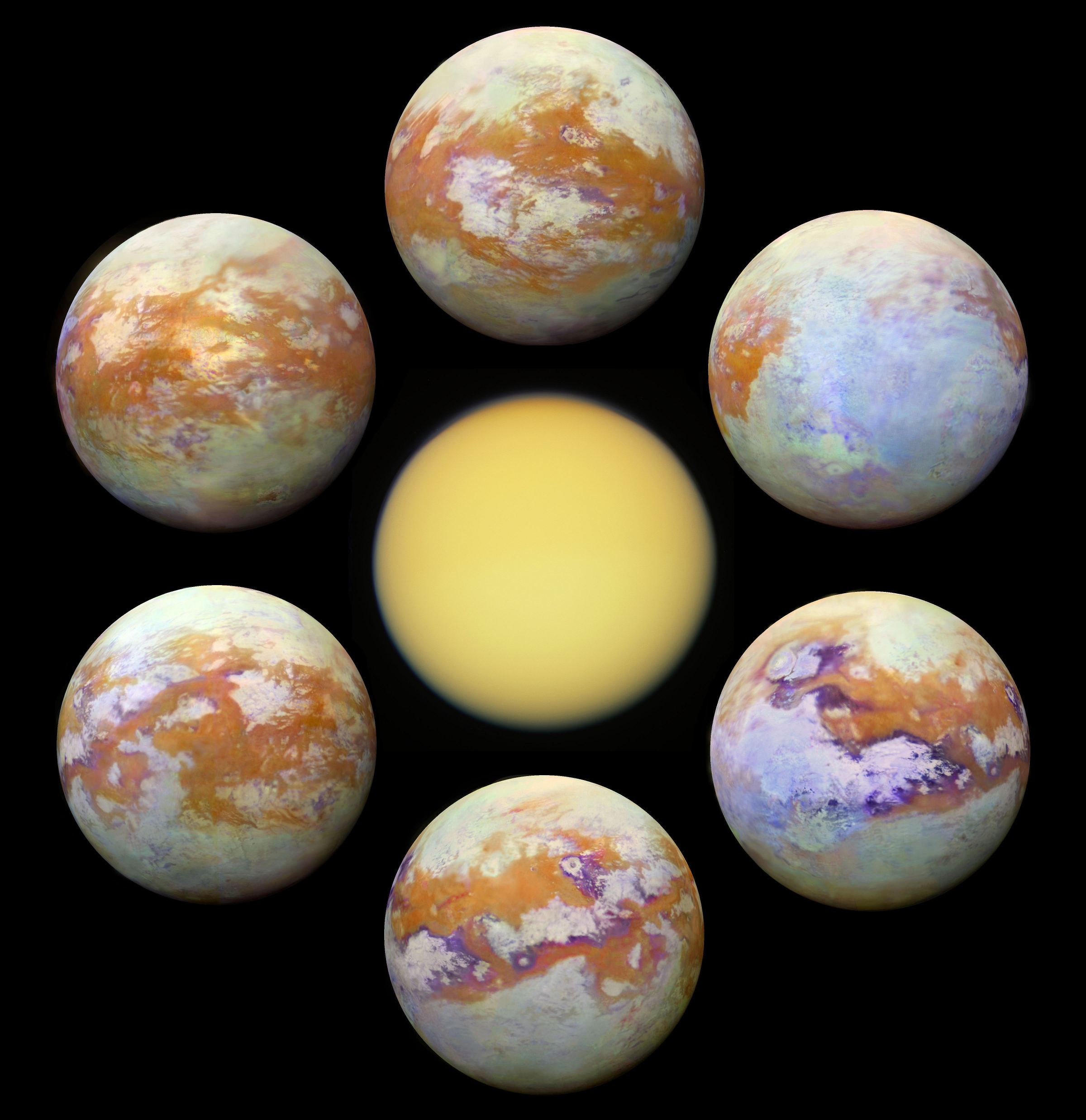
Explanation: Shrouded in a thick atmosphere, Saturn's largest moon Titan really is hard to see. Small particles suspended in the upper atmosphere cause an almost impenetrable haze, strongly scattering light at visible wavelengths and hiding Titan's surface features from prying eyes. But Titan's surface is better imaged at infrared wavelengths where scattering is weaker and atmospheric absorption is reduced. Arrayed around this visible light image (center) of Titan are some of the clearest global infrared views of the tantalizing moon so far. In false color, the six panels present a consistent processing of 13 years of infrared image data from the Visual and Infrared Mapping Spectrometer (VIMS) on board the Cassini spacecraft orbiting Saturn from 2004 to 2017. They offer a stunning comparison with Cassini's visible light view. NASA's revolutionary rotorcraft mission to Titan is due to launch in 2027.

2023 March 30
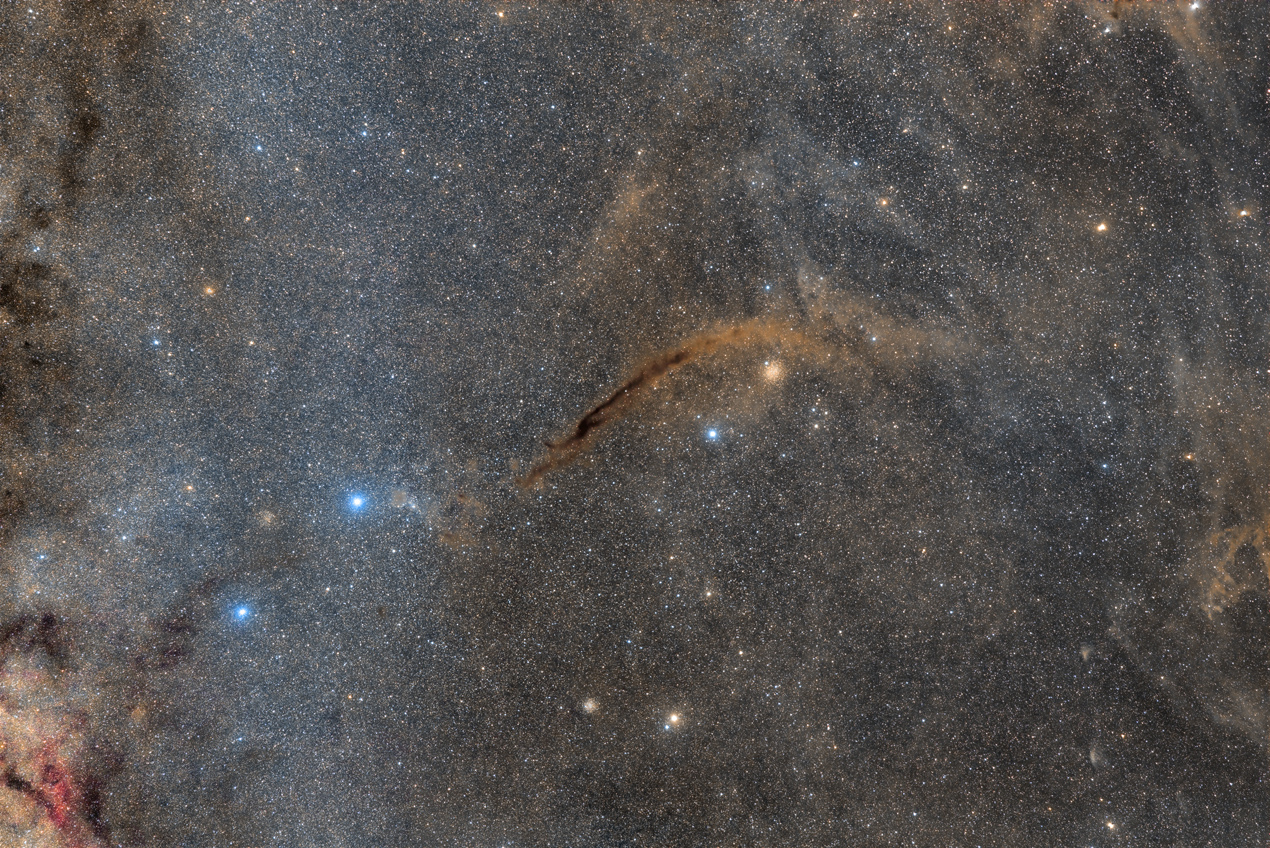
Explanation: The delightful Dark Doodad Nebula drifts through southern skies, a tantalizing target for binoculars toward the small constellation Musca, The Fly. The dusty cosmic cloud is seen against rich starfields just south of the Coalsack Nebula and the Southern Cross. Stretching for about 3 degrees across the center of this telephoto field of view, the Dark Doodad is punctuated near its southern tip (upper right) by yellowish globular star cluster NGC 4372. Of course NGC 4372 roams the halo of our Milky Way Galaxy, a background object some 20,000 light-years away and only by chance along our line-of-sight to the Dark Doodad. The Dark Doodad's well defined silhouette belongs to the Musca molecular cloud, but its better known alliterative moniker was first coined by astro-imager and writer Dennis di Cicco in 1986 while observing Comet Halley from the Australian outback. The Dark Doodad is around 700 light-years distant and over 30 light-years long.
Sept jours de coma… et une expérience consciente Durant sept jours, le neurochirurgien reste plongé dans un état végétatif. Les examens neur...