Une pâte à modeler Play-Doh explose sous l'impact d'une balle de plomb très rapide qui se déplace à environ 200 mètres par seconde. Tirée à partir d'un fusil à plomb, la balle a une énergie totale d'environ 10 joules.
© Alan Sailer
2023 June 26
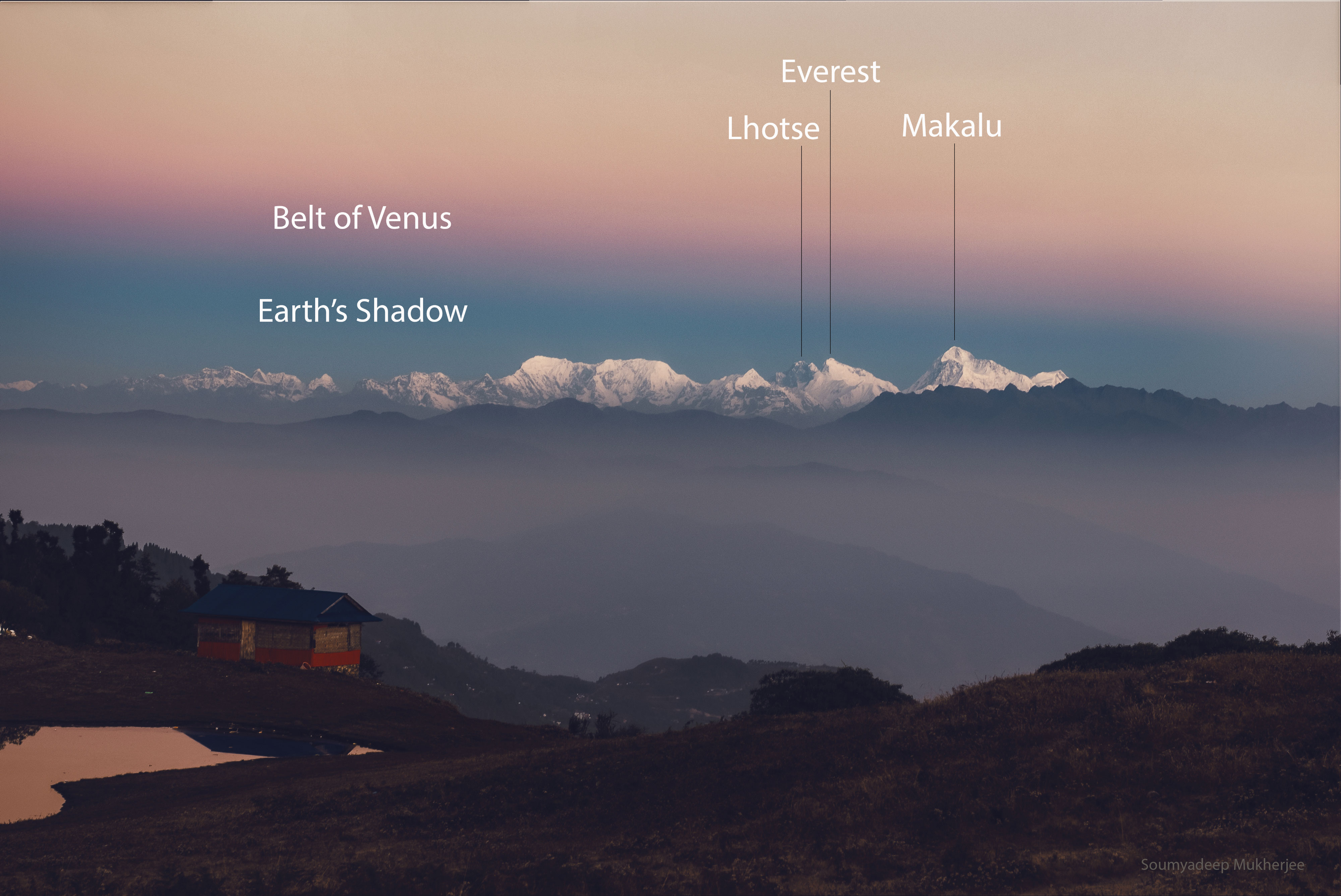
Explanation: You've surely seen it, but you might not have noticed it. During a cloudless twilight, just before sunrise or after sunset, part of the atmosphere above the horizon appears slightly dark and off-color. Called the Belt of Venus, this transitional band between the dark eclipsed sky and the bright day sky can be seen most prominently in the direction opposite the Sun. Straight above, blue sky is normal sunlight reflecting off the atmosphere, while near the horizon the clear sky can appear more orange or red. In the Belt of Venus, the atmosphere reflects more light from the setting (or rising) Sun and so appears more red. Featured here, the Belt of Venus was photographed over several Himalayan mountains including, second from the right, Mount Everest, the tallest mountain on Earth. Although usually not mentioned, the belt is frequently caught by accident in other photographs.
2023 June 28
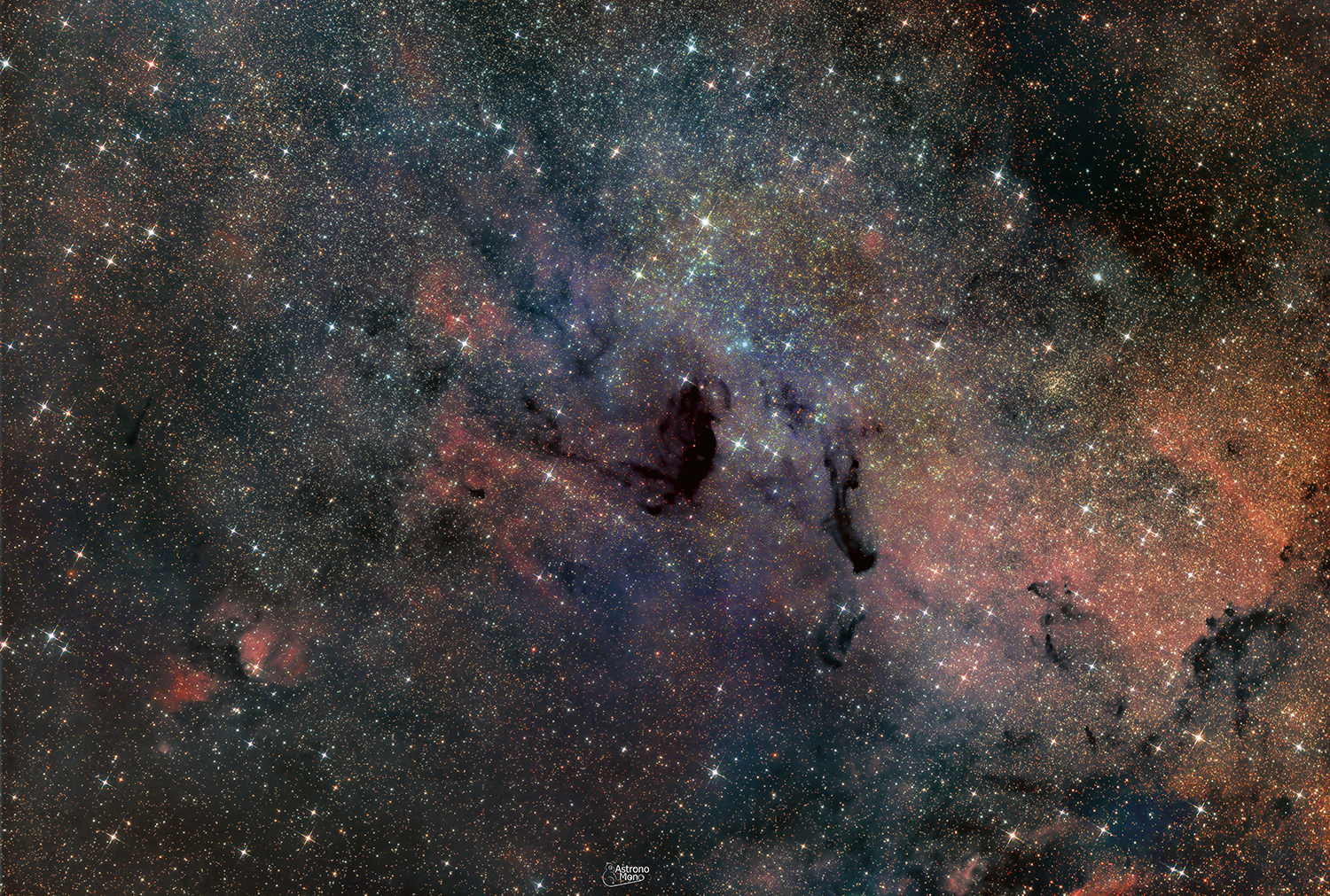
Explanation: Unlike most entries in Charles Messier's famous catalog of deep sky objects, M24 is not a bright galaxy, star cluster, or nebula. It's a gap in nearby, obscuring interstellar dust clouds that allows a view of the distant stars in the Sagittarius spiral arm of our Milky Way galaxy. Direct your gaze through this gap with binoculars or small telescope and you are looking through a window over 300 light-years wide at stars some 10,000 light-years or more from Earth. Sometimes called the Small Sagittarius Star Cloud, M24's luminous stars fill this gorgeous starscape. Covering over 3 degrees or the width of 6 full moons in the constellation Sagittarius, the telescopic field of view includes dark markings B92 and B93 near center, along with other clouds of dust and glowing nebulae toward the center of the Milky Way.
2023 June 25
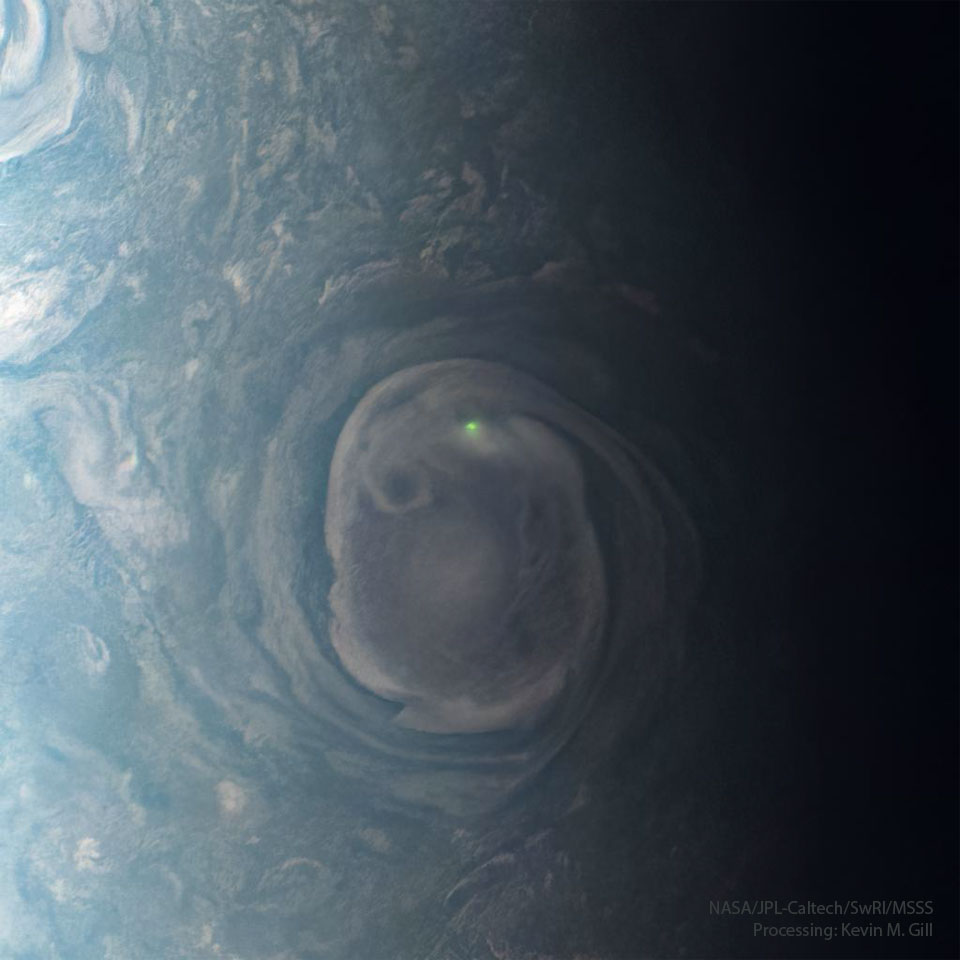
Explanation: Does lightning occur only on Earth? No. Spacecraft in our Solar System have detected lightning on other planets, including Mars, Jupiter and Saturn, and lightning is likely on Venus, Uranus, and Neptune. Lightning is a sudden rush of electrically charged particles from one location to another. On Earth, drafts of colliding ice and water droplets usually create lightning-generating charge separation, but what happens on Jupiter? Images and data from NASA's Jupiter-orbiting Juno spacecraft bolster previous speculation that Jovian lightning is also created in clouds containing water and ice. In the featured Juno photograph, an optical flash was captured in a large cloud vortex near Jupiter's north pole. During the next few months, Juno will perform several close sweeps over Jupiter's night side, likely allowing the robotic probe to capture more data and images of Jovian lightning.


2023 June 24
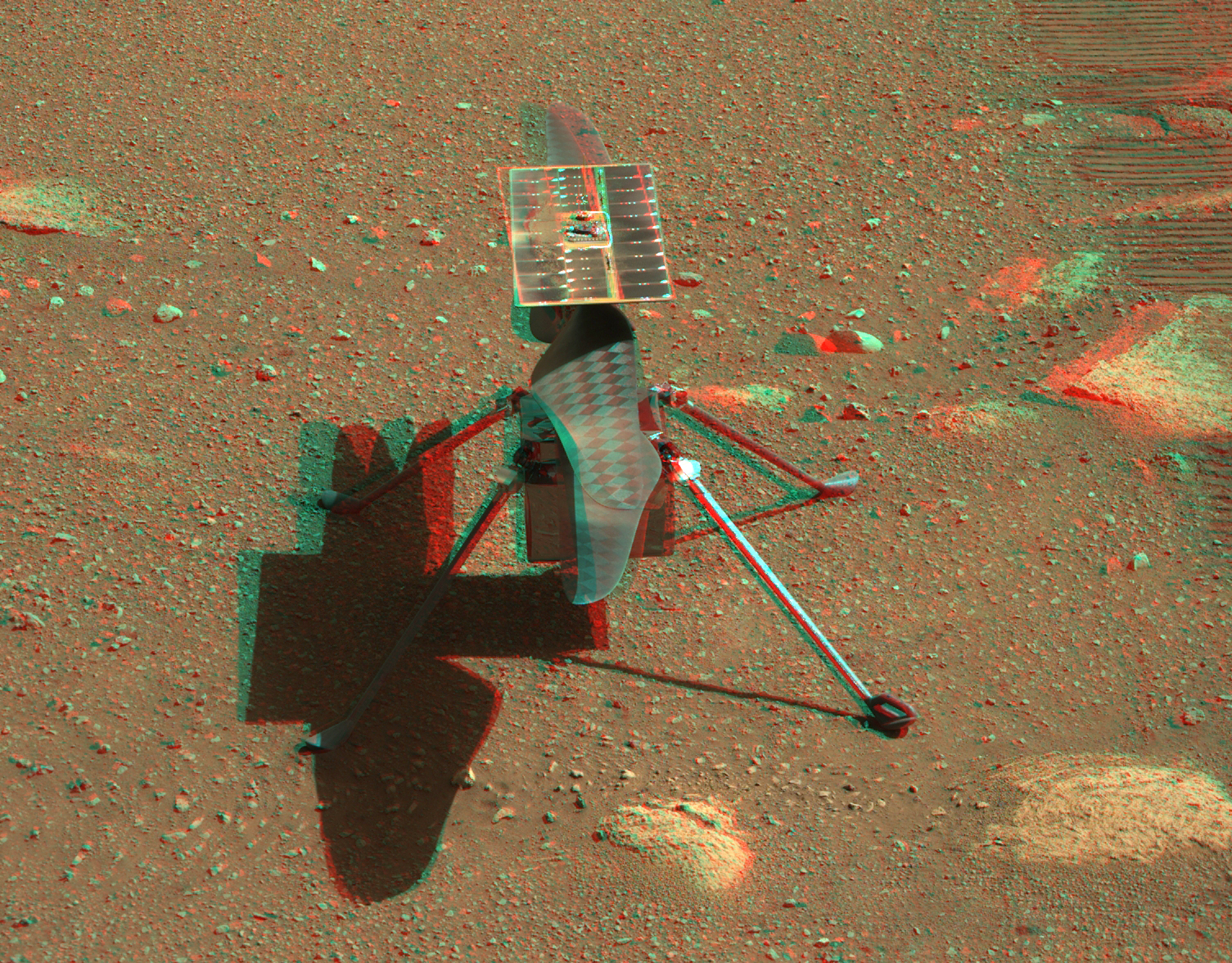
Explanation: The multicolor, stereo imaging Mastcam-Z on the Perseverance rover zoomed in to capture this 3D close-up (get out your red/blue glasses) of the Mars Ingenuity helicopter on mission sol 45. That's Earth-date 2021 April 5. Casting a shadow on the Martian surface, Ingenuity is standing alone on its four landing legs next to the rover's wheel tracks. The experimental helicopter's solar panel, charging batteries that keep it warm through the cold Martian nights and power its flight, sits just above Ingenuity's two 1.2 meter (4 foot) long counter-rotating blades. Thirteen sols later, on April 19, Ingenuity became the first aircraft to perform powered, controlled flight on another planet. It has since gone on to complete more than 50 flights through the thin atmosphere of Mars.
2023 June 22
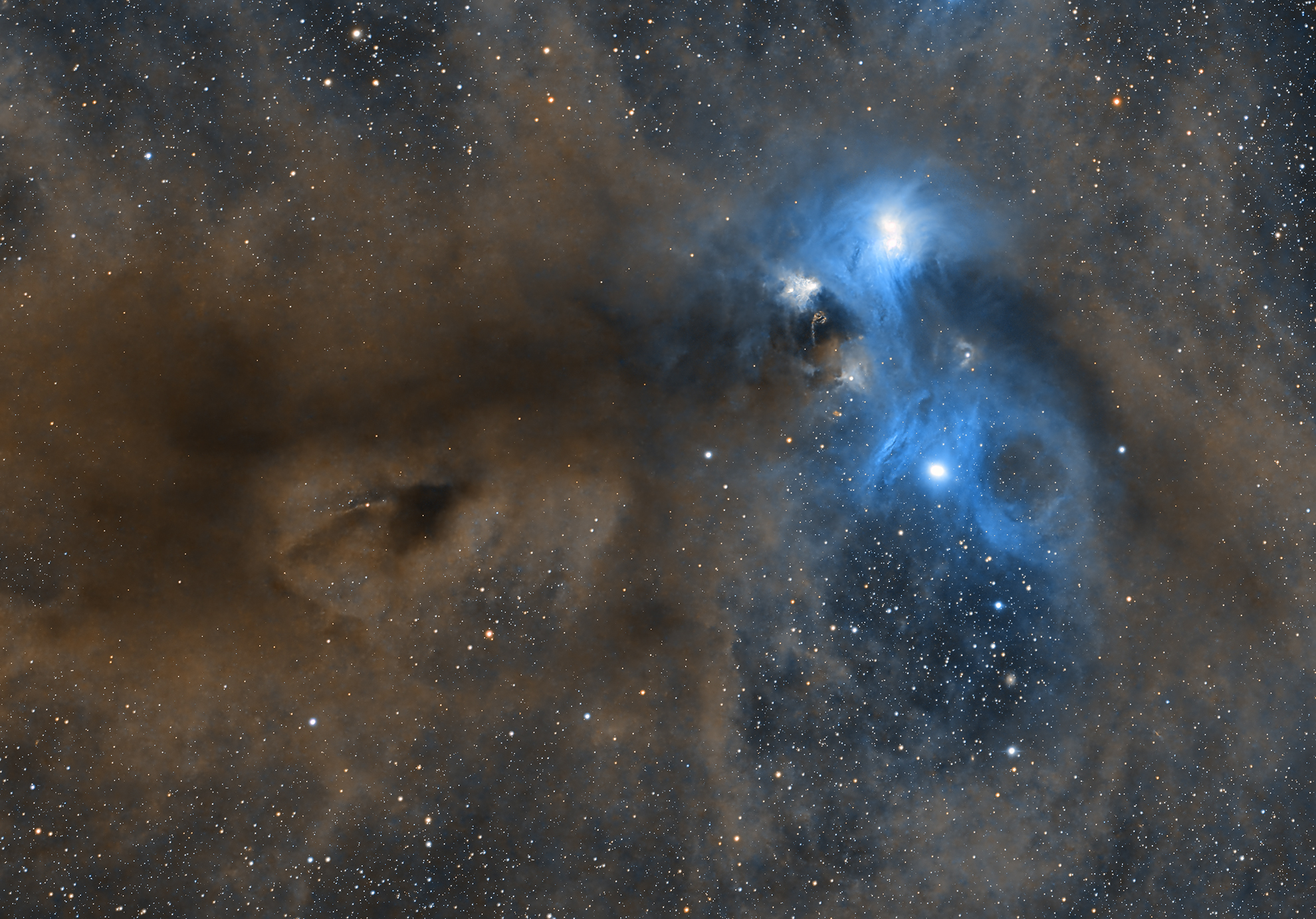
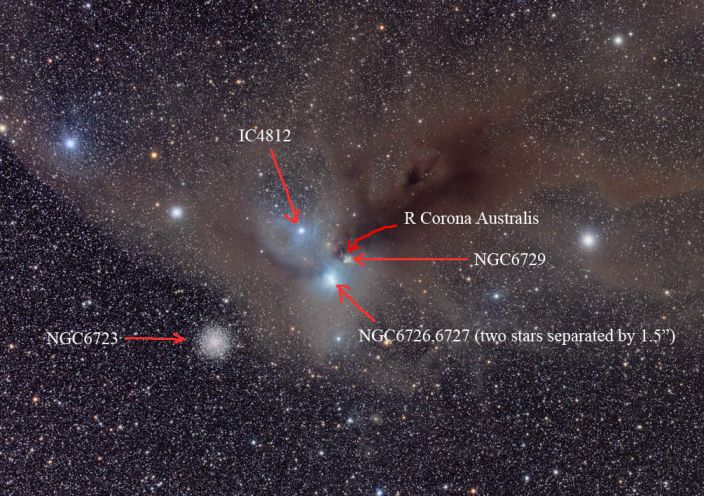
Explanation: Cosmic dust clouds cross a rich field of stars in this telescopic vista near the northern boundary of Corona Australis, the Southern Crown. Part of a sprawling molecular cloud complex this star forming region is a mere 500 light-years away. That's about one third the distance of the more famous stellar nursery known as the Orion Nebula. The 2 degree wide frame would span 15 light-years at the clouds' estimated distance. Mixed with bright nebulosities the dust clouds effectively block light from more distant background stars in the Milky Way and obscure from view embedded stars still in the process of formation. Large dark nebula Bernes 157 is on the left. To its right are a group of pretty reflection nebulae cataloged as NGC 6726, 6727, 6729, and IC 4812. Their characteristic blue color is produced as light from hot stars is reflected by the cosmic dust. The more compact NGC 6729 surrounds young variable star R Coronae Australis. Just below it, filamentary arcs and loops are identified as Herbig Haro objects associated with energetic newborn stars. In fact, at the heart of this area lies the Coronet Cluster, one of the nearest and most active star forming regions.
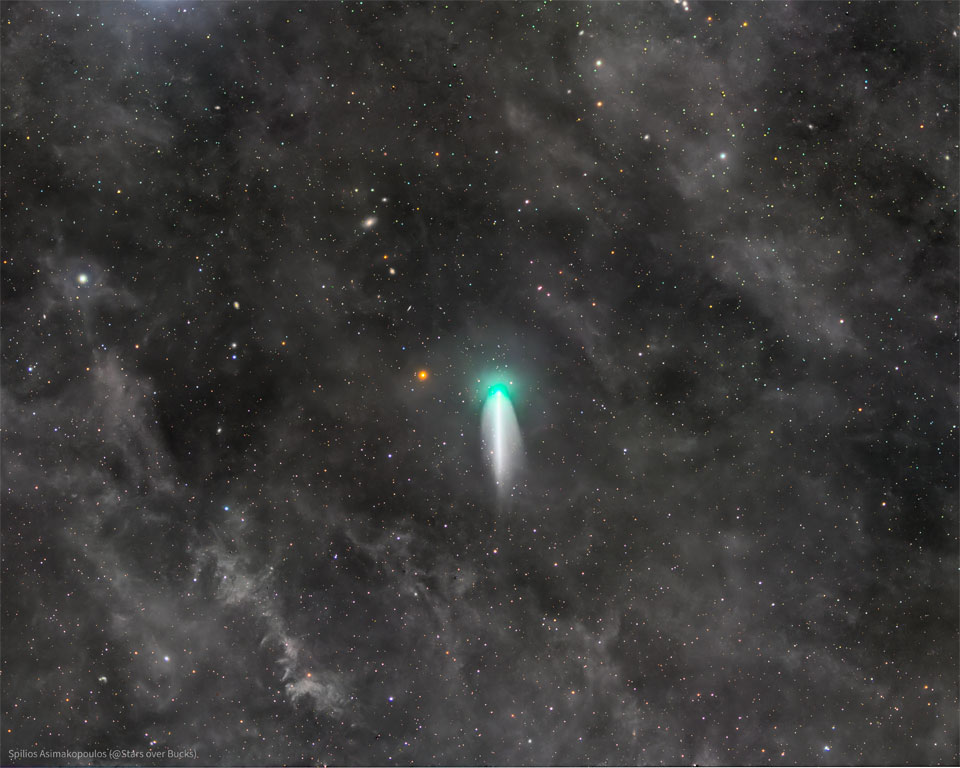
2026 August 24 Comet 220P in Outburst Image Credit & Copyright: Spilios Asimakopoulos Explanation: Comet 220P is unexpectedly bright. N...