Nombre total de pages vues
01/06/2024
SANTé/MEDECINE - Virus et bactéries mortels - Le virus de la dengue gagne du terrain
NUCLEAIRE - Comment survivre à une explosion nucléaire - Nettoyage : n'oubliez aucun recoin ni les animaux domestiques
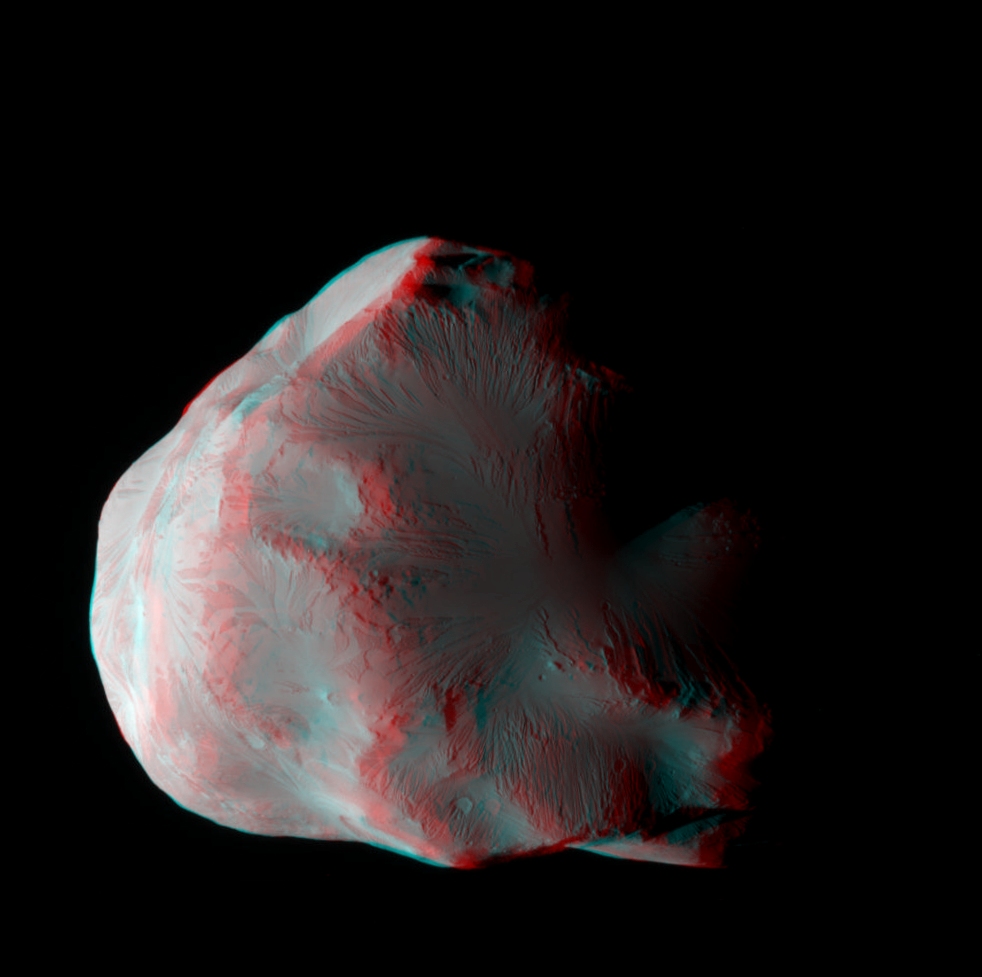
ASTRONOMY - Stereo Helene
2024 June 1
Image Credit: Cassini Imaging Team, ISS, JPL, ESA, NASA; Stereo Image by Roberto Beltramini
Explanation: Get out your red/blue glasses and float next to Helene, small, icy moon of Saturn. Appropriately named, Helene is a Trojan moon, so called because it orbits at a Lagrange point. A Lagrange point is a gravitationally stable position near two massive bodies, in this case Saturn and larger moon Dione. In fact, irregularly shaped ( about 36 by 32 by 30 kilometers) Helene orbits at Dione's leading Lagrange point while brotherly ice moon Polydeuces follows at Dione's trailing Lagrange point. The sharp stereo anaglyph was constructed from two Cassini images captured during a close flyby in 2011. It shows part of the Saturn-facing hemisphere of Helene mottled with craters and gully-like features.
31/05/2024
SANTé/MEDECINE - Virus et bactéries mortels - Les hantavirus et leur terrible syndrome pulmonaire
NUCLEAIRE - Comment survivre à une explosion nucléaire ? - N'utilisez aucun produit cosmétique
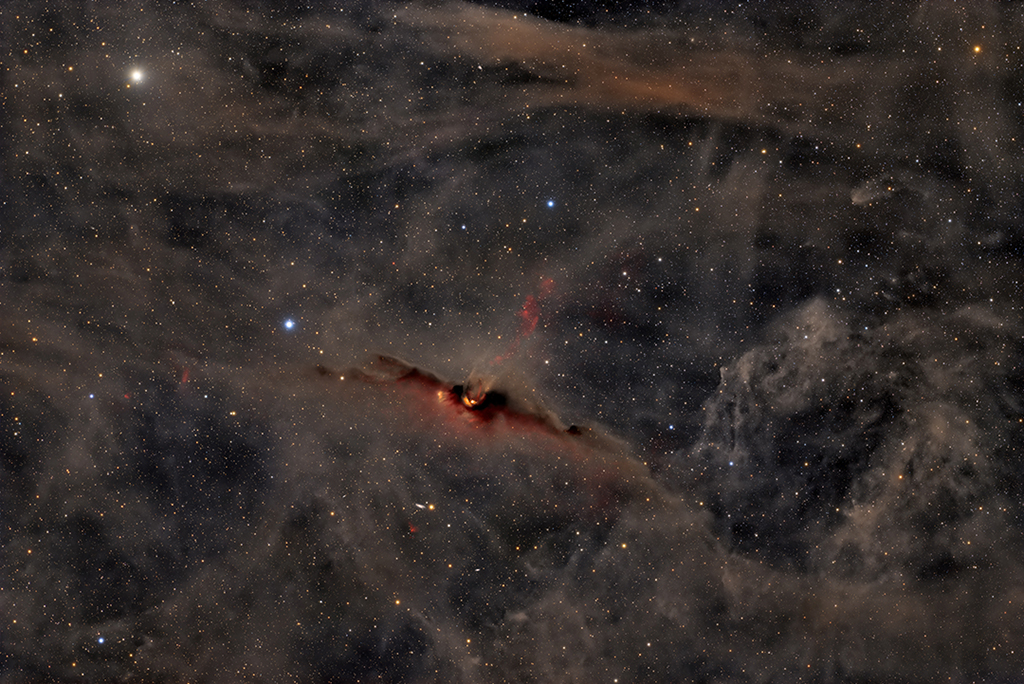
ASTRONOMY - The Nebulous Realm of WR 134
2024 May 31
Image Credit & Copyright: Xin Long
Explanation: Made with narrowband filters, this cosmic snapshot covers a field of view over twice as wide as the full Moon within the boundaries of the constellation Cygnus. It highlights the bright edge of a ring-like nebula traced by the glow of ionized hydrogen and oxygen gas. Embedded in the region's expanse of interstellar clouds, the complex, glowing arcs are sections of shells of material swept up by the wind from Wolf-Rayet star WR 134, brightest star near the center of the frame. Distance estimates put WR 134 about 6,000 light-years away, making the frame over 100 light-years across. Shedding their outer envelopes in powerful stellar winds, massive Wolf-Rayet stars have burned through their nuclear fuel at a prodigious rate and end this final phase of massive star evolution in a spectacular supernova explosion. The stellar winds and final supernova enrich the interstellar material with heavy elements to be incorporated in future generations of stars.
30/05/2024
NUCLEAIRE - Comment survivre à une explosion nucléaire ? - Douchez-vous au plus vite
ASTRONOMY - A Lunar Corona over Paris
2024 May 30
Image Credit & Copyright: Valter Binotto
Explanation: Why does a cloudy moon sometimes appear colorful? The effect, called a lunar corona, is created by the quantum mechanical diffraction of light around individual, similarly-sized water droplets in an intervening but mostly-transparent cloud. Since light of different colors has different wavelengths, each color diffracts differently. Lunar coronae are one of the few quantum mechanical color effects that can be easily seen with the unaided eye. Solar coronae are also sometimes evident. The featured image was taken last month from Paris, France. The blue beacon emanating from the Eiffel Tower did not affect the colorful lunar corona.
29/05/2024
NUCLEAIRE - Comment survivre à une explosion nucléaire ? Scellez et jetez vos vêtements
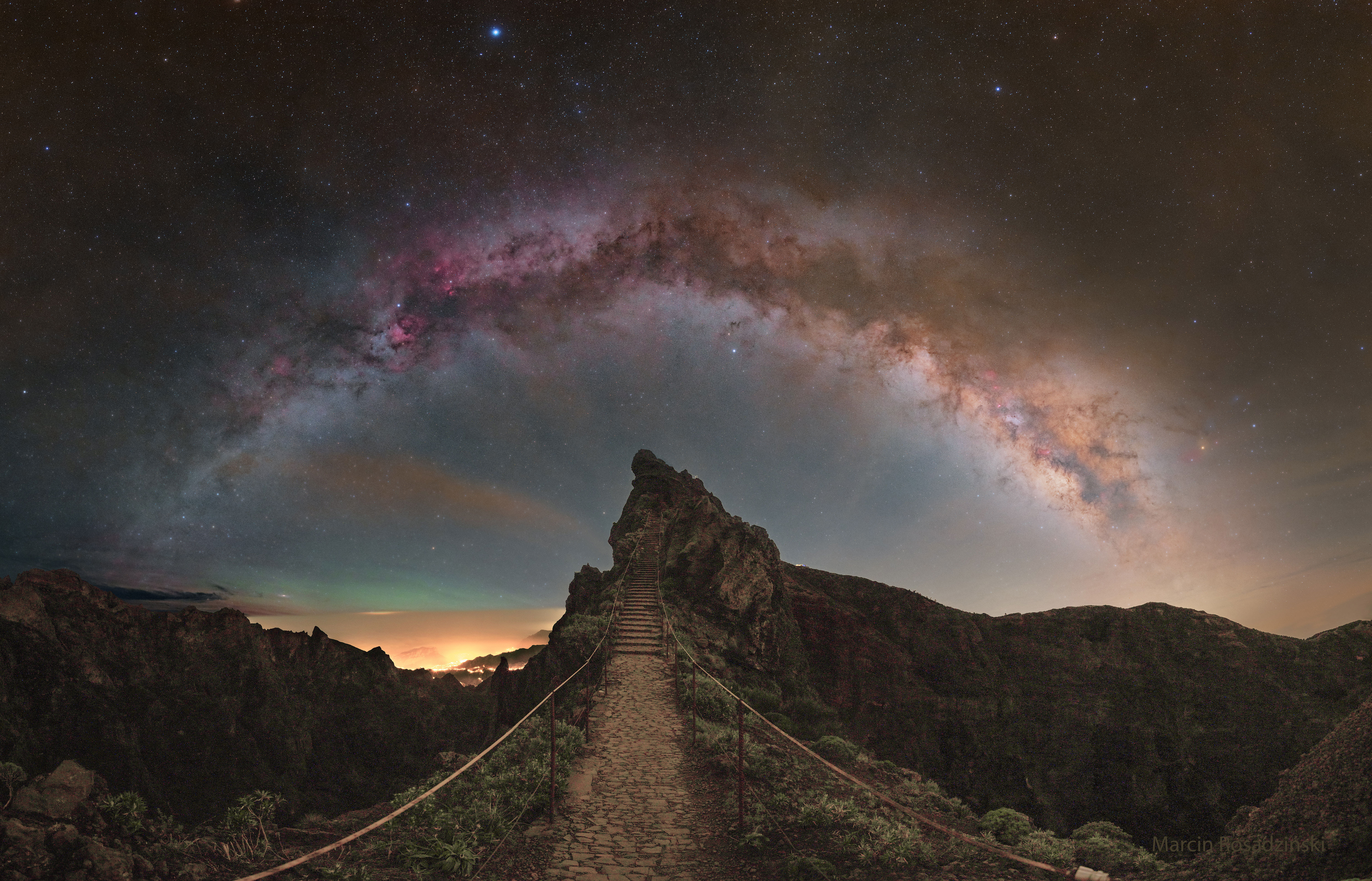
ASTRONOMY - Stairway to the Milky Way
2024 May 29
Image Credit & Copyright: Marcin Rosadziński
Explanation: What happens if you ascend this stairway to the Milky Way? Before answering that, let's understand the beautiful sky you will see. Most eye-catching is the grand arch of the Milky Way Galaxy, the band that is the central disk of our galaxy which is straight but distorted by the wide-angle nature of this composite image. Many stars well in front of the Milk Way will be visible, with the bright white star just below the stellar arch being Altair, and the bright blue star above it being Vega. The air glows green on the left, just above the yellow cloud deck. The featured image was taken last month on Portugal's Madeira Island in the North Atlantic Ocean. Oh, and what happens after you reach the top of these stairs and admire the amazing sky is, quite probably, that you then descend down the stairs on the other side.
Astronomy - THE RED GLOW OF THE COSMIC BAT NEBULA
2026 July 9 The Red Glow of the Cosmic Bat Nebula Image Credit & Copyright: Humbert Cédric Text: Keighley Rockcliffe ( NASA GSFC , U...
-
2026 January 1 Auroral Corona Image Credit & Copyright : Roi Levi Explanation: Cycle 25 solar maximum made 2025 a great year for ...
-
2026 January 2 NanoSail-D2 Image Credit & Copyright : Ralf Vandebergh Explanation: In 2011, on January 20, NASA's NanoSail-D2 ...