Non seulement cette technologie nous permet de tenir à distance le vieillissement et les maladies, mais en théorie, nous pouvons manger tout ce que nous voulons tout en gardant un corps en forme et plein d'énergie.
©Fournis par The Daily Digest
2024 June 24

Explanation: What if we could see back to the beginning of the universe? We could see galaxies forming. But what did galaxies look like back then? These questions took a step forward recently with the release of the analysis of a James Webb Space Telescope (JWST) image that included the most distant object yet discovered. Most galaxies formed at about 3 billion years after the Big Bang, but some formed earlier. Pictured in the inset box is JADES-GS-z14-0, a faint smudge of a galaxy that formed only 300 million years after the universe started. In technical terms, this galaxy lies at the record redshift of z=14.32, and so existed when the universe was only one fiftieth of the its present age. Practically all of the objects in the featured photograph are galaxies.

2024 June 23
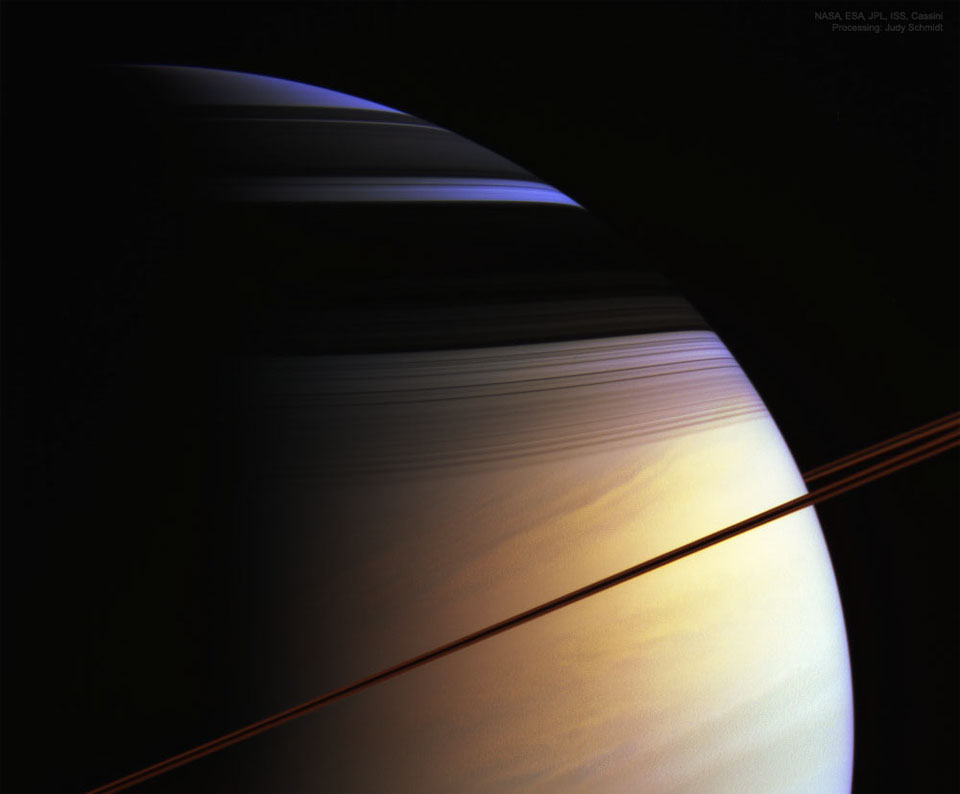
Explanation: What creates Saturn's colors? The featured picture of Saturn only slightly exaggerates what a human would see if hovering close to the giant ringed world. The image was taken in 2005 by the robot Cassini spacecraft that orbited Saturn from 2004 to 2017. Here Saturn's majestic rings appear directly only as a curved line, appearing brown, in part from its infrared glow. The rings best show their complex structure in the dark shadows they create across the upper part of the planet. The northern hemisphere of Saturn can appear partly blue for the same reason that Earth's skies can appear blue -- molecules in the cloudless portions of both planet's atmospheres are better at scattering blue light than red. When looking deep into Saturn's clouds, however, the natural gold hue of Saturn's clouds becomes dominant. It is not known why southern Saturn does not show the same blue hue -- one hypothesis holds that clouds are higher there. It is also not known why some of Saturn's clouds are colored gold.

2024 June 22

Explanation: Stars are forming in Lynds Dark Nebula (LDN) 1251. About 1,000 light-years away and drifting above the plane of our Milky Way galaxy, LDN 1251 is also less appetizingly known as "The Rotten Fish Nebula." The dusty molecular cloud is part of a complex of dark nebulae mapped toward the Cepheus flare region. Across the spectrum, astronomical explorations of the obscuring interstellar clouds reveal energetic shocks and outflows associated with newborn stars, including the telltale reddish glow from scattered Herbig-Haro objects hiding in the image. Distant background galaxies also lurk in the scene, almost buried behind the dusty expanse. This alluring view spans over four full moons on the sky, or 35 light-years at the estimated distance of LDN 1251.


2024 June 21

Explanation: Returning to science operations on June 14, the Hubble Space Telescope used its new pointing mode to capture this sharp image of spiral galaxy NGC 1546. A member of the Dorado galaxy group, the island universe lies a mere 50 million light-years away. The galactic disk of NGC 1546 is tilted to our line-of-sight, with the yellowish light of the old stars and bluish regions of newly formed stars shining through the galaxy's dust lanes. More distant background galaxies are scattered throughout this Hubble view. Launched in 1990, Hubble has been exploring the cosmos for more than three decades, recently celebrating its 34th anniversary.

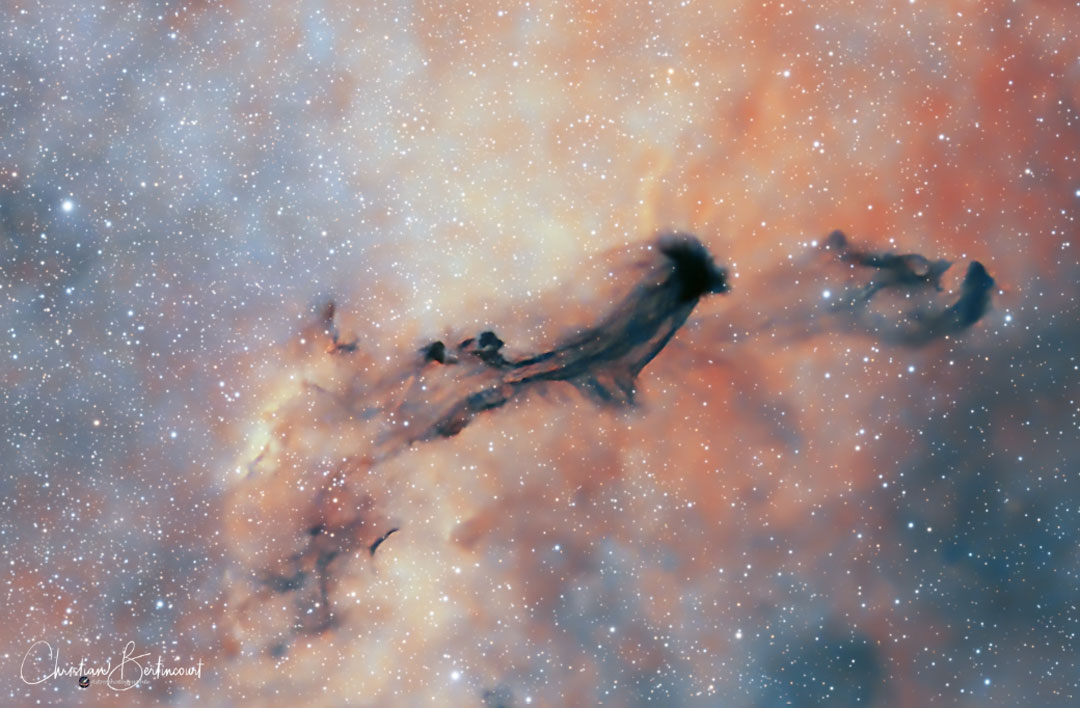
2026 February 20 B93: A Dark Interstellar Ghost Image Credit & Copyright: Christian Bertincourt ; Text: Keighley Rockcliffe ( NASA ...