Nombre total de pages vues

28/06/2024

ASTRONOMY - Comet 13P/Olbers

 2024 June 28

See Explanation.  Clicking on the picture will download
 the highest resolution version available.

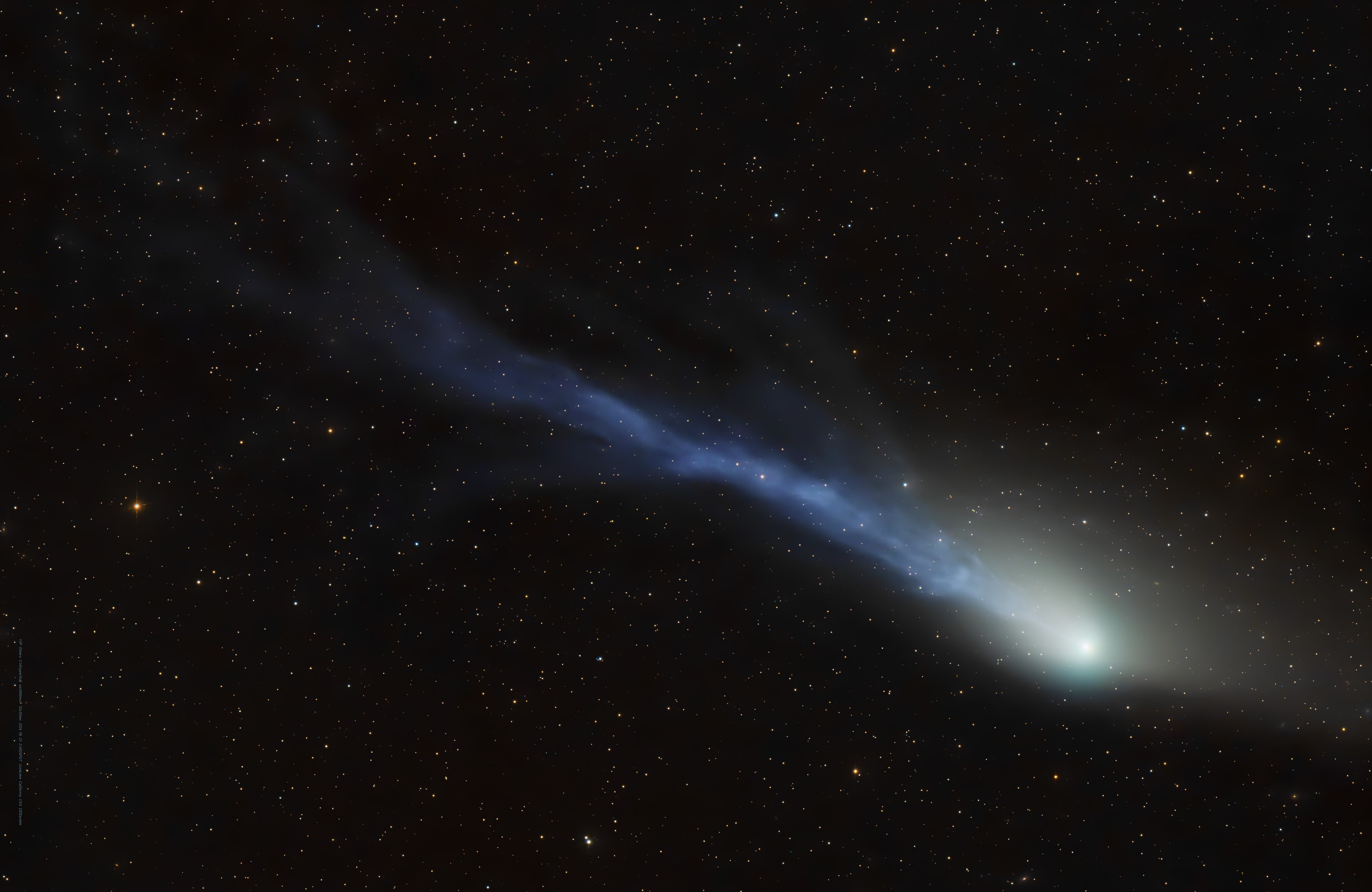
Comet 13P/Olbers
Image Credit & CopyrightDan Bartlett`

Explanation: Not a paradox, Comet 13P/Olbers is returning to the inner Solar System after 68 years. The periodic, Halley-type comet will reach its next perihelion or closest approach to the Sun on June 30 and has become a target for binocular viewing low in planet Earth's northern hemisphere night skies. But this sharp telescopic image of 13P is composed of stacked exposures made on the night of June 25. It easily reveals shifting details in the bright comet's torn and tattered ion tail buffeted by the wind from an active Sun, along with a broad, fanned-out dust tail and slightly greenish coma. The frame spans over two degrees across a background of faint stars toward the constellation Lynx.

27/06/2024

MUSIQUE CLASSIQUE - Chopin - Fantaisie impromptue

"Fantaisie impromptue"

ASTRONOMY - Protostellar Outflows in Serpens

 2024 June 27

See Explanation.  Clicking on the picture will download
 the highest resolution version available.

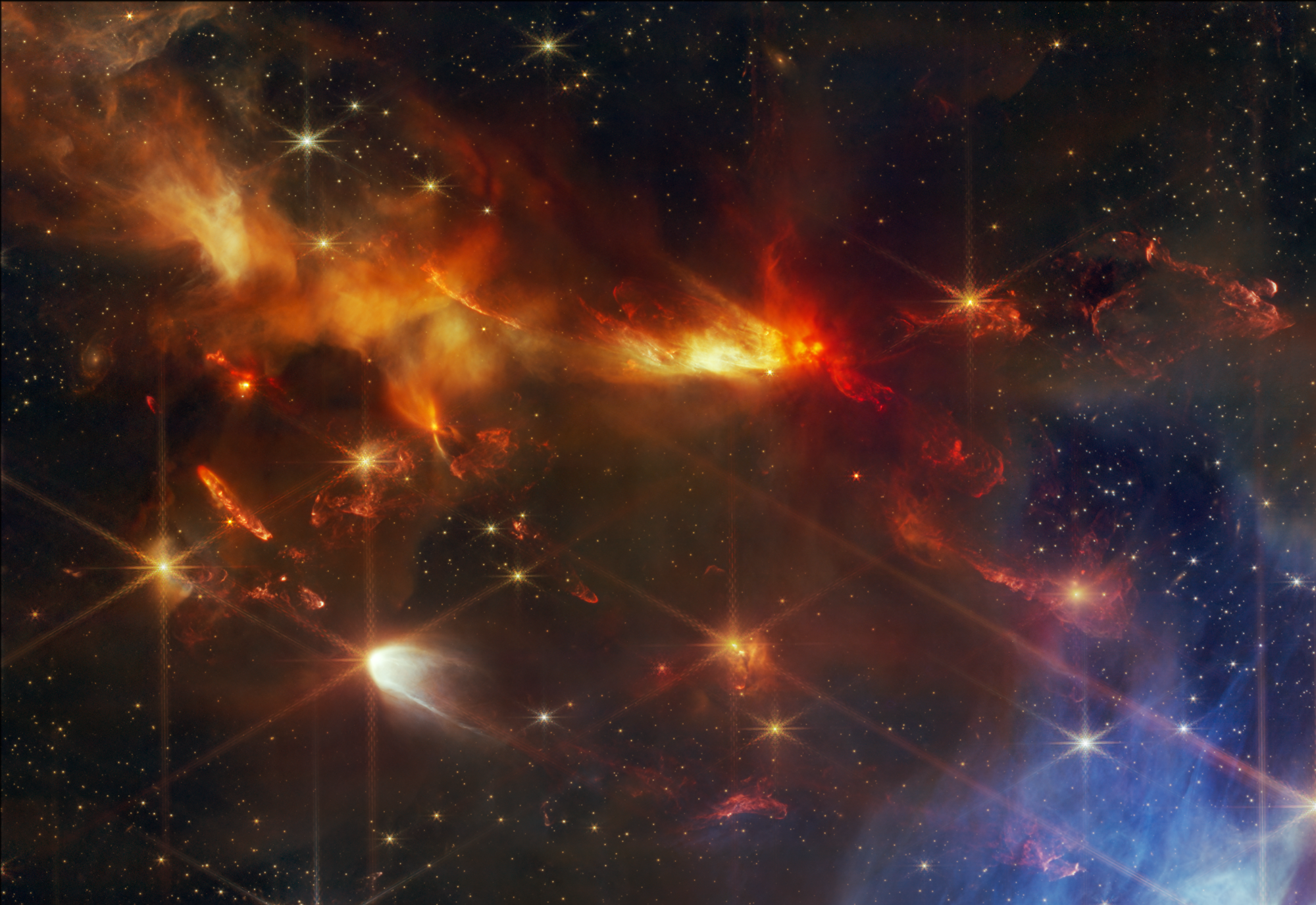
Protostellar Outflows in Serpens
Image Credit: NASAESACSASTScI, Klaus Pontoppidan (NASA-JPL), Joel Green (STScI)

Explanation: Jets of material blasting from newborn stars, are captured in this James Webb Space Telescope close-up of the Serpens Nebula. The powerful protostellar outflows are bipolar, twin jets spewing in opposite directions. Their directions are perpendicular to accretion disks formed around the spinning, collapsing stellar infants. In the NIRcam image, the reddish color represents emission from molecular hydrogen and carbon monoxide produced as the jets collide with the surrounding gas and dust. The sharp image shows for the first time that individual outflows detected in the Serpens Nebula are generally aligned along the same direction. That result was expected, but has only now come into clear view with Webb's detailed exploration of the active young star-forming region. Brighter foreground stars exhibit Webb's characteristic diffraction spikes. At the Serpens Nebula's estimated distance of 1,300 light-years, this cosmic close-up frame is about 1 light-year across.

26/06/2024

SANTé/MEDECINE - Anatomie du coeur humain - Infarctus dans le ventricule gauche


Si une artère coronaire est obstruée, l'irrigation du myocarde en sang diminue localement. Les cellules musculaires manquent d'oxygène et sont affaiblies. Si la situation se prolonge, elle risque de provoquer un infarctus du myocarde, ou crise cardiaque. Certaines régions du muscle cardiaque sont nécrosées : elles sont colorées en sombre en bas de l'illustration. Plus les lésions sont étendues, plus les chances de survie sont minces.

© Patrick J. Lynch, CC by-sa 2.5

SANTé/MEDECINE - L'immortalité pour bientôt - Télécharger son cerveau


Bien que le cerveau humain n'ait pas encore été entièrement cartographié, de nombreuses personnes s'interrogent sur la possibilité de télécharger nos esprits dans des ordinateurs afin d'atteindre l'immortalité.

©Fournis par The Daily Digest

MUSIC - Dmitri Chostakovitch - Valse n° 2

"Valse n.° 2"

ASTRONOMY - Timelapse: Aurora SAR and the Milky Way

 2024 June 26

Timelapse: Aurora, SAR, and the Milky Way
Video Credit & Copyright: Jeff Dai (TWAN); Music (License): Suite bergamasque by Claude Debussy

Explanation: What's happening in the sky this unusual night? Most striking in the featured 4.5-hour 360-degree panoramic video, perhaps, is the pink and purple aurora. That's because this night, encompassing May 11, was famous for its auroral skies around the world. As the night progresses, auroral bands shimmer, the central band of our Milky Way Galaxy rises, and stars shift as the Earth rotates beneath them. Captured here simultaneously is a rare red band running above the aurora: a SAR arc, seen to change only slightly. The flashing below the horizon is caused by passing cars, while the moving spots in the sky are satellites and airplanes. The featured video was captured from XinjiangChina with four separate cameras.

25/06/2024

SANTé/MEDECINE - Anatomie du coeur humain - Vue de la valve tricuspide


La valve auriculo-ventriculaire droite, aussi appelée valve tricuspide, est une valve cardiaque composée de trois cuspides, qui sont des lames d'endocarde. Cette valve est attachée par des cordons de collagène blanc, qui relient les cuspides à la paroi du ventricule. Quand le cœur est relâché, la valve est ouverte, puis elle se ferme quand les ventricules se contractent.

© Patrick J. Lynch, CC by-sa 2.5

SANTé/MEDECINE - L'immortalité pour bientôt - L'immortalité biologique peut être réelle

Bien que cela semble farfelu, l'immortalité biologique a potentiellement été observée dans la vie marine, comme chez l'hydre, une minuscule créature d'eau douce dépourvue d'organes qui, selon 'DW', ne peut être tuée ou mourir de faim.

©Fournis par The Daily Digest

ASTRONOMY - The Dark Doodad Nebula

2024 June 25
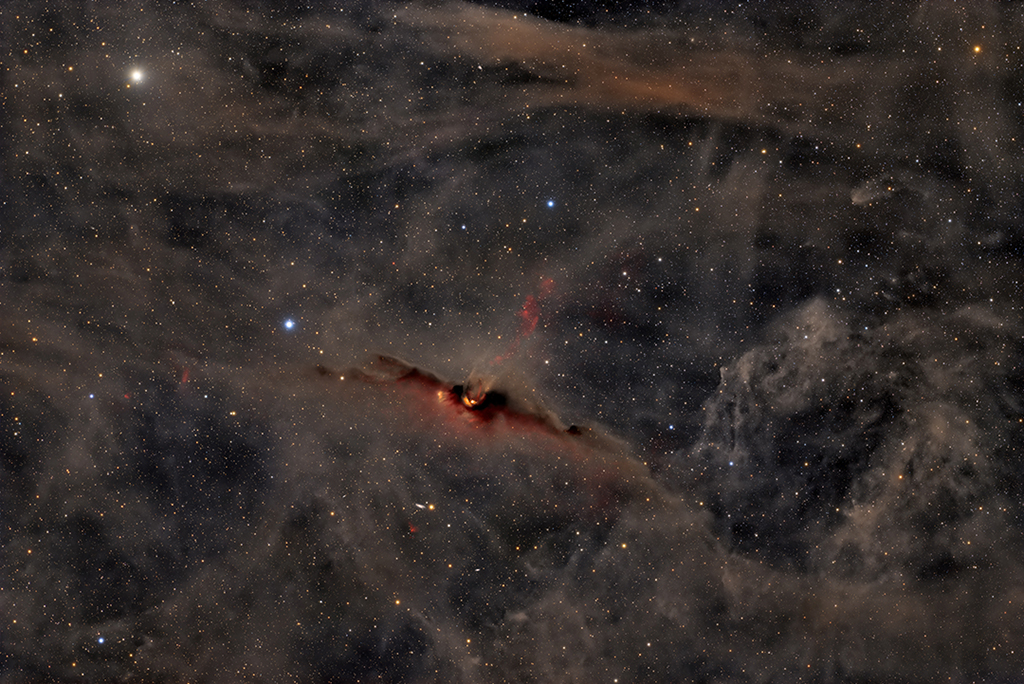
A busy starfield is shown which an elongated brown 
nebula running diagonally from the lower left to the 
upper right. A bright blue star and a star cluster 
appear above the nebula. 
Please see the explanation for more detailed information.

The Dark Doodad Nebula
Image Credit & Copyright: Martin Pugh & Rocco Sung

Explanation: What is that strange brown ribbon on the sky? When observing the star cluster NGC 4372, observers frequently take note of an unusual dark streak nearby running about three degrees in length. The streak, actually a long molecular cloud, has become known as the Dark Doodad Nebula. (Doodad is slang for a thingy or a whatchamacallit.) Pictured here, the Dark Doodad Nebula sweeps across the center of a rich and colorful starfield. Its dark color comes from a high concentration of interstellar dust that preferentially scatters visible light. The globular star cluster NGC 4372 is visible as the fuzzy white spot on the far left, while the bright blue star gamma Muscae is seen to the cluster's upper right. The Dark Doodad Nebula can be found with strong binoculars toward the southern constellation of the Fly (Musca).

Astronomy - THE RED GLOW OF THE COSMIC BAT NEBULA

 2026 July 9 The Red Glow of the Cosmic Bat Nebula Image Credit & Copyright: Humbert Cédric Text: Keighley Rockcliffe ( NASA GSFC , U...