Stratocumulus stratiformis perlucidus castellanus cumulogenitus. Photo prise dans l'Utah, au parc national des Arches (États-Unis).
© Bernhard Mühr, Der Karlsruher Wolkenatlas, www.wolkenatlas.de
2024 October 16

Explanation: Sometimes the night sky is full of surprises. Take the sky over Lindis Pass, South Island, New Zealand one-night last week. Instead of a typically calm night sky filled with constant stars, a busy and dynamic night sky appeared. Suddenly visible were pervasive red aurora, green picket-fence aurora, a red SAR arc, a STEVE, a meteor, and the Moon. These outshone the center of our Milky Way Galaxy and both of its two satellite galaxies: the LMC and SMC. All of these were captured together on 28 exposures in five minutes, from which this panorama was composed. Auroras lit up many skies last week, as a Coronal Mass Ejection from the Sun unleashed a burst of particles toward our Earth that created colorful skies over latitudes usually too far from the Earth's poles to see them. More generally, night skies this month have other surprises, showing not only auroras -- but comets.


2024 October 15
Explanation: How bright and strange will the tails of Comet Tsuchinshan-ATLAS become? The comet has brightened dramatically over the few weeks as it passed its closest to the Sun and, just three days ago, passed its closest to the Earth. C/2023 A3 (Tsuchinshan–ATLAS) became of the brightest comets of the past century over the past few days, but was unfortunately hard to see because it was so nearly superposed on the Sun. As the comet appears to move away from the Sun, it is becoming a remarkable sight -- but may soon begin to fade. The featured animated video shows how the comet's tails have developed, as viewed from Earth, and gives one prediction about how they might further develop. As shown in the video, heavier parts of the dust tail that trails the comet have begun to appear to point in nearly the opposite direction from lighter parts of the dust tail as well as the comet's ion tail, the blue tail that is pushed directly out from the Sun by the solar wind.

2024 October 14

Explanation: Go outside at sunset tonight and see a comet! C/2023 A3 (Tsuchinshan–ATLAS) has become visible in the early evening sky in northern locations to the unaided eye. To see the comet, look west through a sky with a low horizon. If the sky is clear and dark enough, you will not even need binoculars -- the faint tail of the comet should be visible just above the horizon for about an hour. Pictured, Comet Tsuchinshan-ATLAS was captured two nights ago over the Lincoln Memorial monument in Washington, DC, USA. With each passing day at sunset, the comet and its changing tail should be higher and higher in the sky, although exactly how bright and how long its tails will be can only be guessed.
2024 October 13
Explanation: Did you see last night's aurora? This question was relevant around much of the world a few days ago because a powerful auroral storm became visible unusually far from the Earth's poles. The cause was a giant X-class solar flare on Tuesday that launched energetic electrons and protons into the Solar System, connecting to the Earth via our planet's magnetic field. A red glow of these particles striking oxygen atoms high in Earth's atmosphere pervades the frame, while vertical streaks dance. The featured video shows a one-hour timelapse as seen from Cortina d'Ampezzo over Alps Mountain peaks in northern Italy. Stars from our Milky Way Galaxy dot the background while streaks from airplanes and satellites punctuate the foreground. The high recent activity of our Sun is likely to continue to produce picturesque auroras over Earth during the next year or so.

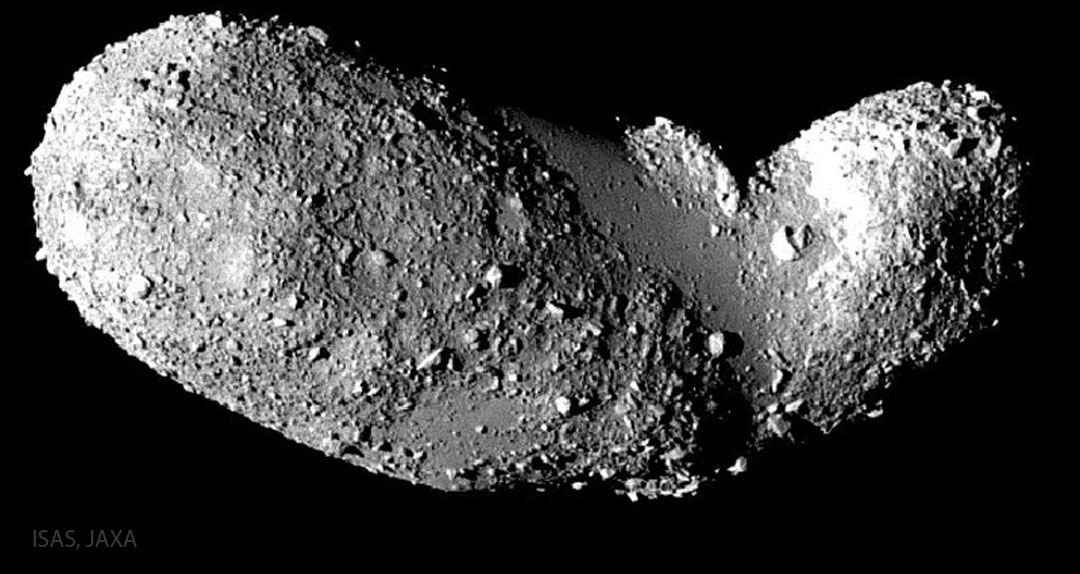
2026 June 30 Unusually Smooth Sections of Asteroid Itokawa Image Credit: JAXA , ISAS Explanation: Why are parts of this asteroid's surf...