Nombre total de pages vues
28/11/2024
METEOROLOGIE - Vagues nuageuses en Republique Tchèque
ASTRONOMY - NGC 206 and the Star Clouds of Andromeda
2024 November 28
Image Credit & Copyright: Roberto Marinoni
Explanation: The large stellar association cataloged as NGC 206 is nestled within the dusty arms of the neighboring Andromeda galaxy along with the galaxy's pinkish star-forming regions. Also known as M31, the spiral galaxy is a mere 2.5 million light-years away. NGC 206 is found at the center of this sharp and detailed close-up of the southwestern extent of Andromeda's disk. The bright, blue stars of NGC 206 indicate its youth. In fact, its youngest massive stars are less than 10 million years old. Much larger than the open or galactic clusters of young stars in the disk of our Milky Way galaxy, NGC 206 spans about 4,000 light-years. That's comparable in size to the giant stellar nurseries NGC 604 in nearby spiral M33 and the Tarantula Nebula in the Large Magellanic Cloud.
27/11/2024
METEOROLOGIE - Arcus sur l'île de Pag en Croatie.
ASTRONOMY - The Meteor and the Comet
2024 November 27
Image Credit & Copyright: Wang Hao; Processing: Song Wentao
Explanation: How different are these two streaks? The streak on the upper right is Comet Tsuchinshan-Atlas showing an impressive dust tail. The comet is a large and dirty iceberg that entered the inner Solar System and is shedding gas and dust as it is warmed by the Sun's light. The streak on the lower left is a meteor showing an impressive evaporation trail. The meteor is a small and cold rock that entered the Earth's atmosphere and is shedding gas and dust as it is warmed by molecular collisions. The meteor was likely once part of a comet or asteroid -- perhaps later composing part of its tail. The meteor was gone in a flash and was only caught by coincidence during a series of exposures documenting the comet's long tail. The featured image was captured just over a month ago from Sichuan Province in China.
26/11/2024
METEOROLOGIE - Une tornade monstrueuse
METEOROLOGIE - Arc-en-ciel vaporeux en Antarctique
ASTRONOMY - The Sombrero Galaxy from Webb and Hubble
2024 November 26
Image Credit: NASA, ESA, CSA, STScI, Hubble Heritage Project (STScI, AURA)
Explanation: This floating ring is the size of a galaxy. In fact, it is a galaxy -- or at least part of one: the photogenic Sombrero Galaxy is one of the largest galaxies in the nearby Virgo Cluster of Galaxies. The dark band of dust that obscures the mid-section of the Sombrero Galaxy in visible light (bottom panel) actually glows brightly in infrared light (top panel). The featured image shows the infrared glow in false blue, recorded recently by the space-based James Webb Space Telescope (JWST) and released yesterday, pictured above an archival image taken by NASA's Hubble Space Telescope in visible light. The Sombrero Galaxy, also known as M104, spans about 50,000 light years and lies 28 million light years away. M104 can be seen with a small telescope in the direction of the constellation Virgo.
25/11/2024
METEOROLOGIE - Sant Bartomeu del Grau (Espagne)
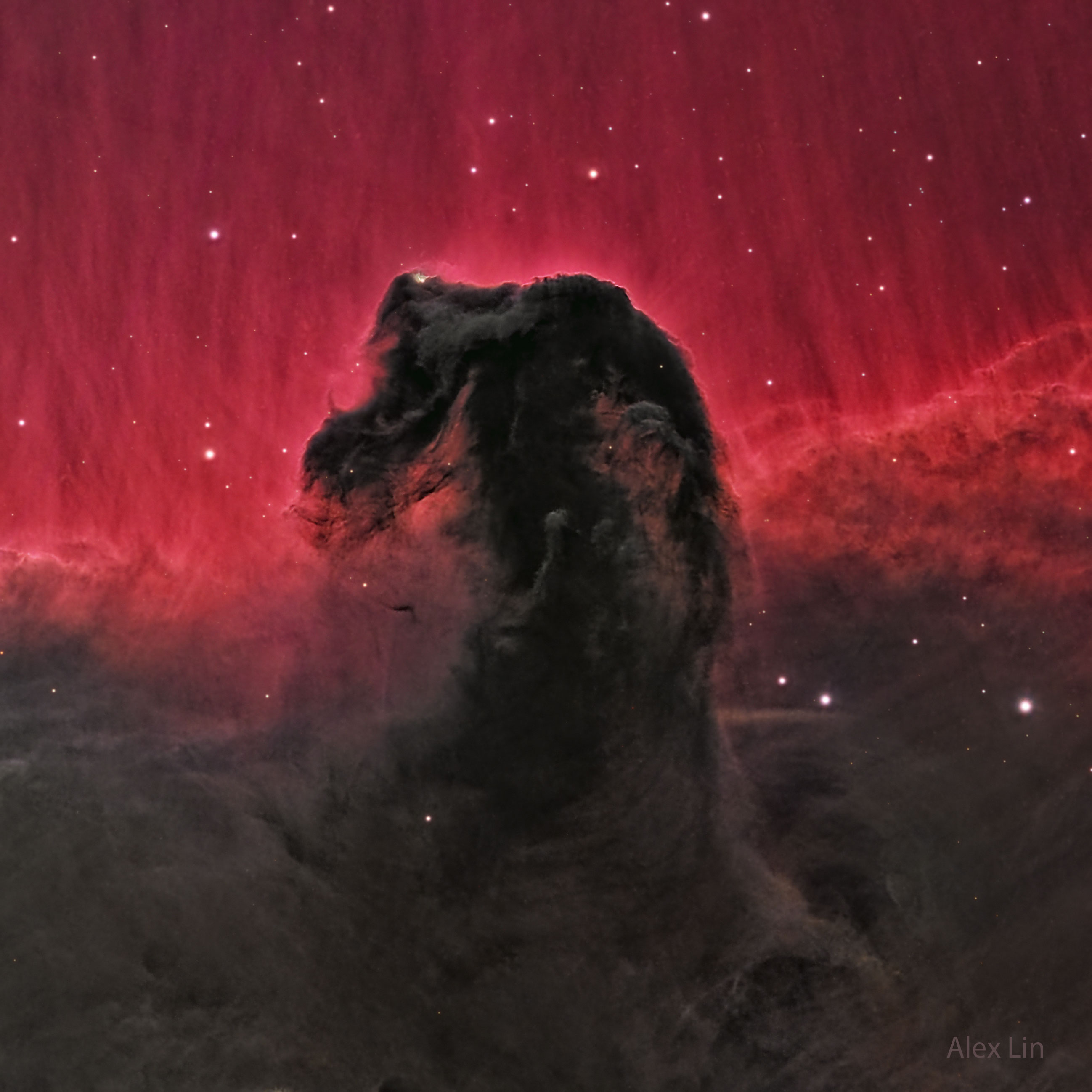
ASTRONOMY - The Horsehead Nebula
2024 November 25
Image Credit & Copyright: Alex Lin (Chilescope)
Explanation: One of the most identifiable nebulas in the sky, the Horsehead Nebula in Orion, is part of a large, dark, molecular cloud. Also known as Barnard 33, the unusual shape was first discovered on a photographic plate in the late 1800s. The red glow originates from hydrogen gas predominantly behind the nebula, ionized by the nearby bright star Sigma Orionis. The darkness of the Horsehead is caused mostly by thick dust, although the lower part of the Horsehead's neck casts a shadow to the left. Streams of gas leaving the nebula are funneled by a strong magnetic field. Bright spots in the Horsehead Nebula's base are young stars just in the process of forming. Light takes about 1,500 years to reach us from the Horsehead Nebula. The featured image was taken from the Chilescope Observatory in the mountains of Chile.
Astronomy - ORION OVER MOUNT TEIDE
2026 May 5 Orion over Mount Teide Image Credit & Copyright: Marcin Rosadziński Explanation: Orion is rarely seen like this. To achiev...
-
Imaginez un monde où le cancer n’est plus une sentence, mais une simple étape à franchir. Grâce à une découverte révolutionnaire, ce rêve es...
-
2026 January 1 Auroral Corona Image Credit & Copyright : Roi Levi Explanation: Cycle 25 solar maximum made 2025 a great year for ...