Nombre total de pages vues
10/02/2025
ARCHEOLOGIE - Le trésor de Toutânkhamon - La Maison d’éternité du pharaon
ASTRONOMY - Auroral Hummingbird over Norway
2025 February 10
Image Credit & Copyright: Mickael Coulon
Explanation: Is this the largest hummingbird ever? Although it may look like a popular fluttering nectarivore, what is pictured is actually a beautifully detailed and colorful aurora, complete with rays reminiscent of feathers. This aurora was so bright that it was visible to the unaided eye during blue hour -- just after sunset when the sky appears a darkening blue. However, the aurora only looked like a hummingbird through a sensitive camera able to pick up faint glows. As reds typically occurring higher in the Earth's atmosphere than the greens, the real 3D shape of this aurora would likely appear unfamiliar. Auroras are created when an explosion on the Sun causes high energy particles to flow into the Earth's atmosphere and excite atoms and molecules of nitrogen and oxygen. The featured image was captured about two weeks ago above Lyngseidt, Norway.
09/02/2025
ARCHEOLOGIE - Le trésor de Toutânkhamon - Le trône du pharaon enfant
SANTé/MEDECINE - Le cerveau - Synapse d'un neurone pyramidal
ASTRONOMY - Milky Way over the Australian Pinnacles
2025 February 9
Image Credit & Copyright: Michael Goh
Explanation: What strange world is this? Earth. In the foreground of the featured image are the Pinnacles, unusual rock spires in Nambung National Park in Western Australia. Made of ancient sea shells (limestone), how these human-sized picturesque spires formed remains unknown. In the background, just past the end of the central Pinnacle, is a bright crescent Moon. The eerie glow around the Moon is mostly zodiacal light, sunlight reflected by dust grains orbiting between the planets in the Solar System. Arching across the top is the central band of our Milky Way Galaxy. Many famous stars and nebulas are also visible in the background night sky. The featured 29-panel panorama was taken and composed in 2015 September after detailed planning that involved the Moon, the rock spires, and their corresponding shadows. Even so, the strong zodiacal light was a pleasant surprise.
07/02/2025
SANTé/MEDECINE - Le cerveau - La substance blanche
ASTRONOMY - LEDA 1313424: The Bullseye Galaxy
2025 February 7
Image Credit: NASA, ESA, Imad Pasha (Yale), Pieter van Dokkum (Yale)
Explanation: The giant galaxy cataloged as LEDA 1313424 is about two and a half times the size of our own Milky Way. Its remarkable appearance in this recently released Hubble Space Telescope image strongly suggests its nickname "The Bullseye Galaxy". Known as a collisional ring galaxy it has nine rings confirmed by telescopic observations, rippling from its center like waves from a pebble dropped into a pond. Of course, the pebble dropped into the Bullseye galaxy was a galaxy itself. Telescopic observations identify the blue dwarf galaxy at center-left as the likely collider, passing through the giant galaxy's center and forming concentric rings in the wake of their gravitational interaction. The Bullseye Galaxy lies some 567 million light-years away toward the constellation Pisces. At that distance, this stunning Hubble image would span about 530,000 light-years.
06/02/2025
ORNITHOLOGIE - Tyran quiquivi (Pitangus sulphuratus)
ARCHEOLOGIE - Le trésor de Toutânkhamon - Le vase à canopes
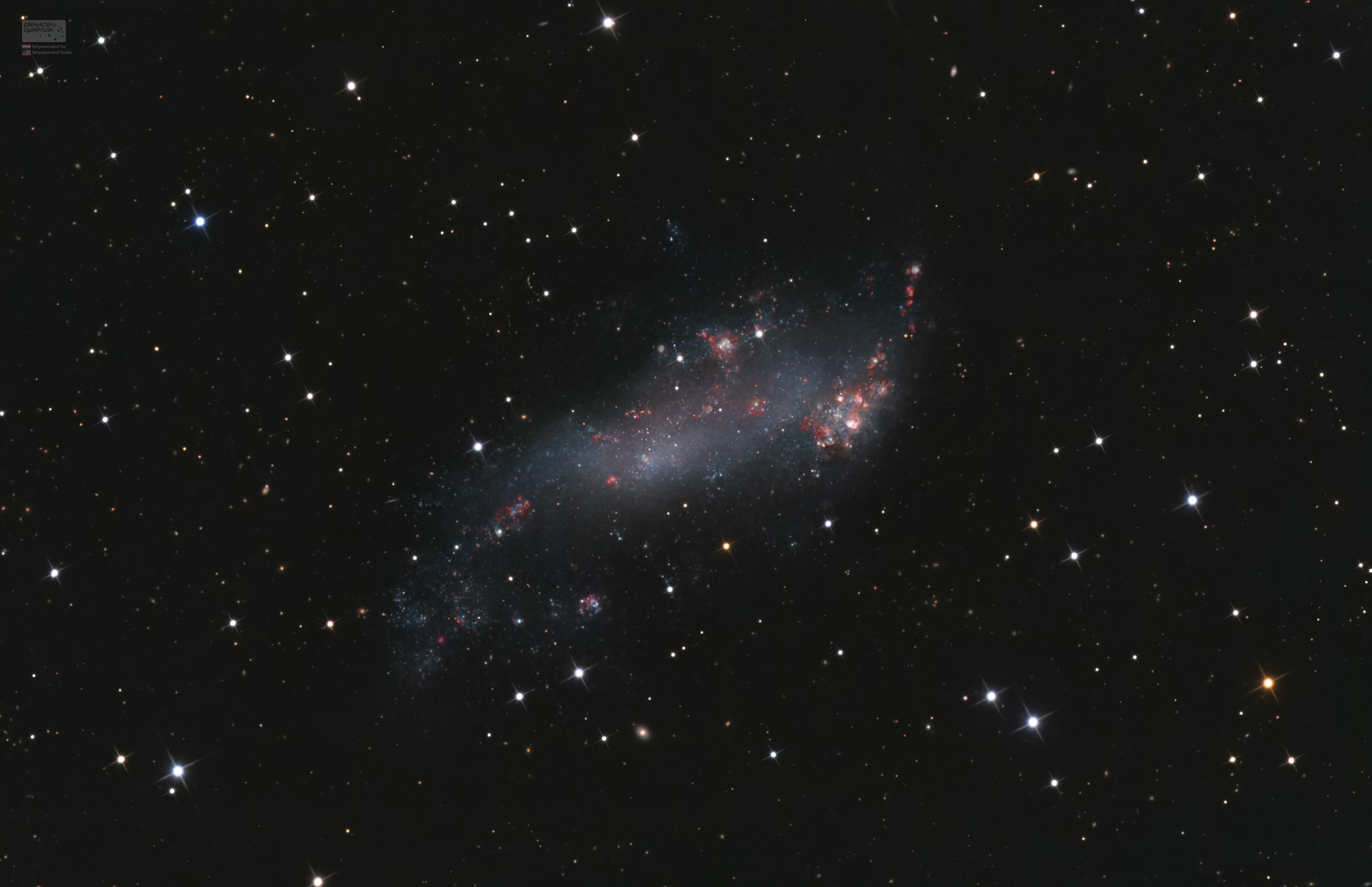
ASTRONOMY - IC 2574: Coddington's Nebula
2025 February 6
Image Credit & Copyright: Lorand Fenyes
Explanation: Grand spiral galaxies often seem to get all the glory, flaunting their young, bright, blue star clusters in beautiful, symmetric spiral arms. But small, irregular galaxies form stars too. In fact dwarf galaxy IC 2574 shows clear evidence of intense star forming activity in its telltale reddish regions of glowing hydrogen gas. Just as in spiral galaxies, the turbulent star-forming regions in IC 2574 are churned by stellar winds and supernova explosions spewing material into the galaxy's interstellar medium and triggering further star formation. A mere 12 million light-years distant, IC 2574 is part of the M81 group of galaxies, seen toward the northern constellation Ursa Major. Also known as Coddington's Nebula, the lovely island universe is about 50,000 light-years across, discovered by American astronomer Edwin Coddington in 1898.
ASTRONOMY - Juno Flyby of Ganymede and Jupiter
2025 December 14 Juno Flyby of Ganymede and Jupiter Video Credit: NASA , JPL-Caltech , SWRI , MSSS ; Animation: Koji Kuramura , Geral...
-
2022 September 26 All the Water on Planet Earth Illustration Credit: Jack Cook, Adam Nieman, Woods Hole Oceanographic Institution ; Data ...
-
2025 May 11 The Surface of Venus from Venera 14 Image Credit: Soviet Planetary Exploration Program , Venera 14 ; Processing & Copyri...