Nombre total de pages vues
17/03/2025
SANTé/MEDECINE - L'IRM pour voir les régions qui s'activent dans le cerveau
ASTRONOMY - Thor's Helmet
2025 March 17
Image Credit & Copyright: Brian Hopkins (East Coast Astronomer)
Explanation: Thor not only has his own day (Thursday), but a helmet in the heavens. Popularly called Thor's Helmet, NGC 2359 is a hat-shaped cosmic cloud with wing-like appendages. Heroically sized even for a Norse god, Thor's Helmet is about 30 light-years across. In fact, the cosmic head-covering is more like an interstellar bubble, blown by a fast wind from the bright, massive star near the bubble's center. Known as a Wolf-Rayet star, the central star is an extremely hot giant thought to be in a brief, pre-supernova stage of evolution. NGC 2359 is located about 15,000 light-years away toward the constellation of the Great Overdog. This sharp image is a mixed cocktail of data from narrowband filters, capturing not only natural looking stars but details of the nebula's filamentary structures. The star in the center of Thor's Helmet is expected to explode in a spectacular supernova sometime within the next few thousand years.
16/03/2025
LA TERRE VUE DU CIEL - Culture du raisin le long du fleuve Orange
ASTRONOMY - Venus and the Triply Ultraviolet Sun
2025 March 16
Image Credit: NASA/SDO & the AIA, EVE, and HMI teams; Digital Composition: Peter L. Dove
Explanation: This was a very unusual type of solar eclipse. Typically, it is the Earth's Moon that eclipses the Sun. In 2012, though, the planet Venus took a turn. Like a solar eclipse by the Moon, the phase of Venus became a continually thinner crescent as Venus became increasingly better aligned with the Sun. Eventually the alignment became perfect and the phase of Venus dropped to zero. The dark spot of Venus crossed our parent star. The situation could technically be labeled a Venusian annular eclipse with an extraordinarily large ring of fire. Pictured here during the occultation, the Sun was imaged in three colors of ultraviolet light by the Earth-orbiting Solar Dynamics Observatory, with the dark region toward the right corresponding to a coronal hole. Hours later, as Venus continued in its orbit, a slight crescent phase appeared again. The next Venusian transit across the Sun will occur in 2117.
15/03/2025
ASTRONOMY - Tololo Totality
Image Credit & Copyright: Petr Horálek/CTIO (Cerro Tololo Observatory) /AURA/NSF/ NOIRLab
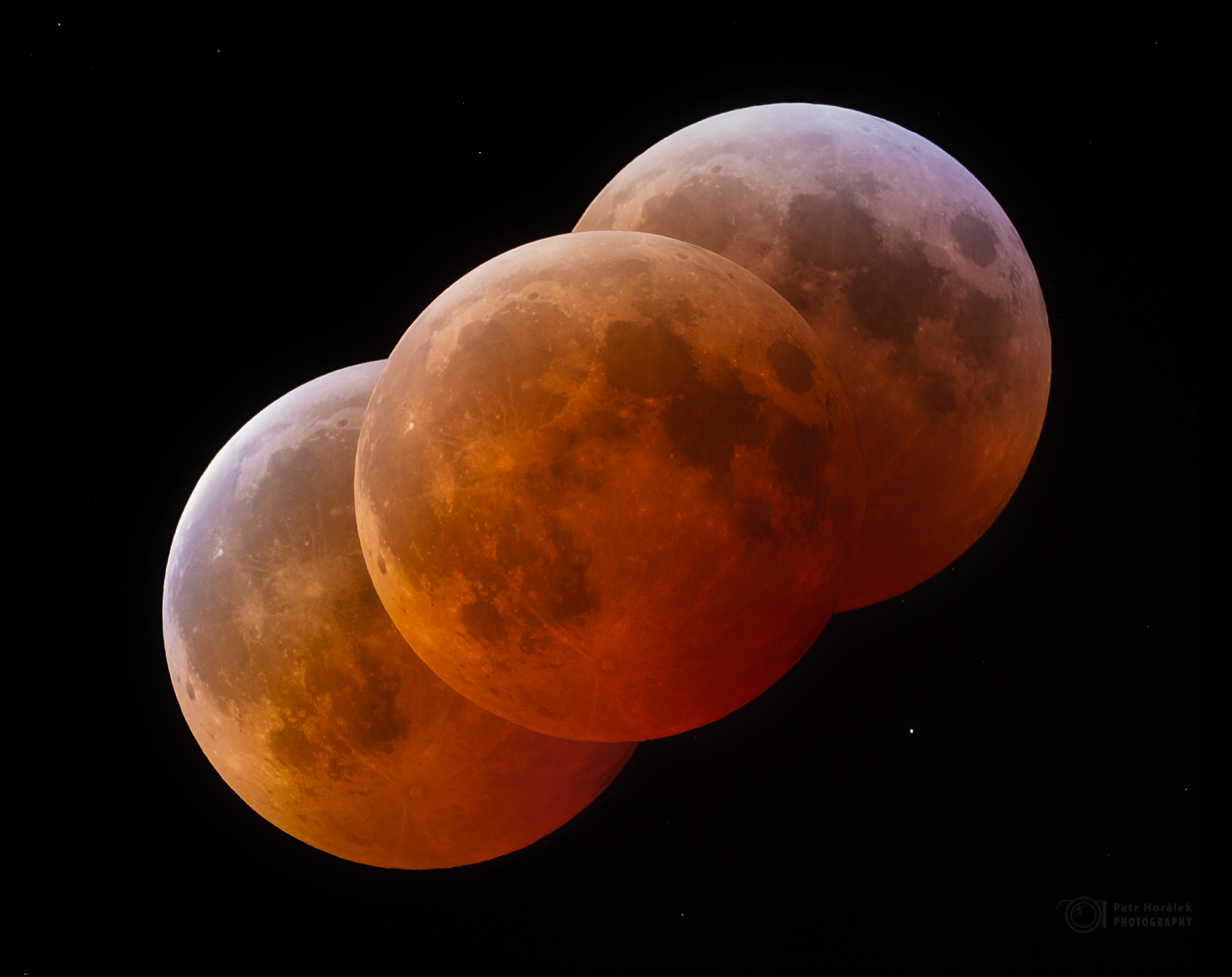
Explanation: On March 14 the Moon was Full. In an appropriate celebration of Pi day, that put the Moon 3.14 radians (180 degrees) in ecliptic longitude from the Sun in planet Earth's sky. As a bonus for fans of Pi and the night sky, on that date the Moon also passed directly through Earth's umbral shadow in a total lunar eclipse. In clear skies, the colors of an eclipsed Moon can be vivid. Reflecting the deeply reddened sunlight scattered into Earth's shadow, the darkened lunar disk was recorded in this time series composite image from Cerro Tololo Observatory, Chile. The lunar triptych captures the start, middle, and end of the total eclipse phase that lasted about an hour. A faint bluish tint seen just along the brighter lunar limb at the shadow's edge is due to sunlight filtered through Earth's stratospheric ozone layer.
14/03/2025
ARCHEOLOGIE - Les sarcophages - ultimes demeures de Toutânkhamon
ASTRONOMY - Moon Pi and Mountain Shadow
2025 March 14
Image Credit & Copyright: Daniel Lopez (El Cielo de Canarias)
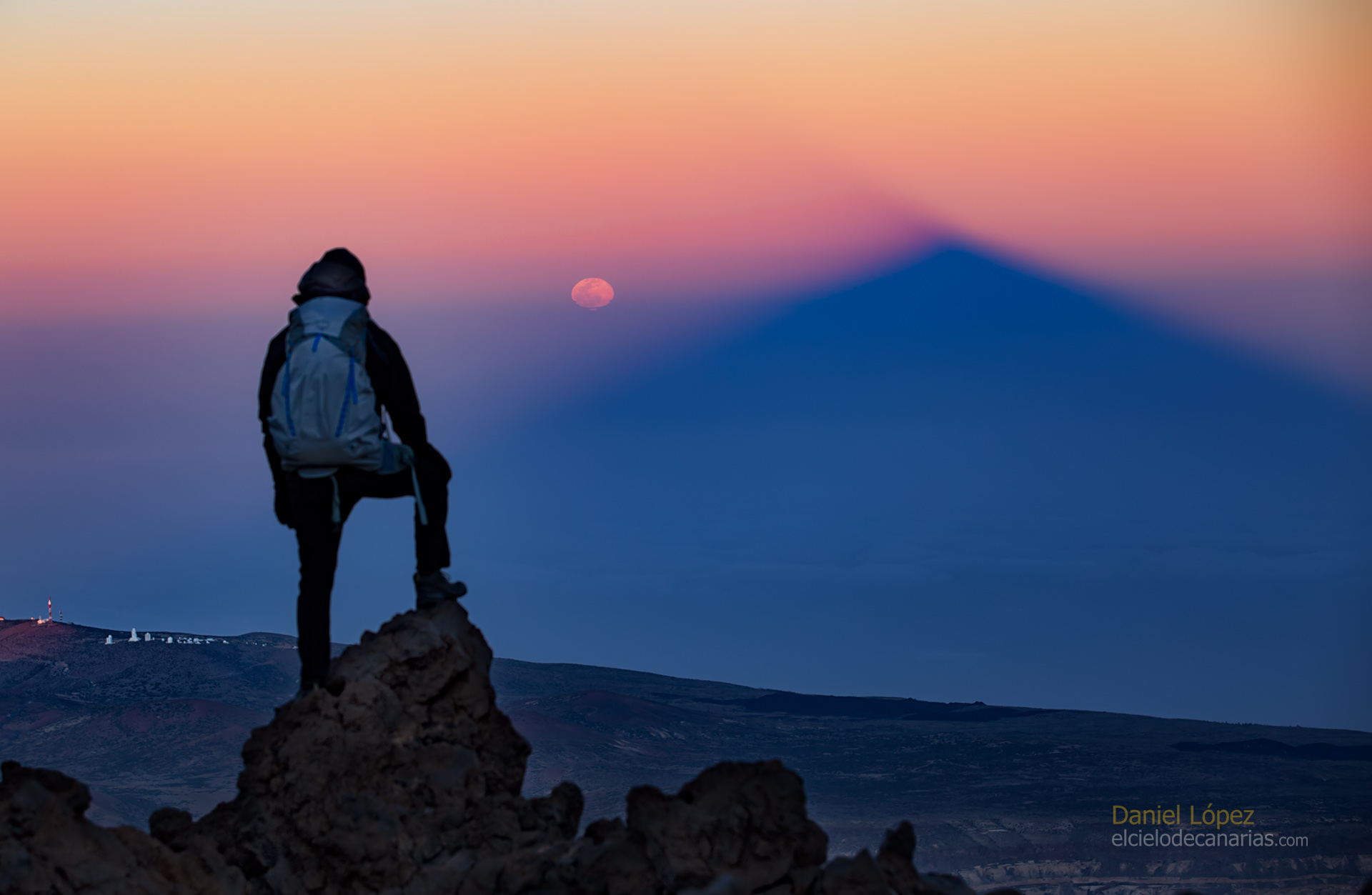
Explanation: What phase of the Moon is 3.14 radians from the Sun? The Full Moon, of course. Even though the Moon might look full for several days, the Moon is truly at its full phase when it is Pi radians (aka 180 degrees) from the Sun in ecliptic longitude. That's opposite the Sun in planet Earth's sky. Rising as the Sun set on March 9, 2020, only an hour or so after the moment of its full phase, this orange tinted and slightly flattened Moon still looked full. It was photographed opposite the setting Sun from Teide National Park on the Canary Island of Tenerife. Also opposite the setting Sun, seen from near the Teide volcano peak about 3,500 meters above sea level, is the mountain's rising triangular shadow extending into Earth's dense atmosphere. Below the distant ridge line on the left are the white telescope domes of Teide Observatory. Today, March 14 2025, the moon is Pi radians from the Sun at exactly 06:55 UTC. That's about three minutes before the midpoint of the March Full Moon's total lunar eclipse.
13/03/2025
ORNITHOLOGIE - Le Caïque à capuchon
ASTRONOMY - The Protostars within Lynds 483
2025 March 13
Image Credit: NASA, ESA, CSA,
Explanation: Two protostars are hidden in a single pixel near the center of a striking hourglass-shaped nebula in this near-infrared image from the James Webb Space Telescope. The actively forming star system lies in a dusty molecular cloud cataloged as Lynds 483, some 650 light-years distant toward the constellation Serpens Cauda. Responsible for the stunning bipolar outflows, the collapsing protostars have been blasting out collimated energetic jets of material over tens of thousands of years. Webb's high-resolution view shows the violence of star-formation in dramatic detail as twisting shock fronts expand and collide with slower, denser material. The premier close-up of the star-forming region spans less than 1/2 a light-year within dark nebula Lynds 483.
12/03/2025
ASTRONOMY - NGC 772: The Fiddlehead Galaxy
2025 March 12
Image Credit & Copyright: Jean-François Bax & Serge Brunier, OCA/C2PU; Text:
Explanation: Why does this galaxy look like a curly vegetable? The Fiddlehead spiral galaxy likely gets its distorted spiral appearance from a gravitational interaction with its close-by elliptical companion NGC 770, seen just below. Cataloged as NGC 772 and Arp 78, the Fiddlehead spans over 200,000 light years, is a nearby 100 million light years beyond the stars of our Milky Way galaxy, and is visible toward the constellation of the Ram (Aries). But in the featured image, the Fiddlehead appears to have another companion -- one with a long and fuzzy tail: Comet 43P/Wolf-Harrington. Though the comet appears to be aimed straight at the massive galaxy, it is actually much closer to us, residing only light minutes away -- well within our Solar System. The comet will never reach the distant spiral galaxy, nor is it physically related to it. By a fortunate trick of perspective, though, these two cosmic wonders briefly share the same frame taken late last year from Calern, France.
Astronomy - R3PanSTARRS : AN ORION COMET
2026 May 15 R3 PanSTARRS: An Orion Comet Image Credit & Copyright: Chester Hall-Fernandez Explanation: Comet R3 PanSTARRS might be be...
-
Imaginez un monde où le cancer n’est plus une sentence, mais une simple étape à franchir. Grâce à une découverte révolutionnaire, ce rêve es...
-
2026 January 1 Auroral Corona Image Credit & Copyright : Roi Levi Explanation: Cycle 25 solar maximum made 2025 a great year for ...