2025 May 19
Nombre total de pages vues
19/05/2025
ASTRONOMY - Charon Flyover from New Horizons
SANTé/MEDECINE - L'ADN des bactéries -
18/05/2025
LA TERRE VUE DU CIEL - Le printemps du lac Baïkal
ASTRONOMY - Pluto Flyover from New Horizons
Video Credit: NASA, JHUAPL, SwRI, P. Schenk & J. Blackwell (LPI); Music Open Sea Morning by Puddle of Infinity
Explanation: What if you could fly over Pluto -- what might you see? The New Horizons spacecraft did just this in 2015 July as it shot past the distant world at a speed of about 80,000 kilometers per hour. Images from this spectacular passage have been color enhanced, vertically scaled, and digitally combined into the featured two-minute time-lapse video. As your journey begins, light dawns on mountains thought to be composed of water ice but colored by frozen nitrogen. Soon, to your right, you see a flat sea of mostly solid nitrogen that has segmented into strange polygons that are thought to have bubbled up from a comparatively warm interior. Craters and ice mountains are common sights below. The video dims and ends over terrain dubbed bladed because it shows 500-meter high ridges separated by kilometer-sized gaps. The robotic New Horizons spacecraft has too much momentum to ever return to Pluto and is now headed out of our Solar System.
16/05/2025
ASTRONOMY - Messier 101
2025 May 16
Image Credit: NASA, ESA, CFHT, NOAO;
Acknowledgement - K.Kuntz (GSFC), F.Bresolin (U.Hawaii), J.Trauger (JPL), J.Mould (NOAO), Y.-H.Chu (U. Illinois)
Explanation: Big, beautiful spiral galaxy M101 is one of the last entries in Charles Messier's famous catalog, but definitely not one of the least. About 170,000 light-years across, this galaxy is enormous, almost twice the size of our own Milky Way. M101 was also one of the original spiral nebulae observed by Lord Rosse's large 19th century telescope, the Leviathan of Parsontown. Assembled from 51 exposures recorded by the Hubble Space Telescope in the 20th and 21st centuries, with additional data from ground based telescopes, this mosaic spans about 40,000 light-years across the central region of M101 in one of the highest definition spiral galaxy portraits ever released from Hubble. The sharp image shows stunning features of the galaxy's face-on disk of stars and dust along with background galaxies, some visible right through M101 itself. Also known as the Pinwheel Galaxy, M101 lies within the boundaries of the northern constellation Ursa Major, about 25 million light-years away.
15/05/2025
SANTé/MEDECINE - ADN - Un caryotype coloré grâce à l'hybridation fluorescente (Fish)
LA TERRE VUE DU CIEL - Les crêtes des monts Tian
ASTRONOMY - A Plutonian Landscape
2025 May 15
Image Credit: NASA, Johns Hopkins Univ./APL, Southwest Research Institute
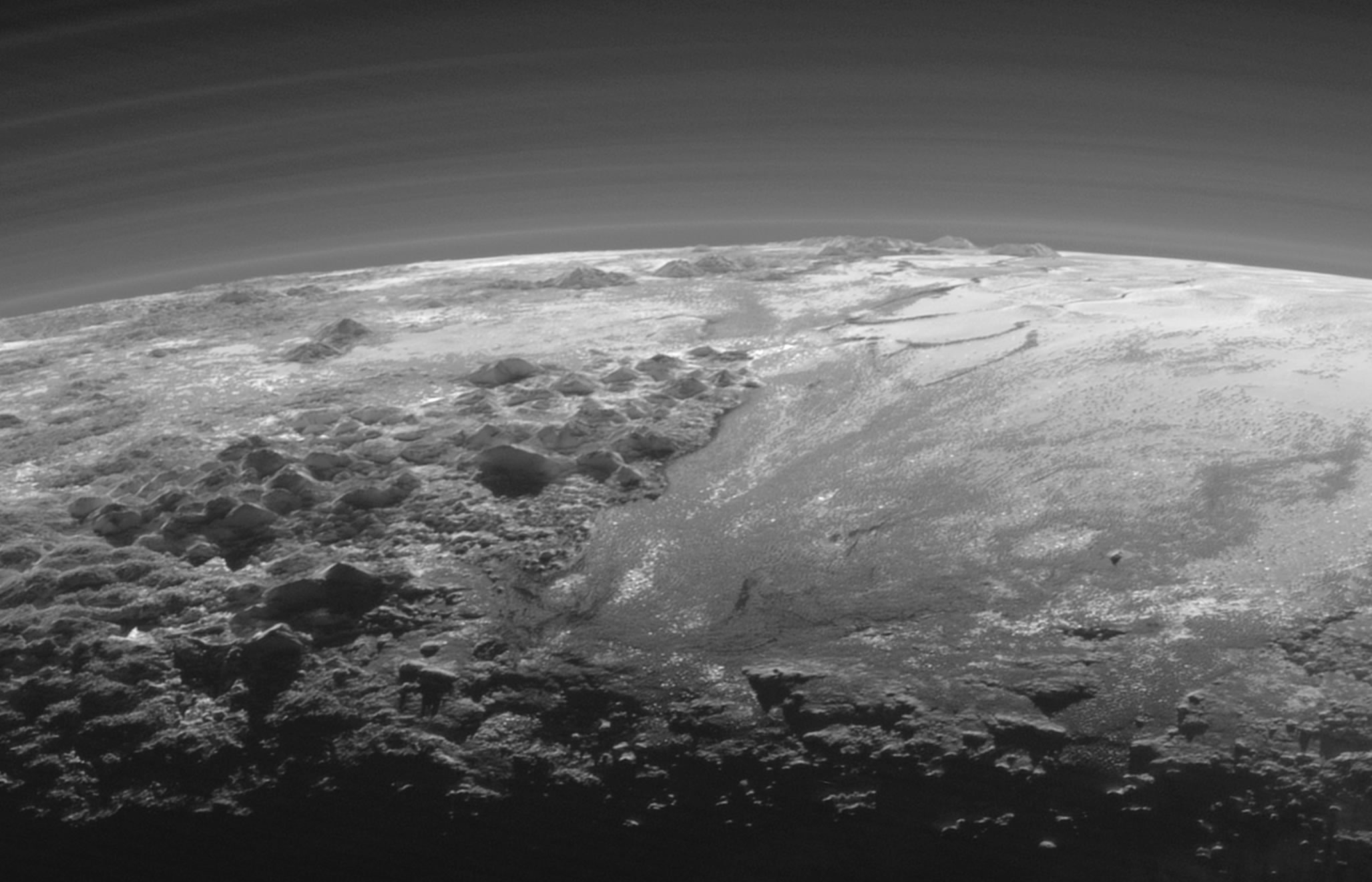
Explanation: This shadowy landscape of majestic mountains and icy plains stretches toward the horizon on a small, distant world. It was captured from a range of about 18,000 kilometers when New Horizons looked back toward Pluto, 15 minutes after the spacecraft's closest approach on July 14, 2015. The dramatic, low-angle, near-twilight scene follows rugged mountains formally known as Norgay Montes from foreground left, and Hillary Montes along the horizon, giving way to smooth Sputnik Planum at right. Layers of Pluto's tenuous atmosphere are also revealed in the backlit view. With a strangely familiar appearance, the frigid terrain likely includes ices of nitrogen and carbon monoxide with water-ice mountains rising up to 3,500 meters (11,000 feet). That's comparable in height to the majestic mountains of planet Earth. The Plutonian landscape is 380 kilometers (230 miles) across.
14/05/2025
SANTé/MEDECINE - ADN - Les chromosomes du génome humain
ASTRONOMY - NGC 1360: The Robin's Egg Nebula
2025 May 14
Image Credit & Copyright: Andrea Iorio, Vikas Chander & ShaRA Team
Explanation: This pretty nebula lies some 1,500 light-years away, its shape and color in this telescopic view reminiscent of a robin's egg. The cosmic cloud spans about 3 light-years, nestled securely within the boundaries of the southern constellation of the Furnace (Fornax). Recognized as a planetary nebula, egg-shaped NGC 1360 doesn't represent a beginning, though. Instead, it corresponds to a brief and final phase in the evolution of an aging star. In fact, visible at the center of the nebula, the central star of NGC 1360 is known to be a binary star system likely consisting of two evolved white dwarf stars, less massive but much hotter than the Sun. Their intense and otherwise invisible ultraviolet radiation has stripped away electrons from the atoms in their mutually surrounding gaseous shroud. The blue-green hue inside of NGC 1360 seen here is the strong emission produced as electrons recombine with doubly ionized oxygen atoms.
Astronomy - R3PanSTARRS : AN ORION COMET
2026 May 15 R3 PanSTARRS: An Orion Comet Image Credit & Copyright: Chester Hall-Fernandez Explanation: Comet R3 PanSTARRS might be be...
-
Imaginez un monde où le cancer n’est plus une sentence, mais une simple étape à franchir. Grâce à une découverte révolutionnaire, ce rêve es...
-
2026 January 1 Auroral Corona Image Credit & Copyright : Roi Levi Explanation: Cycle 25 solar maximum made 2025 a great year for ...