La France vue de l'espace
© Jacques Descloitres, Modis
2025 June 27

Explanation: Big beautiful barred spiral galaxy Messier 109 is the 109th entry in Charles Messier's famous catalog of bright Nebulae and Star Clusters. You can find it just below the Big Dipper's bowl in the northern constellation Ursa Major. In fact, bright dipper star Phecda, Gamma Ursa Majoris, produces the glare at the upper right corner of this telescopic frame. M109's prominent central bar gives the galaxy the appearance of the Greek letter "theta", θ, a common mathematical symbol representing an angle. M109 spans a very small angle in planet Earth's sky though, about 7 arcminutes or 0.12 degrees. But that small angle corresponds to an enormous 120,000 light-year diameter at the galaxy's estimated 60 million light-year distance. The brightest member of the now recognized Ursa Major galaxy cluster, M109 (aka NGC 3992) is joined by spiky foreground stars. Three small, fuzzy bluish galaxies also on the scene, identified (top to bottom) as UGC 6969, UGC 6940 and UGC 6923, are possibly satellite galaxies of the larger barred spiral galaxy Messier 109.

2025 June 26


Explanation: This interstellar skyscape spans over 4 degrees across crowded starfields toward the constellation Sagittarius and the central Milky Way. A First Look image captured at the new NSF–DOE Vera C. Rubin Observatory, the bright nebulae and star clusters featured include famous stops on telescopic tours of the cosmos: Messier 8 and Messier 20. An expansive star-forming region over a hundred light-years across, Messier 8 is also known as the Lagoon Nebula. About 4,000 light-years away the Lagoon Nebula harbors a remarkable cluster of young, massive stars. Their intense radiation and stellar winds energize and agitate this cosmic lagoon's turbulent depths. Messier 20's popular moniker is the Trifid. Divided into three parts by dark interstellar dust lanes, the Trifid Nebula's glowing hydrogen gas creates its dominant red color. But contrasting blue hues in the colorful Trifid are due to dust reflected starlight. The Rubin Observatory visited the Trifid-Lagoon field to acquire all the image data during parts of four nights (May 1-4). At full resolution, Rubin's magnificent Sagittarius skyscape is 84,000 pixels wide and 51,500 pixels tall.


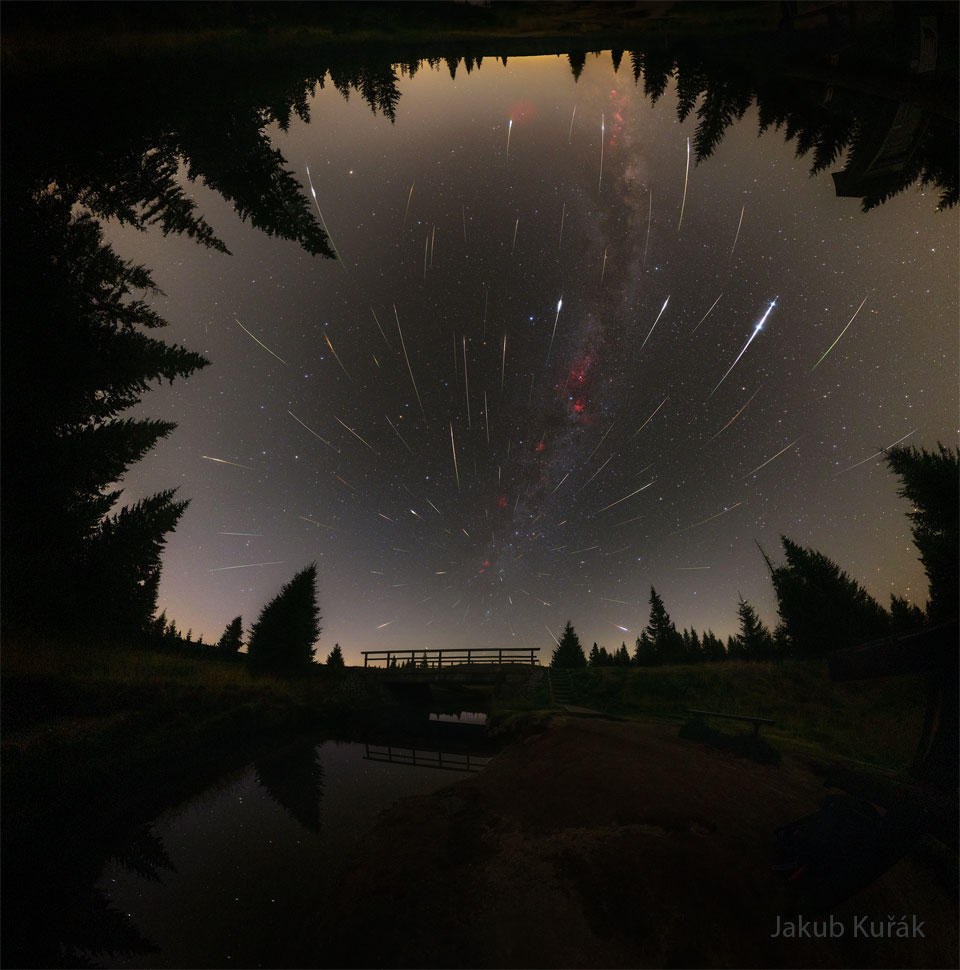
2026 August 18 Perseids from Perseus Image Credit & Copyright: Jakub Kuřák Explanation: This was a good year for the Perseids meteor sh...