Nombre total de pages vues
05/10/2025
SANTé/MEDECINE - La grossesse mois par mois - 3ème mois
ASTRONOMY - M27: Not a Comet
2024 October 5
Image Credit & Copyright: Francesco Sferlazza, Franco Sgueglia
Explanation: While hunting for comets in the skies above 18th century France, astronomer Charles Messier diligently kept a list of the things encountered during his telescopic expeditions that were definitely not comets. This is number 27 on his now famous not-a-comet list. In fact, 21st century astronomers would identify it as a planetary nebula, but it's not a planet either, even though it may appear round and planet-like in a small telescope. Messier 27 (M27) is an excellent example of a gaseous emission nebula created as a sun-like star runs out of nuclear fuel in its core. The nebula forms as the star's outer layers are expelled into space, with a visible glow generated by atoms excited by the dying star's intense but invisible ultraviolet light. Known by the popular name of the Dumbbell Nebula, the beautifully symmetric interstellar gas cloud is over 2.5 light-years across and about 1,200 light-years away in the constellation Vulpecula. This impressive color image highlights details within the well-studied central region and fainter, seldom imaged features in the nebula's outer halo.
04/10/2025
ASTRONOMY - Sardinia Sunset
2025 September 6
Image Credit & Copyright: Lorenzo Busilacchi
Explanation: When the sun sets on September 7, the Full Moon will rise. And on that date denizens around much of our fair planet, including parts of Antarctica, Australia, Asia, Europe, and Africa can witness a total lunar eclipse, with the Moon completely immersed in Earth's shadow. As the bright Full Moon first enters Earth's shadow it will darken, finally taking on a reddish hue during the total eclipse phase. In fact, the color of the Moon during a total lunar eclipse is due to reddened light from sunrises and sunsets around planet Earth. The reddened sunlight is scattered by a dense atmosphere into the planet's otherwise dark central shadow. When the sun set on August 22, this telephoto snapshot of red skies, blue sea, and the Mangiabarche Lighthouse was captured from Sant'Antioco, Sardinia, Italy.
02/10/2025
ASTRONOMIE - Iréelle
01/10/2025
ASTRONOMY - NGC 6960: The Witch's Broom Nebula
2025 October 1
Image Credit & Copyright: Brian Meyers
Explanation: Ten thousand years ago, before the dawn of recorded human history, a new light would suddenly have appeared in the night sky and faded after a few weeks. Today we know this light was from a supernova, or exploding star, and record the expanding debris cloud as the Veil Nebula, a supernova remnant. This sharp telescopic view is centered on a western segment of the Veil Nebula cataloged as NGC 6960 but less formally known as the Witch's Broom Nebula. Blasted out in the cataclysmic explosion, an interstellar shock wave plows through space sweeping up and exciting interstellar material. Imaged with narrow band filters, the glowing filaments are like long ripples in a sheet seen almost edge on, remarkably well separated into atomic hydrogen (red) and oxygen (blue-green) gas. The complete supernova remnant lies about 1400 light-years away towards the constellation Cygnus. This Witch's Broom actually spans about 35 light-years. The bright star in the frame is 52 Cygni, visible with the unaided eye from a dark location but unrelated to the ancient supernova remnant.
30/09/2025
SANTé/MEDECINE - La grossesse mois par mois - 2ème mois
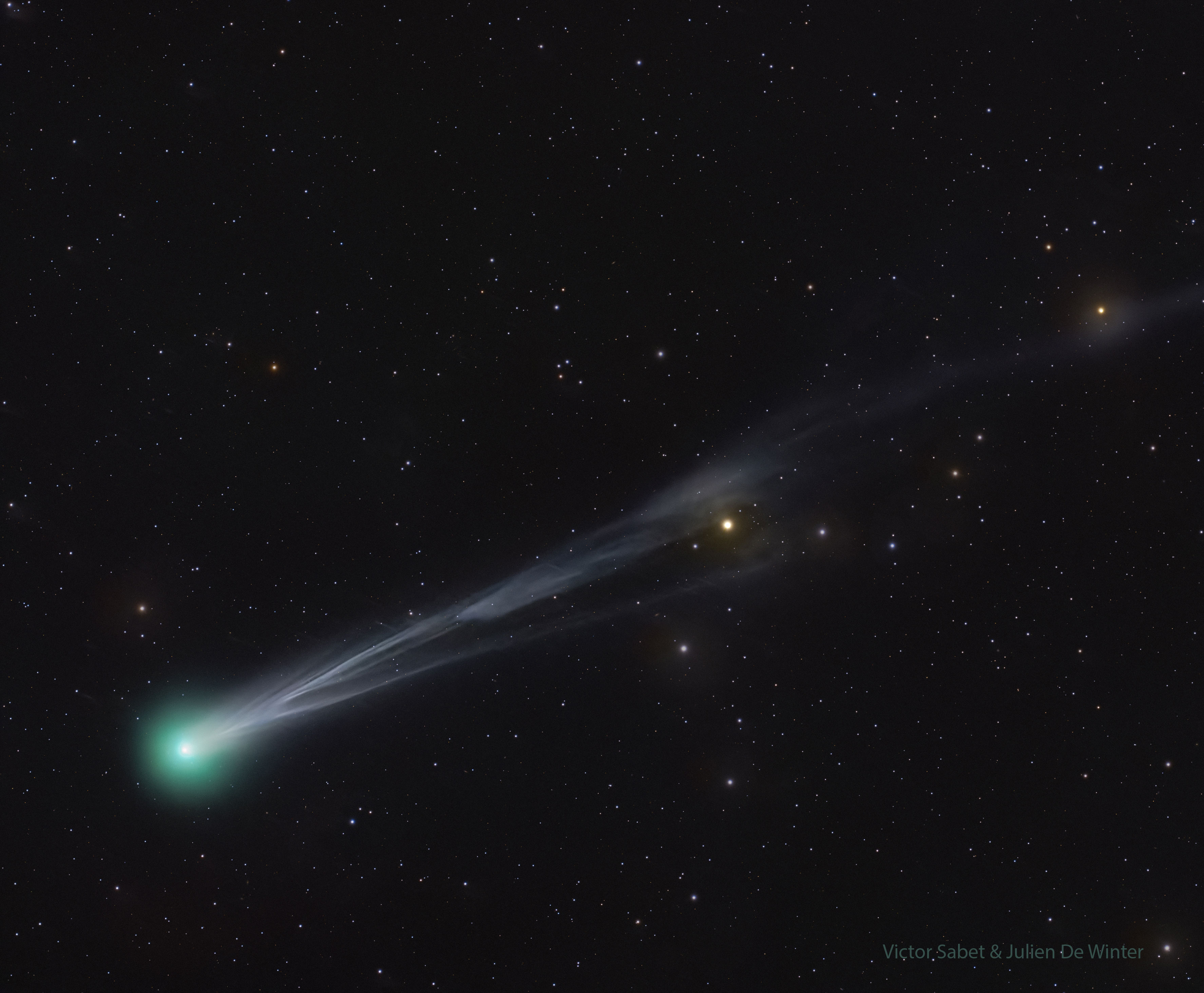
ASTRONOMY - Comet Lemmon Brightens
2025 September 30
Image Credit & Copyright: Victor Sabet & Julien De Winter
Explanation: Comet Lemmon is brightening and moving into morning northern skies. Besides Comet SWAN25B and Comet ATLAS, Comet C/2025 A6 (Lemmon) is now the third comet currently visible with binoculars and on long camera exposures. Comet Lemmon was discovered early this year and is still headed into the inner Solar System. The comet will round the Sun on November 8, but first it will pass its nearest to the Earth -- at about half the Earth-Sun distance -- on October 21. Although the brightnesses of comets are notoriously hard to predict, optimistic estimates have Comet Lemmon then becoming visible to the unaided eye. The comet should be best seen in predawn skies until mid-October, when it also becomes visible in evening skies. The featured image showing the comet's split and rapidly changing ion tail was taken in Texas, USA late last week.
29/09/2025
ASTRONOMY - Two Camera Comets in One Sky
Image Credit & Copyright: Luc Perrot (TWAN)
Explanation: It may look like these comets are racing, but they are not. Comets C/2025 K1 ATLAS (left) and C/2025 R2 SWAN (right) appeared near each other by chance last week in the featured image taken from France's Reunion Island in the southern Indian Ocean. Fainter Comet ATLAS is approaching our Sun and will reach its closest approach in early October when it is also expected to be its brightest -- although still only likely visible with long exposures on a camera. The brighter comet, nicknamed SWAN25B, is now headed away from our Sun, although its closest approach to Earth is expected in mid-October, when optimistic estimates have it becoming bright enough to see with the unaided eye. Each comet has a greenish coma of expelled gas and an ion tail pointing away from the Sun.
28/09/2025
ASTRONOMY - Nebulas and Clusters in Sagittarius
2025 September 17
Image Credit & Copyright: J. De Winter, C. Humbert, C. Robert & V. Sabet; Text: Ogetay Kayali (MTU)
Explanation: Can you spot famous celestial objects in this image? 18th-century astronomer Charles Messier cataloged only two of them: the bright Lagoon Nebula (M8) at the bottom, and the colorful Trifid Nebula (M20) at the upper right. The one on the left that resembles a cat's paw is NGC 6559, and it is much fainter than the other two. Even harder to spot are the thin blue filaments on the left, from supernova remnant (SNR G007.5-01.7). Their glow comes from small amounts of glowing oxygen atoms that are so faint that it took over 17 hours of exposure with just one blue color to bring up. Framing this scene of stellar birth and death are two star clusters: the open cluster M21 just above Trifid, and the globular cluster NGC 6544 at lower left.
Astronomy - HICKSON 44 IN LEO
2026 March 27 Hickson 44 in Leo Image Credit & Copyright : Peter Kennett Explanation: Scanning the skies for galaxies, Canadian astr...
-
2025 May 11 The Surface of Venus from Venera 14 Image Credit: Soviet Planetary Exploration Program , Venera 14 ; Processing & Copyri...
-
2022 September 26 All the Water on Planet Earth Illustration Credit: Jack Cook, Adam Nieman, Woods Hole Oceanographic Institution ; Data ...