Nombre total de pages vues

05/11/2025

LES BELLES I?VENTIONS DE LEONARD DE VINCI - La vis d'Archimède et l'ingénierie hydraulique


Léonard de Vinci était passionné par l'ingénierie hydraulique et par les travaux d'Archimède. On voit donc ici une vis d'Archimède mise en rotation à la main et qui pouvait servir de pompe pour faire remonter de l'eau.

© Crochet.david, CC by-sa 3.0

SANTé/MéDECINE - CANCER - 12 AVANCéES REVOLUTIONNAIRES - 1. Une injection de 7 minutes qui remplace une heure de traitement


En Angleterre, le système de santé public (NHS) va devenir le premier à proposer une injection contre le cancer administrée en seulement 7 minutes. Cette avancée remarquable utilise le médicament Atezolizumab, déjà reconnu pour son efficacité contre les cancers du sein et du poumon. Jusqu’à présent, ce traitement était administré par perfusion pendant une heure, une méthode longue et éprouvante. Grâce à cette innovation, 3 600 patients vont désormais bénéficier de ce format injectable rapide, beaucoup plus confortable au quotidien.

LaNatureCa

04/11/2025

NUCLEAIRE - Contamination - Indonésie : la situation est-elle vraiment sous contrôle ?

Fin septembre 2025, le gouvernement indonésien révélait que les crevettes contaminées au césium 137 détectées aux USA provenaient d’une zone industrielle à 50 kilomètres à l’ouest de Java. L’usine de conditionnement est proche d’une aciérie où aurait été fondue par erreur une source de césium 137. Plus d’un mois plus tard, la situation reste très préoccupante et de nombreuses zones d’ombre subsistent.

Le dernier communiqué (1), publié le 27 octobre par l’agence de presse officielle Antara, se veut rassurant : 21 usines sur 22 auraient été « décontaminées avec succès » et « le processus de décontamination devrait être achevé au plus tard en décembre ».

Mais en l’absence de données chiffrées (cartographie des niveaux de rayonnement, résultats des contrôles sanitaires), impossible de connaître la réalité de la situation.

Et les quelques précisions apportées par le texte ont de quoi inquiéter : 91 habitant·es ont été évacué·es, au-delà des 22 usines on compte 12 autres sites considérés comme contaminés, dont « des terrains vagues, des étals et des zones résidentielles », et 371 tonnes de matériaux ont été transférés sur un site de stockage provisoire.

Un reportage publié le 25 octobre par l’ONG Mongabay (2) permet de saisir les conséquences humaines de la catastrophe. On y découvre le témoignage d’un couple habitant à 1 kilomètre au sud de l’aciérie. Sakinah travaillait dans l’usine de conditionnement de crevettes BMS, et Roni dans l’aciérie PMT. Comme des centaines de personnes, Sakinah et Roni ont cessé de travailler depuis plus d’un mois, sans indemnité de licenciement.

“À la mi-septembre, Roni et Sakinah avaient tous deux subi des examens médicaux. Les analyses sanguines ont confirmé qu’ils avaient été exposés à des radiations. Roni s’est vu prescrire du Radiogardase (3), un médicament destiné à éliminer le césium 137 de l’organisme. Il en prend neuf par jour, trois à la fois, à partir d’une boîte de 63 comprimés. Sakinah n’a pas eu cette chance. Sur son ancien lieu de travail, les examens médicaux étaient sommaires : un bref examen, et guère plus. ‘‘Je n’ai pas reçu de médicaments comme mon mari, seulement des vitamines. Maintenant, les vitamines sont finies’’, a-t-elle déclaré”.

Côté Europe, c’est toujours le silence radio. L’Union Européenne est-elle concernée par des importations provenant des entreprises BMS (pour les crevettes) ou NJS (pour les clous de girofle) ? Un inventaire des autres entreprises indonésiennes exportatrices de denrées, alimentaires ou non, a-t-il été réalisé, et des contrôles ont-ils été effectués ? La CRIIRAD attend toujours les réponses des autorités.

CRIIRAD

03/11/2025

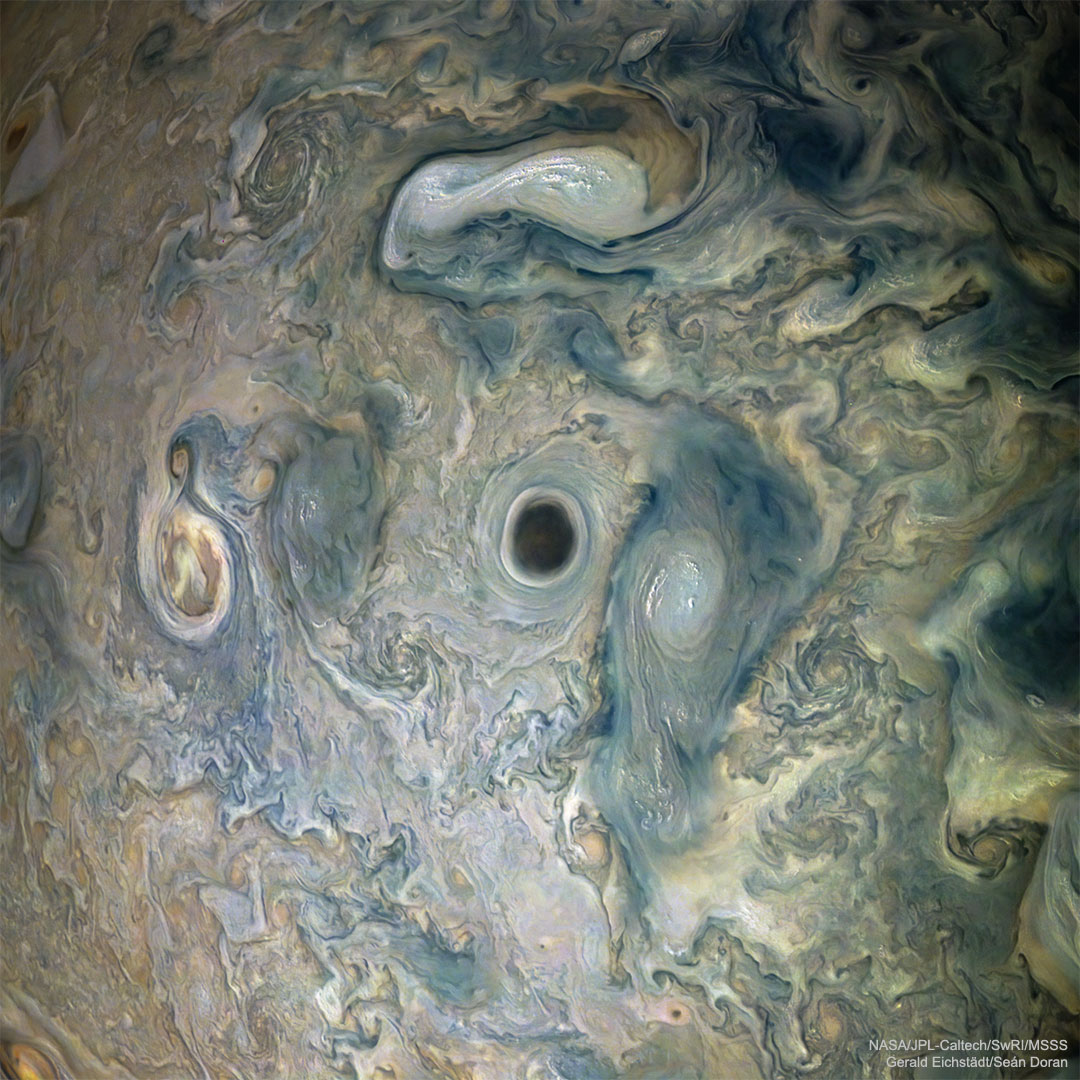
ASTRONOMY - Jupiter Abyss

 2024 November 3

Swirling clouds on the planet Jupiter are pictured, mostly
in white, tan, and light blue. A dark spot appears in the center
surrounded by swirling white and blue clouds. 
Please see the explanation for more detailed information.

Jupiter Abyss
Image Credit: NASAJunoSwRIMSSSProcessing & LicenseGerald Eichstädt & Sean Doran

Explanation: What's that black spot on Jupiter? No one is sure. During one pass of NASA's Juno over Jupiter, the robotic spacecraft imaged an usually dark cloud feature informally dubbed the Abyss. Surrounding cloud patterns show the Abyss to be at the center of a vortex. Since dark features on Jupiter's atmosphere tend to run deeper than light features, the Abyss may really be the deep hole that it appears -- but without more evidence that remains conjecture. The Abyss is surrounded by a complex of meandering clouds and other swirling storm systems, some of which are topped by light colored, high-altitude clouds. The featured image was captured in 2019 while Juno passed only about 15,000 kilometers above Jupiter's cloud tops. The next close pass of Juno near Jupiter will be in about three weeks.

01/11/2025

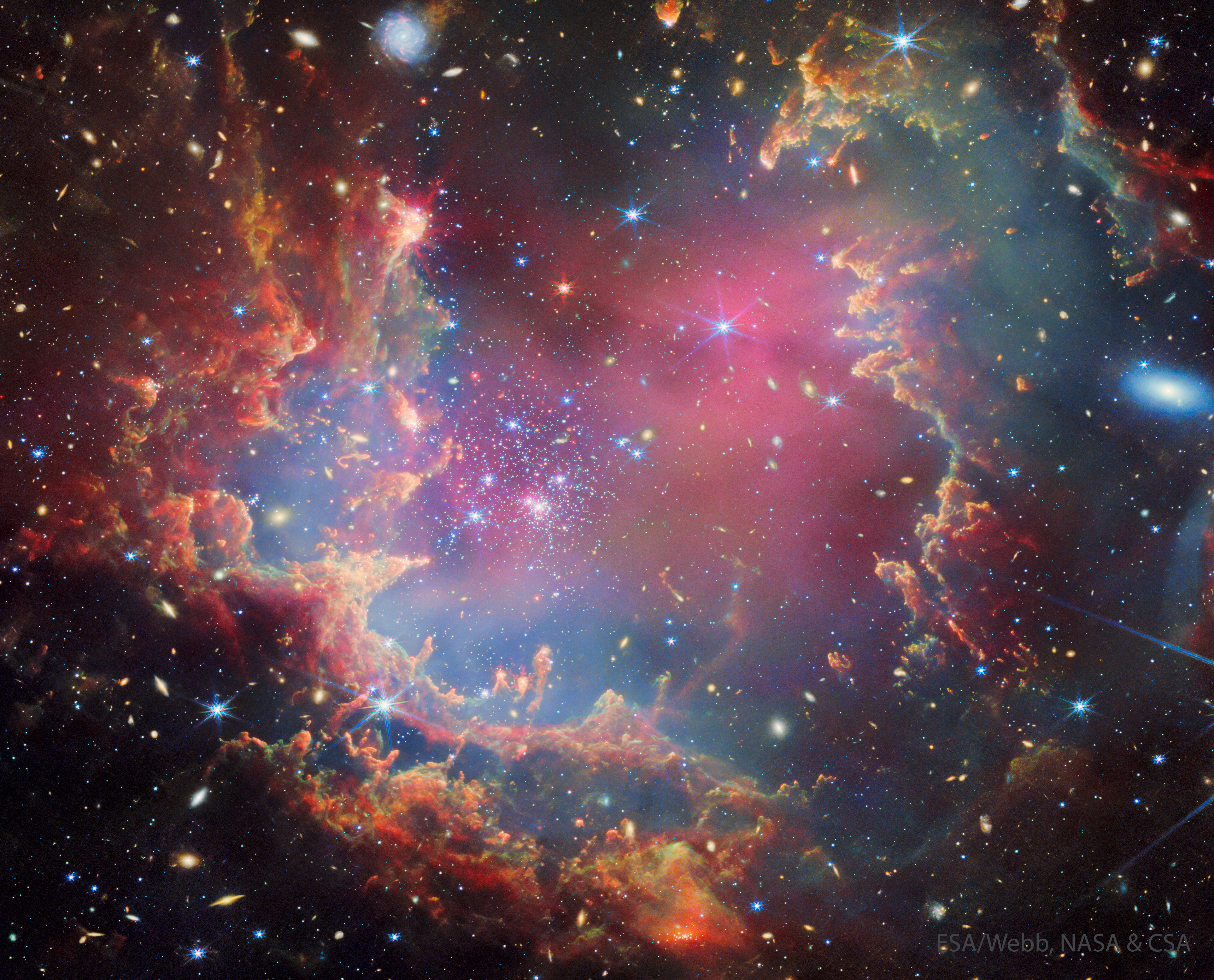
ASTRONOMY - NGC 602: Stars Versus Pillars from Webb

 2024 October 29

A starfield is shown featuring many stars in the center
and many pillars of interstellar dust around the edges
pointing toward the center. The main image is in infrared
light, and a rollover image from Hubble shows the same
scene in visible light.
Please see the explanation for more detailed information.

NGC 602: Stars Versus Pillars from Webb
Credit: ESA/WebbNASA & CSAP. ZeidlerE. SabbiA. NotaM. Zamani (ESA/Webb)

Explanation: The stars are destroying the pillars. More specifically, some of the newly formed stars in the image center are emitting light so energetic that is evaporating the gas and dust in the surrounding pillars. Simultaneously, the pillars themselves are still trying to form new stars. The whole setting is the star cluster NGC 602, and this new vista was taken by the Webb Space Telescope in multiple infrared colors. In comparison, a roll-over image shows the same star cluster in visible light, taken previously by the Hubble Space Telescope. NGC 602 is located near the perimeter of the Small Magellanic Cloud (SMC), a small satellite galaxy of our Milky Way galaxy. At the estimated distance of the SMC, the featured picture spans about 200 light-years. A tantalizing assortment of background galaxies are also visible -- mostly around the edges -- that are at least hundreds of millions of light-years beyond.

OCEANOGRAPHIE - L'importance scientifique de la vague Draupner

L'impact le plus important de la vague Draupner n'a pas été les dégâts causés, mais les données qu'elle a fournies. Pour la première fois, une vague scélérate avait été directement mesurée en pleine mer, fournissant aux scientifiques des preuves tangibles de l'existence de ces géantes soudaines et imposantes.

©Getty Images

28/10/2025

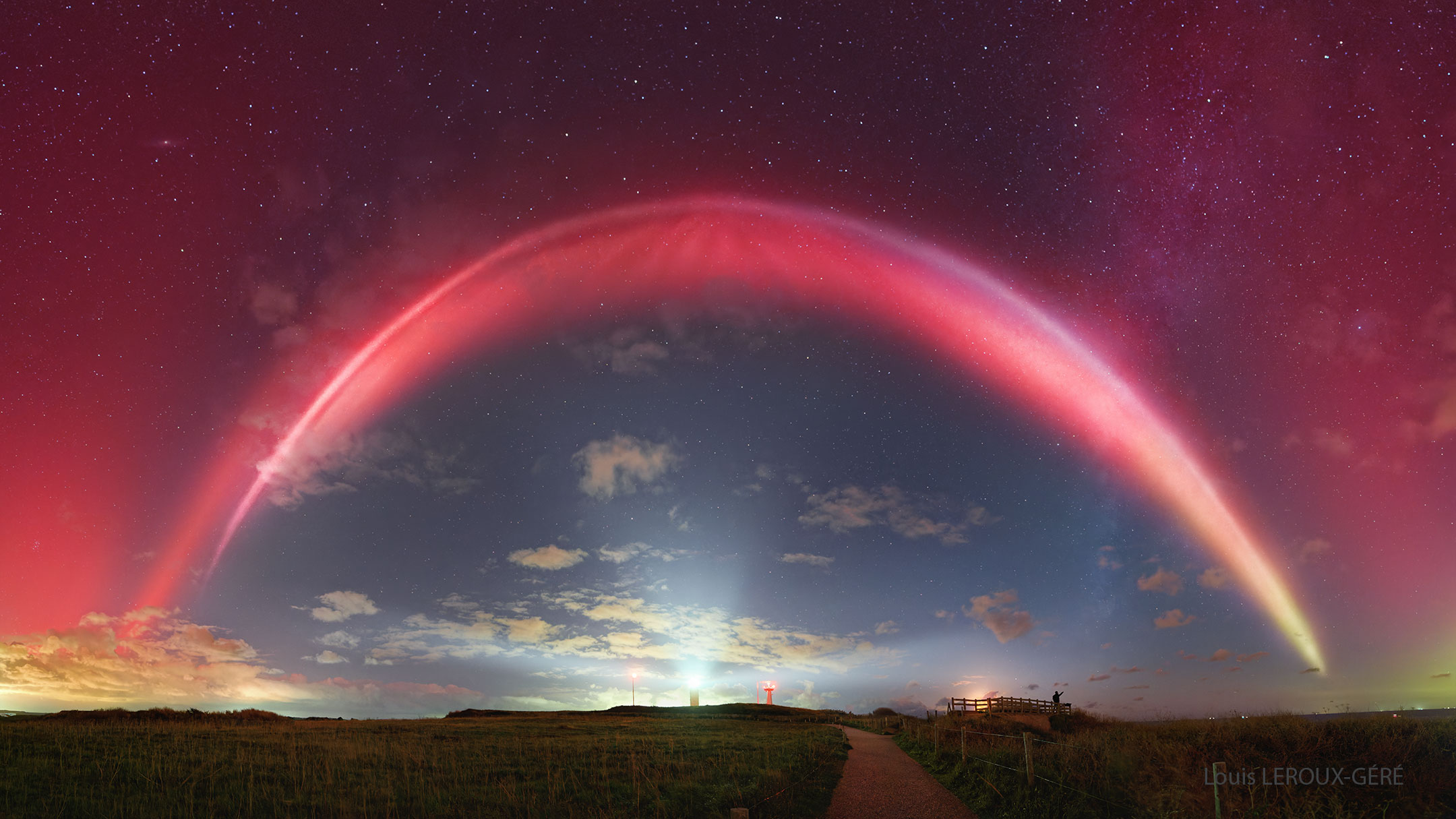
ASTRONOMY - STEVE: A Glowing River over France

2024 October 28
A night sky is shown with a bright red band running
overhead. Above the red band is a diffuse red glow.
A path through a grassy filed is in the foreground
with a path going out toward the horizon. 
Please see the explanation for more detailed information.

STEVE: A Glowing River over France
Credit & Copyright: Louis LEROUX-GÉRÉ

Explanation: Sometimes a river of hot gas flows over your head. In this case the river created a Strong Thermal Emission Velocity Enhancement (STEVE) that glowed bright red, white, and pink. Details of how STEVEs work remain a topic of research, but recent evidence holds that their glow results from a fast-moving river of hot ions flowing over a hundred kilometers up in the Earth's atmosphere: the ionosphere. The more expansive dull red glow might be related to the flowing STEVE, but alternatively might be a Stable Auroral Red (SAR) arc, a more general heat-related glow. The featured picture, taken earlier this month in Côte d'OpaleFrance, is a wide-angle digital composite made as the STEVE arc formed nearly overhead. Although the apparition lasted only a few minutes, this was long enough for the quick-thinking astrophotographer to get in the picture -- can you find him? 

27/10/2025

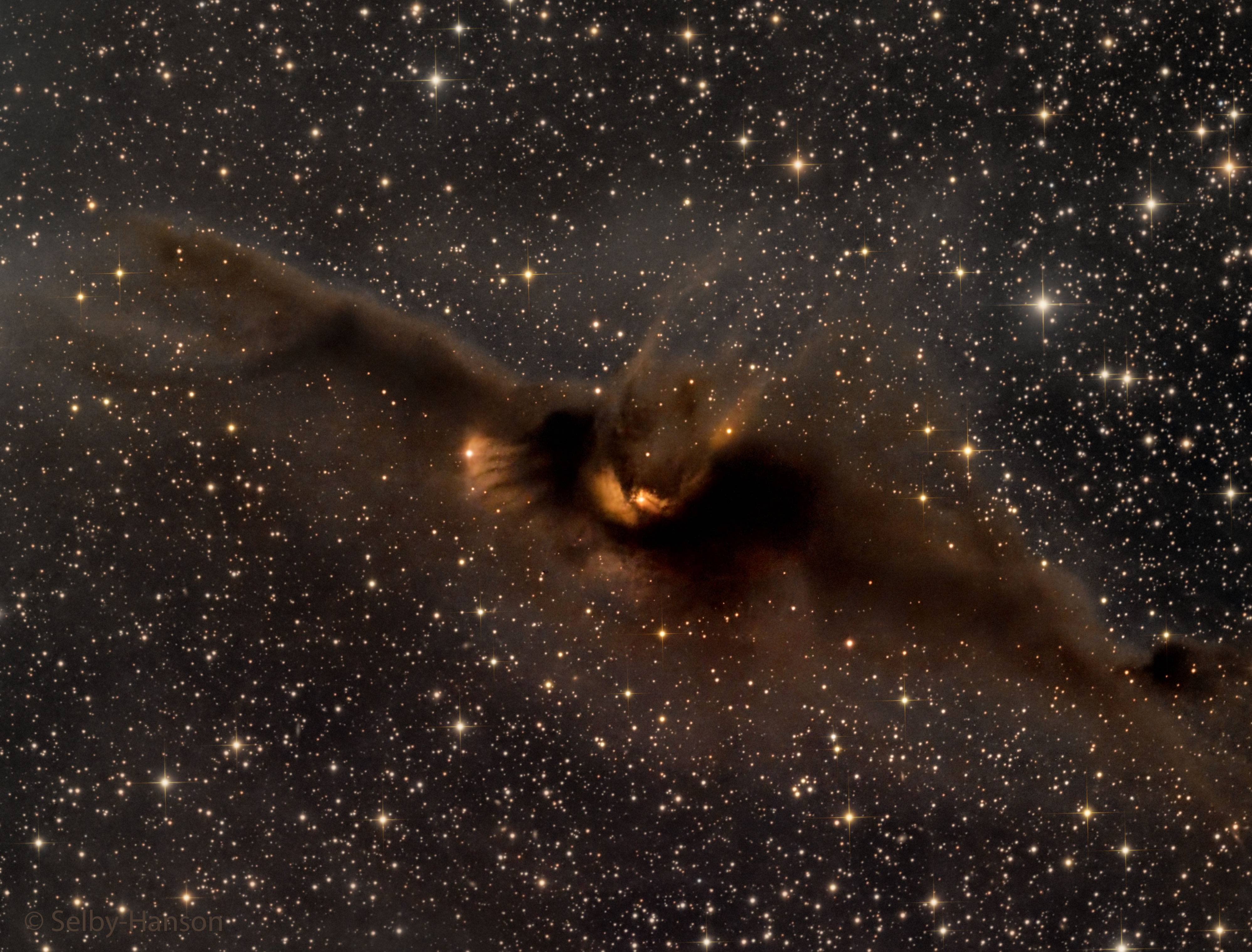
ASTRONOMY - LDN 43: The Cosmic Bat Nebula

 2024 October 27

A starfield is shown with a large brown dust nebula
in the center. The nebula appears, to some, to be shaped
like a bat. One of the stars in the dust nebula even appears
to be the eye of the bat. 
Please see the explanation for more detailed information.

LDN 43: The Cosmic Bat Nebula
Credit & Copyright: Mark Hanson and Mike Selby; Text: Michelle Thaller (NASA's GSFC)

Explanation: What is the most spook-tacular nebula in the galaxy? One contender is LDN 43, which bears an astonishing resemblance to a vast cosmic bat flying amongst the stars on a dark Halloween night. Located about 1400 light years away in the constellation Ophiuchus, this molecular cloud is dense enough to block light not only from background stars, but from wisps of gas lit up by the nearby reflection nebula LBN 7. Far from being a harbinger of death, this 12-light year-long filament of gas and dust is actually a stellar nursery. Glowing with eerie light, the bat is lit up from inside by dense gaseous knots that have just formed young stars.

VULCANOLOGIE - L'avenir de la recherche sur les volcans sous-marins

Les progrès technologiques permettent aux scientifiques de cartographier les fonds marins, de surveiller les éruptions et d'étudier plus précisément le comportement du magma. Tout cela pourrait aider les scientifiques à comprendre notre monde et à protéger tous ceux qui y vivent.

Sources: (EarthSky) (Volcano World) (Britannica) (Oceana) (National Oceanic and Atmospheric Administration) (NASA Earth Observatory)
©Getty Images

26/10/2025

ASTRONOMY - Phantoms in Cassiopeia

 2024 October 26

See Explanation.  Clicking on the picture will download
the highest resolution version available.

Phantoms in Cassiopeia
Image Credit & CopyrightChristophe Vergnes, Hervé Laur

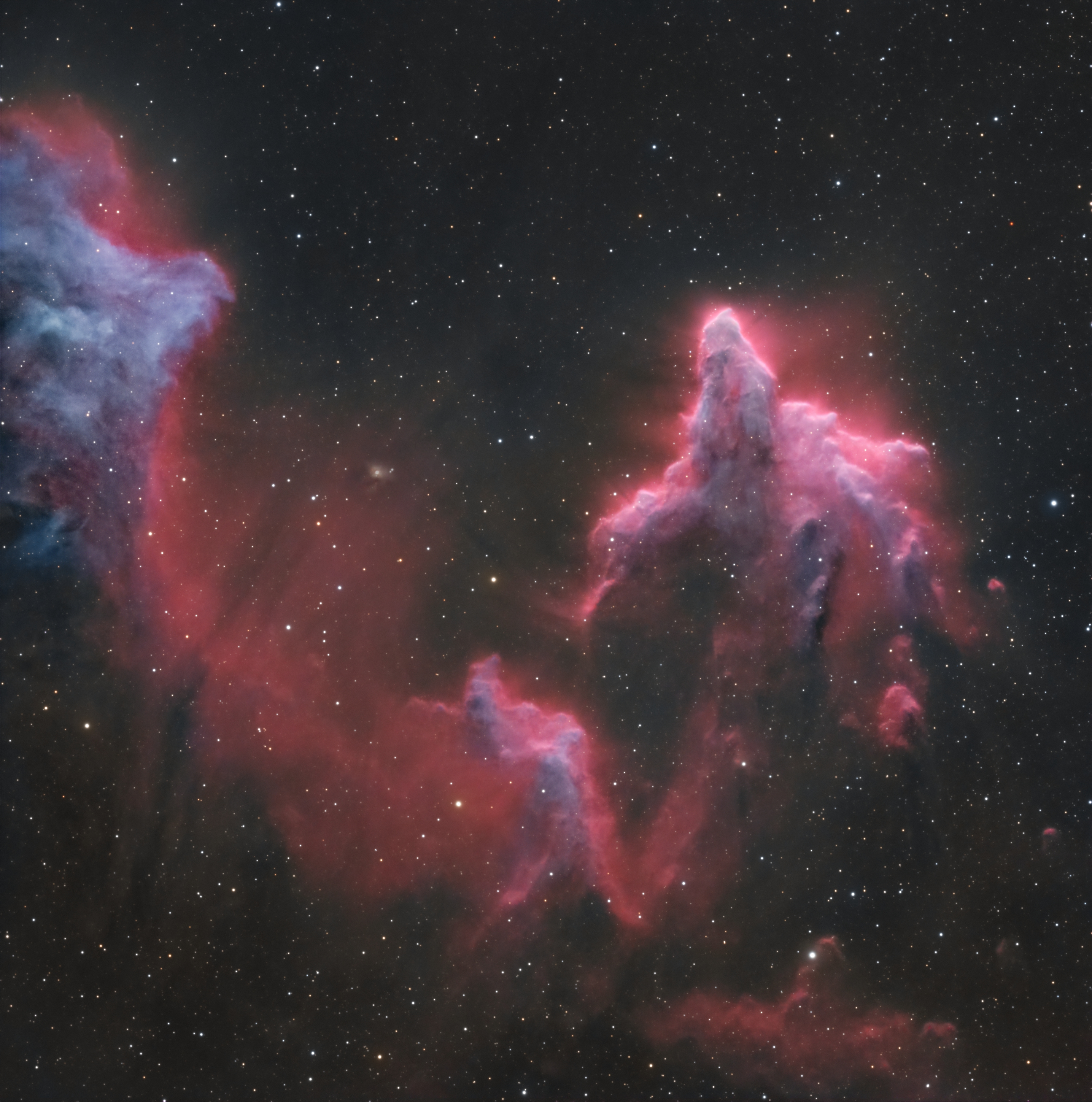
Explanation: These brightly outlined flowing shapes look ghostly on a cosmic scale. A telescopic view toward the constellation Cassiopeia, the colorful skyscape features the swept-back, comet-shaped clouds IC 59 (left) and IC 63. About 600 light-years distant, the clouds aren't actually ghosts. They are slowly disappearing though, under the influence of energetic radiation from hot, luminous star gamma Cas. Gamma Cas is physically located only 3 to 4 light-years from the nebulae and lies just above the right edge of the frame. Slightly closer to gamma Cas, IC 63 is dominated by red H-alpha light emitted as hydrogen atoms ionized by the hot star's ultraviolet radiation recombine with electrons. Farther from the star, IC 59 shows less H-alpha emission but more of the characteristic blue tint of dust reflected star light. The field of view spans over 1 degree or 10 light-years at the estimated distance of the interstellar apparitions.