Nombre total de pages vues
20/11/2025
OCEANOGRAPHIE - Vagues scélérates - Du mythe à la réalité (6/29)
ASTRONOMY - Lynds Dark Nebula 43
2025 October 30
Image Credit & Copyright: Team Ciel Austral
Explanation: Sure, Halloween is an astronomy holiday. But astronomers always enjoy scanning the heavens for spook-tacular galaxies, stars, and nebulae. This favorite is item number 43 from the Beverly Lynds 1962 Catalog of Dark Nebulae, fondly known as the Cosmic Bat nebula. While its visage looks alarmingly like a scary flying mammal, Lynds Dark Nebula 43 is over 12 light-years across. Glowing with eerie light, stars are forming within the dusty interstellar molecular cloud that is dense enough to appear in silhouette against a luminous background of Milky Way stars. Watch out. This Cosmic Bat nebula is a mere 400 light-years distant toward the serpent-bearing constellation Ophiucus.
19/11/2025
ASTRONOMY - Chamaeleon Dark Nebulas
2025 November 19
Image Credit & Copyright: Xinran Li & Houbo Zhao
Explanation: Sometimes the dark dust of interstellar space has an angular elegance. Such is the case toward the far-south constellation of Chamaeleon. Normally too faint to see, dark dust is best known for blocking visible light from stars and galaxies behind it. In this 11.4-hour exposure, however, the dust is seen mostly in light of its own, with its strong red and near-infrared colors creating a brown hue. Contrastingly blue, a bright star Beta Chamaeleontis is visible on the upper right of the V, with the dust that surrounds it preferentially reflecting blue light from its primarily blue-white color. All of the pictured stars and dust occur in our own Milky Way Galaxy with one notable exception: a white spot just below Beta Chamaeleontis is the galaxy IC 3104, which lies far in the distance. Interstellar dust is mostly created in the cool atmospheres of giant stars and dispersed into space by stellar light, stellar winds, and stellar explosions such as supernovas.
SANTé/MEDECINE - CANCER - 12 AVANCEES REVOLUTIONNAIRES - 6. L’intelligence artificielle au service des régions mal desservies
18/11/2025
ASTRONOMY - Comet Lemmon's Wandering Tail
Image Credit: Ignacio Fernández
Explanation: What has happened to Comet Lemmon's tail? The answer is blowing in the wind — the wind from the Sun in this case. This continuous outflow of charged particles from the Sun has been quite variable of late, as the Sun emits bursts of energy, CMEs, that push out and deflect charged particles emitted by the comet itself. The result is a blue hued ion tail for Comet C/2025 A6 (Lemmon) that is not only impressively intricate but takes some unusual turns. This long-duration composite image taken from Alfacar, Spain last month captured this inner Solar System ionic tumult. Comet Lemmon is now fading as it heads out away from the Earth and Sun and back into the outer Solar System.
17/11/2025
SANTé/MEDECINE - CANCER - 12 AVANCEES REVOLUTIONNAIRES - 5. Une intelligence artificielle capable de prédire un cancer des poumons
16/11/2025
ASTRONOMY - Andromeda and Friends
2025 November 15
Image Credit & Copyright: Piotr Czerski
Explanation: This magnificent extragalactic skyscape looks toward the Andromeda Galaxy, the closest large spiral galaxy to the Milky Way. It also accomplishes a Messier catalog trifecta by including Andromeda, cataloged as Messier 31 (M31), along with Messier 32 (M32), and Messier 110 (M110) in the same telescopic field of view. In this frame, M32 is just left of the Andromeda Galaxy's bright core with M110 below and to the right. M32 and M110 are both elliptical galaxies themselves and satellites of the larger spiral Andromeda. By combining 60 hours of broadband and narrowband image data, the deep telescopic view also reveals tantalizing details of dust lanes, young star clusters, and star-forming regions along Andromeda's spiral arms, and faint, foreground clouds of glowing hydrogen gas. For now, Andromeda and friends are some 2.5 million light-years from our own large spiral Milky Way.
15/11/2025
ASTRONOMIE - Spectacle grandiose
14/11/2025
SANTé/MEDECINE - CANCER - 12 AVANCEES REVOLUTIONNAIRES - 4. Une médecine de précision qui s’adapte à l’ADN du patient
13/11/2025
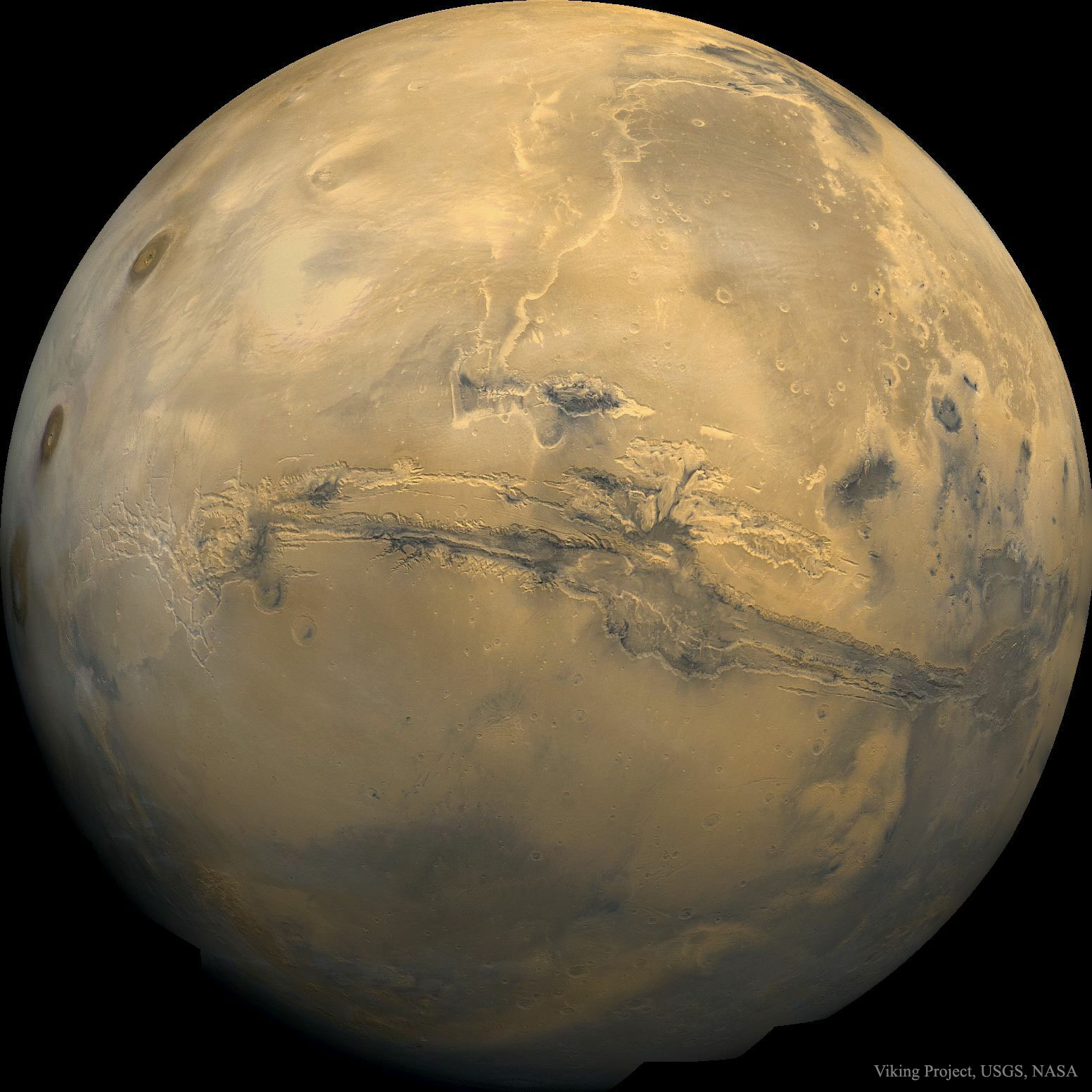
ASTRONOMY - Valles Marineris: The Grand Canyon of Mars
2024 November 10
Image Credit: NASA, USGS, Viking Project
Explanation: The largest canyon in the Solar System cuts a wide swath across the face of Mars. Named Valles Marineris, the grand valley extends over 3,000 kilometers long, spans as much as 600 kilometers across, and delves as much as 8 kilometers deep. By comparison, the Earth's Grand Canyon in Arizona, USA is 800 kilometers long, 30 kilometers across, and 1.8 kilometers deep. The origin of the Valles Marineris remains unknown, although a leading hypothesis holds that it started as a crack billions of years ago as the planet cooled. Several geologic processes have been identified in the canyon. The featured mosaic was created from over 100 images of Mars taken by Viking Orbiters in the 1970s.
-
Imaginez un monde où le cancer n’est plus une sentence, mais une simple étape à franchir. Grâce à une découverte révolutionnaire, ce rêve es...
-
2026 January 1 Auroral Corona Image Credit & Copyright : Roi Levi Explanation: Cycle 25 solar maximum made 2025 a great year for ...