Nombre total de pages vues

07/12/2025

ASTRONOMY - Visualization: Near a Black Hole and Disk

 2025 December 3

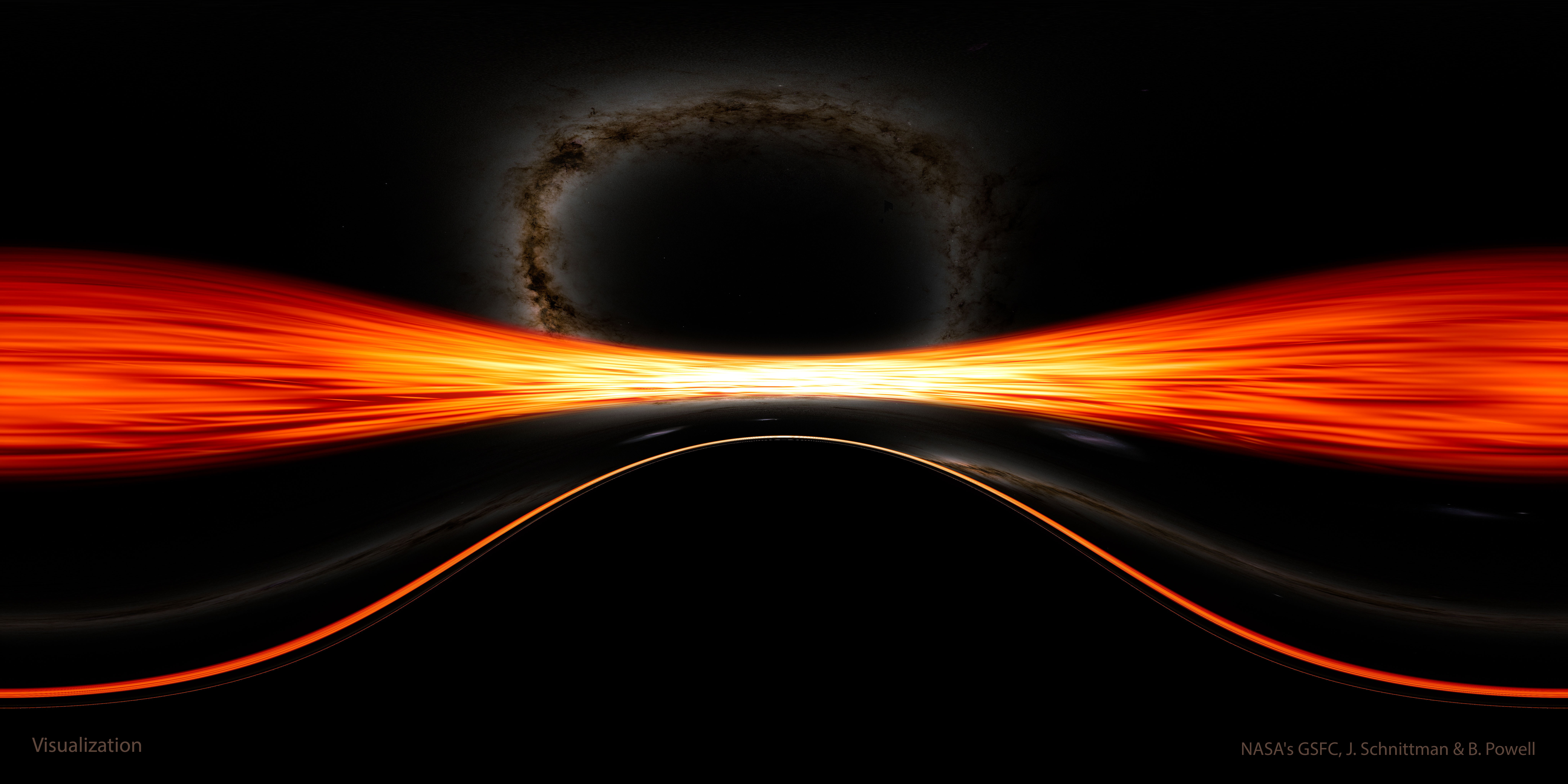
The illustration shows a structured orange band stretching 
horizontally across the imager. Connected in the middle is the Milky Way
Galaxy curving up to the top of the frame. A second image of the orange
band runs like a sine wave across the lower half of the frame, while
a second image of the Milky Way galaxy appears just above it.
Please see the explanation for more detailed information.

Visualization: Near a Black Hole and Disk
Illustration Credit: NASA's GSFCJ. Schnittman & B. Powell; Text: Francis Reddy (U. MarylandNASA's GSFC)

Explanation: What would it look like to plunge into a monster black hole? This image from a supercomputer visualization shows the entire sky as seen from a simulated camera plunging toward a 4-million-solar-mass black hole, similar to the one at the center of our galaxy. The camera lies about 16 million kilometers from the black hole’s event horizon and is moving inward at 62% the speed of light. Thanks to gravity’s funhouse effects, the starry band of the Milky Way appears both as a compact loop at the top of this view and as a secondary image stretching across the bottom. Move the cursor over the image for additional explanations. Visualizations like this allow astronomers to explore black holes in ways not otherwise possible.

06/12/2025

ASTRONOMY - Apollo 17 at Shorty Crater

 2025 December 6

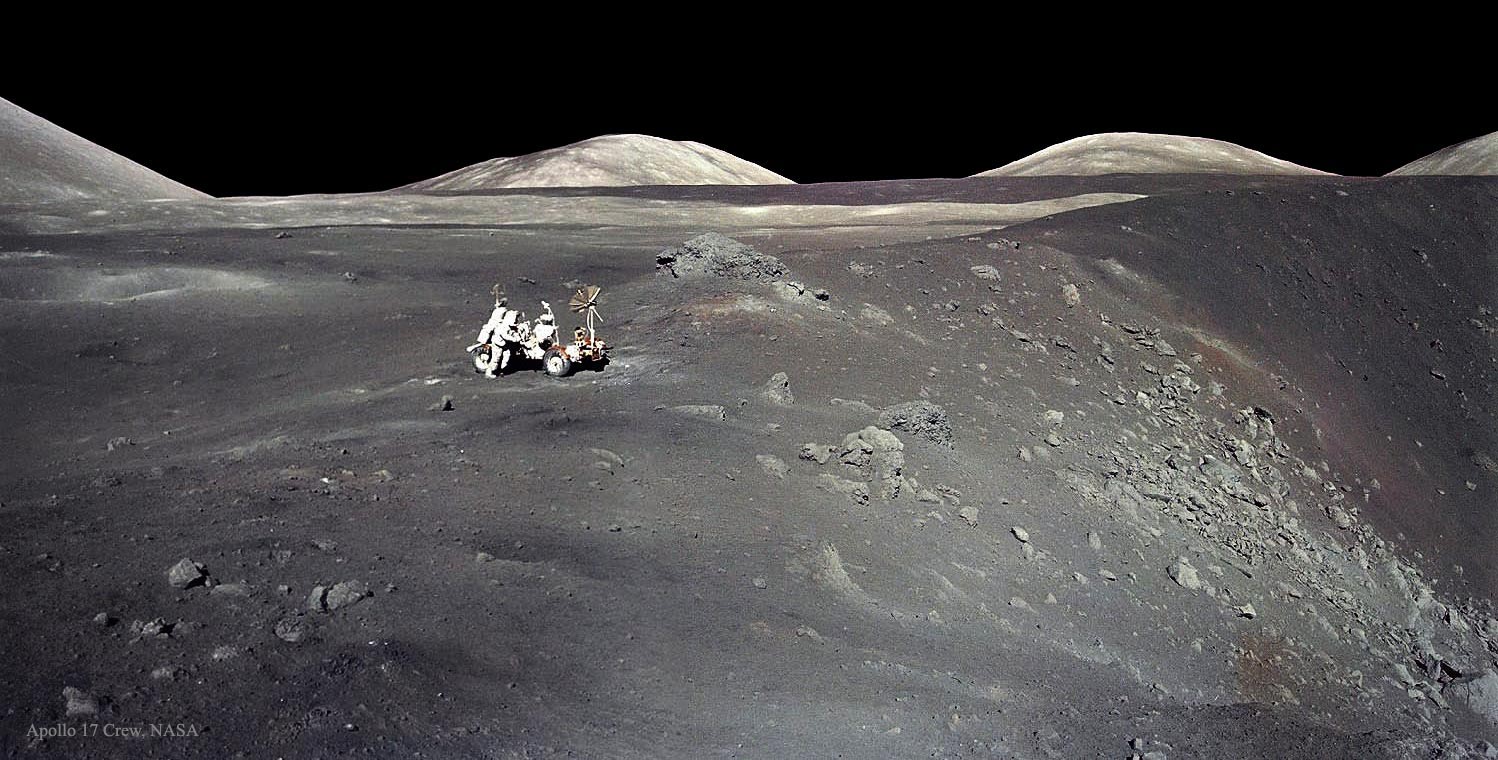
See Explanation.  Clicking on the picture will download
the highest resolution version available.

Apollo 17 at Shorty Crater
Apollo 17 Crew, NASA

Explanation: Fifty three years ago, in December of 1972, Apollo 17 astronauts Eugene Cernan and Harrison Schmitt spent about 75 hours on the Moon exploring the Taurus-Littrow valley, while colleague Ronald Evans orbited overhead. This snapshot from another world was taken by Cernan as he and Schmitt roamed the lunar valley's floor. The image shows Schmitt next to the lunar rover parked at the southeast rim of Shorty Crater. That location is near the spot where geologist Schmitt discovered orange lunar soil. The Apollo 17 crew returned with 110 kilograms of rock and soil samples, more than was returned from any of the other lunar landing sites. And for now, Cernan and Schmitt are the last to walk on the Moon.

05/12/2025

SANTé/MEDECINE - CANCER - 12 AVANCéES REVOLUTIONNAIRES - 11. Une thérapie qui utilise les propres cellules du patient

Les médecins ont mis au point un traitement très spécial appelé « thérapie CAR-T ». Il s’agit d’un procédé où on prélève certaines cellules du système immunitaire du patient, puis on les modifie en laboratoire pour qu’elles sachent reconnaître et attaquer les cellules cancéreuses. Ensuite, on réinjecte ces cellules au patient pour qu’elles fassent le travail à l’intérieur du corps.

Ce traitement a donné de très bons résultats chez certaines personnes atteintes de leucémie (un cancer du sang). Par exemple, une femme qui a reçu ce traitement est toujours en bonne santé 19 ans plus tard. Cela montre que ce genre de thérapie peut parfois fonctionner pendant très longtemps.

Cependant, les autorités de santé, comme la FDA aux États-Unis, ont remarqué que chez environ 30 personnes, un autre cancer est apparu après la thérapie. On ne sait pas encore si c’est directement lié au traitement, mais par prudence, les médecins ajoutent maintenant des avertissements pendant que les recherches se poursuivent.

LaNatureCa

30/11/2025

ASTRONOMY - The Surface of Titan from Huygens

 2025 November 30

A strange orange landscape is shown. What appears 
to be light and dark orange rocks are strewn about. 
The landscape appears roughly flat all the way out 
to the orange sky and horizon. 
Please see the explanation for more detailed information.

The Surface of Titan from Huygens
Image Credit: ESANASAJPLU. ArizonaHuygens Lander

Explanation: If you could stand on Titan -- what would you see? The featured color view from Titan gazes across an unfamiliar and distant landscape on Saturn's largest moon. The scene was recorded by ESA's Huygens probe in 2005 after a 2.5-hour descent through a thick atmosphere of nitrogen laced with methane. Bathed in an eerie orange light at ground level, rocks strewn about the scene could well be composed of water and hydrocarbons frozen solid at an inhospitable temperature of negative 179 degrees C. The large light-toned rock below and left of center is only about 15 centimeters across and lies 85 centimeters away. The saucer-shaped spacecraft is believed to have penetrated about 15 centimeters into a place on Titan's surface that had the consistency of wet sand or clay. Huygen's batteries enabled the probe to take and transmit data for more than 90 minutes after landing. Titan's bizarre chemical environment may bear similarities to planet Earth's before life evolved.

29/11/2025

LES BELLES INVENTIONS DE LEONARD DE VINCI - La mitrailleuse ou ribaudequin


Voici une invention qui illustre bien la passion de Léonard de Vinci pour les armes. N'oublions pas qu'il s'était présenté au duc de Milan comme un ingénieur militaire tout autant qu'un artiste. On voit ici l'une de ses mitrailleuses, encore appelées « ribaudequins » au moment du développement des armes à feu en Europe.

© Sémhur GFDL

ASTRONOMY - Moon Games

2025 November 29
See Explanation.  Clicking on the picture will download
the highest resolution version available.

Moon Games
Image Credit & Copyright: Giorgia Hofer

Explanation: This is not a screen from a video game. Nestled below the tree-line, the small mountain church does look like it might be hiding from Moon though. In the well-composed telephoto snapshot, taken on November 23, the church walls are partly reflecting light from terrestrial flood lights. Of course, the Moon is reflecting light from the Sun. At any given time the Sun illuminates fully half of the Moon's surface, also known as the lunar dayside, but on that night only a sliver of its sunlit surface was visible. About three days after New Moon, the Moon was in a waxing crescent phase. The single exposure was captured shortly after sunset in skies near Danta di Cadore, northern Italy, planet Earth. 

27/11/2025

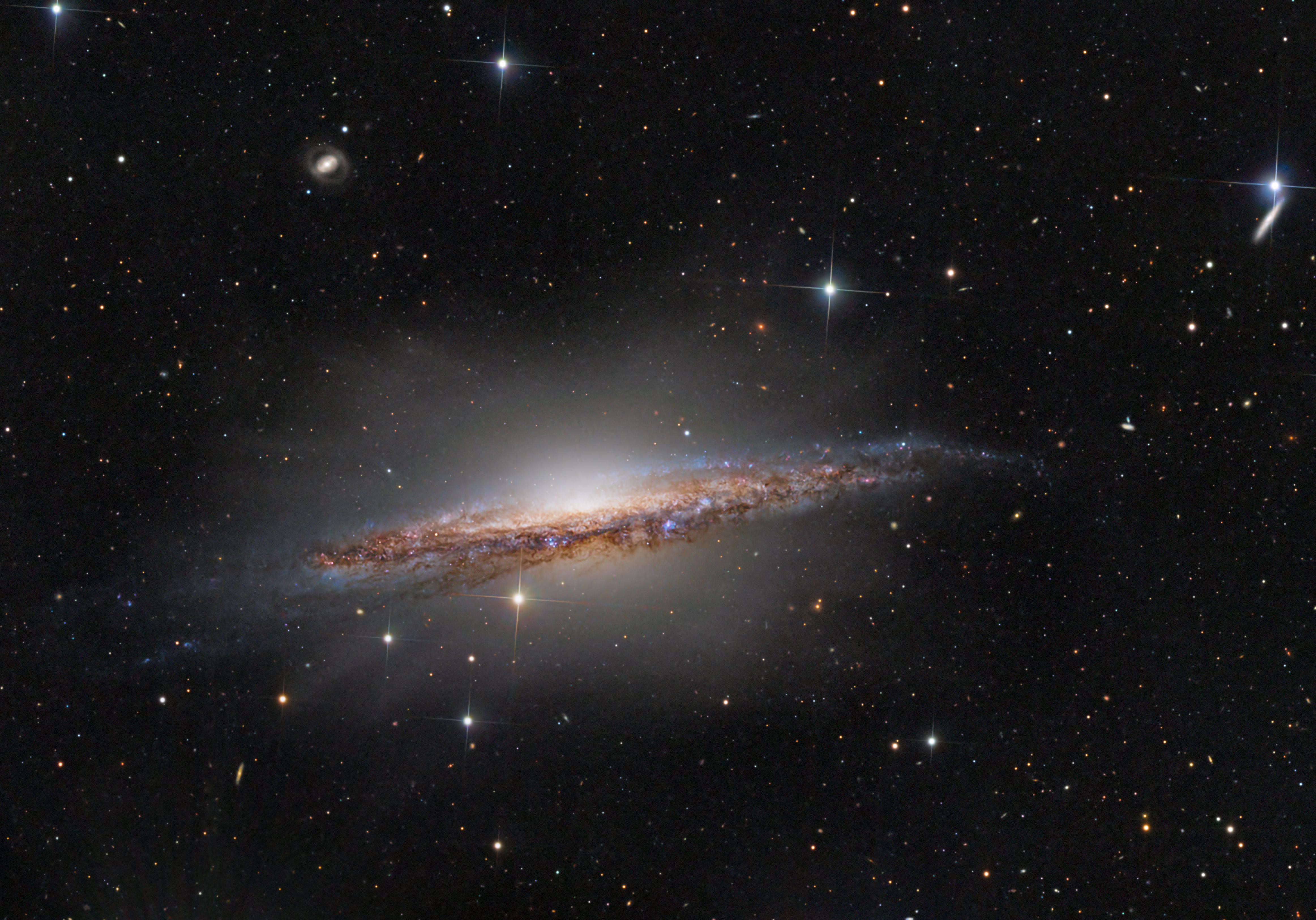
ASTRONOMY - Portrait of NGC 1055

 2025 November 27

See Explanation.  Clicking on the picture will download
the highest resolution version available.

Portrait of NGC 1055
Image Credit & Copyright: John Hayes

Explanation: Big, beautiful spiral galaxy NGC 1055 is a dominant member of a small galaxy group a mere 60 million light-years away toward the aquatically intimidating constellation Cetus. Seen edge-on, the island universe spans over 100,000 light-years, a little larger than our own Milky Way galaxy. The colorful, spiky stars decorating this cosmic portrait of NGC 1055 are in the foreground, well within the Milky Way. But telltale pinkish star forming regions and young blue star clusters are scattered through winding dust lanes along the distant galaxy's thin disk. With a smattering of even more distant background galaxies, the deep image also reveals a boxy halo that extends far above and below the central bulge and disk of NGC 1055. The halo itself is laced with faint, narrow structures, and could represent the mixed and spread out debris from a satellite galaxy disrupted by the larger spiral some 10 billion years ago.

SANTé/MEDECINE - CANCER - 12 AVANCEES REVOLUTIONNAIRES - 10. Une goutte de sang pour détecter le cancer du pancréas

Le cancer du pancréas est connu pour être extrêmement agressif et difficile à diagnostiquer à temps, avec un taux de survie à 5 ans inférieur à 5 %. Des chercheurs de l’université de San Diego ont développé un test nommé PAC-MANN qui peut détecter 95 % des cas précoces à partir de biomarqueurs présents dans une simple goutte de sang. Une autre étude a montré comment ce cancer bloque certaines molécules essentielles, ouvrant la voie à de nouveaux traitements ciblés.

LaNatureCa

26/11/2025

ASTRONOMY - Globular Cluster M15 Deep Field

 2025 November 26

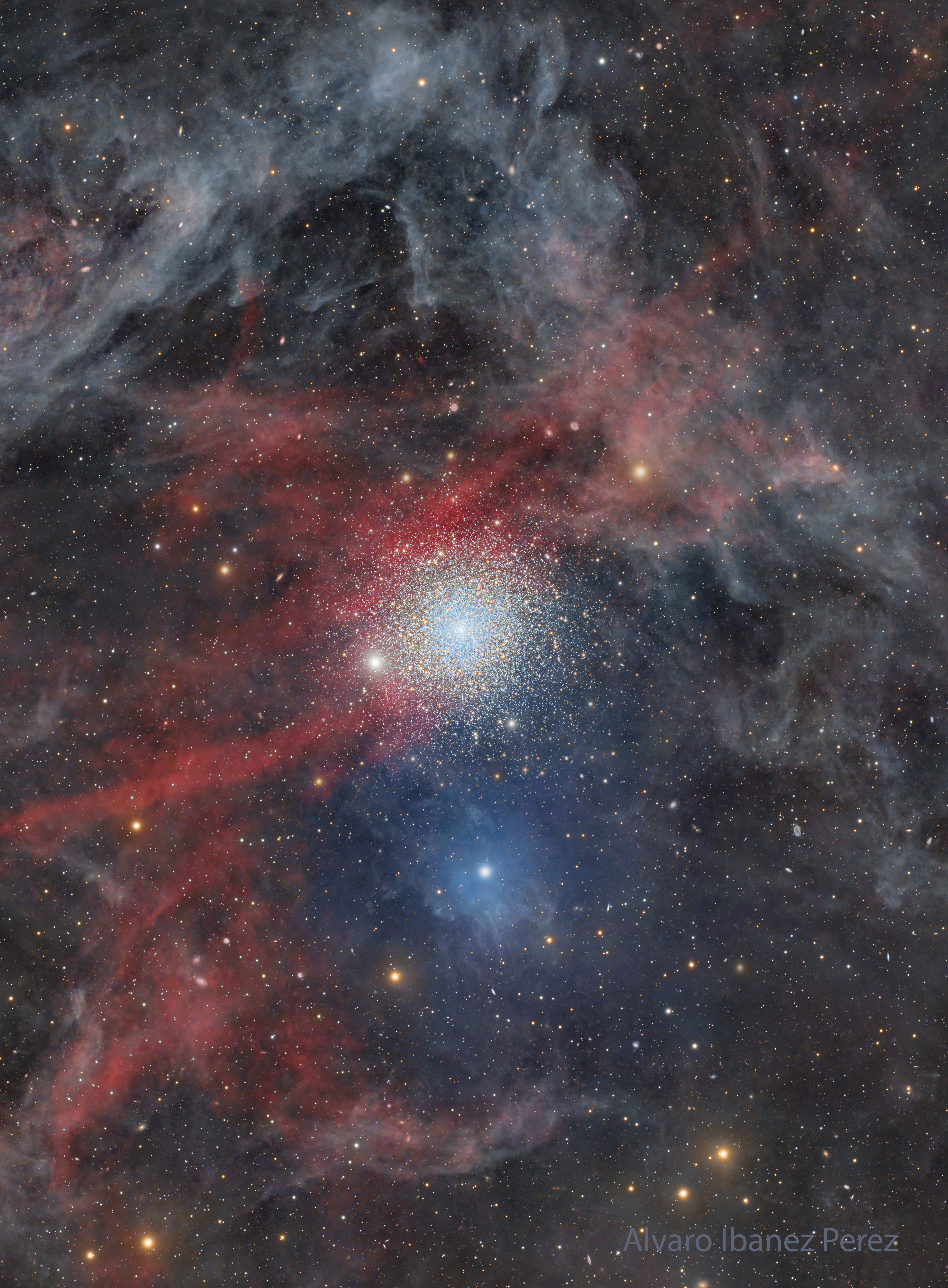
A starfield is shown with thin wisps of gray and red
running through it. In the center is an usual ball -- which
is a globular cluster of stars upon closer inspection. 
Please see the explanation for more detailed information.

Globular Cluster M15 Deep Field
Image Credit & Copyright: Alvaro Ibanez Perez

Explanation: Stars, like bees, swarm around the center of bright globular cluster M15. The central ball of over 100,000 stars is a relic from the early years of our Galaxy, and continues to orbit the Milky Way's centerM15, one of about 150 globular clusters remaining, is noted for being easily visible with only binoculars, having at its center one of the densest concentrations of stars known, and containing a high abundance of variable stars and pulsars. The featured image of M15 was taken by combining very long exposures -- 122 hours in all -- and so brings up faint wisps of gas and dust in front of the giant ball of stars. M15 lies about 35,000 light years away toward the constellation of the Winged Horse (Pegasus).

25/11/2025

SANTé/MEDECINE - CANCER - 12 AVANCEES REVOLUTIONNAIRES - 9. Un traitement du cancer du col de l’utérus qui réduit drastiquement la mortalité


Une étude internationale appelée INTERLACE, menée dans 5 pays, a démontré qu’un cycle de chimiothérapie avant le traitement classique du cancer du col de l’utérus réduit de 40 % le risque de décès et de 35 % le risque de récidive. Cette percée, annoncée en octobre 2024, est la plus importante de ces 20 dernières années pour ce type de cancer. Les médicaments utilisés sont déjà disponibles et peu coûteux, rendant ce traitement accessible au plus grand nombre.

LaNatureCa