Nombre total de pages vues
17/01/2026
MICROPHOTOGRAPHIE - La clé de voûte de la propreté des abeilles
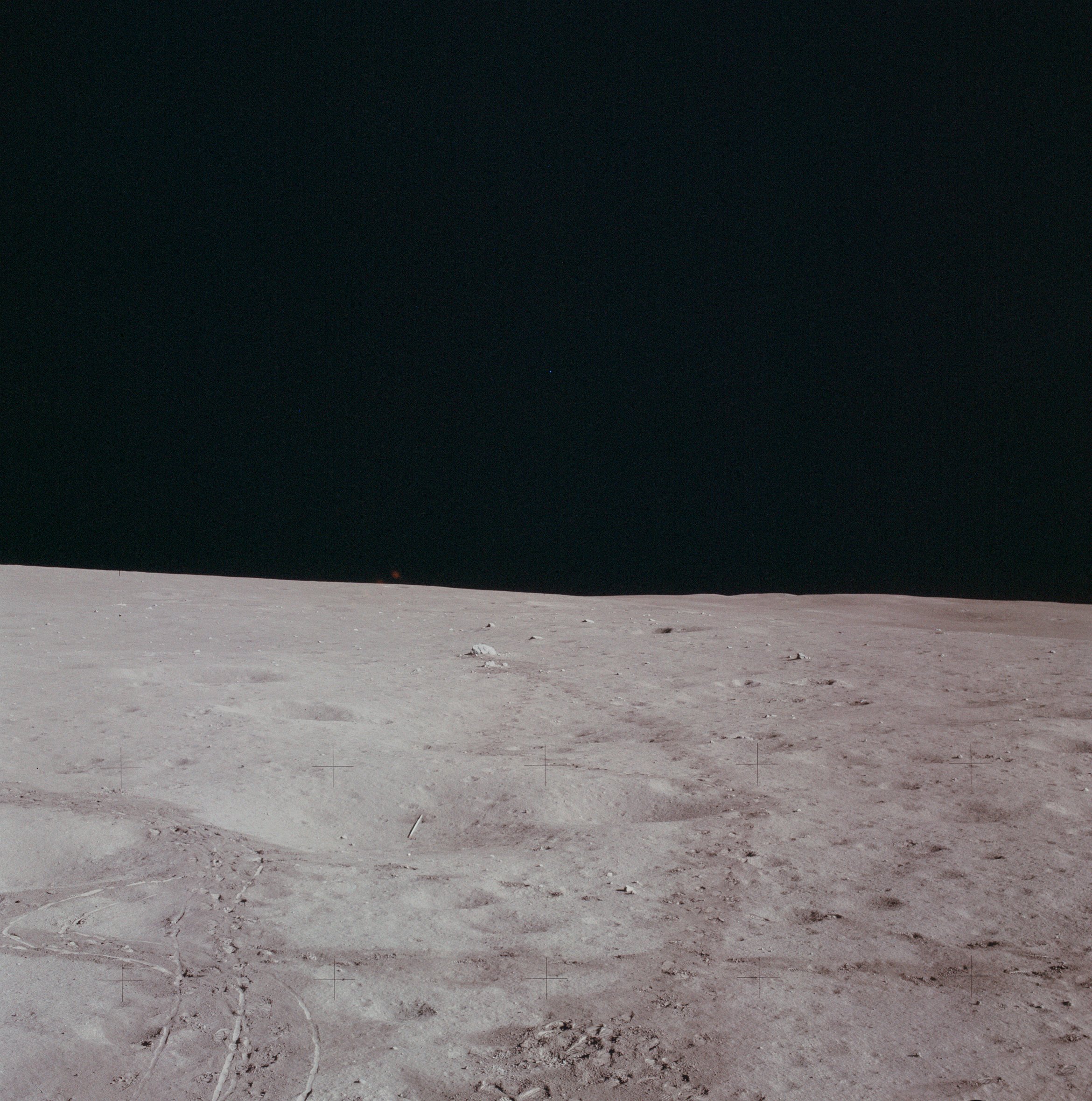
ASTRONOMY - Apollo 14: A View from Antares
2026 January 17
Image Credit: Edgar Mitchell, Apollo 14, NASA; Mosaic - Eric M. Jones
Explanation: Apollo 14's Lunar Module Antares landed on the Moon on February 5, 1971. Toward the end of the stay astronaut Ed Mitchell snapped a series of photos of the lunar surface while looking out a window, assembled into this detailed mosaic by Apollo Lunar Surface Journal editor Eric Jones. The view looks across the Fra Mauro highlands to the northwest of the landing site after the Apollo 14 astronauts had completed their second and final walk on the Moon. Prominent in the foreground is their Modular Equipment Transporter, a two-wheeled, rickshaw-like device used to carry tools and samples. Near the horizon at top center is a 1.5 meter wide boulder dubbed Turtle rock. In the shallow crater below Turtle rock is the long white handle of a sampling instrument, thrown there javelin-style by Mitchell. Mitchell's fellow moonwalker and first American in space, Alan Shepard, also used a makeshift six iron to hit two golf balls. One of Shepard's golf balls is just visible as a white spot below Mitchell's javelin.
16/01/2026
ASTRONOMY - NGC 7023: The Iris Nebula
2026 January 16
Image Credit & Copyright: Justus Falk
Explanation: These cosmic clouds have blossomed 1,300 light-years away in the fertile starfields of the constellation Cepheus. Called the Iris Nebula, NGC 7023 is not the only nebula to evoke the imagery of flowers. Still, this deep telescopic image shows off the Iris Nebula's range of colors and symmetries embedded in surrounding fields of interstellar dust. Within the Iris itself, dusty nebular material surrounds a hot, young star. The dominant color of the brighter reflection nebula is blue, characteristic of dust grains reflecting starlight. Central filaments of the reflection nebula glow with a faint reddish photoluminescence as some dust grains effectively convert the star's invisible ultraviolet radiation to visible red light. Infrared observations indicate that this nebula contains complex carbon molecules known as PAHs. The dusty blue petals of the Iris Nebula span about six light-years.
15/01/2026
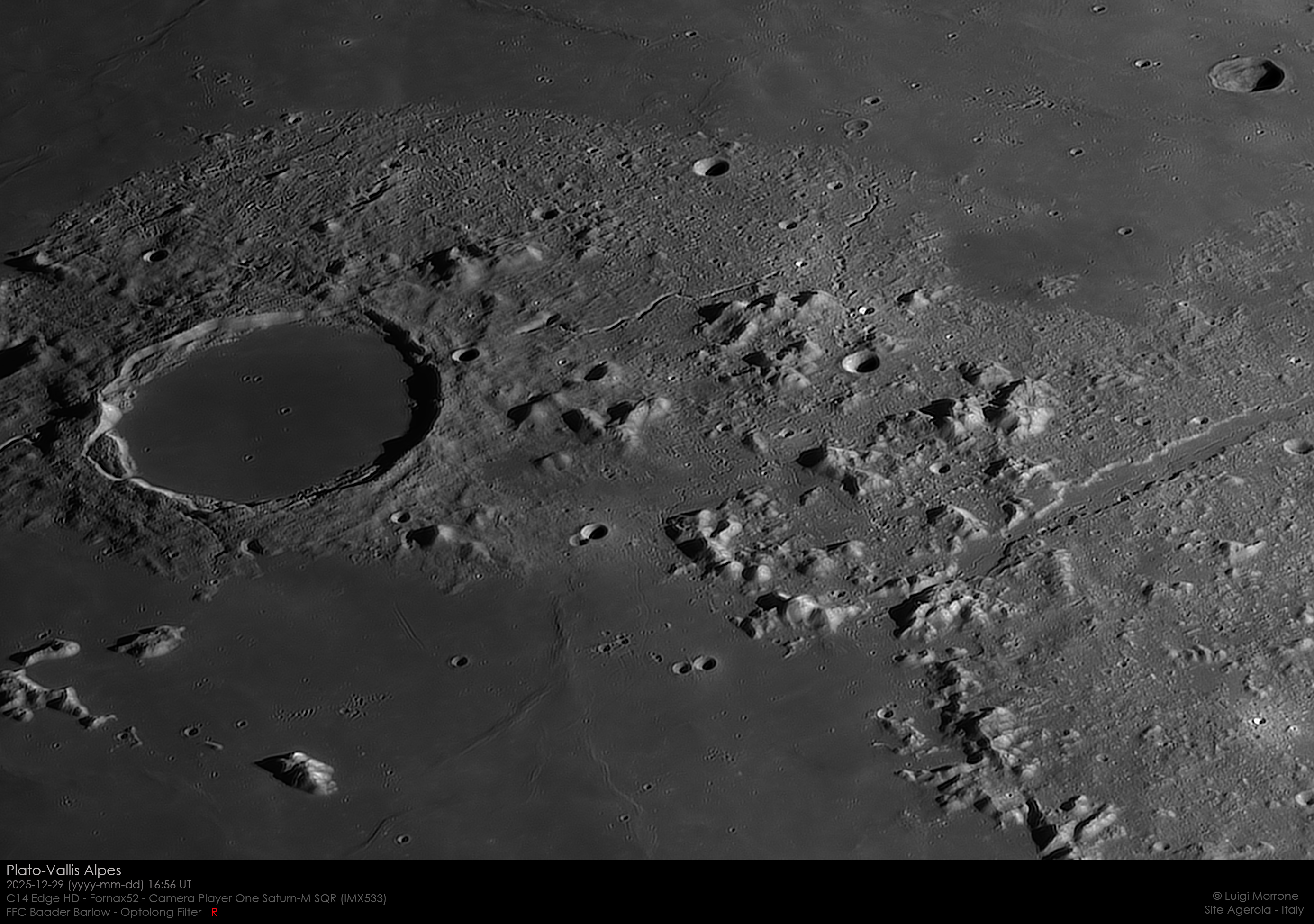
ASTRONOMY - Plato and the Lunar Alps
2026 January 15
Image Credit & Copyright: Luigi Morrone
Explanation: The dark-floored, 95 kilometer wide crater Plato and sunlit peaks of the lunar Alps (Montes Alpes) are highlighted in this this sharp telescopic snapshot of the Moon's surface. While the Alps of planet Earth were uplifted over millions of years as continental plates slowly collided, the lunar Alps were likely formed by a sudden collision that created the giant impact basin known as the Mare Imbrium or Sea of Rains. The mare's generally smooth, lava-flooded floor is seen below the bordering mountain range. The prominent straight feature cutting through the mountains is the lunar Alpine Valley (Vallis Alpes). Joining the Mare Imbrium and northern Mare Frigoris (Sea of Cold) the valley extends toward the upper right, about 160 kilometers long and up to 10 kilometers wide. Of course, the large, bright lunar alpine mountain below and right of Plato crater is named Mont Blanc. Lacking an atmosphere, not to mention snow, the lunar Alps are probably not an ideal location for a winter vacation. Still, a 150 pound skier would weigh a mere 25 pounds on the Moon.
14/01/2026
ASTRONOMY - M51: The Whirlpool Galaxy
2026 January 14
Image Credit & Copyright: Michael Sleeman
Explanation: The Whirlpool Galaxy is a classic spiral galaxy. At only 30 million light years distant and fully 60 thousand light years across, M51, also known as NGC 5194, is one of the brightest and most picturesque galaxies on the sky. The featured deep image is a digital combination of images taken in different colors over 58 hours with a telescope from Lijiang, China. Anyone with a good pair of binoculars, however, can see this Whirlpool toward the constellation of the Hunting Dogs (Canes Venatici). M51 is a spiral galaxy of type Sc and is the dominant member of a whole group of galaxies. Astronomers speculate that M51's spiral structure is primarily due to its gravitational interaction with the smaller galaxy just above it.
13/01/2026
LES BELLES INVENTIONS DE LEONARD DE VINCI - L'Homme de Vitruve - le compas et les proportions
ASTRONOMY - A Solar Eruption from SDO
2026 January 13
Video Credit: NASA, SDO, AIA, Helioviewer; Processing & Text: Ogetay Kayali (MTU)
Explanation: What just leapt from the Sun? A towering structure of solar plasma suddenly rose from the Sun's surface and unfurled into space -- a structure so large that many Earths would easily fit within it-- marking the onset of a dramatic Coronal Mass Ejection (CME). The event was captured in striking detail in late 2024 by NASA's Solar Dynamics Observatory (SDO), whose continuous monitoring improves space weather forecasts and helps humanity better understand how solar activity affects satellites, GPS, radio communications, and power grids on Earth. The featured video blends three extreme-ultraviolet views from SDO’s Atmospheric Imaging Assembly (AIA), revealing how plasma at different temperatures surged upward as the eruption unfolded. Here, red highlights cooler, denser material lifted from the Sun’s lower atmosphere, while yellow traces hotter, million-degree coronal loops stretching outward as magnetic fields open. After the main outburst, the Sun’s magnetic fields quickly reorganize.
12/01/2026
ASTRONOMY - Meteor Dust
Image Credit & Copyright: Xu Chen
Explanation: What's happening to this meteor? It is shedding its outer layers as it passes through the Earth's atmosphere and heats up. The sudden high temperatures not only cause the bright glow along the dramatic streak but also melt and vaporize the meteor's component rock and ice, creating dust. Wind in the atmosphere typically blows this dust away over the next few seconds, leaving no visible trace after only a few minutes. Much of this dust will eventually settle down to the Earth. The featured image was captured in mid-December, coincident with the Geminids meteor shower. On the upper left is Sirius, the brightest star in the night sky, while in the foreground is fog-engulfed Huangshan, the Yellow Mountains of eastern China.
11/01/2026
MICROPHOTOGRAPHIE - Quand le micromonde s’autoassemble
NUCLEAIRE/RADIOACTIVITé - Le kit de survie anti-nucléaire après un impact de bombe
Astronomy - CYGNUS AND THE SOLITARY TREE
2026 March 18 Cygnus and the Solitary Tree Image Credit & Copyright: 2025 Horacio Lander / AstroHoracio Text: Keighley Rockcliffe ...
-
2025 May 11 The Surface of Venus from Venera 14 Image Credit: Soviet Planetary Exploration Program , Venera 14 ; Processing & Copyri...
-
2025 April 14 The Galactic Center in Radio from MeerKAT Image Credit: NASA , ESA , CSA , STScI , SARAO , S. Crowe ( UVA ), J. Bally ...