Nombre total de pages vues

24/03/2026

Astronomy - A GRAVITY MAP OF EARTH

 2026 March 24

A Gravity Map of Earth

Video Credit: NASAGSFCGRACESVS

Explanation: Is gravity the same over the surface of the Earth? No -- in some places you will feel slightly heavier than others. The featured Earth map video shows in colors and exaggerated highs and lows where the gravitational field of Earth is relatively strong and weak. A low spot, where you would feel slightly lighter, can be seen just off the coast of India, in blue, while a relative high occurs in the mountains of Chile in South America. The cause of these irregularities does not always follow present surface features. Scientists hypothesize that other important factors lie in deep underground structures in Earth's mantle and may be related to the Earth's appearance in the distant past. The featured map was composed from data taken by NASA's twin GRACE satellites that orbited the Earth from 2002 to 2017. GRACE mapped Earth's gravity by carefully tracking tiny changes in the distance between the two satellites.

23/03/2026

Microphotographie - DES GLOBULES BLANCS GENETIQUEMENT MODIFIES


Derrière l'idée de la thérapie génique, il y a celle d'introduire un matériel génétique dans des cellules pour soigner une maladie. Ici, des cellules que les chercheurs surnomment les CAR-T, fixées à des billes de fer. CAR, pour Chimeric Antigen Recepto (récepteur antigénique chimérique) et T car ce sont des lymphocytes T -- autrement dit, des globules blancs spécialisés dans la reconnaissance et la destruction de cellules pathogènes -- qui ont été génétiquement modifiés pour exprimer un récepteur -- le fameux CAR -- capable de traquer les cellules cancéreuses dans le sang. Un espoir de guérir enfin les leucémies de l'enfant et les lymphomes de l'adulte.

Les cellules ont été balayées par un microscope électronique à balayage à émission de champ Tescan Mira3 et colorisées à la volée avec un système d'imagerie multidétecteur à quatre canaux développé par Point electronic Halle.

Le champ de vision est de 17 microns de large. 

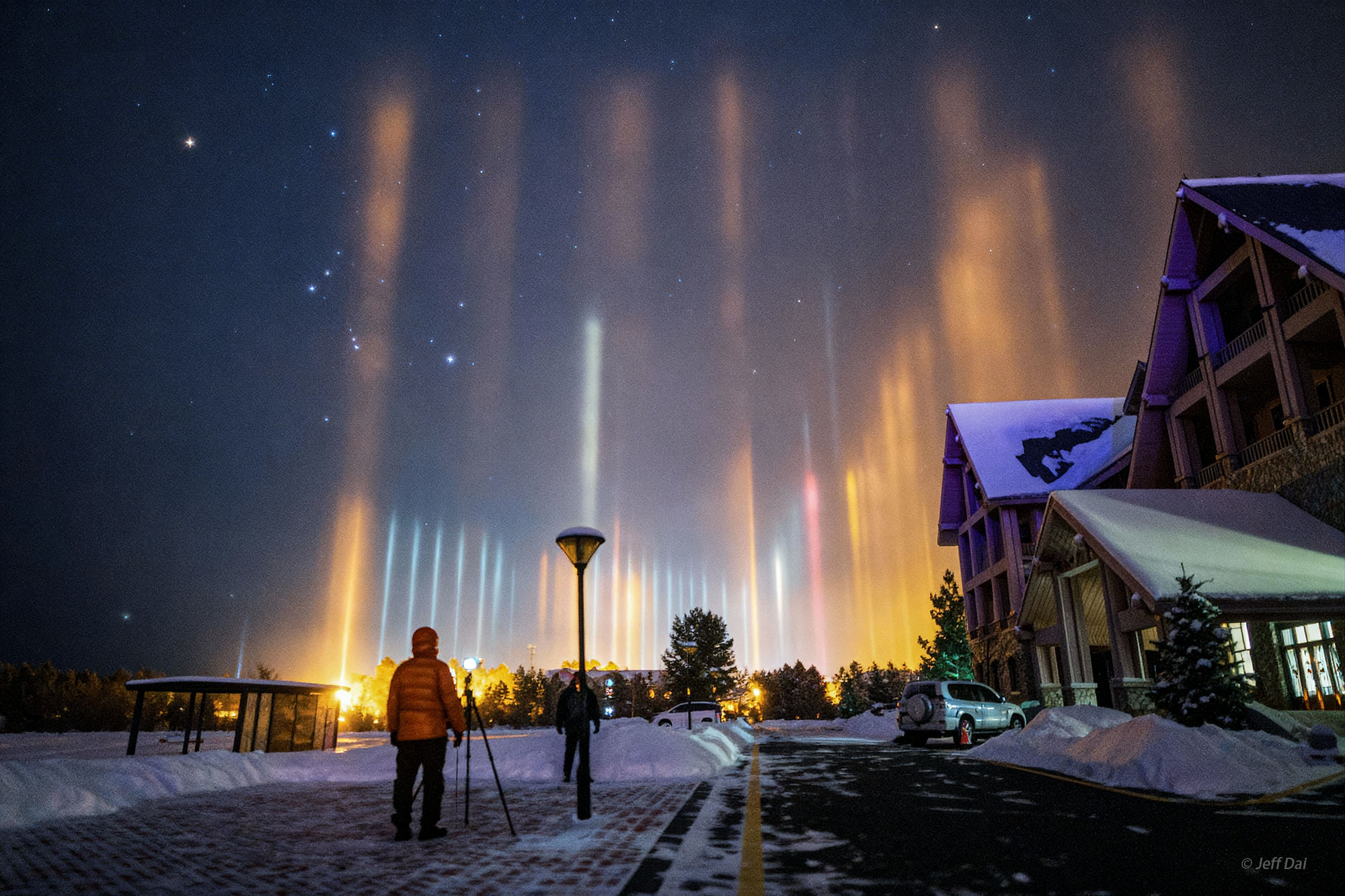
Astronomy - LIGHT PILLARS AND ORION OVER MOHE

2026 March 23
A starry sky appears above a snowy street with a 
house on the right. The constellation of Orion is 
visible on the left. Up from the ground many pillars
of light are seen. Two people stand watching the pillars
on the street in the foreground. 
Please see the explanation for more detailed information.

Light Pillars and Orion over Mohe
Image Credit & Copyright: Jeff Dai (TWAN)

Explanation: What's happening at the end of that street? Pictured here are not auroras but light pillars, a phenomenon typically much closer. In most places on Earth, a lucky viewer can see a Sun pillar, a column of light appearing to extend up from the Sun caused by flat fluttering ice-crystals reflecting sunlight from the upper atmosphere. Usually, these ice crystals evaporate before reaching the ground. During freezing temperatures, however, flat fluttering ice crystals may form near the ground and are sometimes known as a crystal fog. These small ice crystals may then reflect not the Sun but ground lights. The featured image captured not only numerous light pillars but also the iconic constellation of Orion, and was taken in Mohe, the northernmost city in China

22/03/2026

Microphotographie - CHANGER SON REGARD SUR LE PAIN MOISI

L'Aspergillus niger est un champignon filamenteux extrêmement commun. C'est lui qui constitue la moisissure noire que l'on peut trouver sur les substrats riches en glucides comme le pain, mais aussi les fruits et les légumes. L'Aspergillus niger est rarement toxique. Mais il revêt une importance économique, car il est souvent à l'origine de gâchis alimentaires. Et cette microphotographie nous le présente sous un jour fort peu ragoûtant, malgré les effets de flou artistique.

Il faut savoir que cette moisissure se développe en collant des stolons -- des hyphes spécialisés dans une forme de multiplication asexuée -- à travers la surface de la nourriture. Là où les stolons touchent la surface, les rhizoïdes se développent dans la nourriture et fixent la moisissure. Chacun forme alors un sporange noir.

Ici, l'Aspergillus niger est scanné par un microscope électronique à balayage à émission de champ Tescan Mira3 et colorisé à la volée avec un système d'imagerie multidétecteur à quatre canaux développé par Point electronic Halle. Le champ de vision est de 262 microns de large.

Astronomy - LEAVING EARTH

 2026 March 22

Leaving Earth
Video Credit: NASAJHU Applied Physics LabCarnegie Inst. WashingtonMESSENGER

Explanation: What would it look like to leave planet Earth? Such an event was recorded visually in great detail by the MESSENGER spacecraft as it swung back past the Earth in 2005 on its way in toward the planet Mercury. Earth can be seen rotating in this time-lapse video, as it recedes into the distance. The sunlit half of Earth is so bright that background stars are not visible. The robotic MESSENGER spacecraft orbit around Mercury from 2011 to 2015 has conducted the first complete map of the surface. On occasion, MESSENGER peered back at its home world. MESSENGER is one of the few things created on the Earth that will never return. At the end of its mission, MESSENGER was purposefully crashed into Mercury's surface.

21/03/2026

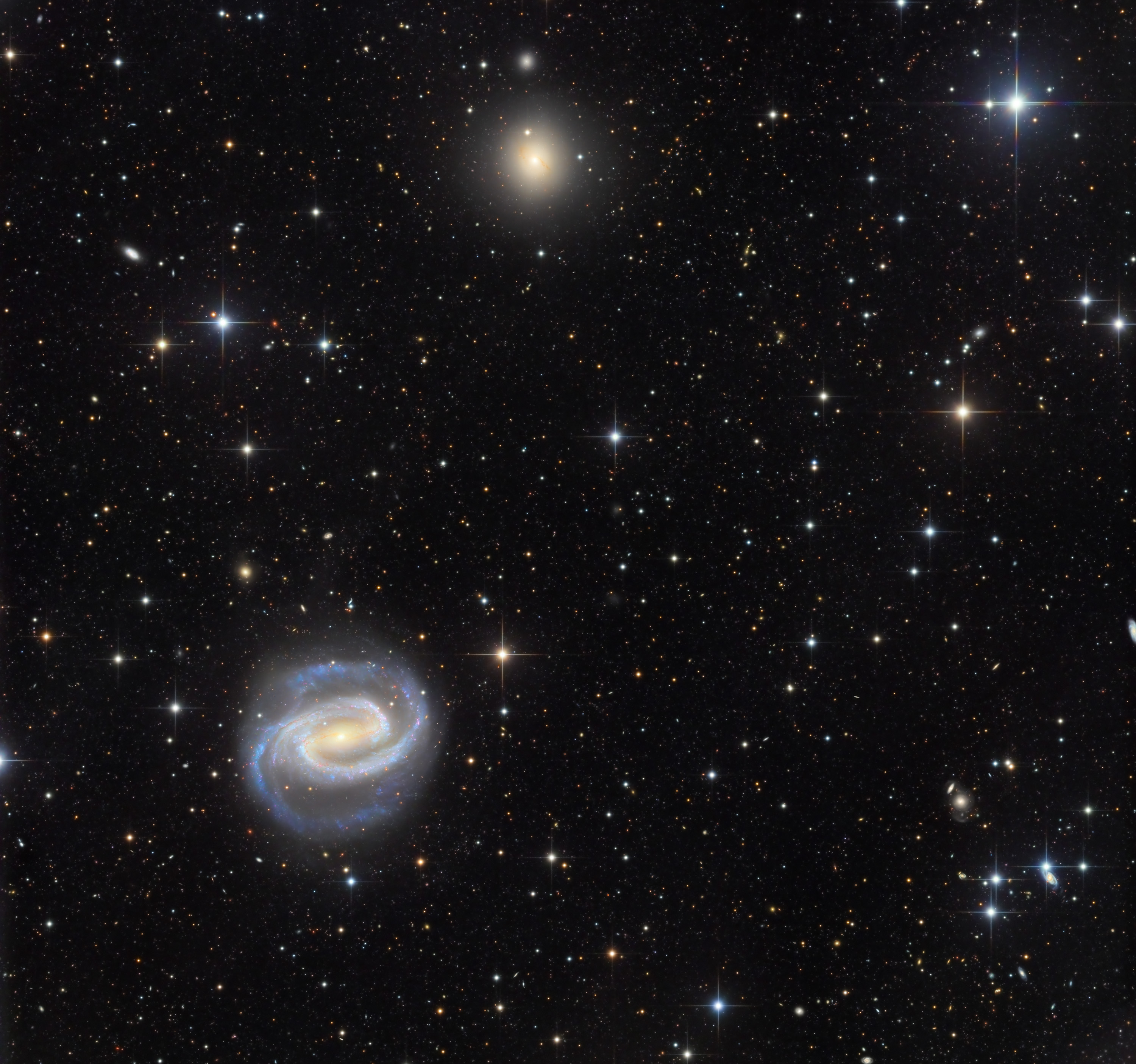
Astronomy - GALAXIES IN THE RIVER : NGC 1300 AND NGC 1297

 2026 March 21

See Explanation.  Clicking on the picture will download
the highest resolution version available.

Galaxies in the River: NGC 1300 and NGC 1297
Image Credit & CopyrightDietmar Hager and Eric Benson

Explanation: Spiral NGC 1300 and elliptical NGC 1297 are galaxies that lie on the banks of the southern constellation Eridanus (The River). At 70 million light-years distant or more, both are members of the Eridanus Galaxy Cluster. About 100,000 light-years across, at lower left in this sharp, galaxy group photo NGC 1300 is seen face-on with a prominent central bar and grand, sweeping spiral arms. Like other spiral galaxies, including our own barred spiral Milky Way Galaxy, NGC 1300 is thought to have a supermassive central black hole. A contrast in appearance and slightly more distant, NGC 1297 is the roughly spherical large elliptical galaxy near the top of the frame. With little active star formation, elliptical galaxies are composed of older populations of stars and are likely he result of multiple collisions and mergers with spirals.

20/03/2026

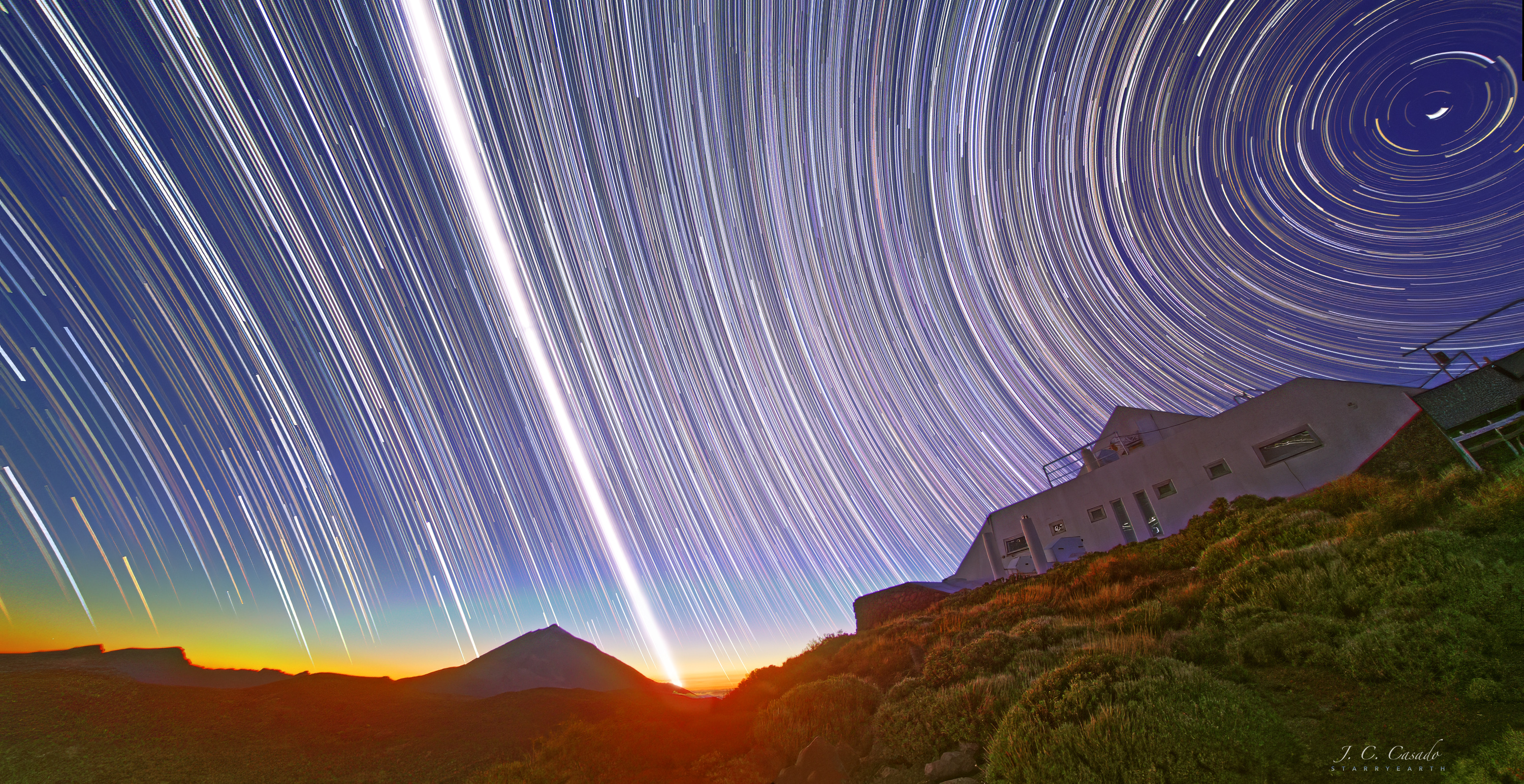
Astronomy - SPRING EQUINOX AT TEIDE OBSERVATORY

 2026 March 20

See Explanation.  Clicking on the picture will download
the highest resolution version available.

Spring Equinox at Teide Observatory
Image Credit & CopyrightJuan Carlos Casado (Starry EarthTWAN)

Explanation: The defining astronomical moment of the equinox today is at 14:46 UTC (March 20). That's when the Sun crosses the celestial equator moving north in its yearly journey through planet Earth's sky, marking the beginning of spring for our fair planet in the northern hemisphere and fall in the southern hemisphere. Then, day and night are nearly equal around the globe. In fact, both day and nighttime exposures from a spring equinox at the Observatorio del Teide in Tenerife, Canary Islands, Spain, are used in this composited skyscape. Over 1,000 images were taken with a fisheye lens and merged in the ambitious equinox project. The apparent motion of the Sun setting along the celestial equator on the equinox date follows the bright linear, diagonal track from the sequence of daytime exposures taken over 6 hours. After sunset, nighttime exposures recorded startrails, with the celestial equator as a linear track and concentric arcs circling the north celestial pole near Polaris at upper right and the south celestial pole beyond the lower left edge (and below the Teide horizon). The foreground includes the distant Teide volcano peak and the observatory's pyramid-shaped solar laboratory building.

19/03/2026

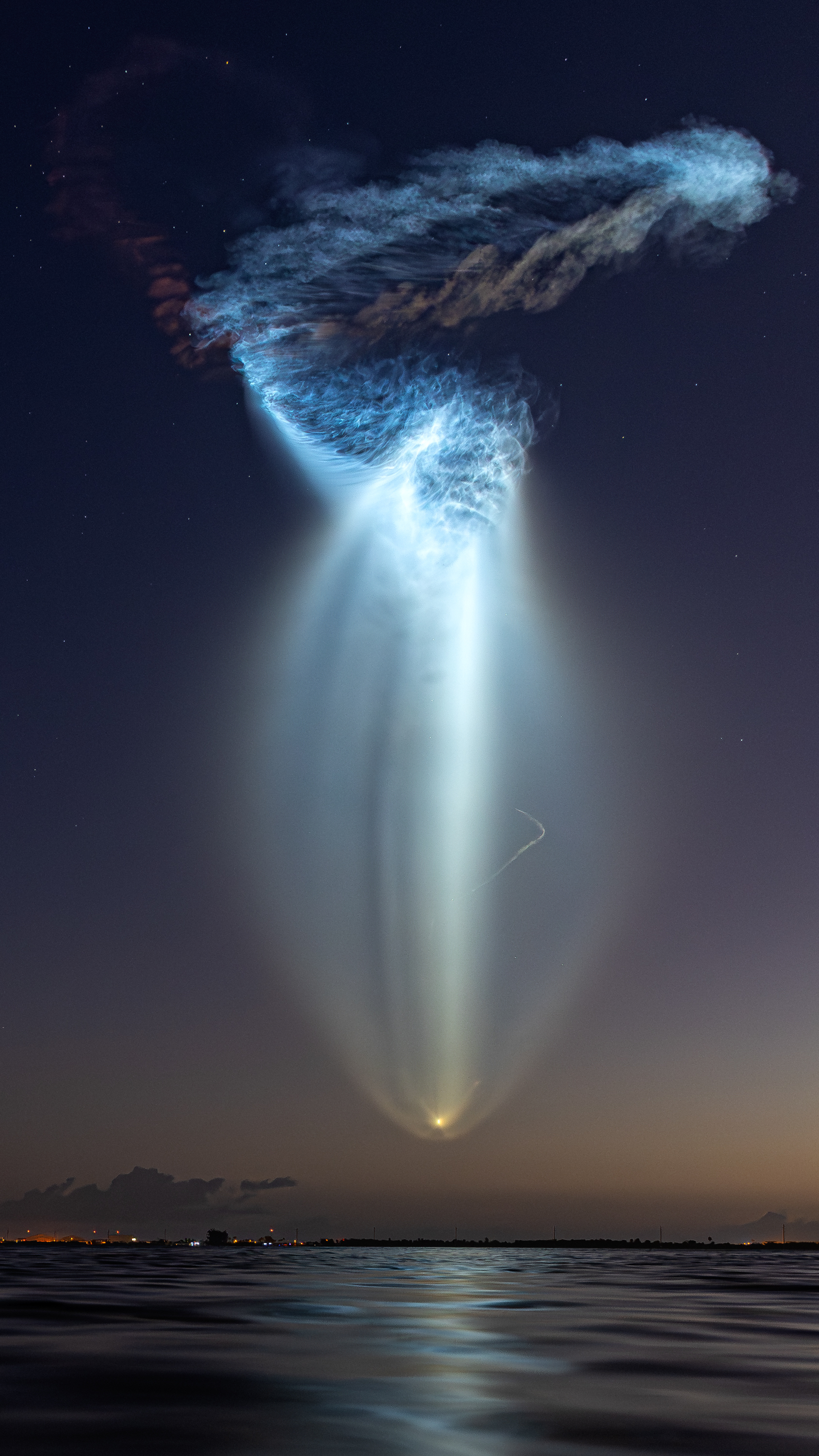
Astronomy - LAUNCH PLUME : SPACEX JELLY FISH

 2026 March 19

A SpaceX Falcon 9 rocket launch produces a glowing cloud,
	  reminiscent of a jellyfish.
	  Please see the explanation for more detailed information.

Launch Plume: SpaceX Jellyfish
Image Credit & CopyrightMichael Seeley
Text: Cecilia Chirenti (NASA GSFCUMCPCRESST II)

Explanation: Even if you live with your head in the clouds, you won’t find a jellyfish like this one very often. The featured image shows a SpaceX Falcon 9 rocket launch from Cape Canaveral in Florida on March 4. The launch happened 52 minutes before sunrise, and the second stage rocket exhaust plume was high enough in the sky to catch the light of the rising sun, while the photographer was still in the dark. This combination of light and shadow, possible at dawn or dusk, makes the exhaust, mostly water vapor and carbon dioxide, appear as a glowing cloud. It only looks like it's going down, as the rocket follows the curvature of the Earth on its way to space. A related effect is the twilight phenomenon, which causes colorful contrails sometimes mistaken for UFOs. But, in case you are wondering: real jellyfish were sent to space by NASA in the 1990s as part of a science experiment.

18/03/2026

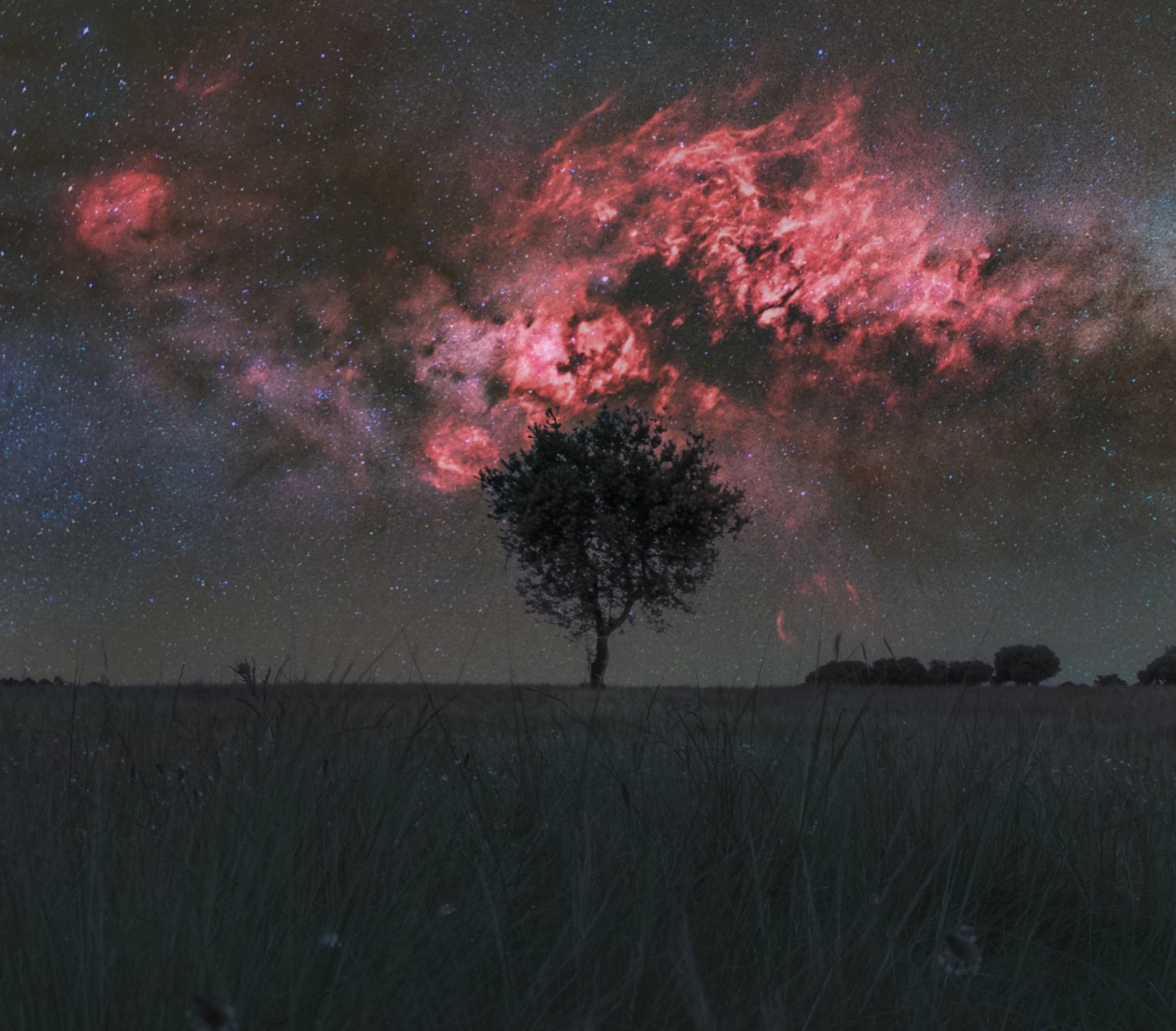
Astronomy - CYGNUS AND THE SOLITARY TREE

 2026 March 18

Clouds of gas glow red in the night sky above a dark tree on the horizon that stands in a meadow. 
Please see the explanation for more detailed information.

Cygnus and the Solitary Tree
Image Credit & Copyright: 2025 Horacio Lander / AstroHoracio
Text: Keighley Rockcliffe (NASA GSFCUMBC CSSTCRESST II)

Explanation: A lone tree stands in a quiet meadow in Guadalajara, Spain, silhouetted against the Cygnus region rising above like flames in the night sky. This deep night skyscape is a composite of exposures that reveals a range of brightness and color human eyes can't quite see on their own. Spanning over a thousand times the angular size of the full moon, Cygnus sets the sky afire with active star formation where clouds of gas and dust collapse under gravity until nuclear fusion ignites and new stars are born. These stars ionize the surrounding hydrogen gas, causing it to glow crimson, while tendrils of interstellar dust absorb some of that light and cast dark shadows across the sky. Cygnus is a trove of celestial treasures, notably the VeilCrescent, and Pelican nebulae, as well as Cygnus X-1, the first confirmed black hole. Cygnus continues to yield fresh science, including a new three-dimensional model of the Cygnus Loop made possible by the Chandra X-ray Observatory.

Astronomy - THE GUARDIANS OF RAPA NUI BENEATH THE MILKY WAY

 2026 March 25 The Guardians of Rapa Nui beneath the Milky Way Image Credit and Copyright:  Rositsa Dimitrova Text:   Keighley Rockcliffe  (...