
Image composite réunissant deux heures d'exposition de la pluie annuelle d'étoiles filantes, les Perséides, le 12 août 2016 (nuit du maximum d'activité), au-dessus du lac Svityaz, en Ukraine.
© Ihor Khomych, via Spaceweather
2026 April 13
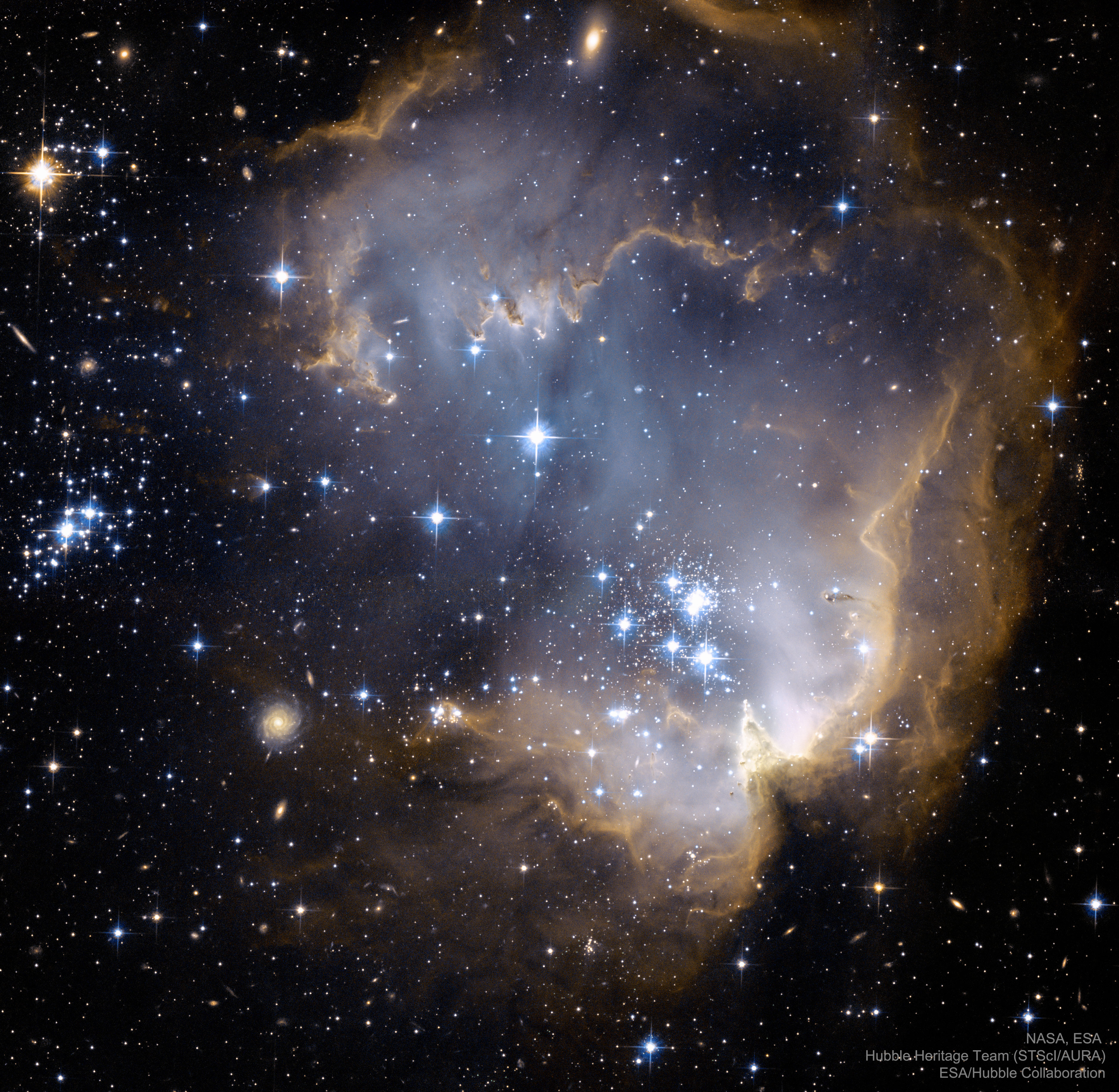
Explanation: The clouds may look like an oyster, and the stars like pearls, but look beyond. Near the outskirts of the Small Magellanic Cloud, a satellite galaxy some 200 thousand light-years distant, lies 5 million year young star cluster NGC 602. Surrounded by natal gas and dust, NGC 602 is featured in this stunning Hubble image of the region. Fantastic ridges and swept back shapes strongly suggest that energetic radiation and shock waves from NGC 602's massive young stars have eroded the dusty material and triggered a progression of star formation moving away from the cluster's center. At the estimated distance of the Small Magellanic Cloud, the featured picture spans about 200 light-years, but a tantalizing assortment of background galaxies are also visible in this sharp multi-colored view. The background galaxies are hundreds of millions of light-years or more beyond NGC 602.

2026 April 10
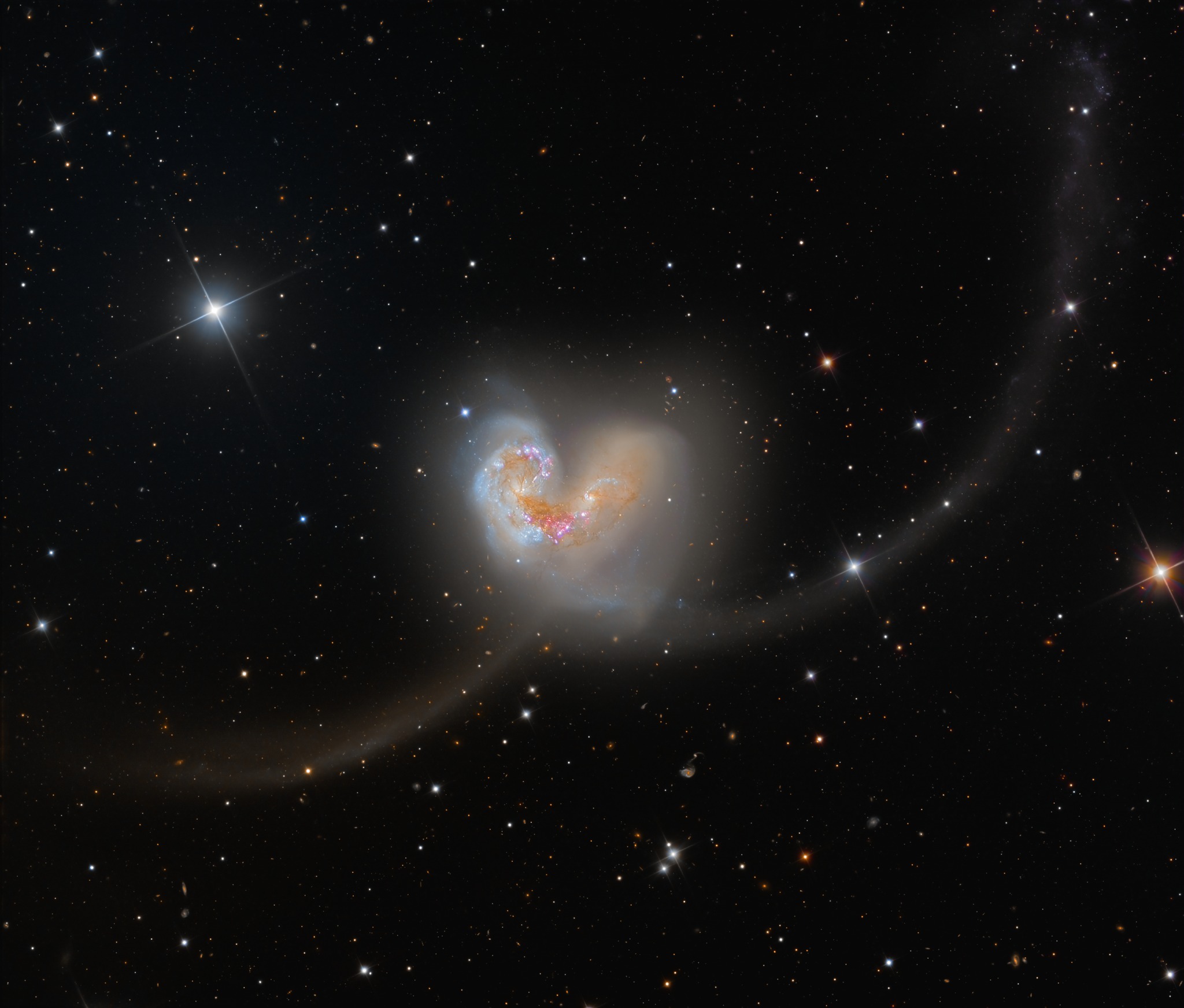
Explanation: Some 60 million light-years away in the southerly constellation Corvus, two large galaxies are colliding. Stars in the two galaxies, cataloged as NGC 4038 and NGC 4039, very rarely collide in the course of the ponderous cataclysm that lasts for hundreds of millions of years. But the galaxies' large clouds of molecular gas and dust often do, triggering furious episodes of star formation near the center of the cosmic wreckage. Spanning over 50 thousand light-years, this stunning telescopic frame also reveals new star clusters and matter flung far from the scene of the accident by gravitational tidal forces. The remarkably sharp ground-based image follows the faint tidal tails and distant background galaxies in the field of view. The suggestive overall visual appearance of the extended arcing structures gives the galaxy pair, also known as Arp 244, its popular name - The Antennae.
 .../
.../2026 April 8
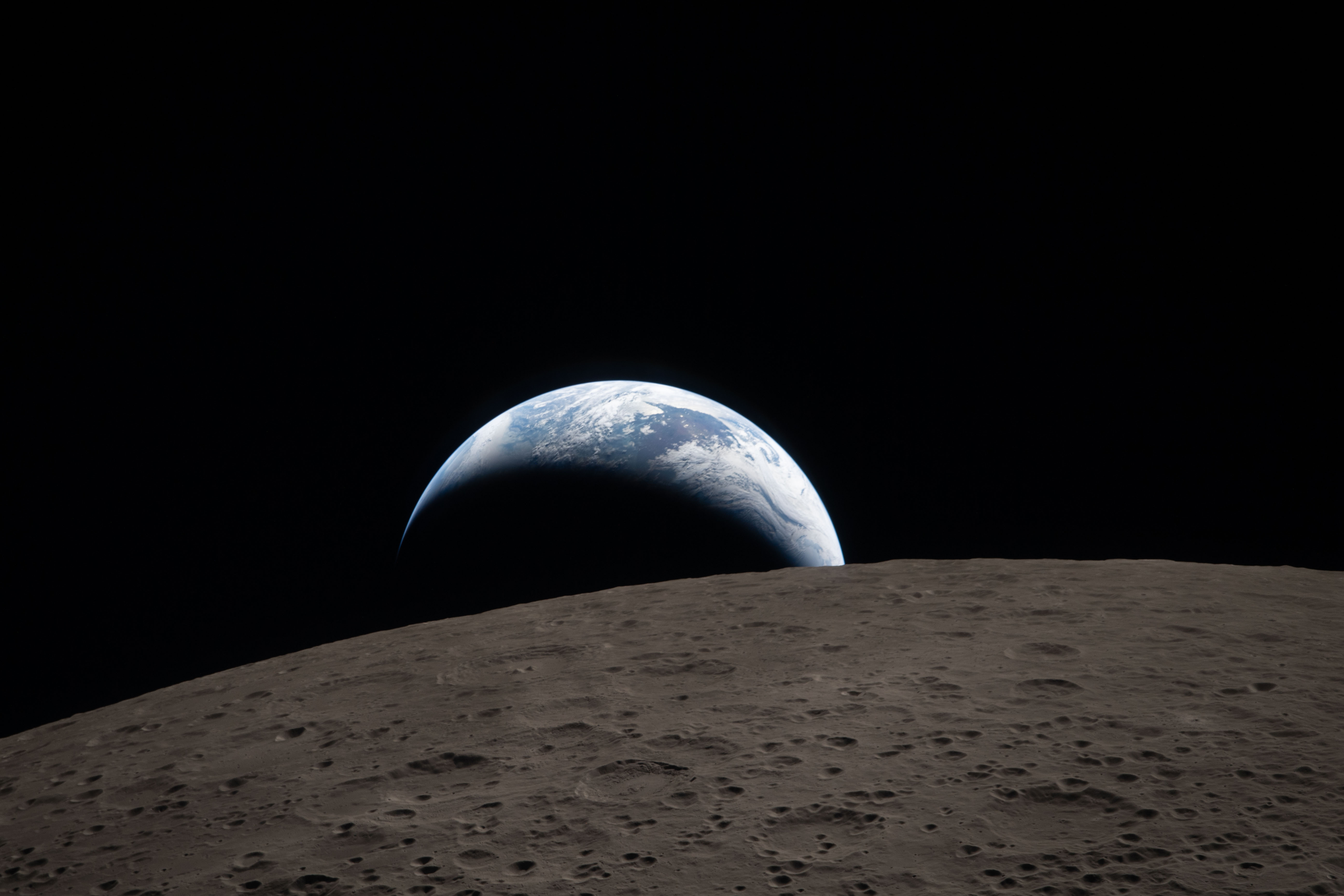
Explanation: And to all of you down there on Earth and around Earth, we love you, from the Moon. We will see you on the other side,
said Artemis II pilot Victor Glover on April 6th at 6:44pm ET as 8.3 billion minus four people and one Earth set below the Moon's horizon. The Orion spacecraft, Integrity, then traveled behind the Moon as part of its seven-hour lunar flyby. The crew characterized never-before-seen regions of the far side of the Moon, which is puzzlingly less volcanically active than the near side. New observations of crater peaks, floors, terraces, and rings preserved on the lunar surface will help piece together the impact history of the Solar System. Among many other surface characterizations, the crew observed one of the Moon's best-preserved basins, the Orientale basin, and identified two new craters. As Earth rose above the Moon’s horizon and Integrity began its return home, Artemis II mission specialist Christina Koch powerfully summarized humanity’s grander mission: ...we will always choose Earth. We will always choose each other.


2026 April 7
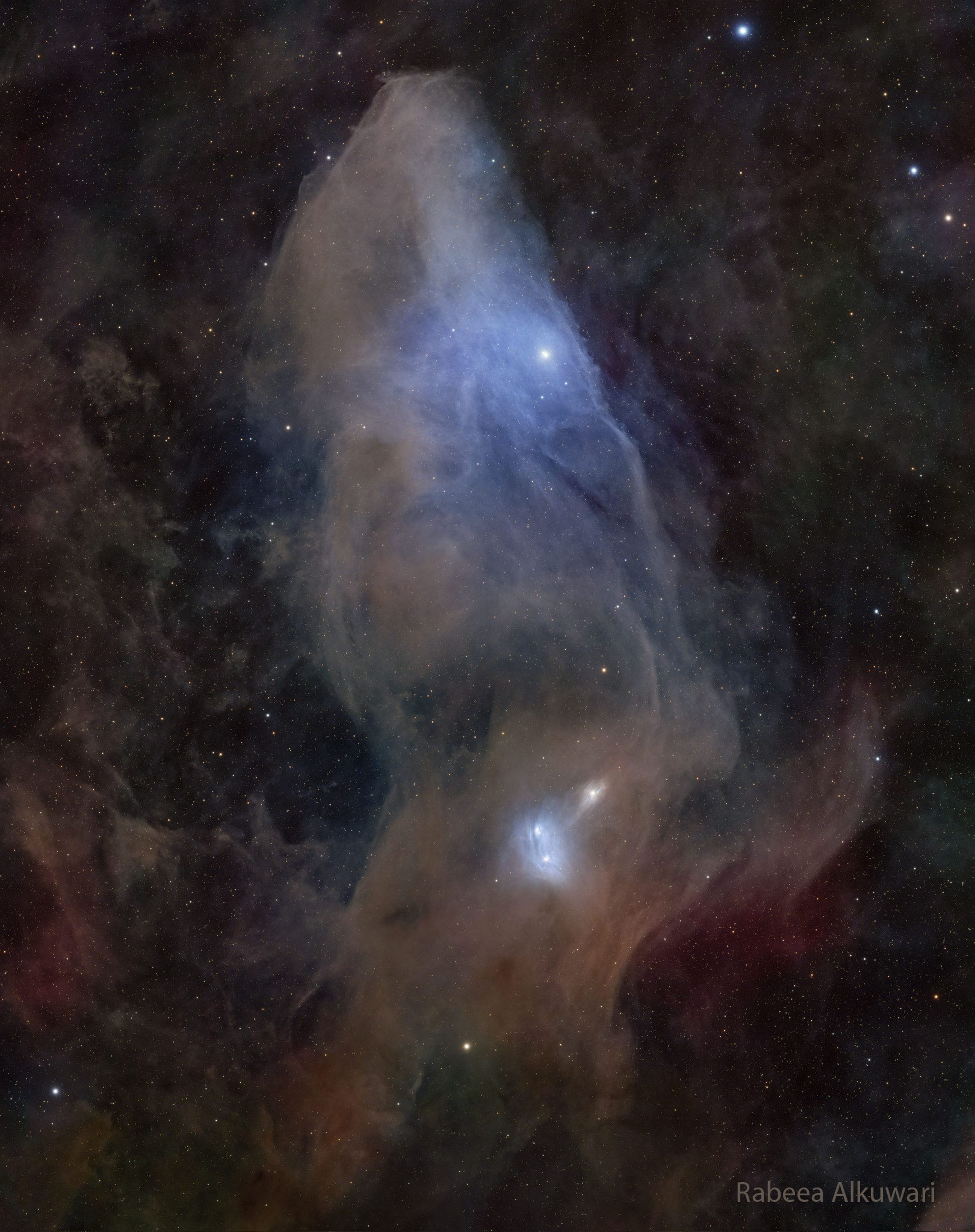
Explanation: Do you see the horse's head? What you are seeing is not the famous Horsehead nebula toward Orion, but rather a fainter nebula that only takes on a familiar form with deeper imaging. The main part of the here-imaged molecular cloud complex is reflection nebula IC 4592. Reflection nebulas are made up of very fine dust that normally appears dark but can look quite blue when reflecting the visible light of energetic nearby stars. In this case, the source of much of the reflected light is a star at the eye of the horse. That star is part of Nu Scorpii, one of the brighter star systems toward the constellation of the Scorpion (Scorpius). A second reflection nebula dubbed IC 4601 is visible surrounding two stars just below the image center. The featured picture was taken from Sawda Natheel in Qatar.
2026 April 4
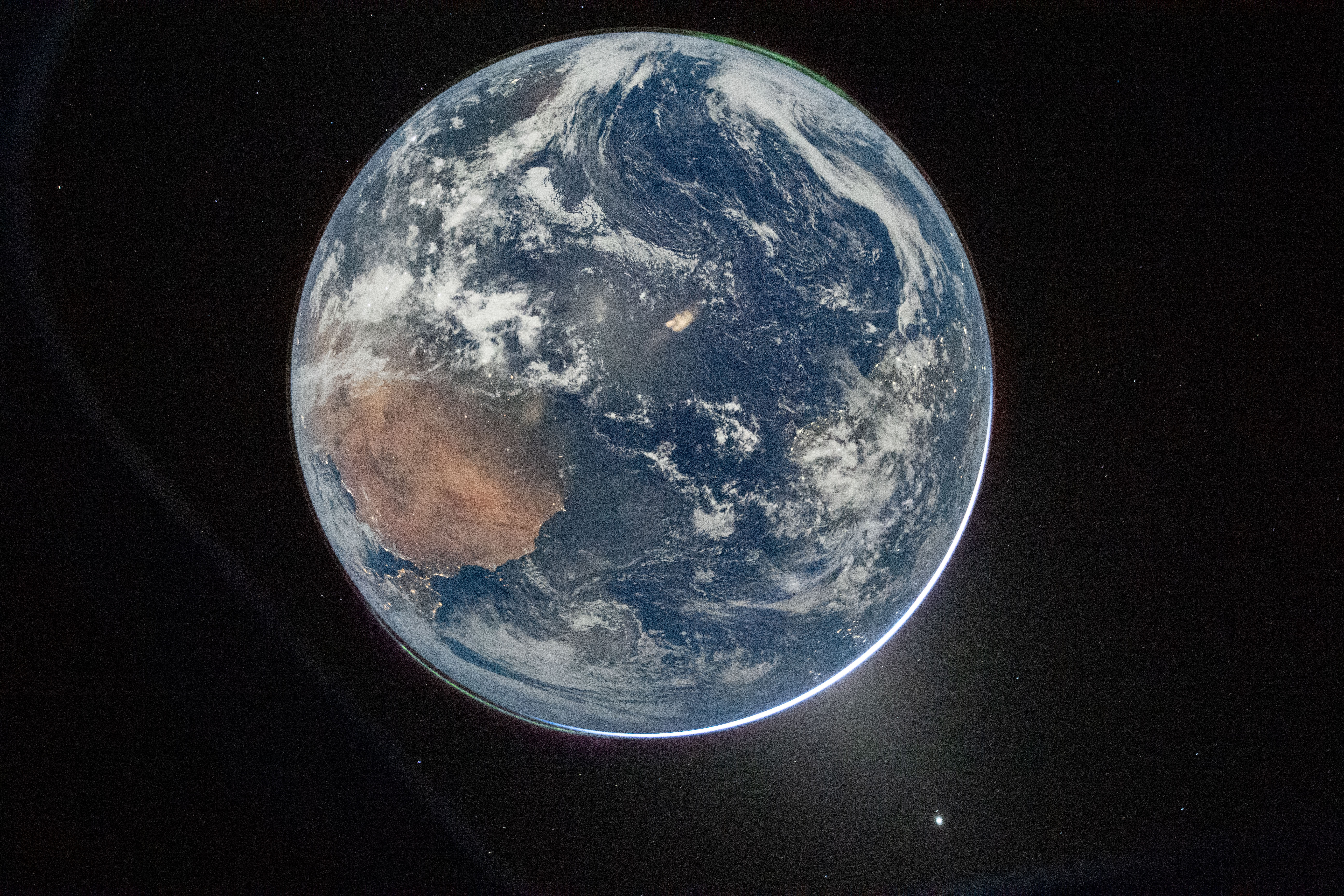
Explanation: From pole to pole our fair planet is captured in this snapshot from space, an evocative image from a window of the Orion spacecraft Integrity. From the spacecraft's perspective the Sun is moving behind Earth's bright limb along the lower right. Africa and the Iberian peninsula are in view on the pale blue planet's surface, while aurorae crown Earth's south and north poles at top right and bottom left. Commander Reid Wiseman took the historic picture on Artemis II mission flight day 2 (April 2), after the completion of the planned translunar injection burn. That burn boosted the spacecraft out of Earth orbit, sending Integrity and crew on a trajectory that will take them around the Moon and back again. That's a journey humans last made over 50 years ago.
2026 April 3
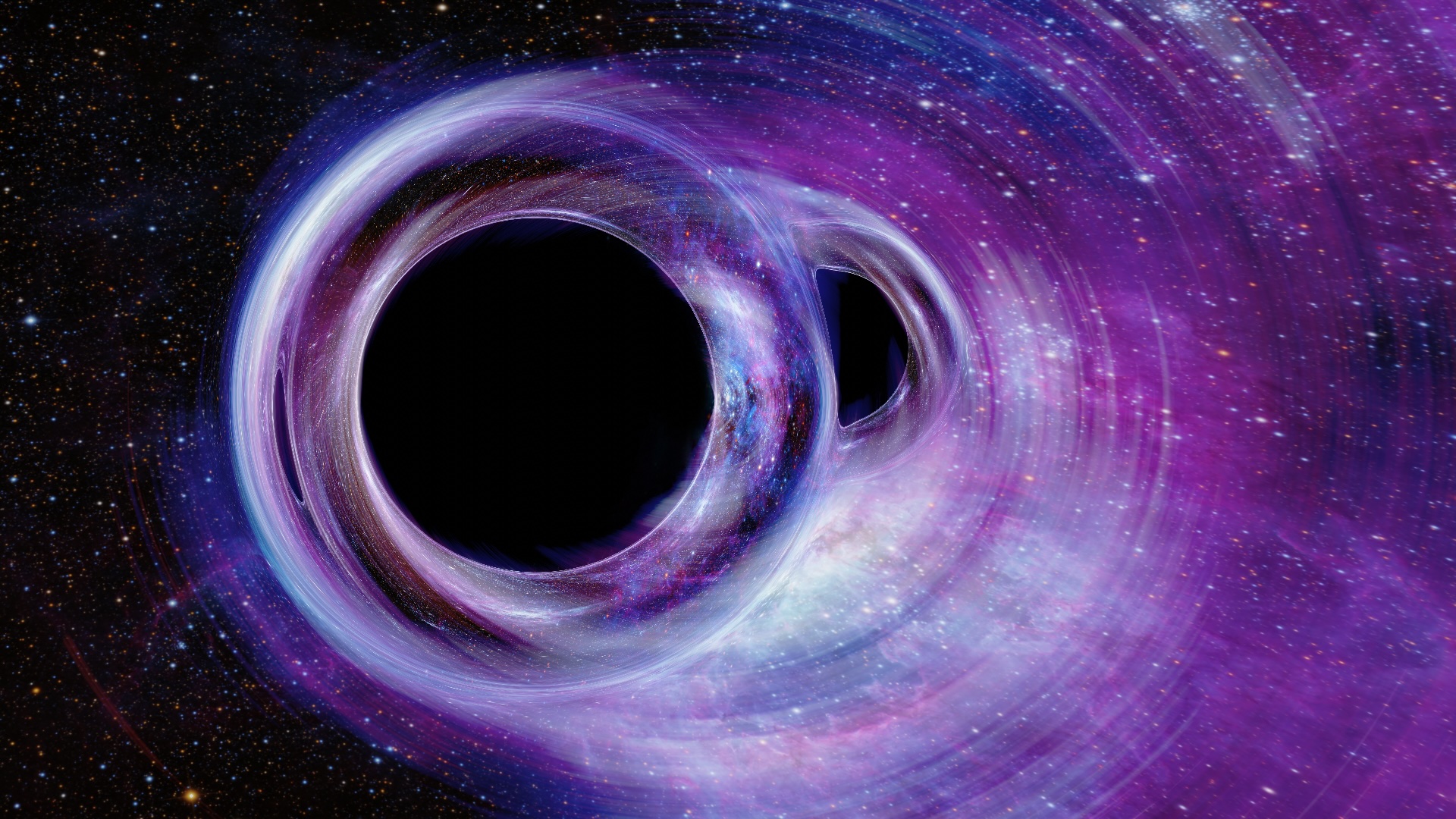
Explanation: How can we see what is invisible? Black holes are not easy to see in the dark cosmic night, but astronomers can find them by analyzing their gravitational effects on matter, light and spacetime. The featured image shows an illustration that combines a simulation of a black hole binary system in its final "death-dance" with an astrophotography image of the Tarantula Nebula in the background. Even though black holes don't emit light, they distort the path of light rays, acting like a gravitational lens. As a result, the nebula appears extremely distorted, forming Einstein rings and multiple images. Tarantula Nebula lies in the Large Magellanic Cloud, a dwarf galaxy that is one of the satellite galaxies of the Milky Way, 160,000 light-years away. That is more than 1,000 times closer than any of the binary black hole mergers detected so far. We'll probably never detect a merger so close to home!
Un scientifique profondément sceptique Avant cet événement, Eben Alexander ne laissait aucune place au doute. Pour lui, les expériences de...


