Nombre total de pages vues

01/05/2026

Santé/Médecine - CANCER : DES CHERCHEURS ONT MIS AU POINT UN PIEGE DE LA TUMEUR

Dans la lutte contre le cancer, la résistance aux médicaments pose problème depuis toujours car les tumeurs ne sont pas des blocs homogènes. Elles sont composées de cellules différentes, dont certaines possèdent déjà, ou acquièrent rapidement, des mécanismes de défense, ce qui fait qu'elles parviennent à neutraliser le traitement ou à modifier leur fonctionnement interne pour continuer à se multiplier.

C’est précisément cette faculté d’adaptation qu'une équipe de scientifiques de l’Université d’État de Pennsylvanie a choisi d’exploiter. Publiée dans la revue Nature Biotechnology, l'étude montre comment il est possible d'orienter l’évolution des cellules tumorales pour mieux les éliminer ensuite.

Un système à double switch génétique

Concrètement, les chercheurs ont imaginé une méthode de « double commutation de sélection génétique » qui consiste à introduire dans les cellules cancéreuses deux dispositifs génétiques capables, à terme, de conduire à leur destruction.

Dans un premier temps, certaines cellules sont rendues résistantes à un médicament déjà utilisé contre le cancer du poumon, l’Erlotinib, un puissant inhibiteur de la phosphorylation intracellulaire de l'EGPR, le gène à l'origine du récepteur qui donne l'ordre à la cellule de se multiplier.

Sous la pression du traitement, ces cellules modifiées prennent alors l’avantage sur les autres et deviennent majoritaires dans la tumeur. Autrement dit, les chercheurs orientent volontairement la sélection des cellules qui survivent.

Cancer : une nouvelle approche génétique cible les cellules malades sans toucher aux autres

Dans un second temps, un autre gène est activé, cette fois à l’aide d’une molécule considérée comme inoffensive, le 5-FC. Ce gène produit une enzyme qui transforme cette substance en une toxine, la molécule 5-FU, qui constitue la chimiothérapie la plus prescrite car elle est chimiquement proche de celles qui constituent notre ADN et peut donc en perturber la duplication.

De la sorte, cette toxine va tuer non seulement les cellules modifiées, mais aussi celles qui se trouvent autour d’elles. Le piège se referme donc sur la tumeur au moment même où elle pensait avoir trouvé une issue.

La technique du piège

Cette stratégie est innovante. Au lieu de subir l’évolution du cancer, l'objectif est désormais de la diriger, la résistance des cellules tumorales devenant une étape préparatoire avant l’attaque finale qui provoquera leur élimination.


Pour autant, il ne s’agit encore que d’un traitement expérimental qui n'a pas été testé sur des patients. Il n'y a pas eu d'essai clinique. Par ailleurs, il faudra trouver le moyen d’introduire ces gènes thérapeutiques dans les tumeurs. Nonobstant, si cette méthode était validée, elle pourrait permettre de concevoir des thérapies plus intelligentes, capables non seulement de détruire la tumeur, mais également de prévenir les rechutes et les récidives.

FuturaSciences

30/04/2026

Musique - BERLINER PHILLHARMONIKER - EDWARD ELGAR - OP 12-SALUT L'AMOUR

"Salut l'amour"

Astronomy - A DOUBLE HELIX LUNAR ECLIPSE

 2025 November 3

A wide angle image of the night sky is punctuated by
a radio telescope on the lower left. Two bands of light
run through the sky: the Milky Way and zodiacal light.
The bands intertwine like a double helix. Near the top
is an orange orb that is a totally eclipsed moon.
Please see the explanation for more detailed information.

A Double Helix Lunar Eclipse
Image Credit & Copyright: Chunlin Liu

Explanation: The image was timed to capture a total lunar eclipse -- but it came with quite a twist. First, the eclipse: the fully Earth-shadowed Moon is visible as the orange orb near the top. The eclipsed Moon's orange color is caused by a slight amount of red light scattered first by Earth's atmosphere, adding a color like a setting Sun. Now, the twist: one of the apparent double helix bands is the Milky Way, the central disk of our home galaxy. The second band is zodiacal light, sunlight scattered by dust in our Solar System. The reason they cross is because the plane where dust orbits our Sun is tilted relative to the plane where stars orbit our Galaxy. This well-known tilt is shown dramatically in the featured wide-angle Mercator-projected picture, spanning from horizon to horizon, captured in early September from Mingantu Observing Station in Inner MongoliaChina

29/04/2026

Santé/Médecine - LES SYMPTOMES DE LA FIBROMYALGIE: 5. PERTURBATION DU SOMMEIL (7/12)


Cette maladie affecte aussi le sommeil, ce qui aggrave davantage les symptômes de fatigue. Même après une longue nuit de sommeil, on se réveille fatigué. Ceux qui en souffrent décrivent un sommeil trop léger et non réparateur.

CommentEconomiser

Astronomy- THE MOON VENUS AND THE PLEIADES

 2026 April 29

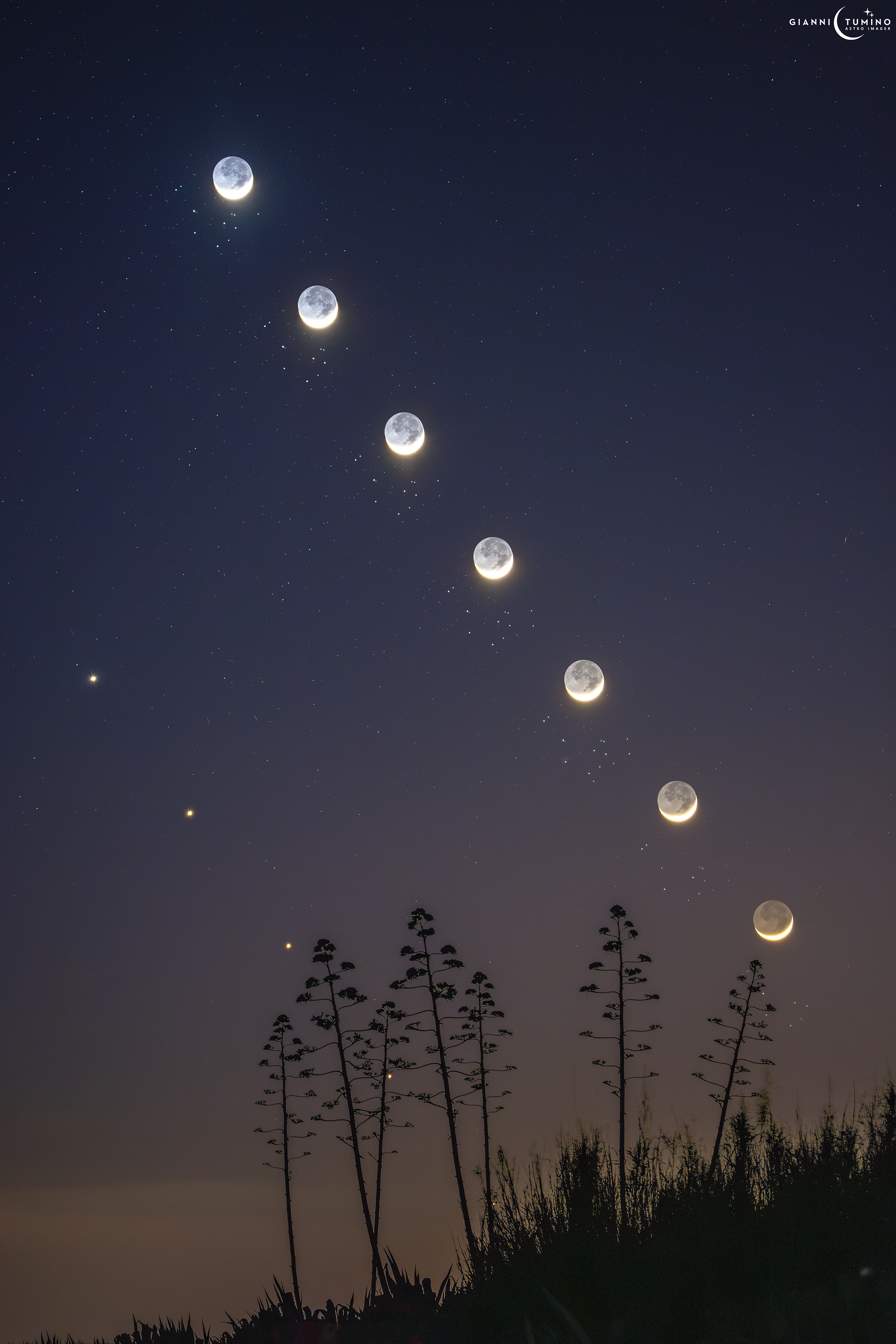
The crescent Moon, Venus, and the Pleiades travel across the twilight sky. The silhouettes of a few beach flowers decorate the foreground.

The Moon, Venus, and the Pleiades
Image Credit & Copyright: Gianni Tumino
Text: Keighley Rockcliffe (NASA GSFCUMBC CSSTCRESST II)

Explanation: No, Earth did not recently acquire six more moons! Today’s APOD is a combination of images following the Moon, Venus, and the Pleiades across a southern Sicilian sky as twilight turned to evening on April 19. From 2023 to 2029, the Pleiades' and the Moon “visit" each other once per month due to the Pleiades' location in the ecliptic plane. April 2026 saw the celestial alignment of their visit with Venus. About six stars in the Pleiades cluster (Messier 45) are typically visible with the unaided eye. Due to the cluster’s visibility across the world, there are many myths and legends across cultures associated with the Pleiades. The Haudenosaunee people of North America, for example, say that seven boys danced so enthusiastically that they lifted off into the sky. Astronomers recently found thousands more Pleiades members, showing that after thousands of years of gazing upon this cluster, there is yet more to learn about the Pleiades.

28/04/2026

Astronomy - CG 30: COMETARY GLOBULES

2026 April 28
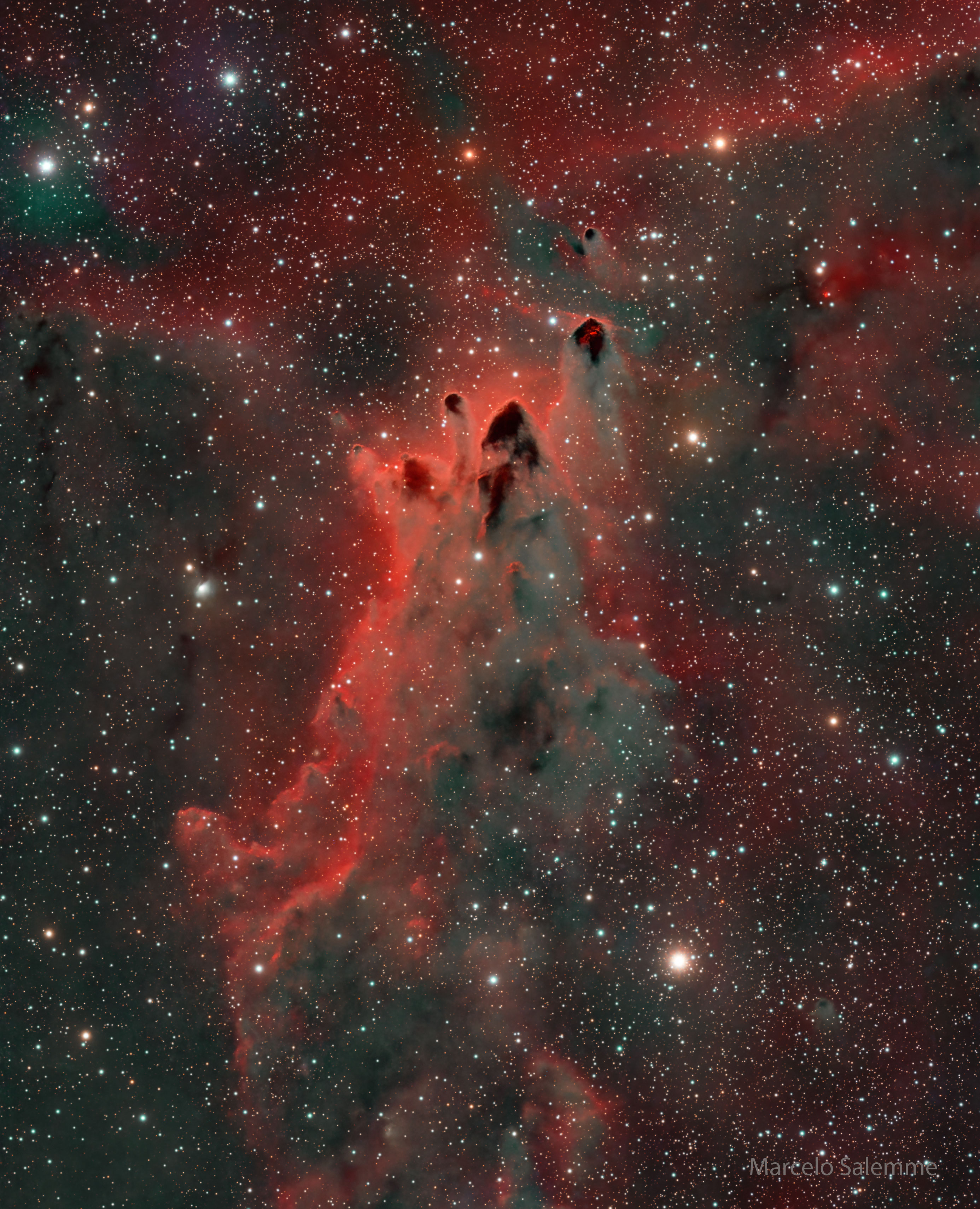
A star field with a few red wisps surrounds 
a nebula that has many several dark components each
of which has a dark head closer to the top of the image.
A red glow is brightest near the top of each component.
Please see the explanation for more detailed information.

CG 30: Cometary Globules
Image Credit & Copyright: Marcelo Salemme

Explanation: They're like mountain peaks, but they are forming stars. Bright-rimmed, flowing shapes gather near the center of this rich starfield toward the borders of the nautical southern constellations Puppis and Vela. Composed of interstellar gas and dust, the grouping of light-year sized cometary globules is about 1300 light-years distant. Energetic ultraviolet light from nearby hot stars has molded the globules and ionized their bright rims. The globules also stream away from the Vela supernova remnant which may have influenced their swept-back shapes. Within them, cores of cold gas and dust are likely collapsing to form low mass stars whose formation will ultimately cause the globules to disperse. In fact, cometary globule CG 30 (upper right in the group) sports a small reddish glow inside its head, a telltale sign of energetic jets from a star in the early stages of formation

Santé/Médecine - LES SYMPTOMES DE LA FIBROMYALGIE: 4. UNE FATIGUE PERSISTANTE (6/12)


Très fréquemment, la fibromyalgie cause une fatigue persistante, et ce, dès le réveil. L’intensité varie d’une personne à l’autre. Elle oscille entre fatigue légère et sensation d’épuisement, comme celle que l’on ressent avec la grippe. La fatigue peut être ressentie au moindre effort et vider la personne de son énergie. Lorsque c’est le cas, c’est l’épuisement total : À ce moment là, la personne se sent incapable de faire quoi que ce soit.

CommentEconomiser

27/04/2026

Astronomy - CG 4: THE GLOBULE AND THE GALAXY

 2026 March 11

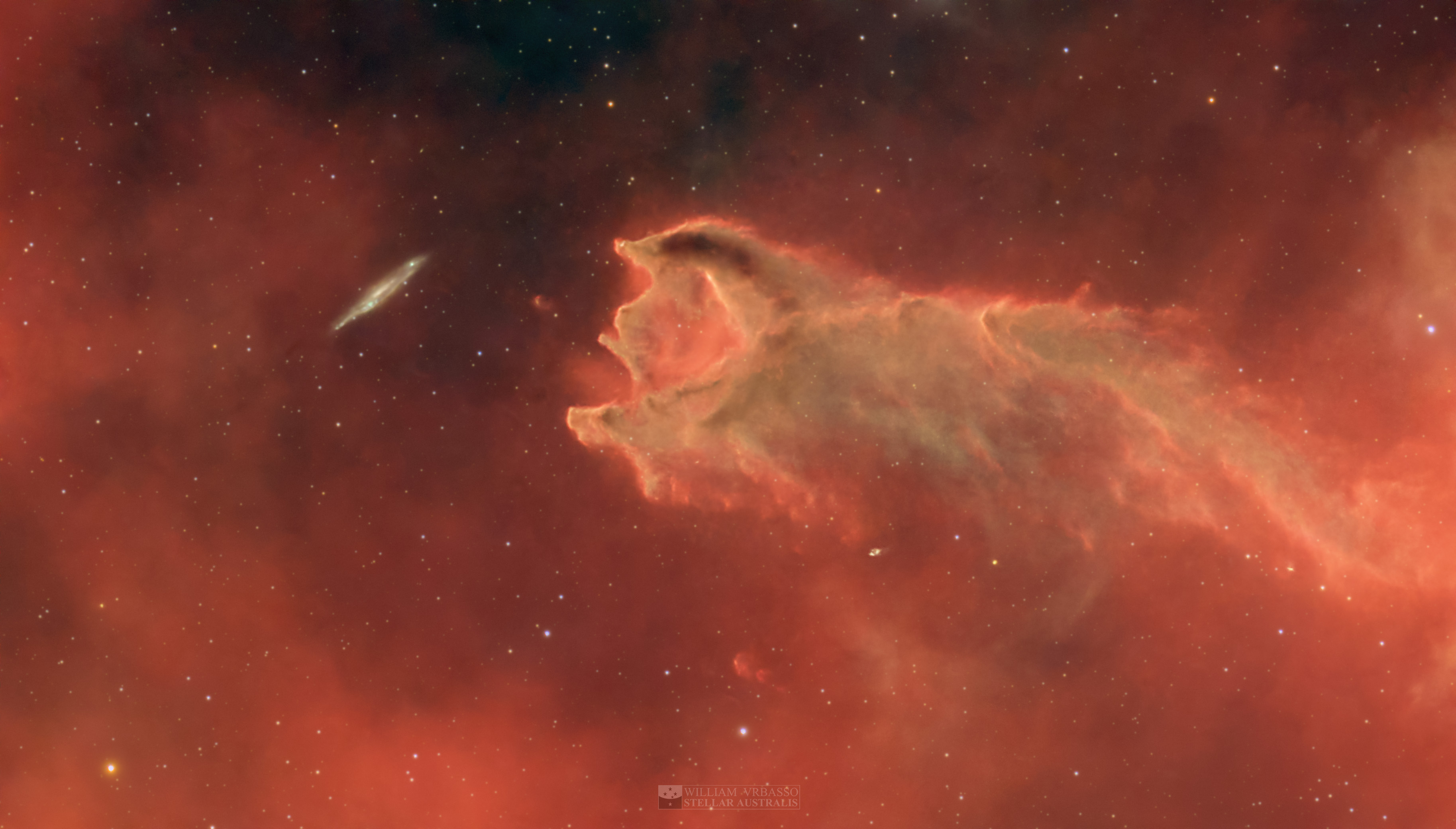
A cometary globule extends in front of a field of stars,
	  showing what seems like an open mouth towards a distant
	  galaxy in the background.
	  Please see the explanation for more detailed information.

CG 4: The Globule and the Galaxy
Image Credit & CopyrightWilliam Vrbasso
Text: Cecilia Chirenti (NASA GSFCUMCPCRESST II)

Explanation: Is this a cosmic monster ready to devour an unsuspecting galaxy? Thankfully, that is not the case. The red “monster” shown in the featured image is Cometary Globule CG 4, 1,300 light-years away in the Constellation Puppis. CG 4 is a molecular cloud, where hydrogen becomes cold enough to form molecules that can be brought together by gravity to create stars. The shape of CG 4 resembles that of a comet, but its head is 1.5 light-year in diameter and its tail is 8 light-years long; for comparison, the distance from the Earth to the sun is only 8 light-minutes. Astronomers believe that the tail of a cometary globule could have been shaped by a nearby supernova explosion or by irradiation from hot, massive stars. Indeed, CG 4 and other nearby globules point away from the Vela Supernova Remnant, at the center of the Gum Nebula. The edge-on spiral galaxy, ESO 257-19, is more than a hundred million light-years beyond CG 4, and is completely safe from the “monster”.

26/04/2026

Astronomy - MYSTIC MOUNTAIN MONSTER BEING DESTROYED

 2026 April 26

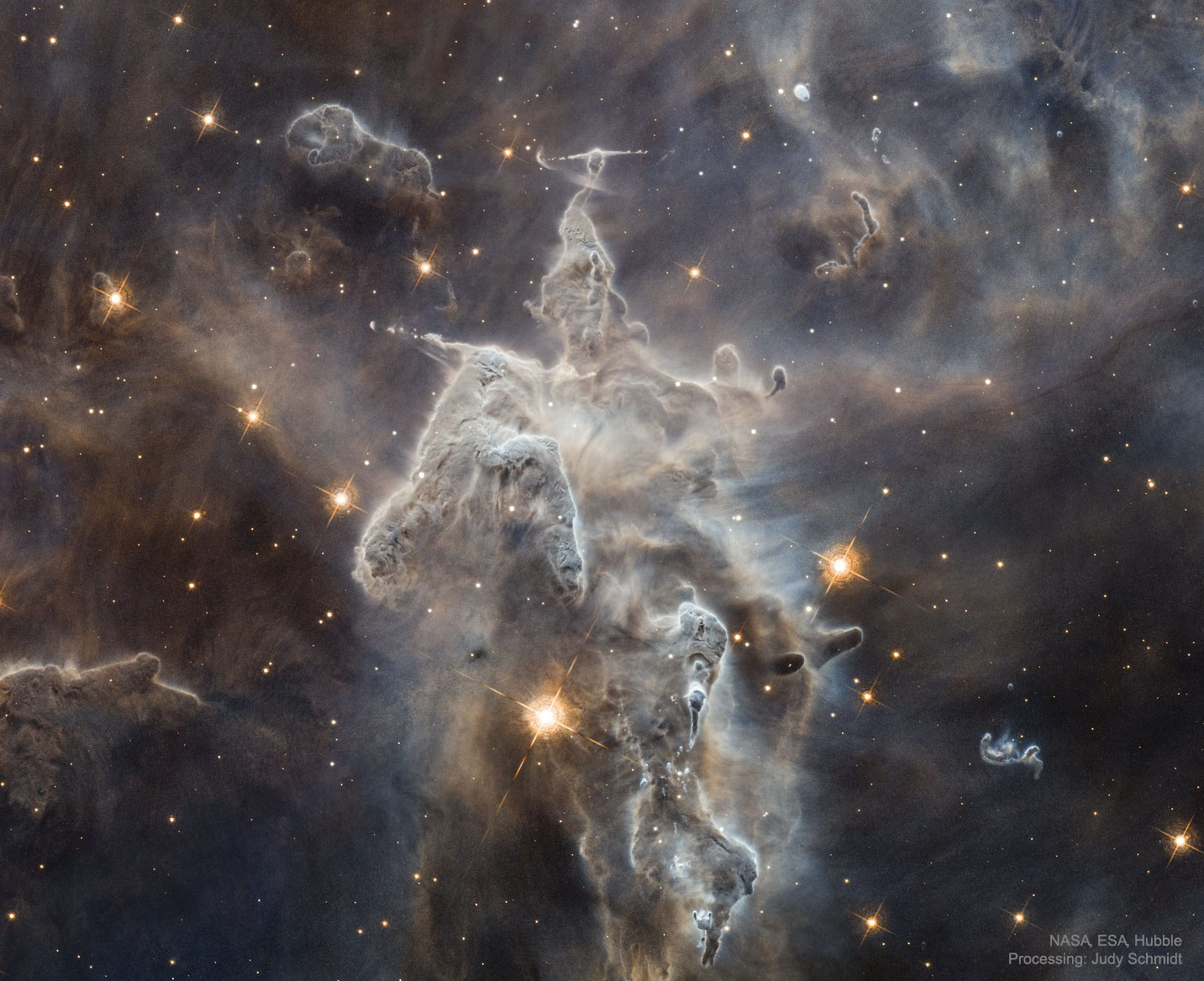
The featured image shows a large pillar of dust and
gas in the Carina Nebula. The pillar has many humps and 
several jets.
Please see the explanation for more detailed information.

Mystic Mountain Monster being Destroyed
Image Credit: HubbleNASAESAProcessing & LicenseJudy Schmidt

Explanation: Inside the head of this interstellar monster is a star that is slowly destroying it. The huge monster, actually an inanimate series of pillars of gas and dust, measures light years in length. The in-head star is not itself visible through the opaque interstellar dust but is bursting out partly by ejecting opposing beams of energetic particles called Herbig-Haro jets. Located about 7,500 light years away in the Carina Nebula and known informally as Mystic Mountain, the appearance of these pillars is dominated by dark dust even though they are composed mostly of clear hydrogen gas. The featured image was taken with the Hubble Space Telescope. All over these pillars, the energetic light and winds from massive newly formed stars are evaporating and dispersing the dusty stellar nurseries in which they formed. Within a few million years, the head of this giant, as well as most of its body, will have been completely evaporated by internal and surrounding stars.

25/04/2026

Santé/Médecine - LES SYMPTOMES DE LA FIBROMYALGIE: 3. - DES RAIDEURS MATINALES (5/12)


Beaucoup de personnes atteintes de fibromyalgies souffrent de raideurs. Généralement, elles sont plus intenses le matin, au réveil. Mais on peut aussi les ressentir en journée, si l’on reste trop longtemps dans la même position.

Au toucher, les muscles deviennent plus durs et plus sensibles. Souvent, les raideurs provoquent aussi des spasmes. C'est quoi des spasmes ? Ce sont des contractions musculaires douloureuses.

CommentEconomiser

Astronomy - SIMULATION TNG50: A GALAXY CLUSTER FORMS

Simulation TNG50: A Galaxy Cluster Forms Video Credit: IllustrisTNG Project ; Visualization: Dylan Nelson ( Max Planck Institute for Astro...