Nombre total de pages vues

01/07/2026

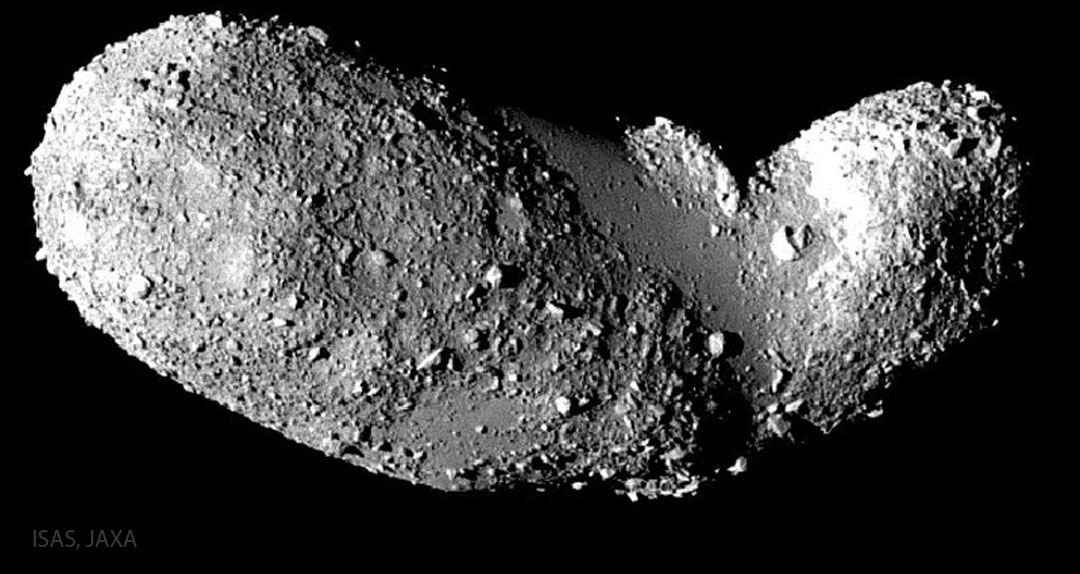
Astronomy - UNUSUALLY SMOOTH SECTIONS OF ASTEROID ITOKAWA

 2026 June 30

Dark space surrounds a gray peanut sized object.
The object has a surface that has many rough nodules
but also some relatively smooth sections. 
Please see the explanation for more detailed information.

Unusually Smooth Sections of Asteroid Itokawa
Image Credit: JAXA, ISAS

Explanation: Why are parts of this asteroid's surface so smooth? The answer seems likely to do with the dynamics of an asteroid that is a loose pile of rubble rather than a solid rock. The unusual asteroid Itokawa was visited by the Japanese spacecraft Hayabusa in 2005 which imaged and documented its unusual structure and mysterious lack of craters. Analyses of the border regions between smooth and rugged sections indicate that jostling of the asteroid might be creating segregation between large and small rocks near the surface, like the Brazil nut effect. The robotic Hayabusa actually touched down on one of the smooth patches, dubbed the MUSES Sea, and collected soil samples. These samples were returned to Earth and are not only giving clues to the ancient history of this unusual asteroid, but also about the early years of our entire Solar System. Computer simulations show that 500-meter asteroid Itokawa may impact the Earth within the next few million years.

Rocking Space: Today is Astero

27/06/2026

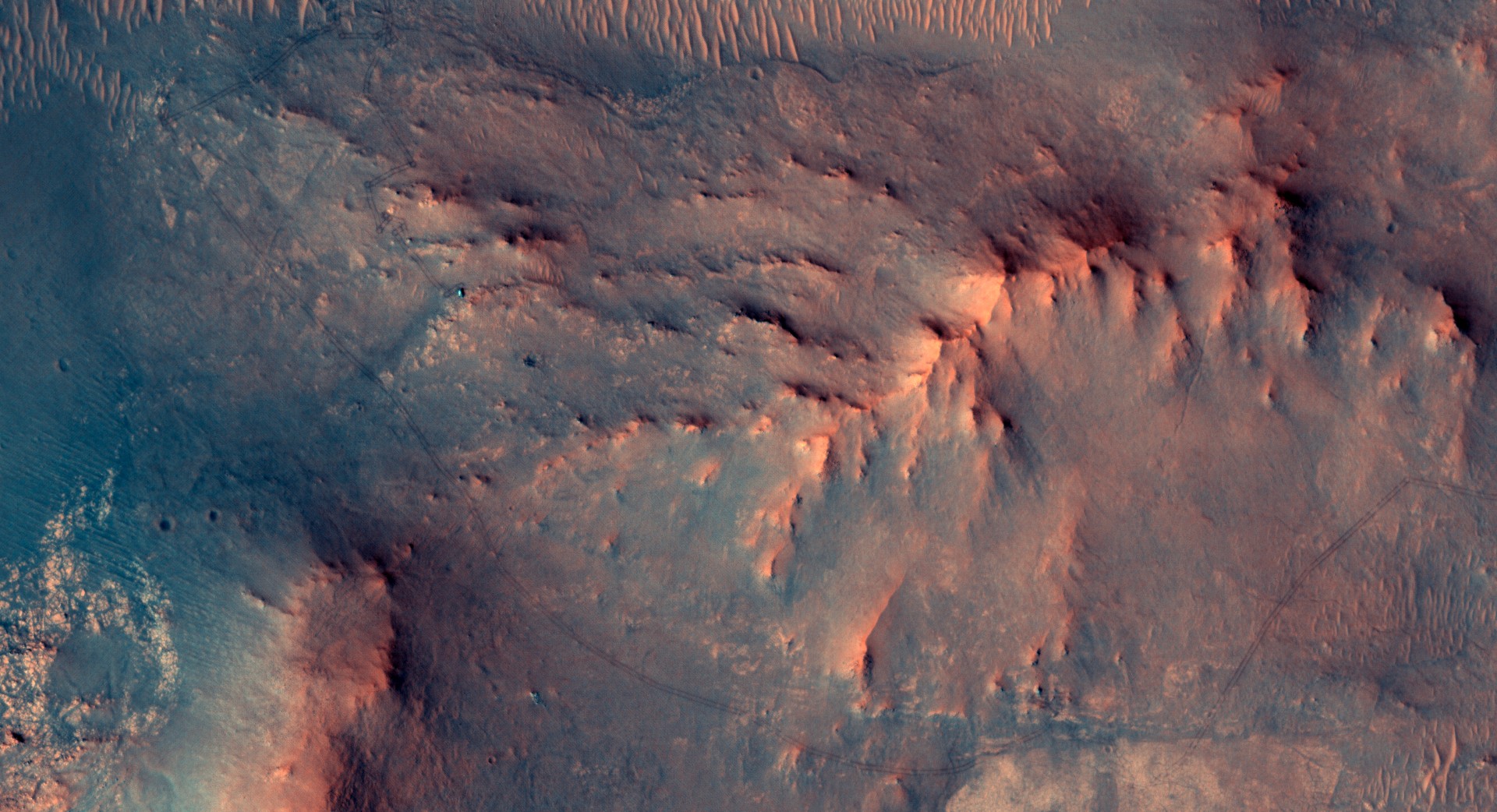
Astronomy - MARS MARATHON BY PERSEVERANCE

2026 June 27
See Explanation.  Clicking on the picture will download
the highest resolution version available.

Mars Marathon by Perseverance
Image Credit: NASA, LPL (U. Arizona), MRO, HiRISE

Explanation: In this recent HiRISE view from the Mars Reconnaissance Orbiter, the little green dot indicated on the surface of the big Red Planet is the Perseverance Mars rover. Recorded on June 13, the car-sized, six-wheeled robot was imaged a day before completing a Martian marathon, traveling a total distance of 26.218 miles (42.195 kilometers) since it began exploring the surface of Mars. That equivalent marathon distance was achieved by Perseverance on its mission sol (Martian day) 1,890, after about 5 Earth years and 4 Earth months of driving. Perseverance is continuing to hunt for biosignatures. In the HiRISE image, the Mars rover's tracks can be seen leading to its location in an area west of its landing site in Jezero crater near an ancient river delta

26/06/2026

Géoglyphes - L'HOMME DE MARREE EN AUSTRALIE


L'Homme de Marree est un géoglyphe situé sur un plateau à Finnis Springs, 60 km à l'ouest de la ville de Marree, dans le centre de l'Australie-Méridionale. Long de 4,2 km, il semble représenter un aborigène d'Australie chassant les oiseaux à l'aide d'un bâton à lancer. Il n’a été découvert qu’en 1998 à l’aide d’un avion et son origine est inconnue. Elle pourrait être moderne et due à un artiste non aborigène.

© Peter Campbell, CC by-sa 3.0

La vie et la mort - Y-A-T-IL UNE VIE APRèS LA MORT ? (5/5)

Entre hypothèses médicales et questions philosophiques

Les sceptiques avancent plusieurs explications : libération massive de neurotransmetteurs, manque d’oxygène, constructions mémorielles a posteriori. Cependant, aucune hypothèse ne permet aujourd’hui d’expliquer de manière satisfaisante l’ensemble des cas documentés, en particulier lorsque l’activité cérébrale est quasi nulle. Le témoignage d’Eben Alexander ne constitue pas une preuve scientifique définitive d’une vie après la mort. Il représente toutefois un élément troublant, venant d’un spécialiste du cerveau lui-même, qui reconnaît les limites actuelles de la science.

Une question toujours ouverte

Aujourd’hui encore, Eben Alexander affirme ne pas chercher à imposer une croyance, mais à ouvrir un débat. Son expérience soulève une interrogation essentielle : la conscience humaine est-elle strictement limitée au fonctionnement biologique du cerveau, ou existe-t-il une dimension encore inconnue ? Entre science, médecine et philosophie, la question reste ouverte. Mais une chose est certaine : lorsqu’un neurochirurgien remet en cause ses propres certitudes après avoir frôlé la mort, le sujet mérite d’être examiné avec sérieux.

CommentEconomiser

24/06/2026

La vie et la mort - Y-A-T-IL UNE VIE APRèS LA MORT ? (4/5)

Une remise en question scientifique

Après sa guérison, Eben Alexander analyse son propre dossier médical. Il constate que, selon les connaissances actuelles en neurosciences, son cerveau n’était pas en état de produire une telle expérience. Pour lui, cette contradiction est centrale. 

En 2012, il publie un ouvrage dans lequel il détaille son coma, son expérience et ses réflexions. Le livre devient rapidement un best-seller international et suscite un débat intense entre neurologues, philosophes et chercheurs en sciences cognitives. D’autres chercheurs s’y intéressent Eben Alexander n’est pas un cas isolé.

Depuis les années 1970, des chercheurs comme Raymond Moody, psychiatre américain, étudient les expériences de mort imminente. Raymond Moody a notamment documenté des témoignages de patients capables de décrire avec précision des événements survenus pendant leur mort clinique, parfois malgré des handicaps sensoriels majeurs. 

Pour ces chercheurs, ces récits posent une question fondamentale : la conscience ou l'âme pourraient-elles exister indépendamment du cerveau ?

CommentEconomiser

.../>

22/06/2026

Astronomy - M27 : THE DUMBBELL NEBULA

 2026 June 22

A starfield surrounds a large and colorful nebula.
Red spokes poke out from the outside of the nebula in
some directions, while a blue haze appears in other
directions. The nebula center is multicolored. 
Please see the explanation for more detailed information.

M27: The Dumbbell Nebula
Image Credit & Copyright: Francesco Antonucci

Explanation: Is this what will become of our Sun? Quite possibly. The first hint of our Sun's future was discovered inadvertently in 1764. At that time, Charles Messier was compiling a list of diffuse objects not to be confused with comets. The 27th object on Messier's list, now known as M27 or the Dumbbell Nebula, is a planetary nebula, one of the brightest planetary nebulas on the sky and visible with binoculars toward the constellation of the Fox (Vulpecula). It takes light about 1000 years to reach us from M27, featured here in colors enhanced by red for hydrogen and blue for oxygen. We now know that in about 6 billion years, our Sun will shed its outer gases into a planetary nebula like M27, while its remaining center will become an X-ray hot white dwarf star. Understanding the physics and significance of M27 was well beyond 18th century science, though. Even today, many things remain mysterious about planetary nebulas, including how their intricate shapes are created.

21/06/2026

Musica - MARI SAMUELSEN - LE QUATTRO STAGIONI : L'ESTATE (ANTONIO VIVALDI)

"L'Estate"

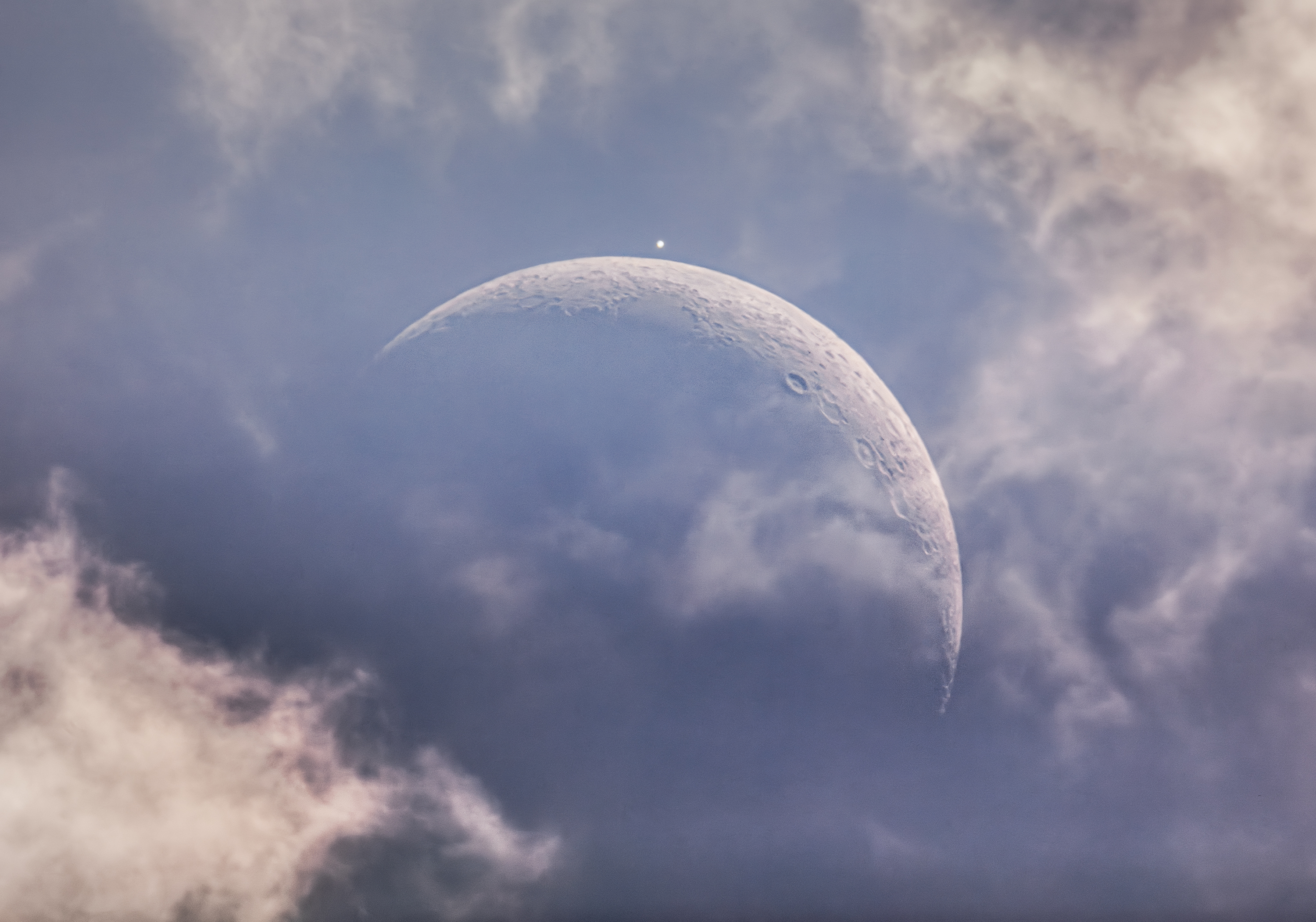
Astronomy - DAYTIME MOON MEETS EVENING STAR

 2026 June 20

See Explanation.  Clicking on the picture will download
the highest resolution version available.

Daytime Moon Meets Evening Star
Image Credit & Copyright: Debra Ceravolo

Explanation: Venus is now appearing on the celestial stage as Earth's brilliant evening star, performing with the Moon, other wandering planets, and bright stars in western skies. For evening sky gazers on June 17, the celestial beacon rose after sunset close by a young, slender, crescent Moon. But from some locations the Moon could be seen to occult or pass in front of Venus. And from a backyard observatory in southern British Columbia, Canada, the lunar occultation was played out in daylight. This stunning telescopic snapshot captured a scene in dramatically cloudy skies, following Venus' hour long disappearance, as the evening star emerged beyond the bright lunar limb.

17/06/2026

La vie et la mort - Y-A-T-IL UNE VIE APRèS LA MORT ? (3/5)

Sept jours de coma… et une expérience consciente

Durant sept jours, le neurochirurgien reste plongé dans un état végétatif. Les examens neurologiques indiquent une activité cérébrale minimale, incompatible avec la formation de souvenirs complexes ou d’expériences conscientes élaborées.

Durant sept jours, le neurochirurgien reste plongé dans un état végétatif. Les examens neurologiques indiquent une activité cérébrale minimale, incompatible avec la formation de souvenirs complexes ou d’expériences conscientes élaborées.

Pourtant, à son réveil, Eben Alexander décrit un vécu détaillé et structuré. Il affirme avoir eu la sensation de quitter son corps et d’évoluer dans un univers lumineux, paisible, dominé par un sentiment d’amour profond et inconditionnel. Selon lui, cette expérience était d’une clarté et d’une intensité supérieures à celles de la réalité ordinaire. Ce qui interpelle particulièrement la communauté scientifique est la cohérence de son récit, rapporté dès son réveil, avant toute exposition à des récits similaires ou à des interprétations spirituelles.

CommentEconomiser

.../>

15/06/2026

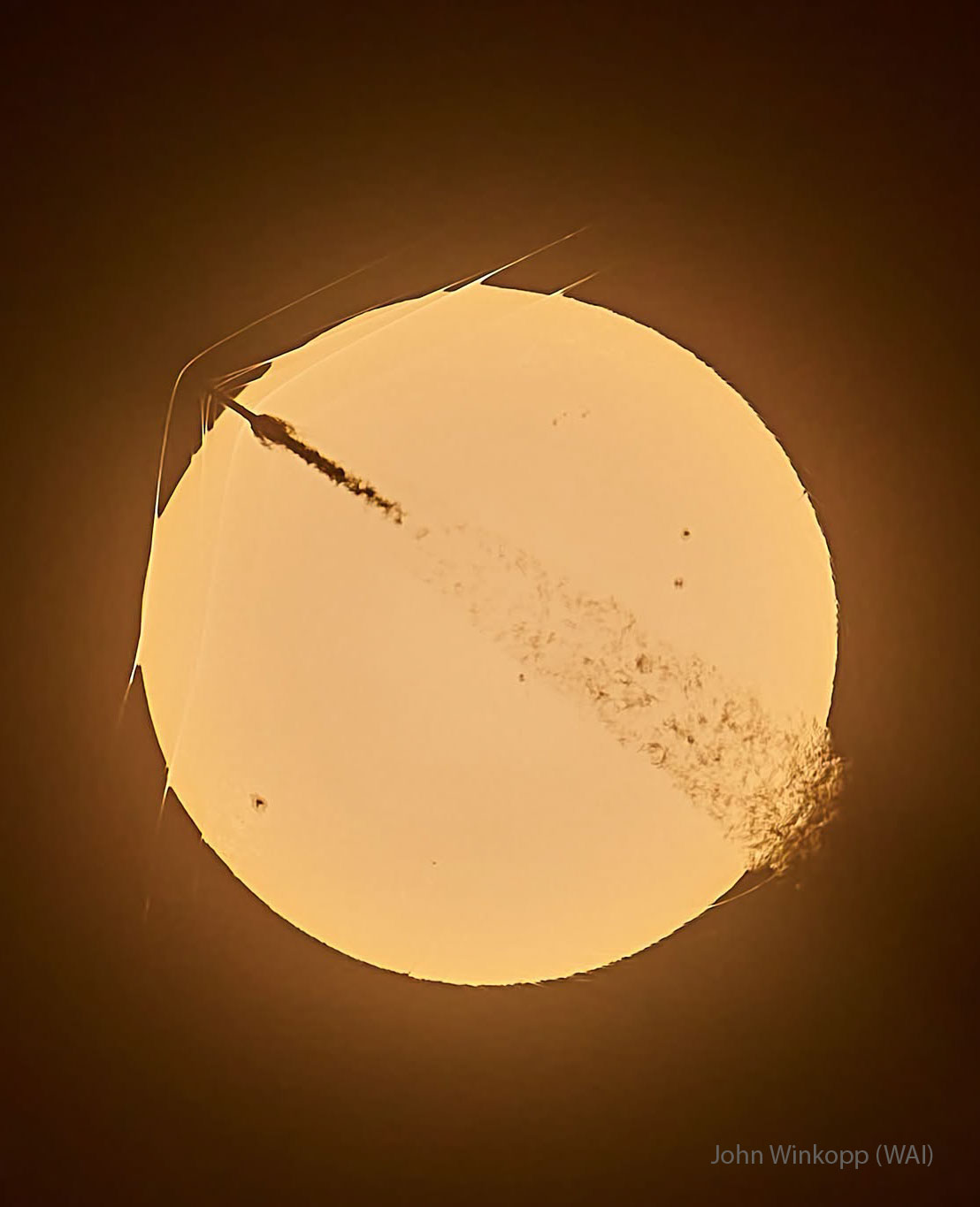
Astronomy - TRIPLE SHOCKWAVE FROM SUN CROSSING ROCKET

 2026 June 15

The disk of the Sun is shown with a rocket launching
through it. The rising rocket shows a plume behind it and
three unusual waves curve around its top tip.
Please see the explanation for more detailed information.

Triple Shockwave from Sun Crossing Rocket
Image Credit & Copyright: John Winkopp (WAI Media)

Explanation: What's happening to this Sun-crossing rocket? The SpaceX Falcon 9 rocket, visible on the upper left, launched only about one minute before this amazing image was captured. As it rose to low Earth orbit from Cape Canaveral, Florida, USA, in late May, the rocket became supersonic before it crossed the disk of the distant Sun -- from the perspective of the well-placed photographer. The spacecraft's high speed caused bow-shaped compressed-air shockwaves to form across leading surfaces, with at least three visible even outside the Sun's disk because they refract sunlight. The trailing exhaust caused turbulence visible on the lower right. None of this was damaging to the robotic Starlink 10-53 mission, which delivered 29 communications satellites to low Earth orbit as planned. And if that isn't amazing enough - the Sun had spots!

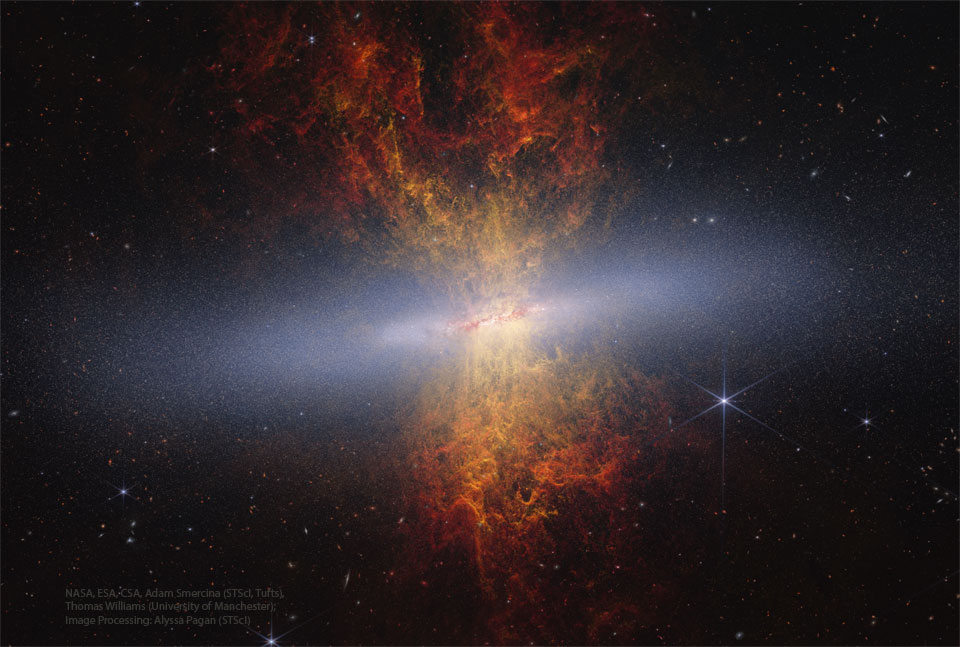
Astronomy - M82: GALAXY WITH A SUPERGALACTIC WIND

 2026 June 29 M82: Galaxy with a Supergalactic Wind Image Credit: NASA , ESA , CSA , A. Smercina (STScI, Tufts), T. Williams (U. Mancheste...