
Outre des panneaux solaires, trois éoliennes à axes verticaux fournissent l'énergie électrique. Les vitres, par effet de serre, assurent un apport thermique aux espaces intérieurs.
© Vincent Callebaut
2026 August 20

Explanation: Like an illustration in a galactic Just So Story, the Elephant's Trunk Nebula winds through the emission region and young star cluster complex IC 1396, in the high and far off constellation of Cepheus. Also known as vdB 142, this cosmic elephant's trunk is over 20 light-years long. The detailed telescopic view features the bright swept-back ridges and pockets of cool interstellar dust and gas that abound in the region. But the dark, tendril-shaped clouds contain the raw material for star formation and hide protostars within. Nearly 3,000 light-years distant, the relatively faint IC 1396 complex covers a large region on the sky, spanning over 5 degrees. Top to bottom this proboscidean-like rendition reaches across an almost 1 degree wide field of view, though. That's a little less than the angular size of 2 full moons.
2026 July 30
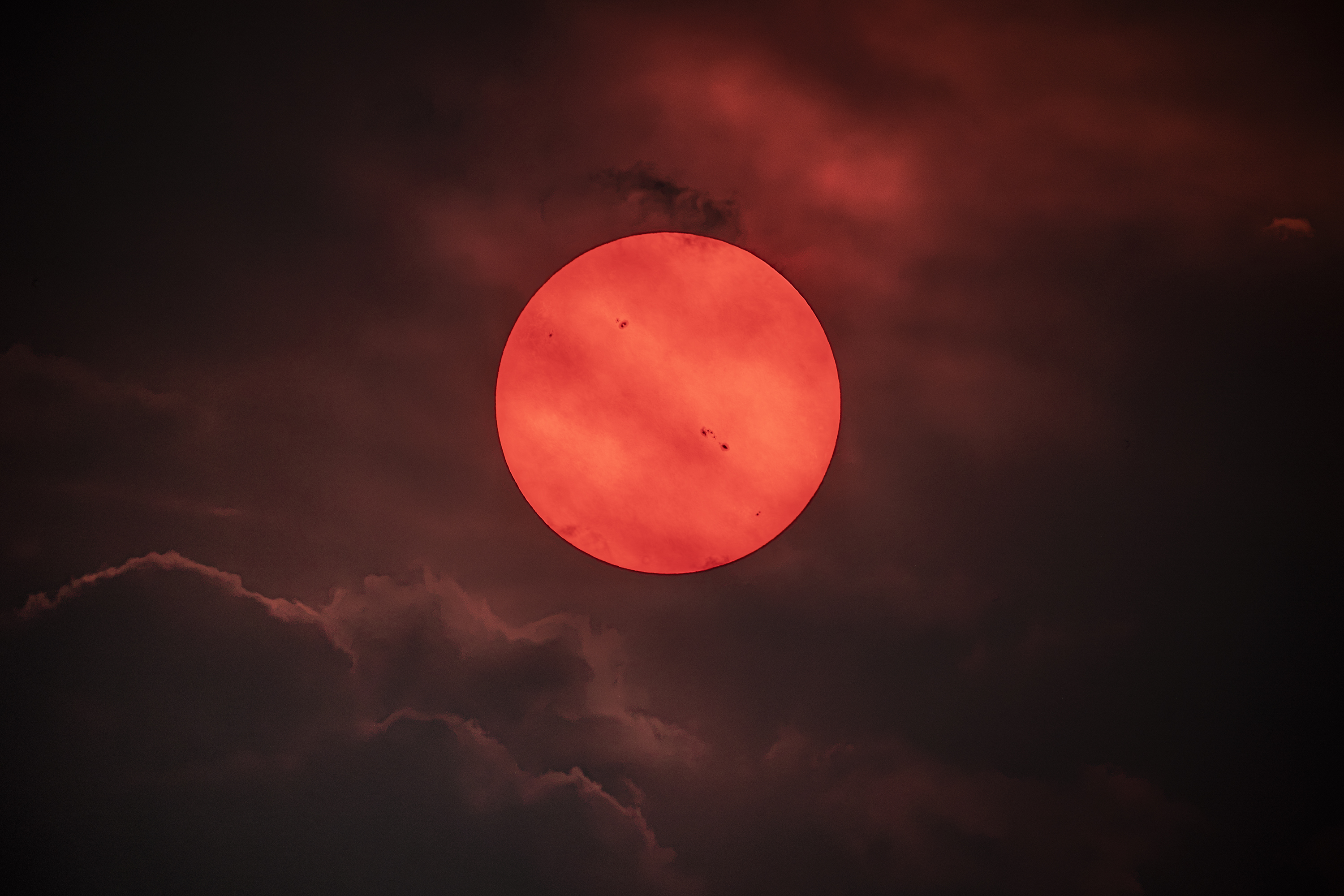
Explanation: This could be the view from an exoplanet orbiting around a red dwarf star, but it is our own Sun. This image was taken on July 22, 2026, in the Okanagan region in the Canadian province of British Columbia. Wildfire smoke from the Pacific Northwest acted as a solar filter, allowing the photographer to take this photo of the Sun directly. Several sunspots are also visible in this eerie image; just below and right of the center is AR 4493, a fast evolving, giant active solar region and sunspot group. The smoke is made of tiny particles that help block and scatter light with bluer colors, so the light we see coming from the Sun is dimmer and redder than usual (but it is never safe to stare directly at the Sun). Sunsets and sunrises are also more colorful because of the smoke. Some 6 billion years from now, the Sun will actually start to turn redder as it approaches its red giant phase.
2026 August 18
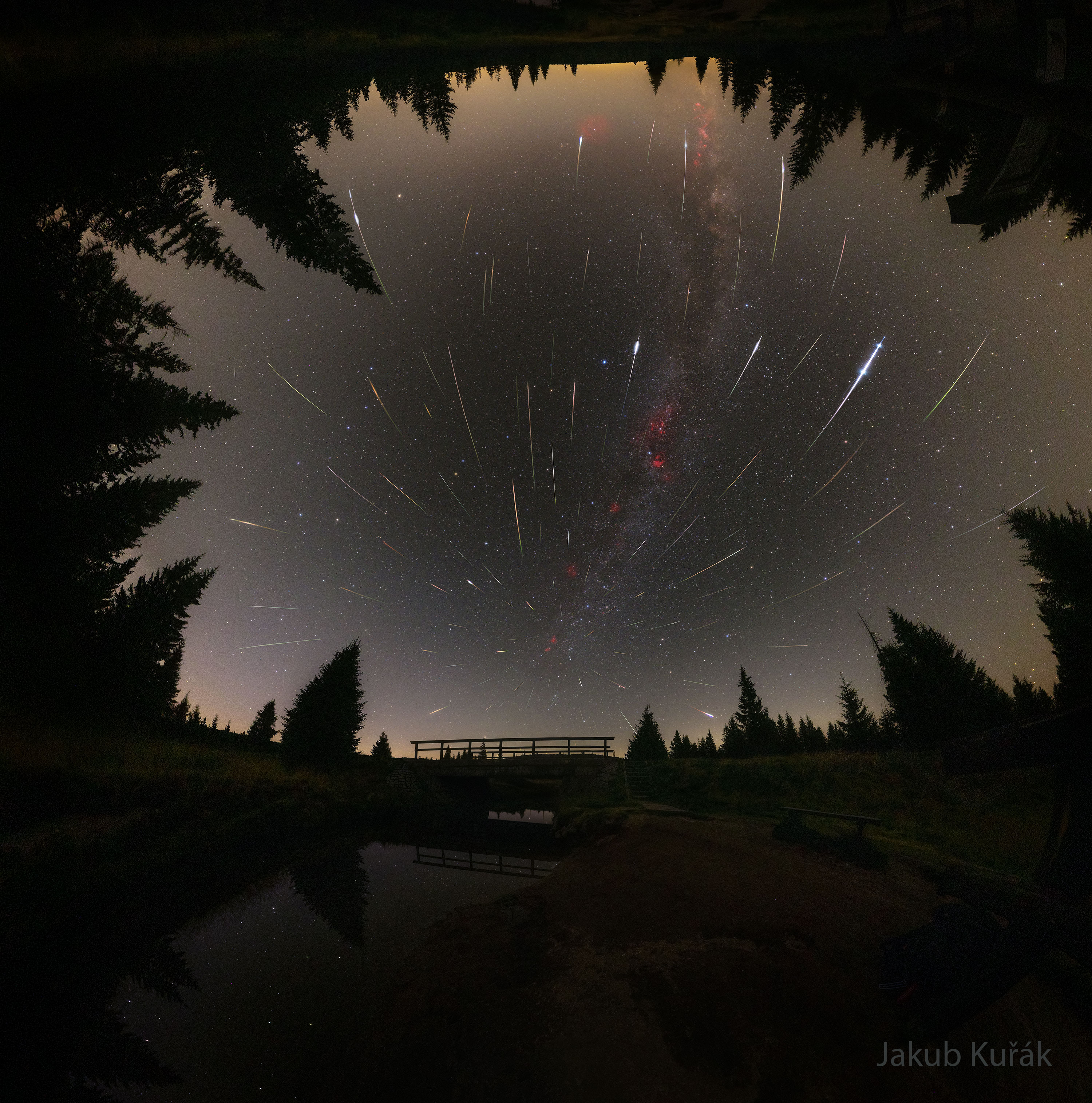
Explanation: This was a good year for the Perseids meteor shower. A key reason was the Moon was absent from lighting up Earth's night sky so that more meteors were visible than usual. Where was the Moon? It was busy visiting the Sun. Near the Perseids peak, the Moon moved directly in front of the Sun and created a total solar eclipse visible from Greenland and Spain. The Perseids occur when the Earth collides with a stream of Sun-orbiting debris cast off by Comet Swift-Tuttle. Perseid meteors, although typically only the size of a sand grain, tend to be fast and bright because Swift-Tuttle's debris orbits the Sun in a direction partly opposite Earth's orbital motion. In the featured image compilation, accumulated over several nights from Jizerka in the Czech Republic, the Perseids meteor streaks can be traced back to a single location on the sky -- its radiant in Perseus.

2026 August 17
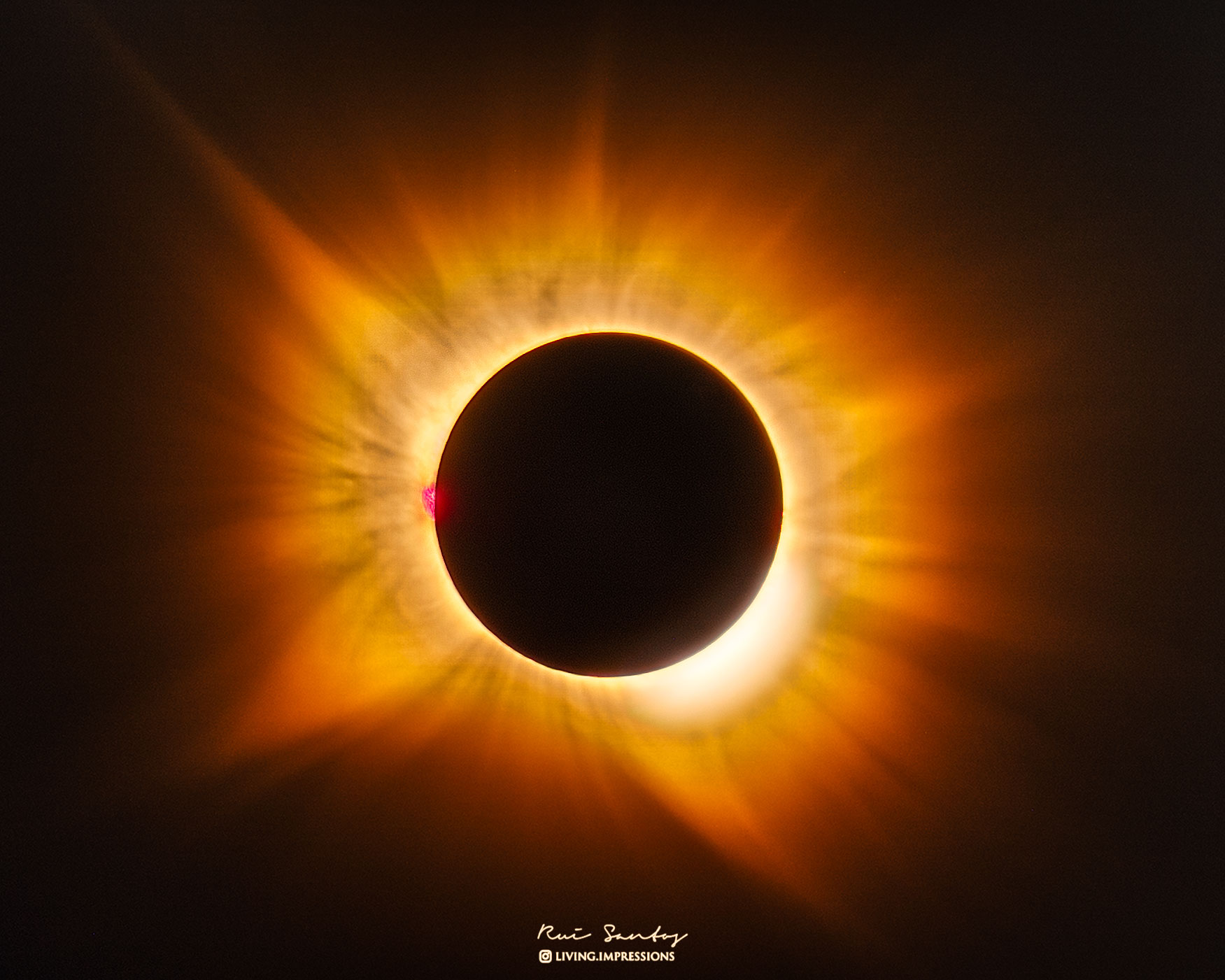
Explanation: This total solar eclipse appeared not only poetically beautiful but scientifically interesting. Usually the solar corona appears white, and to some observers the corona of last week's total solar eclipse did appear this pearly color. But this time, totality observers in Spain saw a corona that appeared unusually golden. For one reason, from Spain, the totality occurred when the setting Sun was near the horizon. That low, sunlight travels through a large amount of air which scatters out blue light. An unusual amount of smoke in the air from nearby forest fires acted as a second filter, further scattering the remaining blue tones and deepening the already gold-dominated light. The HDR-processed, multiple-exposure featured image was captured from Benavente, Spain last week. One thing that did not appear golden was a hydrogen-glowing prominence that hovered over the Sun's left edge -- its original bright pink color survived.

2026 August 16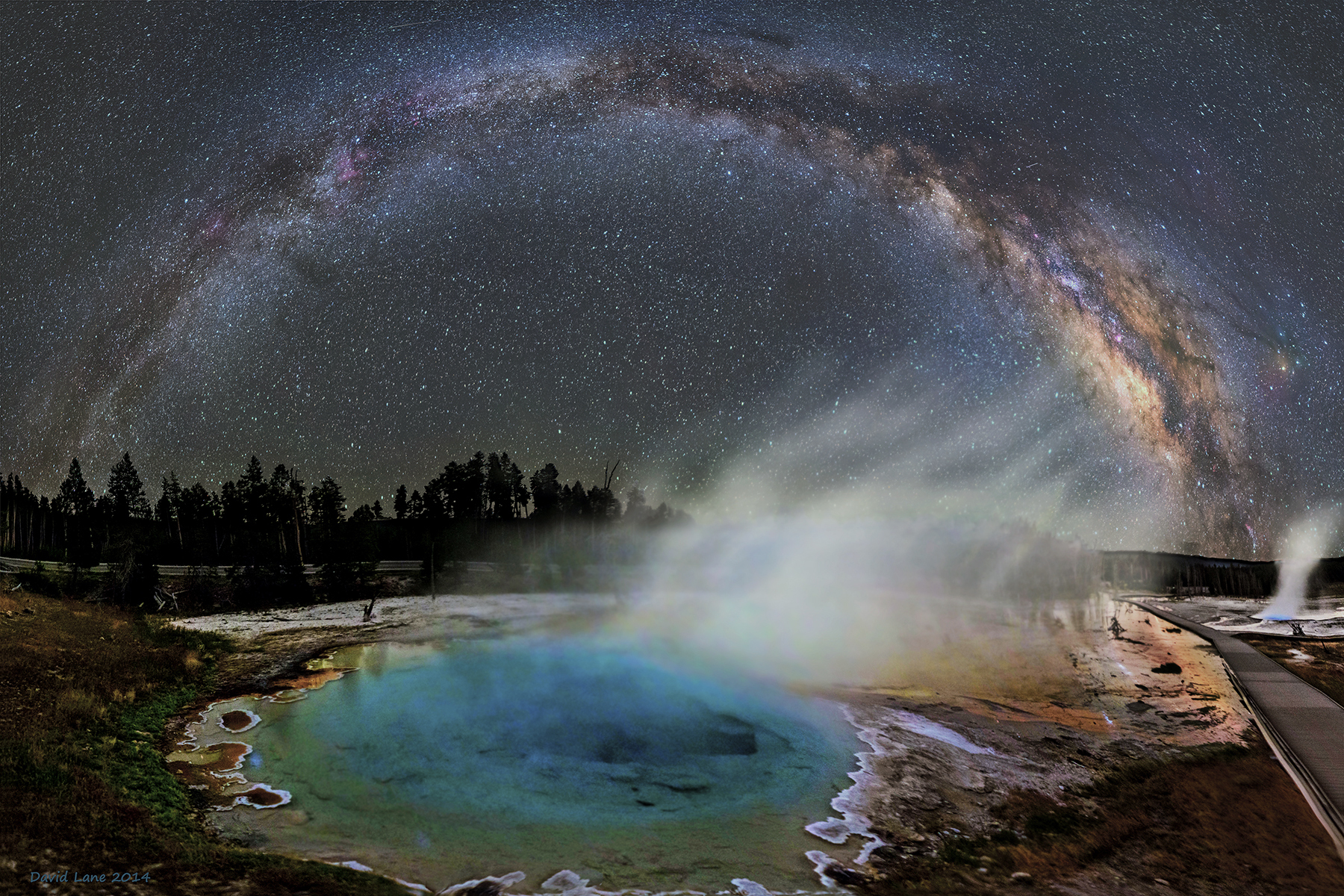
Explanation: The Milky Way was not created by an evaporating lake. The colorful pool of water, about 10 meters across, is known as Silex Spring and is located in Yellowstone National Park in Wyoming, USA. Illuminated artificially, the colors are caused by layers of bacteria that grow in the hot spring. Steam rises off the spring, heated by underground magma associated with the Yellowstone Hotspot. Unrelated and far in the distance, the central band of our Milky Way Galaxy arches high overhead, a band lit by billions of stars. The picture features a 16-image panorama taken in 2014. If the Yellowstone Hotspot causes another supervolcanic eruption as it did about 640,000 years ago, a large part of North America
2026 August 15
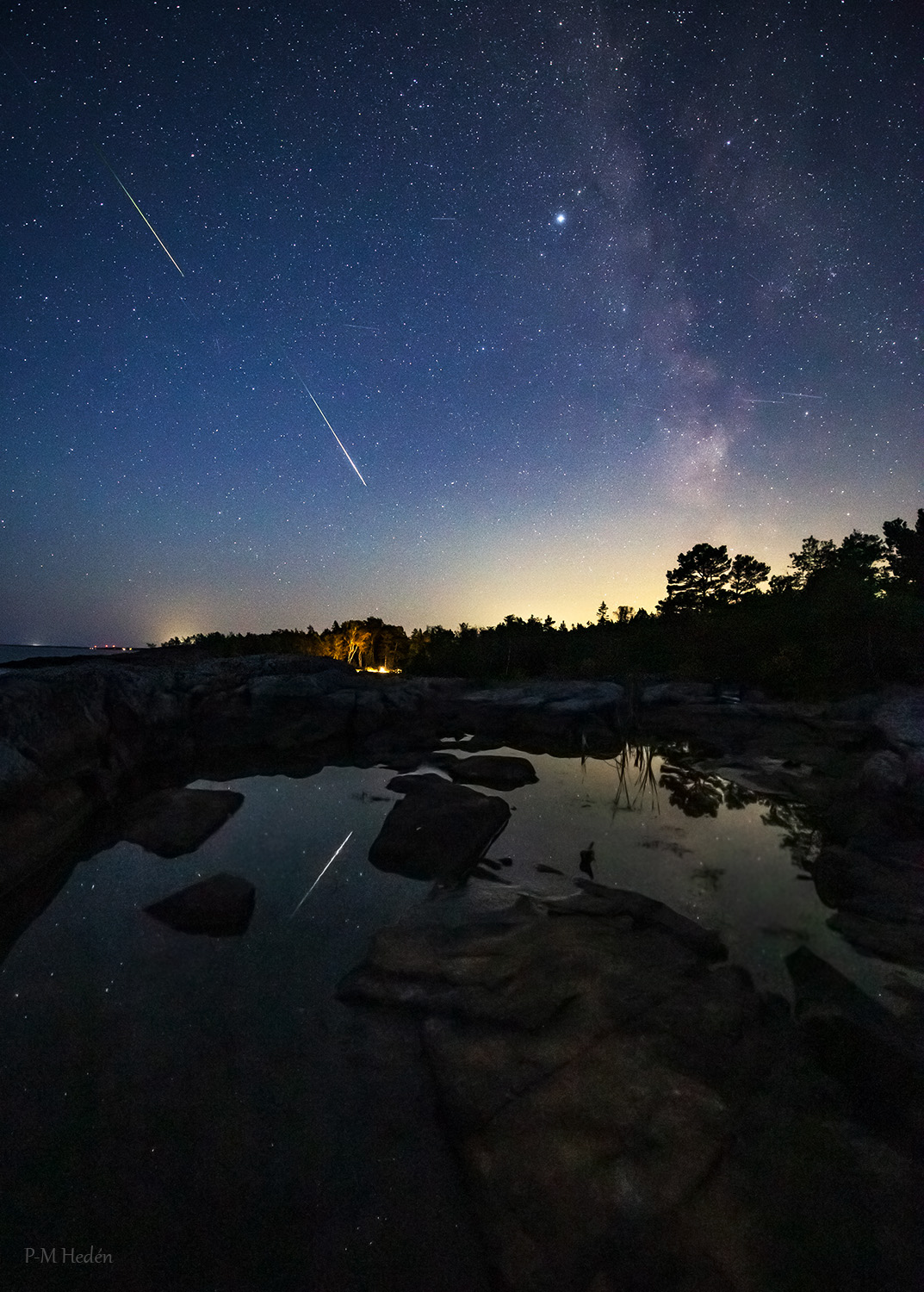
Explanation: Known for its bright and fast meteors, the annual Perseid Meteor Shower comes to planet Earth's skies from a radiant in the heroic constellation Perseus. The popular northern summer celestial spectacle is created as grains of dust cast off along the orbit of periodic comet 109P/Swift-Tuttle vaporize in Earth's dense atmosphere, tracing brief, but beautiful streaks through the night. Taken near the shower's peak of activity on August 12, this composite image recorded two bright perseid meteors and one meteor's watery reflection from a location near the coastal village of Grisslehamn, Sweden. Almost as bright as Altair, brightest star on the scene, the meteors appear along with the faint, diffuse background of the Milky Way. This year, the shower's peak activity coincided with a New Moon, so perseid meteor flashes were undiminished by bright moonlight. And for many skywatchers, this night of bright perseid meteors followed their viewing of the silhouette of the New Moon in a much anticipated solar eclipse.

Cet animal de 3 centimètres de long a des allures de fantôme ou d' ange des mers (ghost-like sea-angel). Scientifiquement dénommé Platy...


