Nombre total de pages vues
01/10/2026
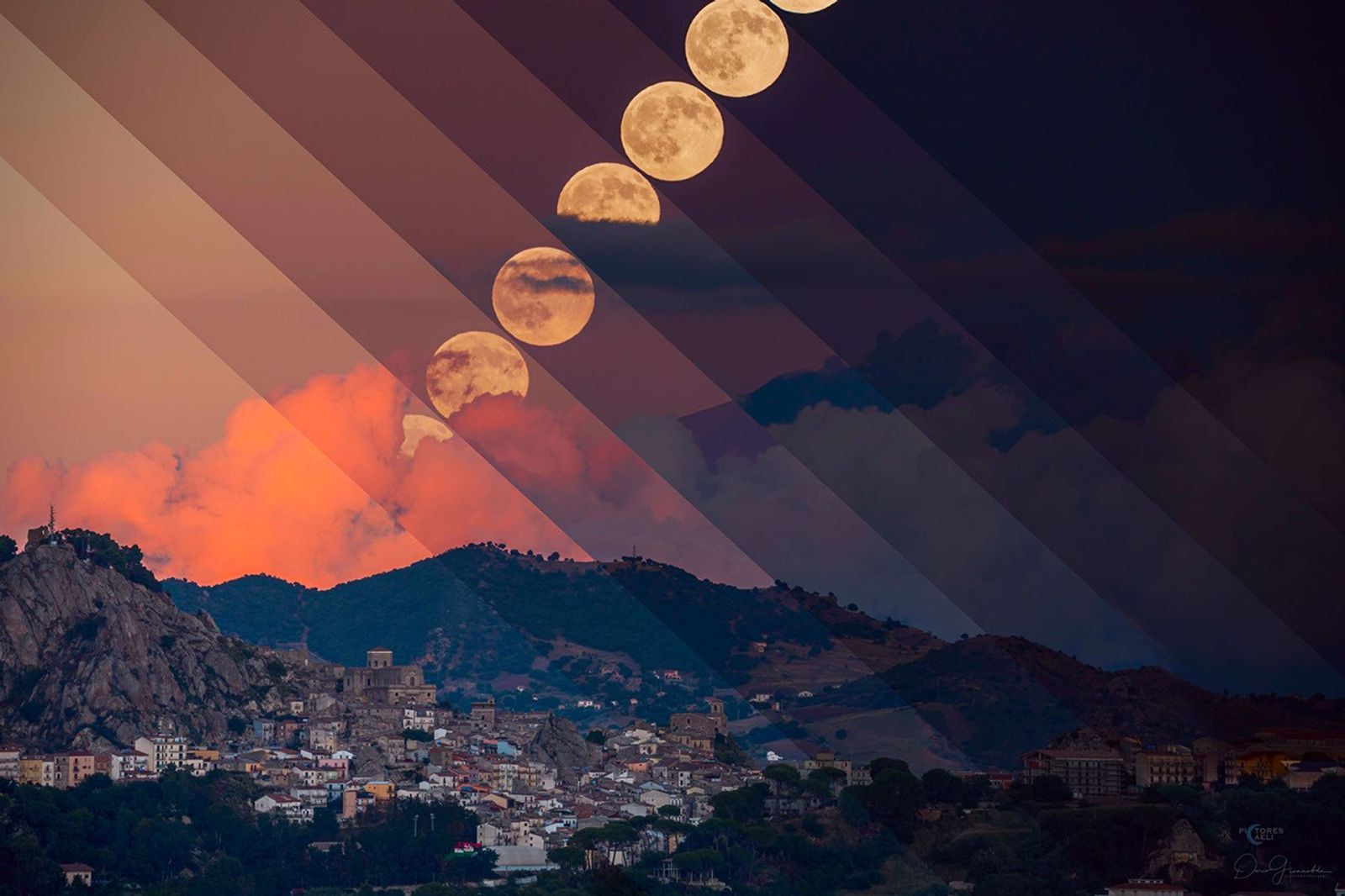
Astronomy - HARVEST MOON WITH ERUPTING MOUNT ETNA
Monde sous-marin - L'ESCARGOT DE MER MONNAIE CARAÏBE
30/09/2026
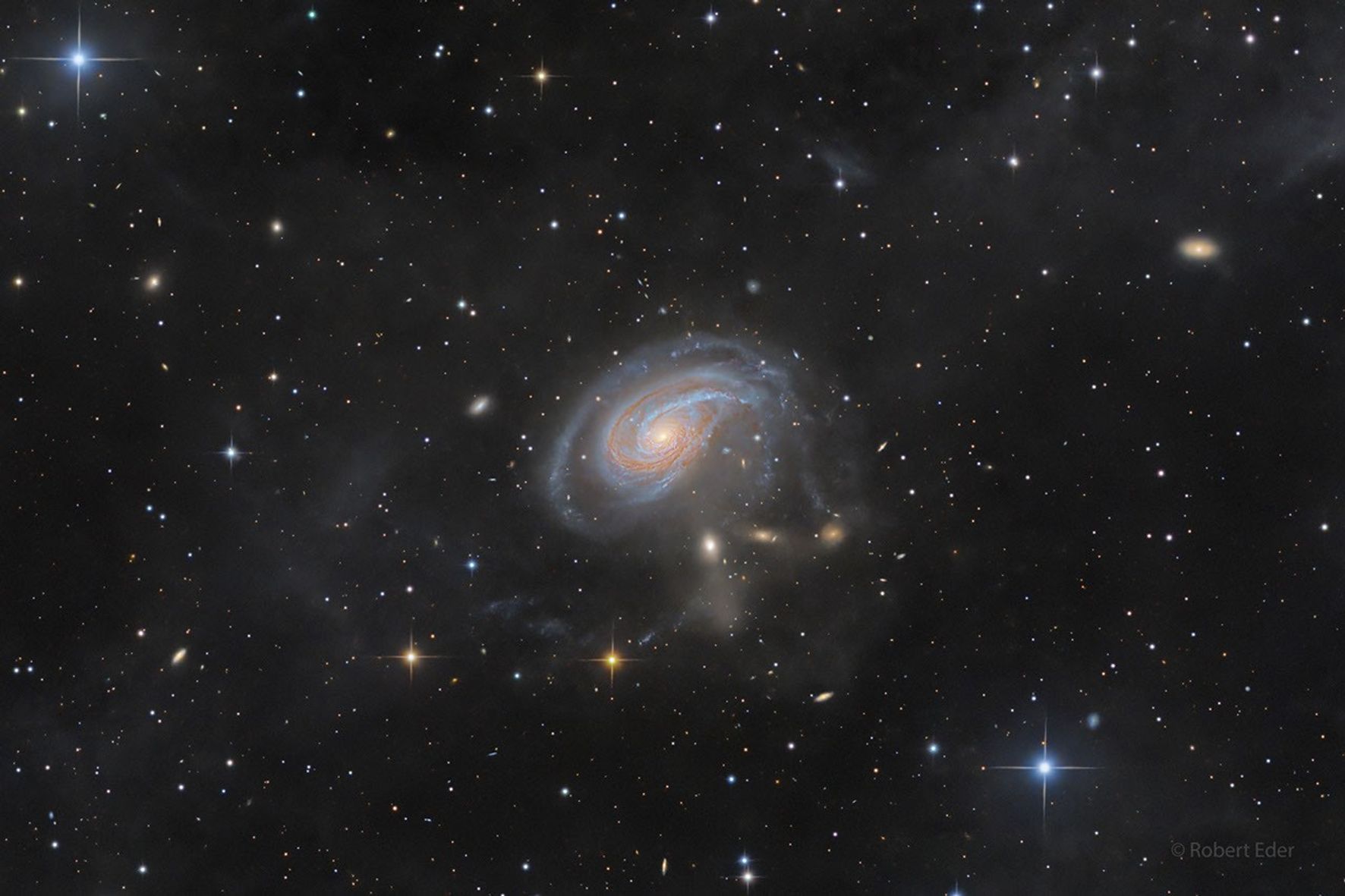
Astronomy - ARP 78: PECULIAR GALAXY IN ARIES
Arp 78: Peculiar Galaxy in Aries
Explanation: Peculiar spiral galaxy Arp 78 is found within the boundaries of the head strong constellation Aries. Some 100 million light-years beyond the stars and nebulae of our Milky Way galaxy, the island universe is an enormous 200,000 light-years across. Also known as NGC 772, it sports a prominent, outer spiral arm in this detailed cosmic portrait. Tracking along sweeping dust lanes and lined with young blue star clusters, Arp 78's overdeveloped spiral arm is pumped-up by galactic-scale gravitational tides. Interactions with its brightest companion galaxy, the more compact NGC 770 seen directly below the larger spiral, are likely responsible. Embedded in faint star streams revealed in the deep telescopic exposure, NGC 770's fuzzy, elliptical appearance contrasts nicely with spiky foreground Milky Way stars.
| Date | September 30, 2026 |
|---|---|
| Credit & Copyright | Robert Eder |
| Authors & editors: | Jerry Bonnell, Cecilia Chirenti, Robert Nemiroff, Keighley Rockcliffe |
| A service of: | ASD at NASA / GSFC, NASA Science Activation & Michigan Tech. U. |
24/09/2026
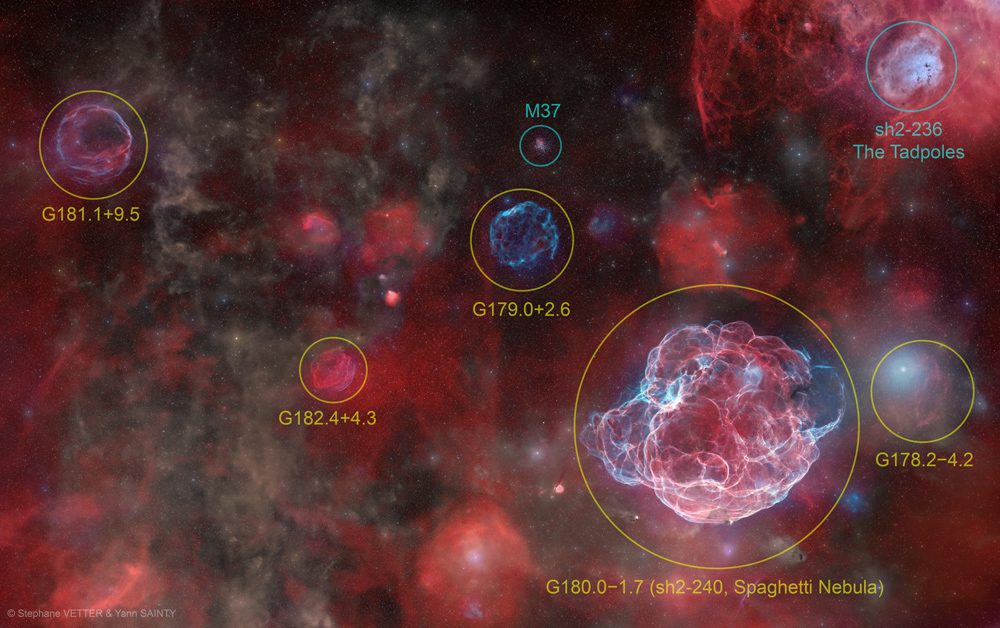
Astronomy - THE GHOSTS OF FIVE SUPERNOVAS
2026 September 24
Image Credit & Copyright: Stephane Vetter, Yann Sainty
Text: Cecilia Chirenti (NASA GSFC, UMCP, CRESST II)
Explanation: The ghosts of five supernovas haunt this extraordinary image. It was acquired at Oukaïmeden Observatory in Morocco with approximately 200 hours of observations and shows a large patch of the sky, equivalent to the area of one thousand full moons tiled together, in the constellation of Auriga (the Charioteer). From left to right, the five supernova remnants visible across the field are G181.1+9.5, G182.4+4.3, G179.0+2.6, G180.0−1.7 (Sh2-240, the Spaghetti Nebula), and G178.2−4.2. They are highlighted in the annotated image, together with open cluster M37 and the Tadpole Nebula. As each explosion expanded into space, it created a growing shell of shocked gas and delicate filamentary structures shown in red (hydrogen) and blue (oxygen), respectively. These ancient stellar explosions happened independently; they are at various distances up to about several thousands of light-years away from Earth and have estimated ages up to tens of thousands of years old. Early humans may have witnessed them as bright new stars, fading over weeks or months
23/09/2026
Microphotographie - UNE BACTERIE CREEE PAR LES HOMMES
21/09/2026
Monde sous-marin - TREPIED ARC-EN-CIEL
15/09/2026
Monde sous-marin - LE NAPOLEON (CHEILINUS UNDULATUS) UN POISSON MENACé
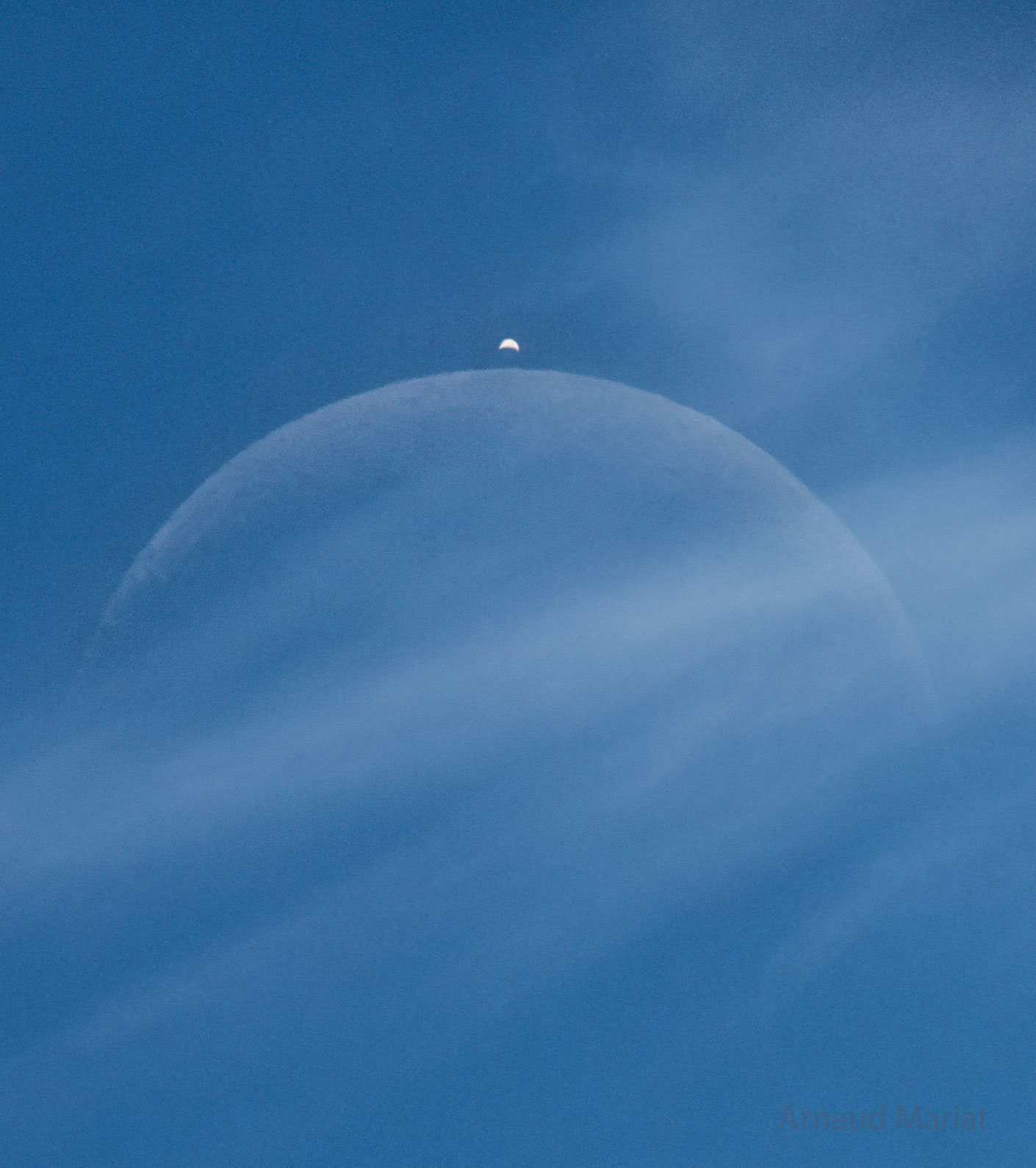
Astronomy - A DAYTIME ECLIPSE : MOON OCCULTS VENUS
2026 September 15
Image Credit & Copyright: Arnaud Mariat
Explanation: There was something behind the clouds. Upon close inspection, it was the Moon, which was hard to see yesterday around noon above the small village of Cessy, France. But soon, it was not only the Moon. As expected, a bright dot suddenly appeared from behind the Moon -- the planet Venus far in the distance. Captured in the single featured exposure, both appeared to show a crescent phase. The Moon's crescent was quite slight -- with only about 10 percent of its face illuminated by the Sun. In contrast, Venus's crescent was more full -- showing about 25 percent illumination. Venus appeared brighter because it is nearer the Sun and because its clouds are more reflective than the dark lunar surface. An occultation of Venus by the Moon is visible to only about 10 percent of the Earth, but in yesterday's event even most of that was experiencing daytime.
13/09/2026
Astronomy - COMET NEOWISE RISING OVER THE ADRIATIC SEA
Video Credit & Copyright: Paolo Girotti
Explanation: This sight was worth getting out of bed early. Just over four years ago, Comet C/2020 F3 (NEOWISE) rose before dawn to the delight of northern sky enthusiasts awake that early. Up before sunrise on July 8th, the featured photographer was able to capture in dramatic fashion one of the few comets visible to the unaided eye this century, an inner-Solar System intruder that has become known as the Great Comet of 2020. The resulting video detailed Comet NEOWISE from Italy rising over the Adriatic Sea. The featured time-lapse video combines over 240 images taken over 30 minutes. The comet was seen rising through a foreground of bright and undulating noctilucent clouds, and before a background of distant stars. Comet NEOWISE remained unexpectedly bright for over a month, with its ion and dust tails found to emanate from a nucleus spanning about five kilometers across.
12/09/2026
Santé/Médecine - AVC ET GROUPE SANGUIN
Astronomy - 3D 67P
Epxlanation: Put on your red/blue glasses and float next to the jagged and double-lobed nucleus of Churyumov-Gerasimenko, also known as Com...
-
2026 January 2 NanoSail-D2 Image Credit & Copyright : Ralf Vandebergh Explanation: In 2011, on January 20, NASA's NanoSail-D2 ...
-
2026 January 1 Auroral Corona Image Credit & Copyright : Roi Levi Explanation: Cycle 25 solar maximum made 2025 a great year for ...