"Ave Maria"
15/01/2022

ASTRONOMY - Galileo's Europa
2022 January 15
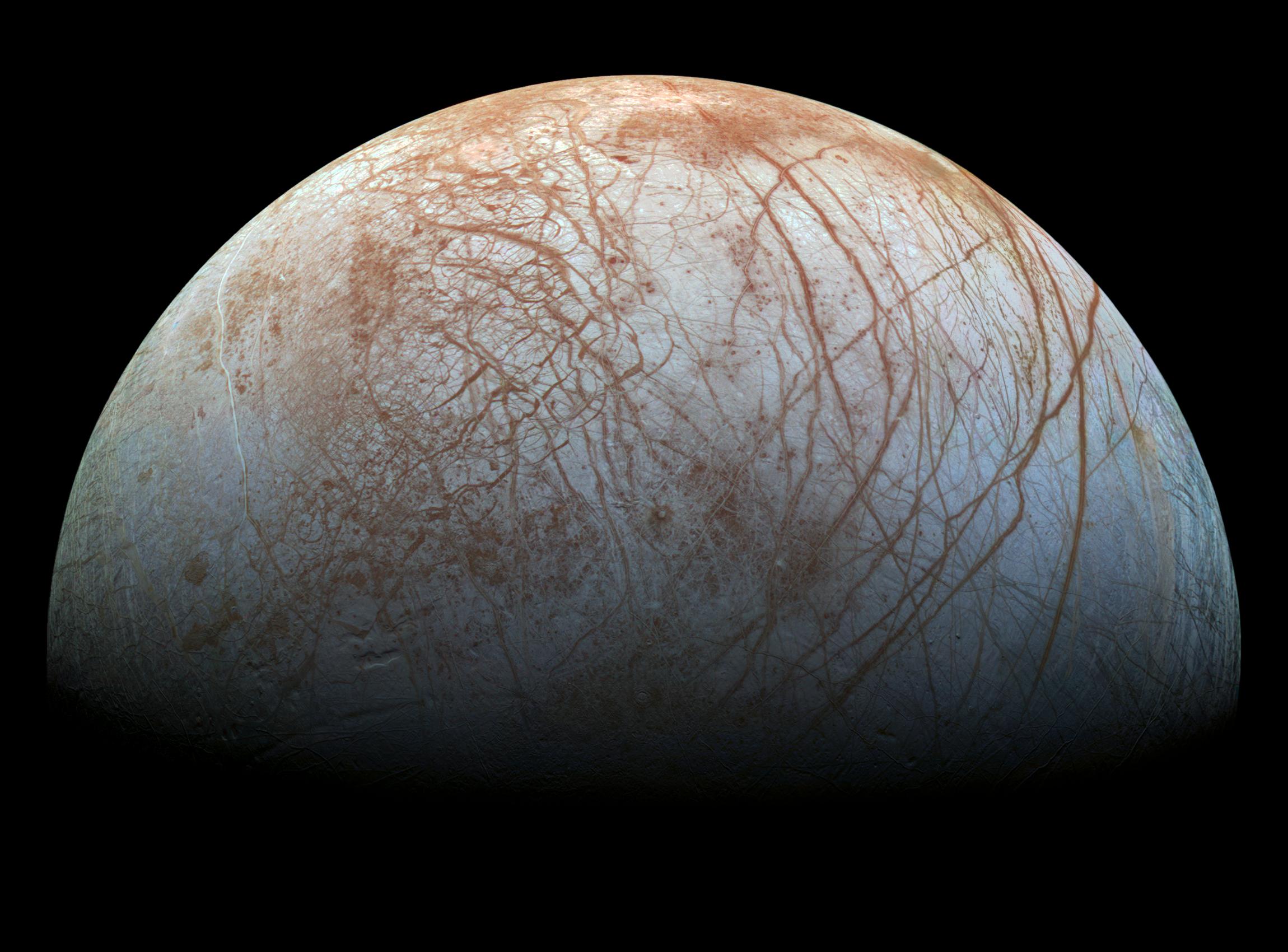
Image Credit: NASA, JPL-Caltech, SETI Institute, Cynthia Phillips, Marty Valenti
Explanation: Looping through the Jovian system in the late 1990s, the Galileo spacecraft recorded stunning views of Europa and uncovered evidence that the moon's icy surface likely hides a deep, global ocean. Galileo's Europa image data has been remastered here, with improved calibrations to produce a color image approximating what the human eye might see. Europa's long curving fractures hint at the subsurface liquid water. The tidal flexing the large moon experiences in its elliptical orbit around Jupiter supplies the energy to keep the ocean liquid. But more tantalizing is the possibility that even in the absence of sunlight that process could also supply the energy to support life, making Europa one of the best places to look for life beyond Earth. What kind of life could thrive in a deep, dark, subsurface ocean? Consider planet Earth's own extreme shrimp.
13/01/2022
ART FRACTAL - Un joyau

Une formule mathématique assistée d'un logiciel produit de véritables bijoux.
© Nevit, DR
ASTRONOMY - Supernova Remnant Simeis 147
2022 January 13
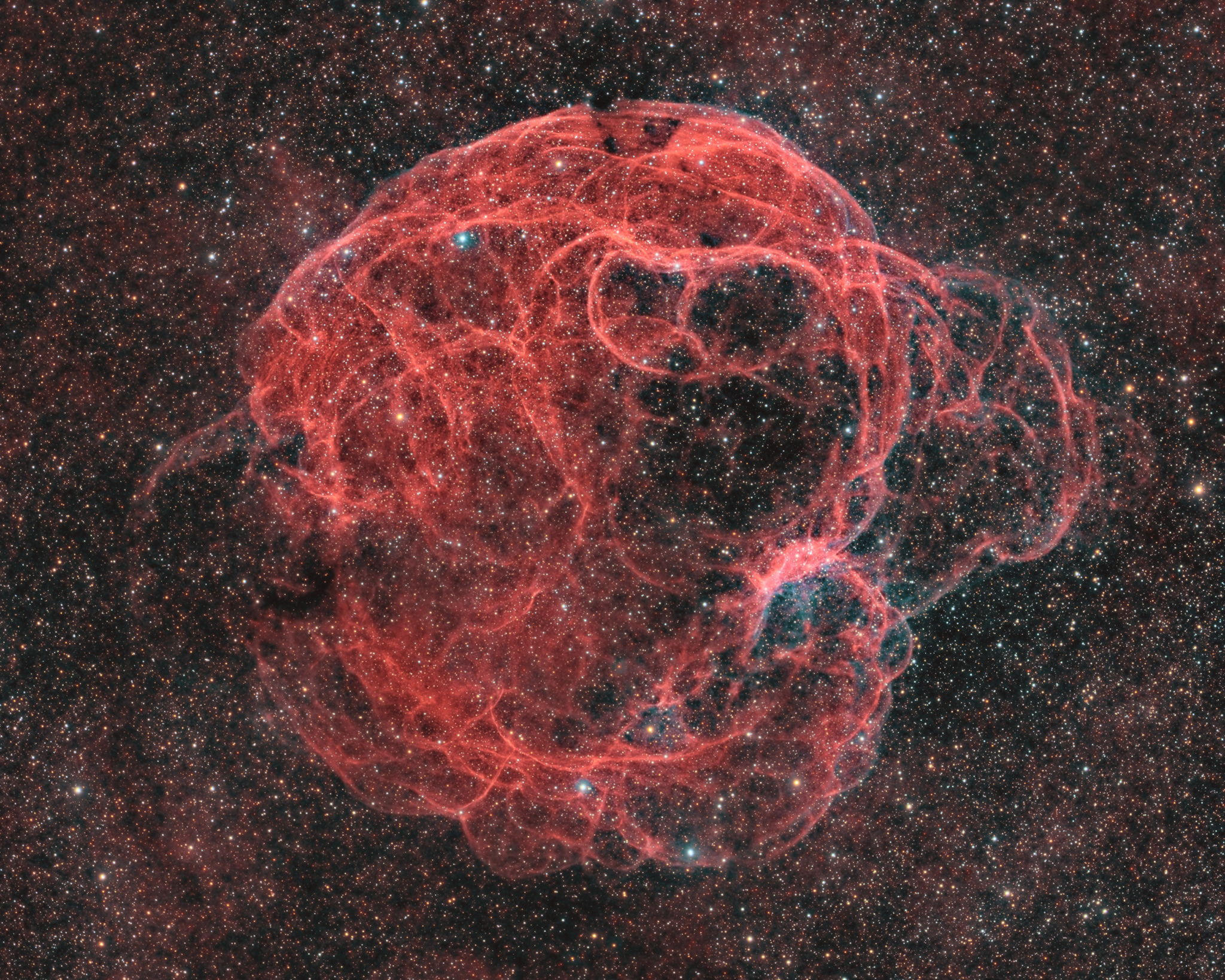
Image Credit & Copyright: Jason Dain
Explanation: It's easy to get lost following the intricate, looping, twisting filaments in this detailed image of supernova remnant Simeis 147. Also cataloged as Sharpless 2-240 it goes by the popular nickname, the Spaghetti Nebula. Seen toward the boundary of the constellations Taurus and Auriga, it covers nearly 3 degrees or 6 full moons on the sky. That's about 150 light-years at the stellar debris cloud's estimated distance of 3,000 light-years. This composite includes image data taken through narrow-band filters where reddish emission from ionized hydrogen atoms and doubly ionized oxygen atoms in faint blue-green hues trace the shocked, glowing gas. The supernova remnant has an estimated age of about 40,000 years, meaning light from the massive stellar explosion first reached Earth 40,000 years ago. But the expanding remnant is not the only aftermath. The cosmic catastrophe also left behind a spinning neutron star or pulsar, all that remains of the original star's core.
12/01/2022
ASTRONOMY - Comet Leonard Closeup from Australia
2022 January 12
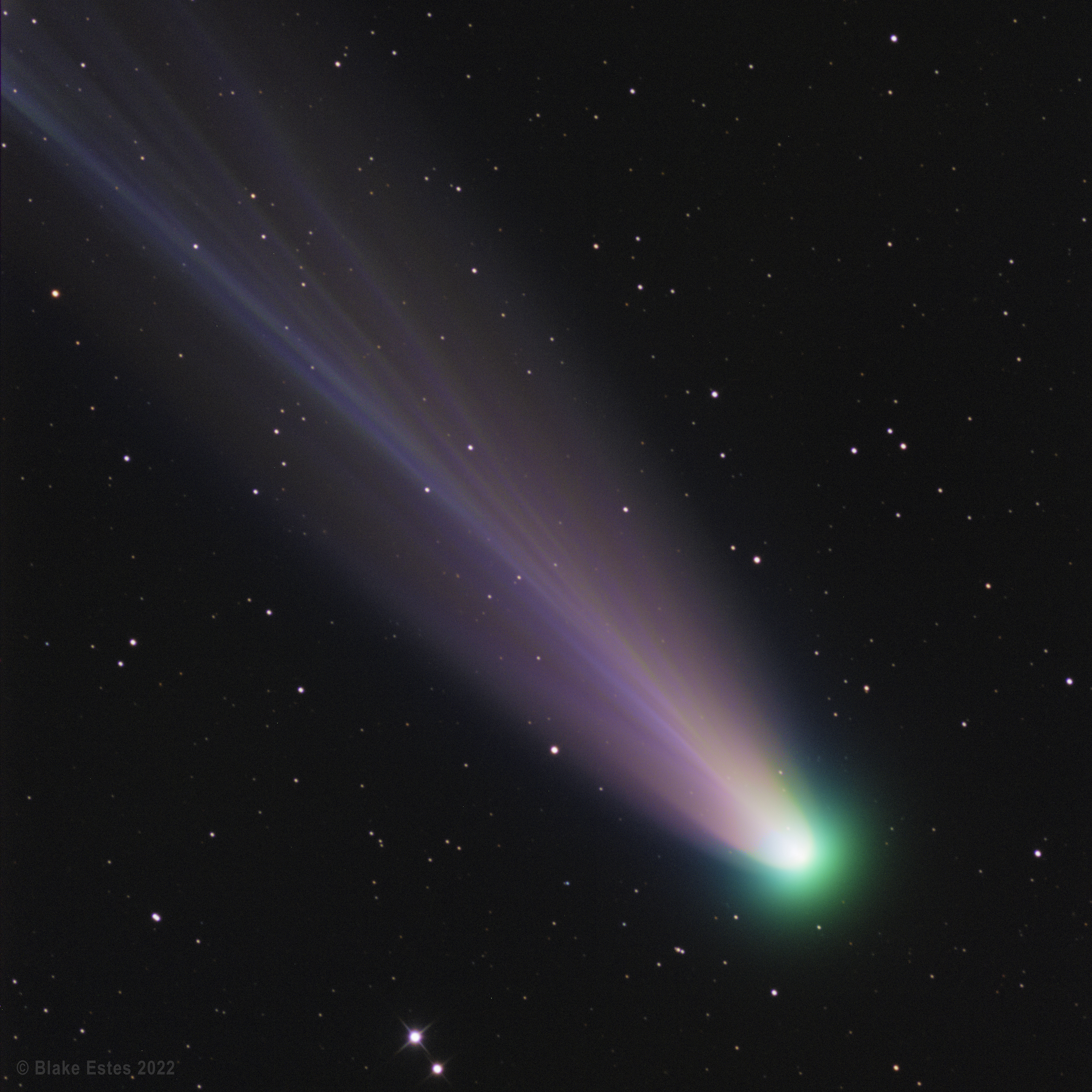
Image Credit & Copyright: Blake Estes (itelescope.net)
Explanation: What does Comet Leonard look like up close? Although we can't go there, imaging the comet's coma and inner tails through a small telescope gives us a good idea. As the name implies, the ion tail is made of ionized gas -- gas energized by ultraviolet light from the Sun and pushed outward by the solar wind. The solar wind is quite structured and sculpted by the Sun's complex and ever changing magnetic field. The effect of the variable solar wind combined with different gas jets venting from the comet's nucleus accounts for the tail's complex structure. Following the wind, structure in Comet Leonard's tail can be seen to move outward from the Sun even alter its wavy appearance over time. The blue color of the ion tail is dominated by recombining carbon monoxide molecules, while the green color of the coma surrounding the head of the comet is created mostly by a slight amount of recombining diatomic carbon molecules. Diatomic carbon is destroyed by sunlight in about 50 hours -- which is why its green glow does not make it far into the ion tail. The featured imagae was taken on January 2 from Siding Spring Observatory in Australia. Comet Leonard, presently best viewed from Earth's Southern Hemisphere, has rounded the Sun and is now headed out of the Solar System.
MICROPHOTOGRAPHIE - Marek Mis - Un mélange à base d'hématoxyline qui fait des étincelles

Sur cette incroyable microphotographie, il ne s'agit finalement que du résultat du simple mélange d'un médicament destiné à traiter les rhinites avec de l'hématoxyline, un colorant couramment utilisé en histologie. Il permet d'étudier les tissus biologiques en teintant notamment les noyaux des cellules en une sorte de bleu violet. Mais ici, rien de vivant. Que des cristaux inertes à partir desquels un brin de lumière polarisée et un grossissement de 100 fois parviennent à créer un véritable enchantement.
Cliché réalisé à l'aide d'un microscope Olympus BH-2 et d'un appareil Pentax K5. © Marek Miś. Tous droits réservés
11/01/2022
SANTé/MEDECINE - Remèdes naturels - Soulager l'Arthrose et Toute Douleur Inflammatoire
 |
| Arthrose |
Les douleurs liées aux inflammations et à l’arthrose peuvent être très pénibles. Le problème, c'est que les médicaments sont la plupart du temps inefficaces contre ces douleurs. Heureusement, il existe des solutions naturelles pour améliorer votre situation. Certains aliments peuvent soulager les douleurs. Voici les plus efficaces :

- 1. Le curcuma La curcumine, l’élément actif qui compose cette épice, a un pouvoir de guérison.
- 2. Le gingembre Préparez un thé avec cette racine.
- 3. Les oméga-3 Essayez les graines de lin moulues, les graines de chia entières et les graines de chanvre.
- 4. Les cerises Elles contiennent des substances appelées anthocyanosides qui sont très efficaces pour diminuer le niveau d’acide urique.
- 5. L’ananas Il contient de la bromélaïne anti-inflammatoire.
- 6. Le vinaigre de cidre Mélangez une cuillère à soupe de vinaigre de cidre à 100 à 200 ml d’eau purifiée et faites tremper vos mains douloureuses.
CommentEconomiser
ASTRONOMY - Orion's Belt Region in Gas and Dust
2022 January 11
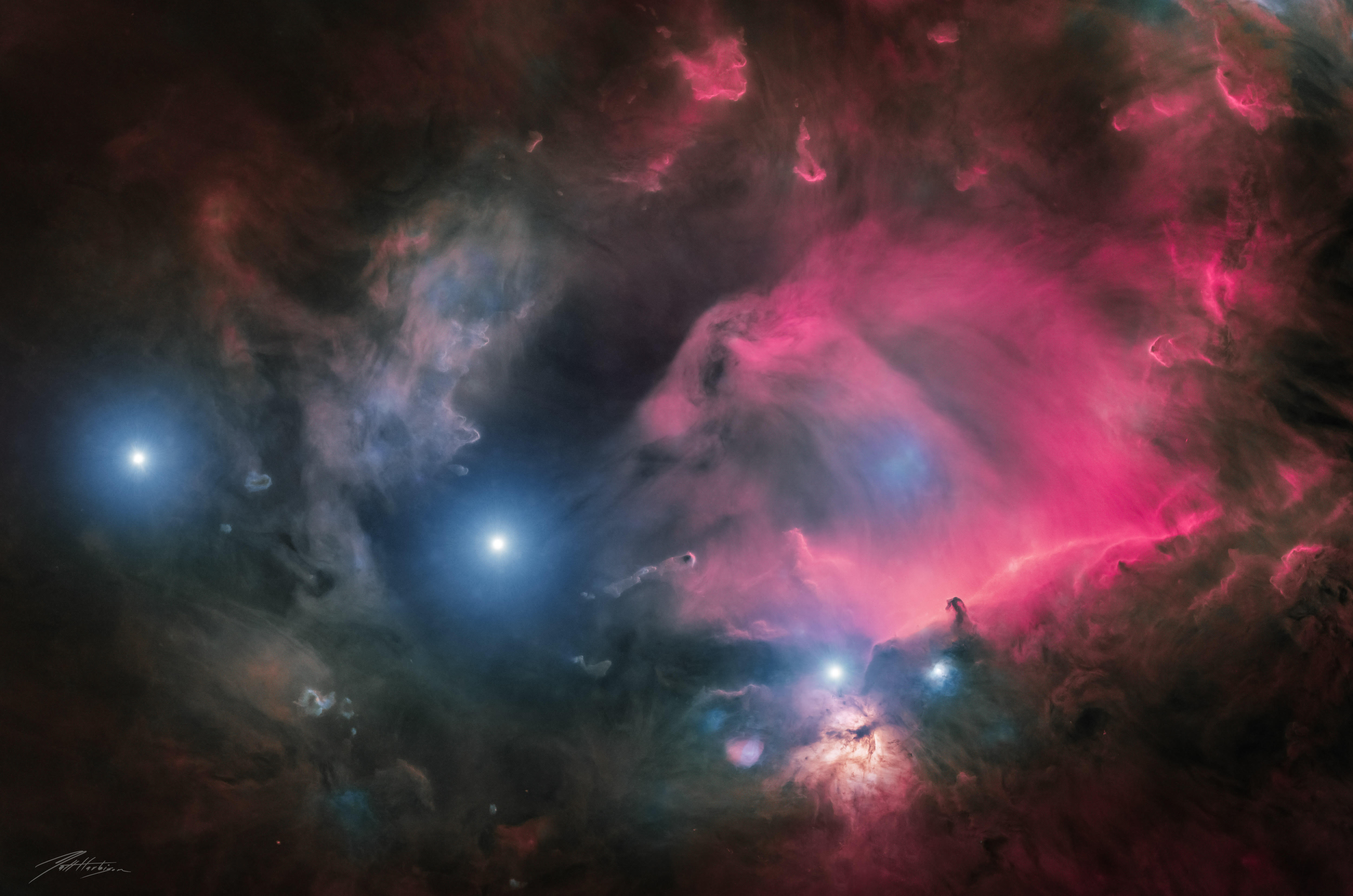
Image Credit & Copyright: Matt Harbison (Space4Everybody), Marathon Remote Imaging Observatory
Explanation: You may have seen Orion's belt before -- but not like this. The three bright stars across this image are, from left to right, Mintaka, Alnilam, and Alnitak: the iconic belt stars of Orion. The rest of the stars in the frame have been digitally removed to highlight the surrounding clouds of glowing gas and dark dust. Some of these clouds have intriguing shapes, including the Horsehead and Flame Nebulas, both near Alnitak on the lower right. This deep image, taken last month from the Marathon Skypark and Observatory in Marathon, Texas, USA, spans about 5 degrees, required about 20 hours of exposure, and was processed to reveal the gas and dust that we would really see if we were much closer. The famous Orion Nebula is off to the upper right of this colorful field. The entire region lies only about 1,500 light-years distant and so is one of the closest and best studied star formation nurseries known.
10/01/2022
MINERAUX - L’arsenic rouge, un minéral d’artiste

ASTRONOMY - Comet Leonard's tail wag
2022 January 10
Image Credit: NASA, NRL, STEREO-A; Processing: B. Gallagher
Explanation: Why does Comet Leonard's tail wag? The featured time-lapse video shows the ion tail of Comet C/2021 A1 (Leonard) as it changed over ten days early last month. The video was taken by NASA's Solar Terrestrial Relations Observatory-Ahead (STEREO-A) spacecraft that co-orbits the Sun at roughly the same distance as the Earth. Each image in this 29-degree field was subtracted from following image to create frames that highlight differences. The video clearly shows Comet Leonard's long ion tail extending, wagging, and otherwise being blown around by the solar wind -- a stream of fast-moving ions that stream out from the Sun. Since the video was taken, Comet Leonard continued plunging toward the Sun, reached its closest approach to the Sun between the orbits of Mercury and Venus, survived this closest approach without breaking apart, and is now fading as heads out of our Solar System.
Inscription à :
Articles (Atom)
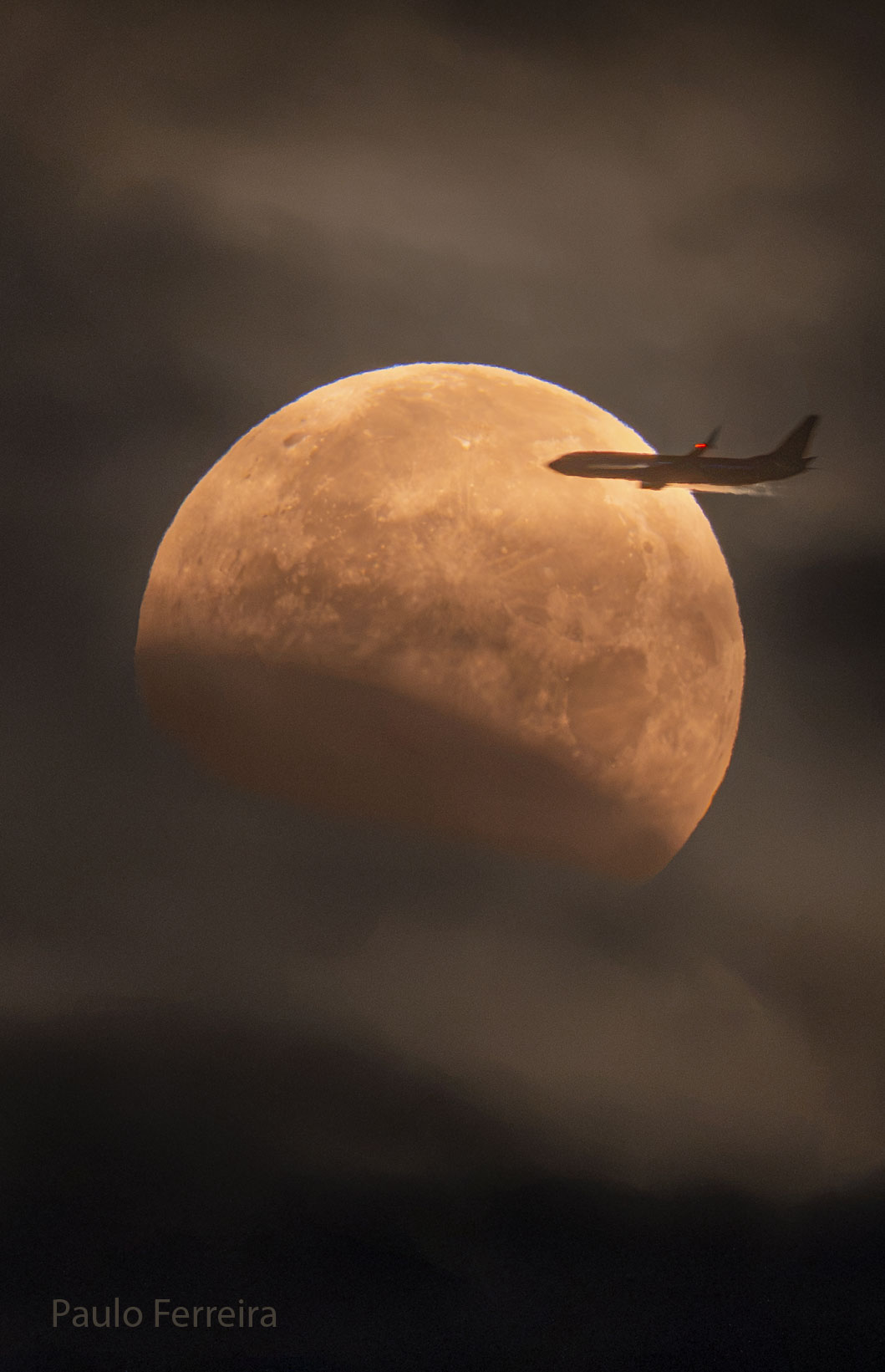
Astronomy - A PLANE LUNAR ECLIPSE
2026 September 1 A Plane Lunar Eclipse Image Credit: Paulo Ferreira Explanation: Did you need to be on the right side of this airplane to se...
-
2026 January 2 NanoSail-D2 Image Credit & Copyright : Ralf Vandebergh Explanation: In 2011, on January 20, NASA's NanoSail-D2 ...
-
2026 January 1 Auroral Corona Image Credit & Copyright : Roi Levi Explanation: Cycle 25 solar maximum made 2025 a great year for ...



#/media/File:Animation_of_C%EF%BC%8F2021_A1's_orbit_around_Sun_-_2021_close_approach.gif)