Nombre total de pages vues
20/06/2023
DELICIEUSES HERBES AROMATIQUES - La verveine, pour faciliter la digestion
19/06/2023
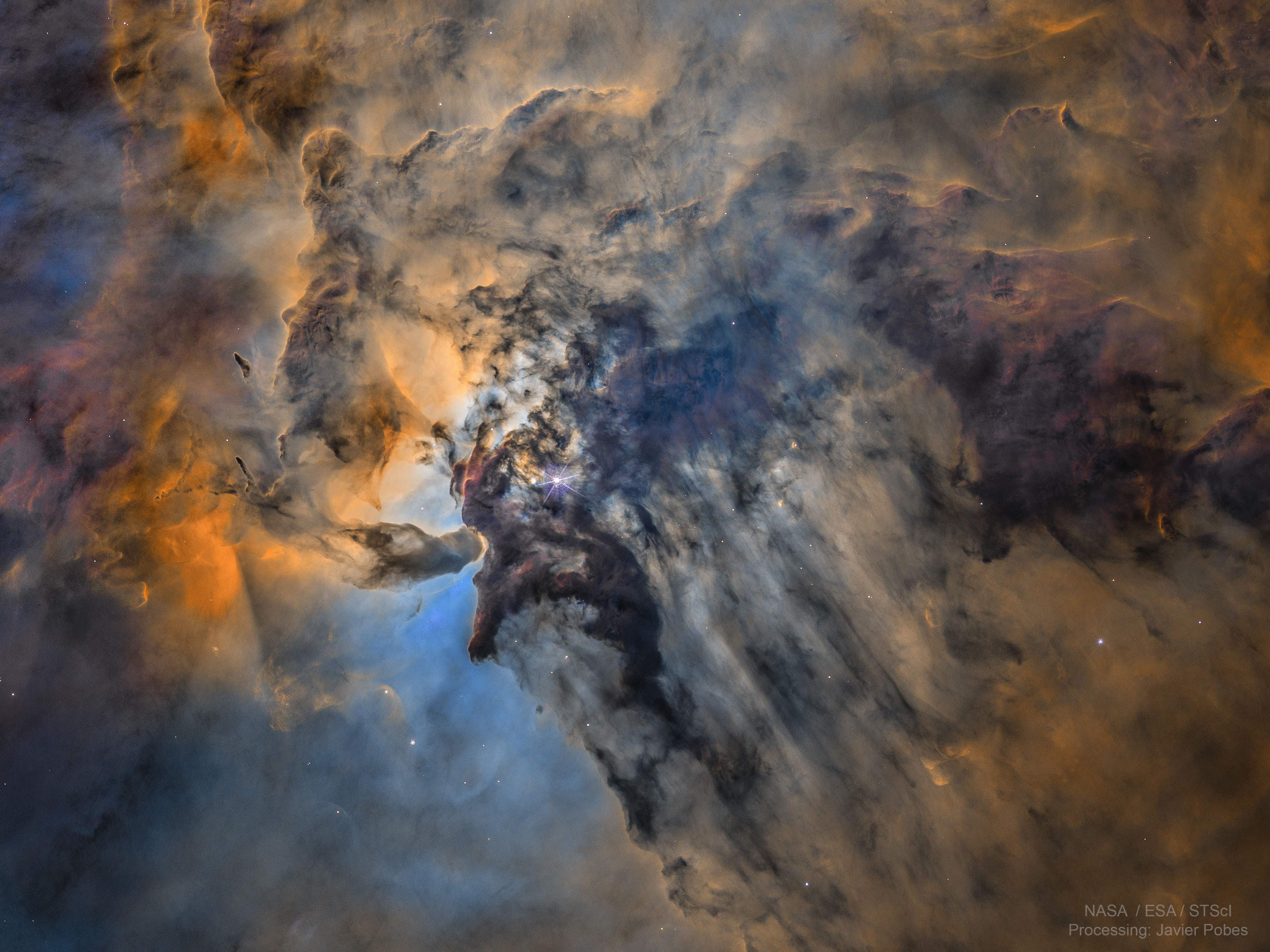
ASTRONOMY - The Busy Center of the Lagoon Nebula
2023 June 19
Image Credit: NASA, ESA, Hubble; Processing: Francisco Javier Pobes Serrano
Explanation: The center of the Lagoon Nebula is a whirlwind of spectacular star formation. Visible near the image center, at least two long funnel-shaped clouds, each roughly half a light-year long, have been formed by extreme stellar winds and intense energetic starlight. A tremendously bright nearby star, Herschel 36, lights the area. Vast walls of dust hide and redden other hot young stars. As energy from these stars pours into the cool dust and gas, large temperature differences in adjoining regions can be created generating shearing winds which may cause the funnels. This picture, spanning about 15 light years, combines images taken in four colors by the orbiting Hubble Space Telescope. The Lagoon Nebula, also known as M8, lies about 5000 light years distant toward the constellation of the Archer (Sagittarius).
15/06/2023
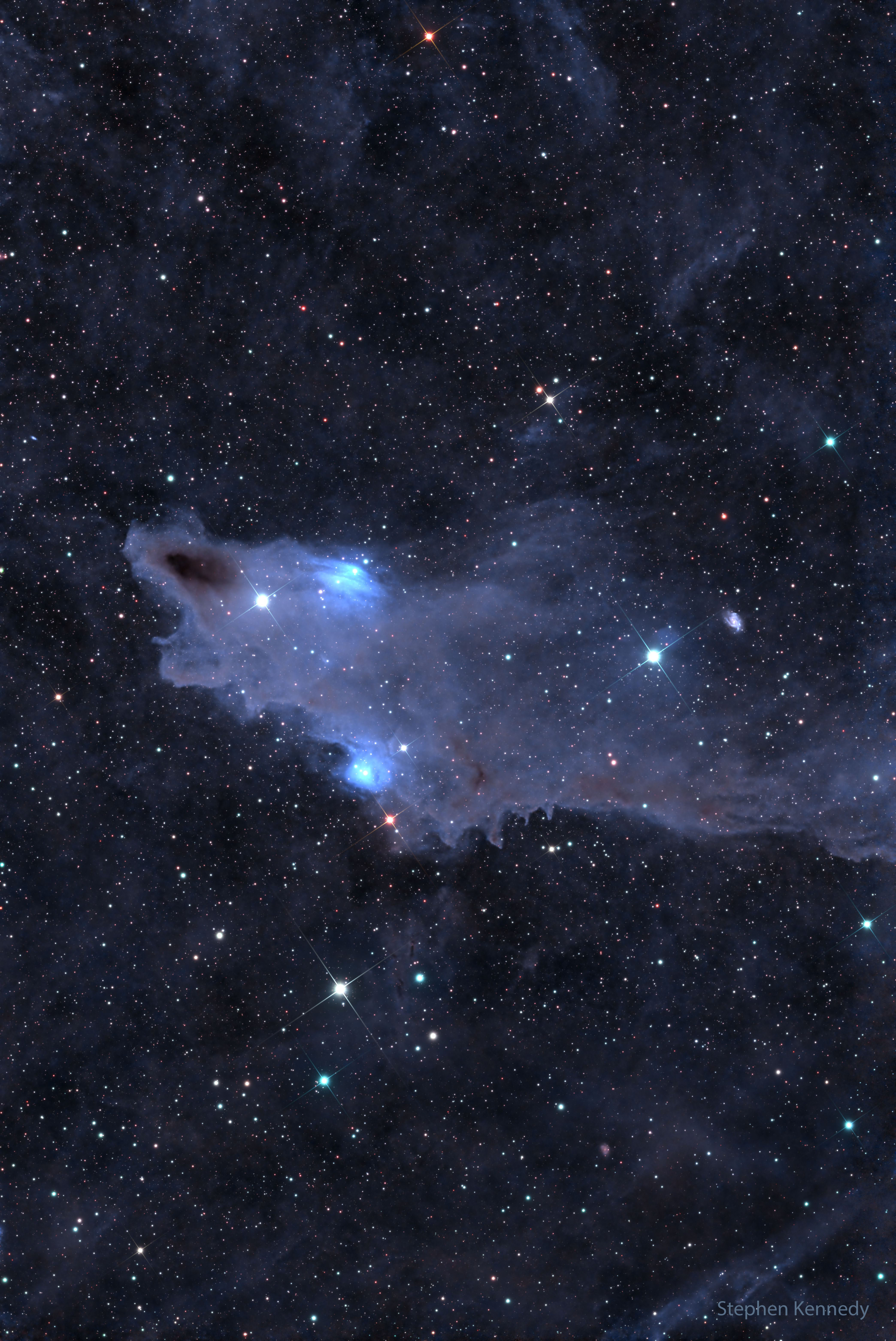
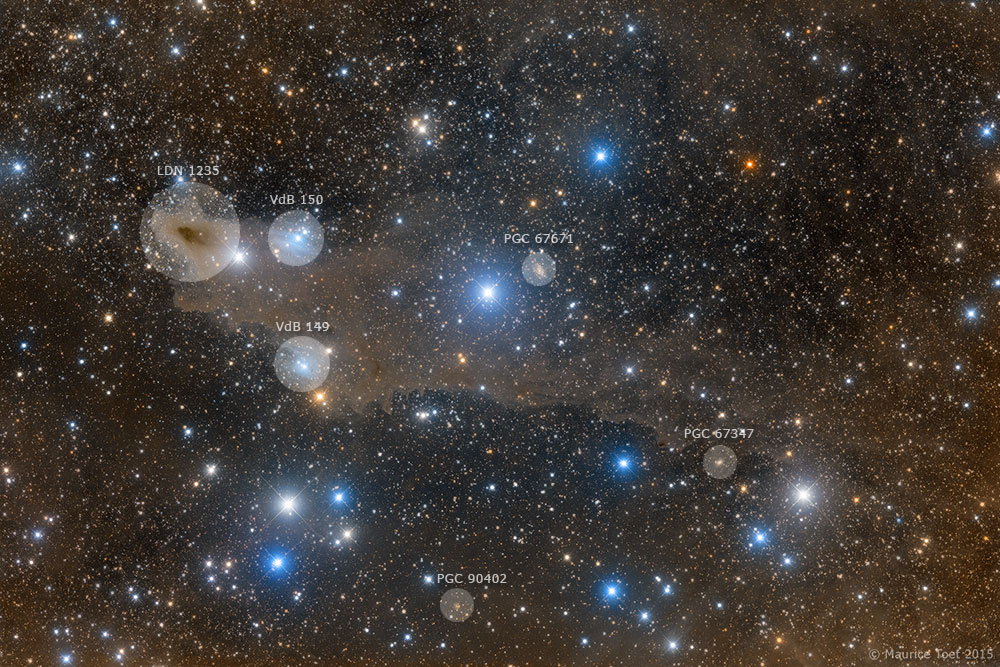
ASTRONOMY - The Shark Nebula
2023 June 14
Image Credit & Copyright: Stephen Kennedy
Explanation: There is no sea on Earth large enough to contain the Shark nebula. This predator apparition poses us no danger as it is composed only of interstellar gas and dust. Dark dust like that featured here is somewhat like cigarette smoke and created in the cool atmospheres of giant stars. After being expelled with gas and gravitationally recondensing, massive stars may carve intricate structures into their birth cloud using their high energy light and fast stellar winds as sculpting tools. The heat they generate evaporates the murky molecular cloud as well as causing ambient hydrogen gas to disperse and glow red. During disintegration, we humans can enjoy imagining these great clouds as common icons, like we do for water clouds on Earth. Including smaller dust nebulae such as Lynds Dark Nebula 1235 and Van den Bergh 149 & 150, the Shark nebula spans about 15 light years and lies about 650 light years away toward the constellation of the King of Aethiopia (Cepheus).
13/06/2023
ASTRONOMY - Moons Across Jupiter
2023 June 13
Image Credit: NASA; ESA, JPL, Cassini Imaging Team, SSI; Processing: Kevin M. Gill
Explanation: Jupiter's moons circle Jupiter. The featured video depicts Europa and Io, two of Jupiter's largest moons, crossing in front of the grand planet's Great Red Spot, the largest known storm system in our Solar System. The video was composed from images taken by the robotic Cassini spacecraft as it passed Jupiter in 2000, on its way to Saturn. The two moons visible are volcanic Io, in the distance, and icy Europa. In the time-lapse video, Europa appears to overtake Io, which is odd because Io is closer to Jupiter and moves faster. The explanation is that the motion of the fast Cassini spacecraft changes the camera location significantly during imaging. Jupiter is currently being visited by NASA's robotic Juno spacecraft, while ESA's Jupiter Icy Moons Explorer (JUICE), launched in April, is enroute.
DELICIEUSES HERBES AROMATIQUES - Le romarin
Le romarin officinal, reconnaissable à ses fleurs bleutées, est un arbrisseau de la famille des Lamiacées. Il pousse à l'état sauvage sur le pourtour méditerranéen, dans les garrigues arides et rocailleuses.
La plante s'utilise de préférence fraîche mais les fleurs séchées parfument agréablement un plat ou un dessert. Il sert également à aromatiser les grillades ou à rehausser les ragoûts, les civets, les soupes ou les sauces.
Le romarin est mellifère et contient plusieurs agents actifs antimycosiques, antibactériens et antioxydants. Il est également utilisé en parfumerie depuis le XIVe siècle.
© Cyclonebill, CC by-sa 2.0 et Tony Hisgett, CC by 2.0
11/06/2023
ASTRONOMY - Simulation: A Disk Galaxy Forms
2023 May 31
Video Credit: TNG Collaboration, MPCDF, FAS Harvard U.; Music: World's Sunrise (YouTube: Jimena Contreras)
Explanation: How did we get here? We know that we live on a planet orbiting a star orbiting a galaxy, but how did all of this form? Since our universe moves too slowly to watch, faster-moving computer simulations are created to help find out. Specifically, this featured video from the IllustrisTNG collaboration tracks gas from the early universe (redshift 12) until today (redshift 0). As the simulation begins, ambient gas falls into and accumulates in a region of relatively high gravity. After a few billion years, a well-defined center materializes from a strange and fascinating cosmic dance. Gas blobs -- some representing small satellite galaxies -- continue to fall into and become absorbed by the rotating galaxy as the present epoch is reached and the video ends. For the Milky Way Galaxy, however, big mergers may not be over -- recent evidence indicates that our large spiral disk Galaxy will collide and coalesce with the slightly larger Andromeda spiral disk galaxy in the next few billion years.
08/06/2023
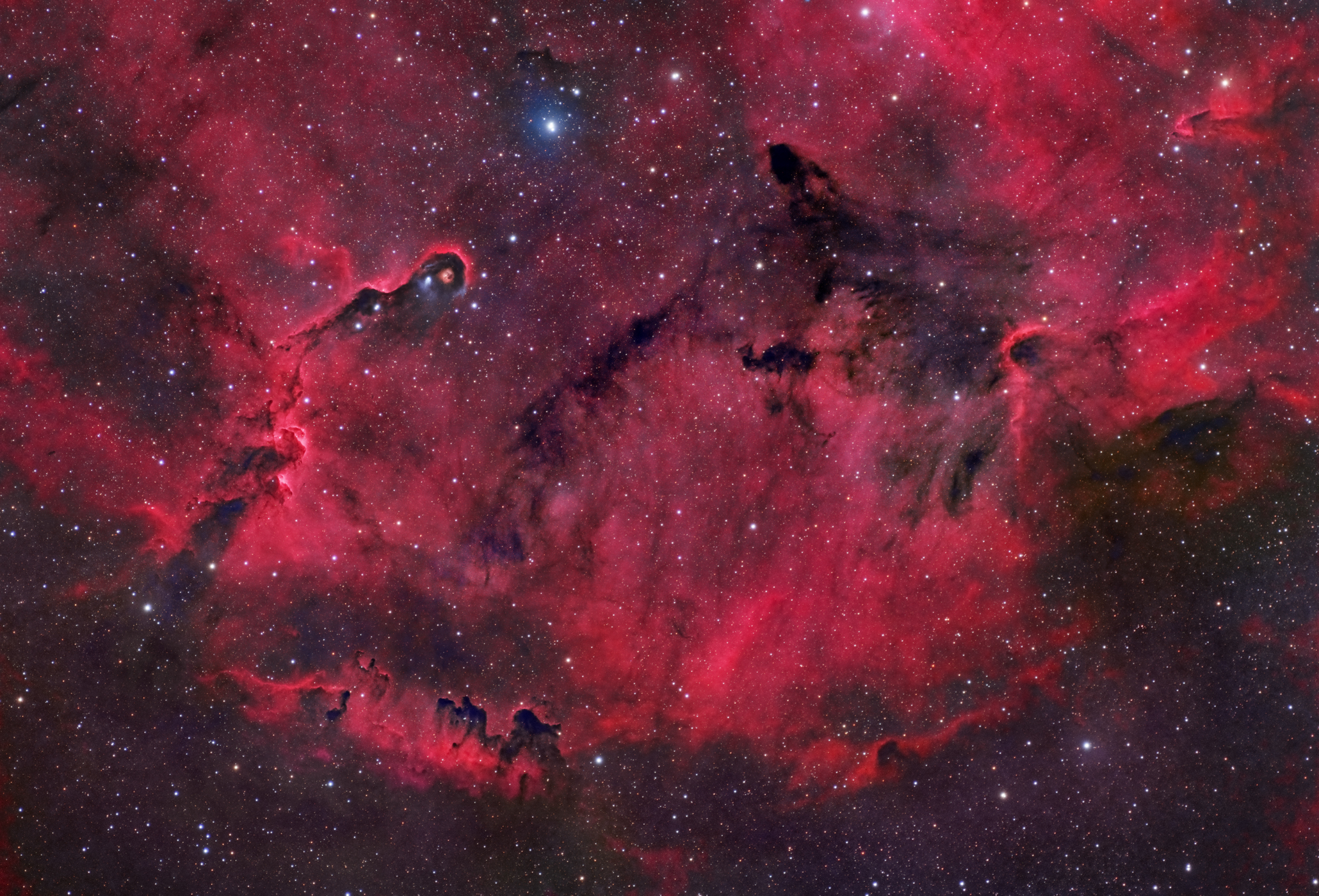
ASTRONOMY - Elephant's Trunk and Caravan
2023 June 8
Image Credit & Copyright: Steve Cannistra (StarryWonders)
Explanation: Like an illustration in a galactic Just So Story, the Elephant's Trunk Nebula winds through the emission region and young star cluster complex IC 1396, in the high and far off constellation of Cepheus. Seen on the left the cosmic elephant's trunk, also known as vdB 142, is over 20 light-years long. This detailed telescopic view features the bright swept-back ridges and pockets of cool interstellar dust and gas that abound in the region. But the dark, tendril-shaped clouds contain the raw material for star formation and hide protostars within. Nearly 3,000 light-years distant, the relatively faint IC 1396 complex covers a large region on the sky, spanning over 5 degrees. This rendition spans a 1 degree wide field of view though, about the angular size of 2 full moons. Of course the dark shapes below and to the right of the outstretched Elephant's Trunk, are known to some as The Caravan.
07/06/2023
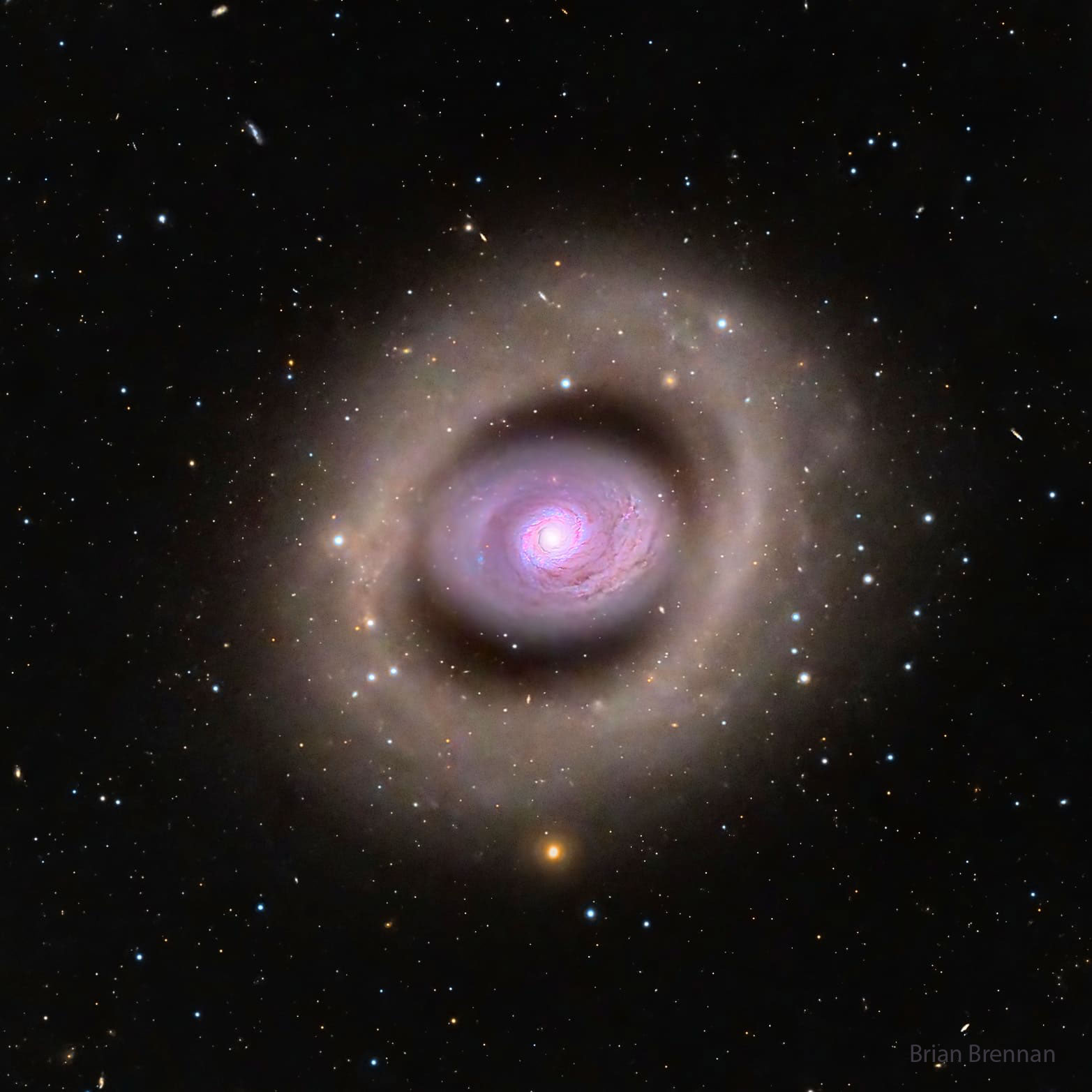
ASTRONOMY - M94: A Double Ring Galaxy
2023 June 7
Image Credit & Copyright: Brian Brennan
Explanation: Most galaxies don't have any rings of stars and gas -- why does M94 have two? First, spiral galaxy M94 has an inner ring of newly formed stars surrounding its nucleus, giving it not only an unusual appearance but also a strong interior glow. A leading origin hypothesis holds that an elongated knot of stars known as a bar rotates in M94 and has generated a burst of star formation in this inner ring. Observations have also revealed another ring, an outer ring, one that is more faint, different in color, not closed, and relatively complex. What caused this outer ring is currently unknown. M94, pictured here, spans about 45,000 light years in total, lies about 15 million light years away, and can be seen with a small telescope toward the constellation of the Hunting Dogs (Canes Venatici).
AERONAUTIQUE - Avions de légende - Le Canadair CL 415 - un bombardier d'eau à la capacité impressionnante
ASTRONOMY - Galle: Happy Face Crater on Mars
2026 February 1 Galle: Happy Face Crater on Mars Image Credit: NASA , MGS , MSSS Explanation: Mars has put on a happy face. The Martian...
-
2022 September 26 All the Water on Planet Earth Illustration Credit: Jack Cook, Adam Nieman, Woods Hole Oceanographic Institution ; Data ...
-
2025 May 11 The Surface of Venus from Venera 14 Image Credit: Soviet Planetary Exploration Program , Venera 14 ; Processing & Copyri...