Nombre total de pages vues
25/02/2024
MYSTERES SOUS L'EAU DES LACS - Paysage sans vie dans un bras mort du Rhône
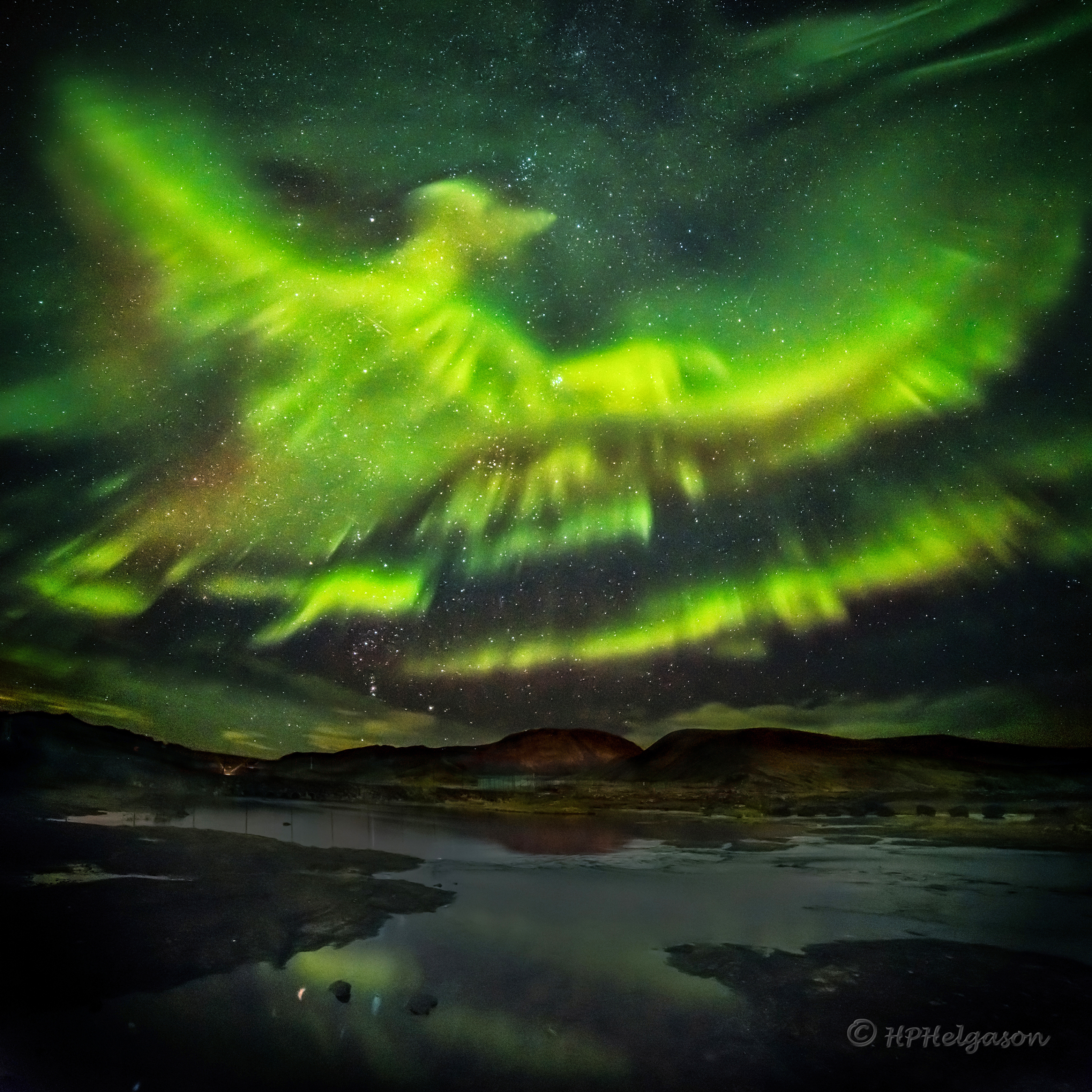
ASTRONOMY - A Phoenix Aurora over Iceland
2024 February 25
Image Credit & Copyright: Hallgrimur P. Helgason; Rollover Annotation: Judy Schmidt
Explanation: All of the other aurora watchers had gone home. By 3:30 am in Iceland, on a quiet September night, much of that night's auroras had died down. Suddenly, unexpectedly, a new burst of particles streamed down from space, lighting up the Earth's atmosphere once again. This time, surprisingly, pareidoliacally, the night lit up with an amazing shape reminiscent of a giant phoenix. With camera equipment at the ready, two quick sky images were taken, followed immediately by a third of the land. The mountain in the background is Helgafell, while the small foreground river is called Kaldá, both located about 30 kilometers north of Iceland's capital Reykjavík. Seasoned skywatchers will note that just above the mountain, toward the left, is the constellation of Orion, while the Pleiades star cluster is also visible just above the frame center. The 2016 aurora, which lasted only a minute and was soon gone forever -- would possibly be dismissed as a fanciful fable -- were it not captured in the featured, digitally-composed, image mosaic.
24/02/2024
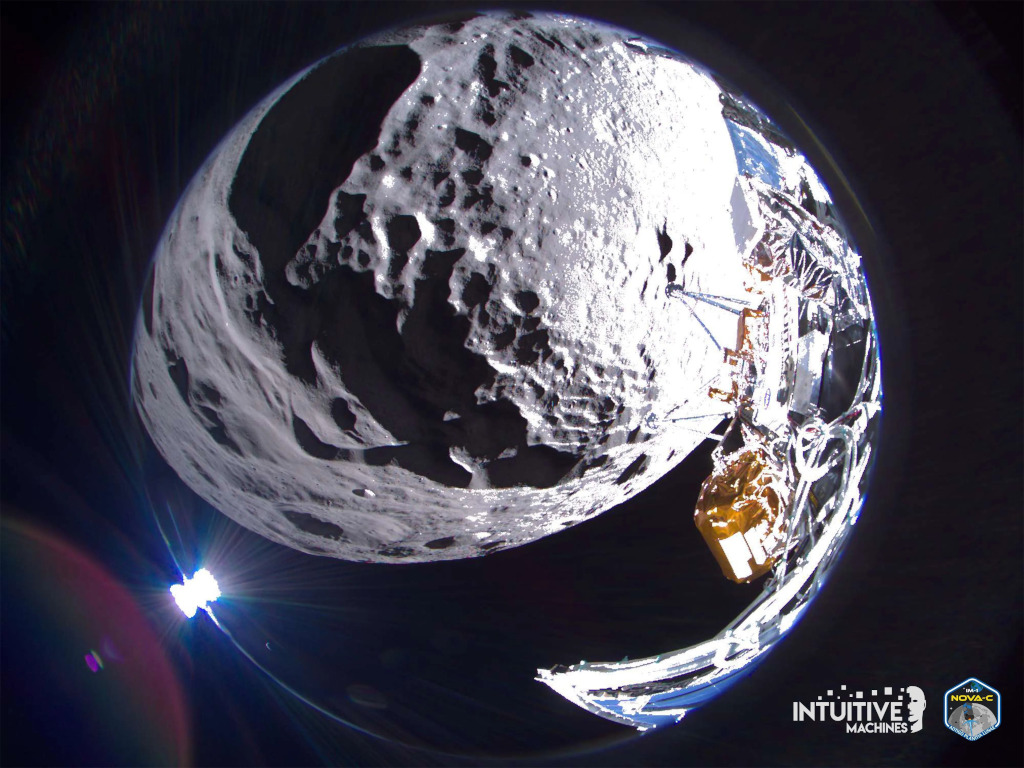
ASTRONOMY - To the Moon
2024 February 24
Image Credit: Intuitive Machines
Explanation: Intuitive Machines' robotic lander Odysseus has accomplished the first U.S. landing on the Moon since the Apollo 17 mission in 1972. Launched on a SpaceX rocket on February 15, the phone booth sized lander reached lunar orbit on the 21st and touched down on the lunar surface at 6:23 pm ET on February 22nd. Its landing region is about 300 kilometers north of the Moon's south pole, near a crater designated Malapert A. The lander is presently collecting solar power and transmitting data back to the Intuitive Machines' mission control center in Houston. The mission marks the first commercial uncrewed landing on the Moon. Prior to landing, Odysseus’ camera captured this extreme wide angle image (landing legs visible at right) as it flew over Schomberger crater some 200 kilometers from its landing site. Odysseus was still about 10 kilometers above the lunar surface.
23/02/2024
SANTé/MEDECINE - Les robots guidés par scanner, l'avenir de la chirurgie ?
MYSTERES SOUS L'EAU DES LACS - Un bras mort du Rhône plein de vie
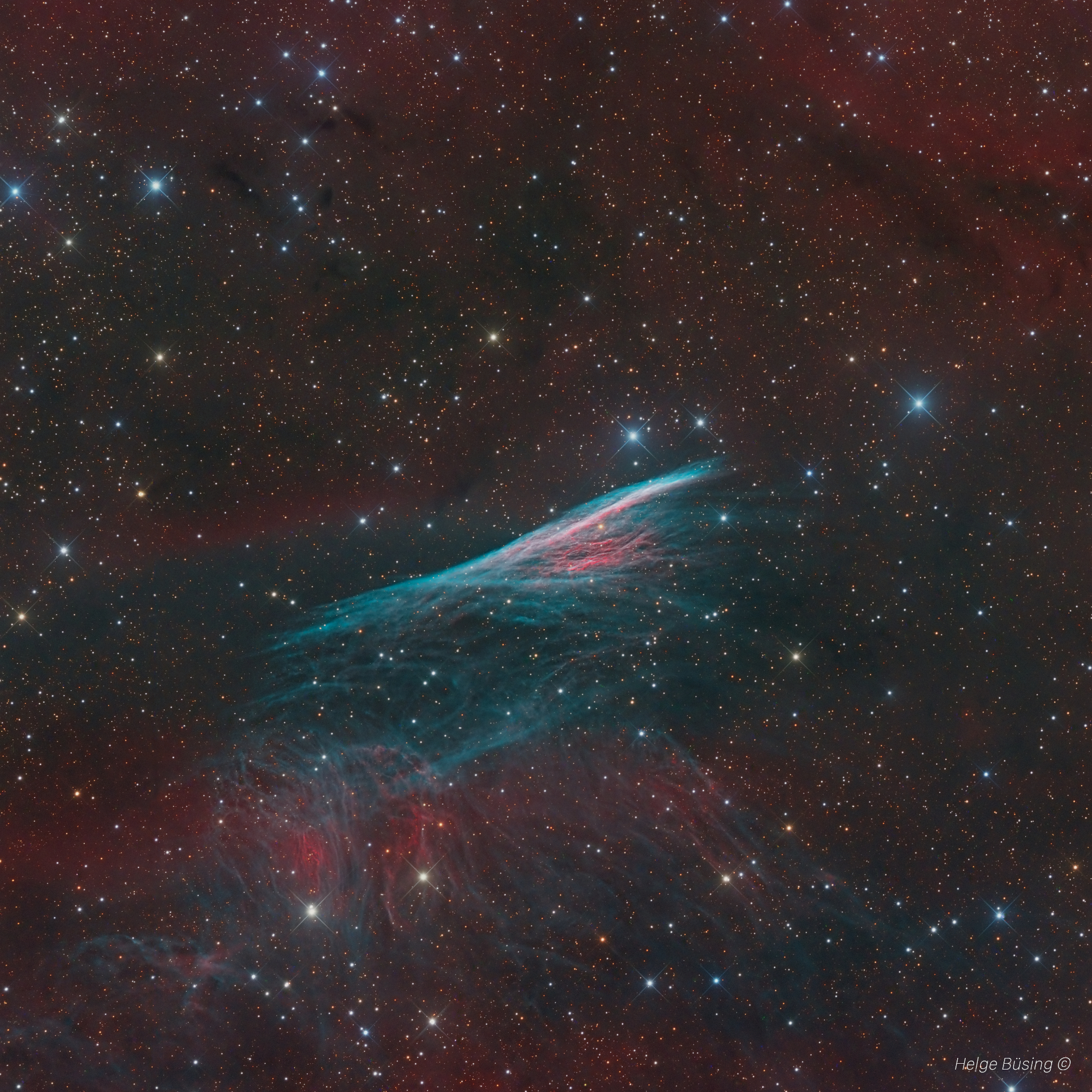
ASTRONOMY - The Pencil Nebula Supernova Shock Wave
2024 February 23
Image Credit & Copyright: Helge Buesing
Explanation: This supernova shock wave plows through interstellar space at over 500,000 kilometers per hour. Centered and moving upward in the sharply detailed color composite its thin, bright, braided filaments are actually long ripples in a cosmic sheet of glowing gas seen almost edge-on. Discovered in the 1840s by Sir John Herschel, the narrow-looking nebula is sometimes known as Herschel's Ray. Cataloged as NGC 2736, its pointed appearance suggests its modern popular name, the Pencil Nebula. The Pencil Nebula is about 800 light-years away. Nearly 5 light-years long it represents only a small part of the Vela supernova remnant though. The enormous Vela remnant itself is around 100 light-years in diameter, the expanding debris cloud of a star that was seen to explode about 11,000 years ago. Initially, the section of the shock wave seen as the Pencil nebula was moving at millions of kilometers per hour but has slowed considerably, sweeping up surrounding interstellar material.
22/02/2024
AUTOMOBILE - INVENTIONS QUI N'ONT JAMAIS VU LE JOUR - Pare-brise arrière rabattables
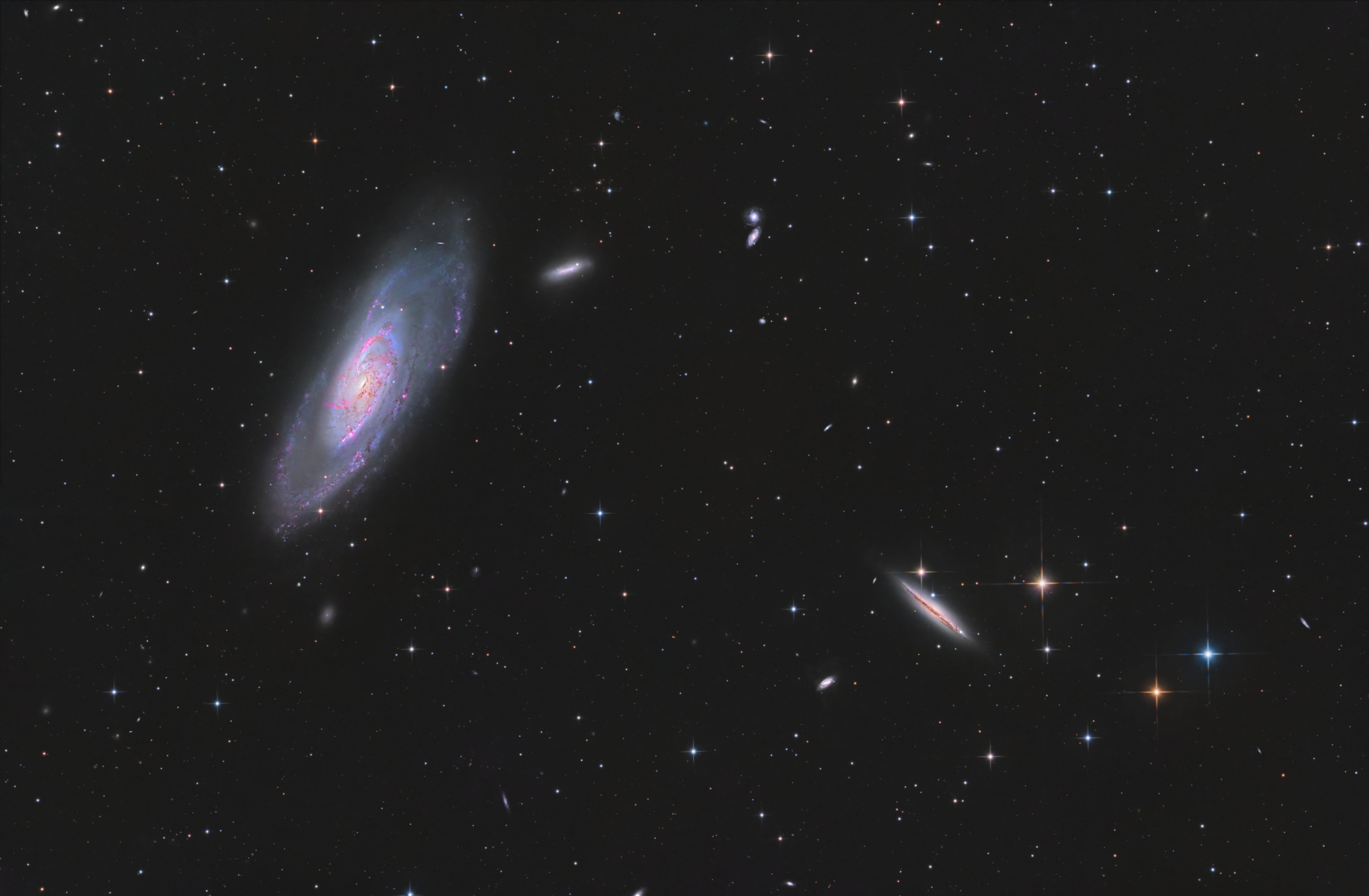
ASTRONOMY - A View Toward M106
2024 February 22
Image Credit & Copyright: Kyunghoon Lim
Explanation: Big, bright, beautiful spiral, Messier 106 dominates this cosmic vista. The nearly two degree wide telescopic field of view looks toward the well-trained constellation Canes Venatici, near the handle of the Big Dipper. Also known as NGC 4258, M106 is about 80,000 light-years across and 23.5 million light-years away, the largest member of the Canes II galaxy group. For a far far away galaxy, the distance to M106 is well-known in part because it can be directly measured by tracking this galaxy's remarkable maser, or microwave laser emission. Very rare but naturally occurring, the maser emission is produced by water molecules in molecular clouds orbiting its active galactic nucleus. Another prominent spiral galaxy on the scene, viewed nearly edge-on, is NGC 4217 below and right of M106. The distance to NGC 4217 is much less well-known, estimated to be about 60 million light-years, but the bright spiky stars are in the foreground, well inside our own Milky Way galaxy.
21/02/2024
SANTé/MEDECINE - Coupe transversale d'une artère humaine obtenue grâce aux ultrasons
MYSTERES SOUS LES LACS - Les yeux de braise d'un couple de crapauds
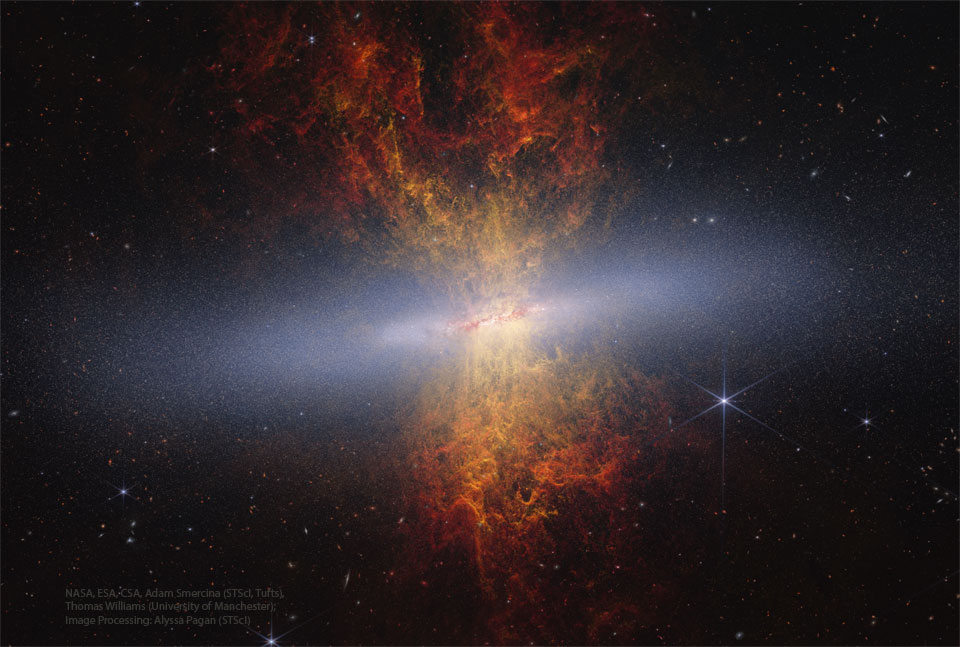
Astronomy - M82: GALAXY WITH A SUPERGALACTIC WIND
2026 June 29 M82: Galaxy with a Supergalactic Wind Image Credit: NASA , ESA , CSA , A. Smercina (STScI, Tufts), T. Williams (U. Mancheste...
-
2026 January 1 Auroral Corona Image Credit & Copyright : Roi Levi Explanation: Cycle 25 solar maximum made 2025 a great year for ...
-
2026 January 2 NanoSail-D2 Image Credit & Copyright : Ralf Vandebergh Explanation: In 2011, on January 20, NASA's NanoSail-D2 ...