Nombre total de pages vues
26/02/2025
ARCHEOLOGIE - Le trésor de Toutânkhamon - Horus le faucon - le dieu solaire
ASGRONOMY - Einstein Ring Surrounds Nearby Galaxy Center
2025 February 26
Image Credit & Copyright: ESA, NASA, Euclid Consortium; Processing: J.-C. Cuillandre, G. Anselmi, T. Li
Explanation: Do you see the ring? If you look very closely at the center of the featured galaxy NGC 6505, a ring becomes evident. It is the gravity of NGC 6505, the nearby (z = 0.042) elliptical galaxy that you can easily see, that is magnifying and distorting the image of a distant galaxy into a complete circle. To create a complete Einstein ring there must be perfect alignment of the nearby galaxy's center and part of the background galaxy. Analysis of this ring and the multiple images of the background galaxy help to determine the mass and fraction of dark matter in NGC 6505's center, as well as uncover previously unseen details in the distorted galaxy. The featured image was captured by ESA's Earth-orbiting Euclid telescope in 2023 and released earlier this month.
25/02/2025
SANTé/MEDECINE - Le râle agonique - À quoi ressemble-t-il ?
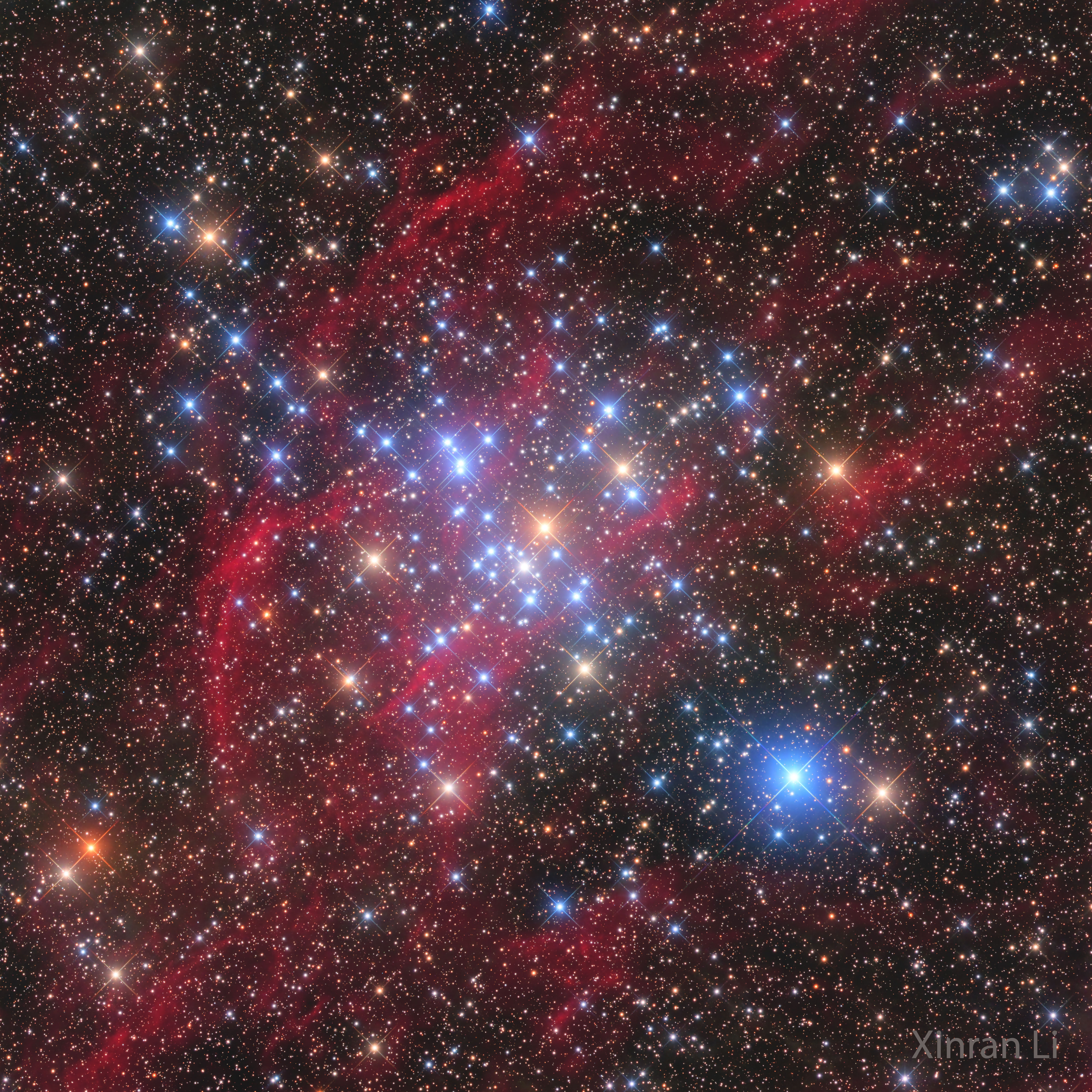
ASTRONOMY - M41: The Little Beehive Star Cluster
Image Credit & Copyright: Xinran Li
Explanation: Why are there so many bright blue stars? Stars are usually born in clusters, and the brightest and most massive of these stars typically glow blue. Less-bright, non-blue stars like our Sun surely also exist in this M41 star cluster but are harder to see. A few bright orange-appearing red giant stars are visible. The red-light filaments are emitted by diffuse hydrogen gas, a color that was specifically filtered and enhanced in this image. In a hundred million years or so, the bright blue stars will have exploded in supernovas and disappeared, while the slightly different trajectories of the fainter stars will cause this picturesque open cluster to disperse. Similarly, billions of years ago, our own Sun was likely born into a star cluster like M41, but it has long since drifted apart from its sister stars. The featured image was captured over four hours with Chilescope T2 in Chile.
24/02/2025
ASTRONOMY - Light Pillar over Erupting Etna
2025 February 24
Image Credit & Copyright: Davide Caliò
Explanation: Can a lava flow extend into the sky? No, but light from the lava flow can. One effect is something quite unusual -- a volcanic light pillar. More typically, light pillars are caused by sunlight and so appear as a bright column that extends upward above a rising or setting Sun. Alternatively, other light pillars -- some quite colorful -- have been recorded above street and house lights. This light pillar, though, was illuminated by the red light emitted by the glowing magma of an erupting volcano. The volcano is Italy's Mount Etna, and the featured image was captured with a single shot during an early morning in mid-February. Freezing temperatures above the volcano's lava flow created ice-crystals either in the air above the volcano or in condensed water vapor expelled by Mount Etna. These ice crystals -- mostly flat toward the ground but fluttering -- then reflected away light from the volcano's caldera.
22/02/2025
ARCHEOLOGIE - Toutânkhamon - Le trésor de Anubis - le dieu funéraire
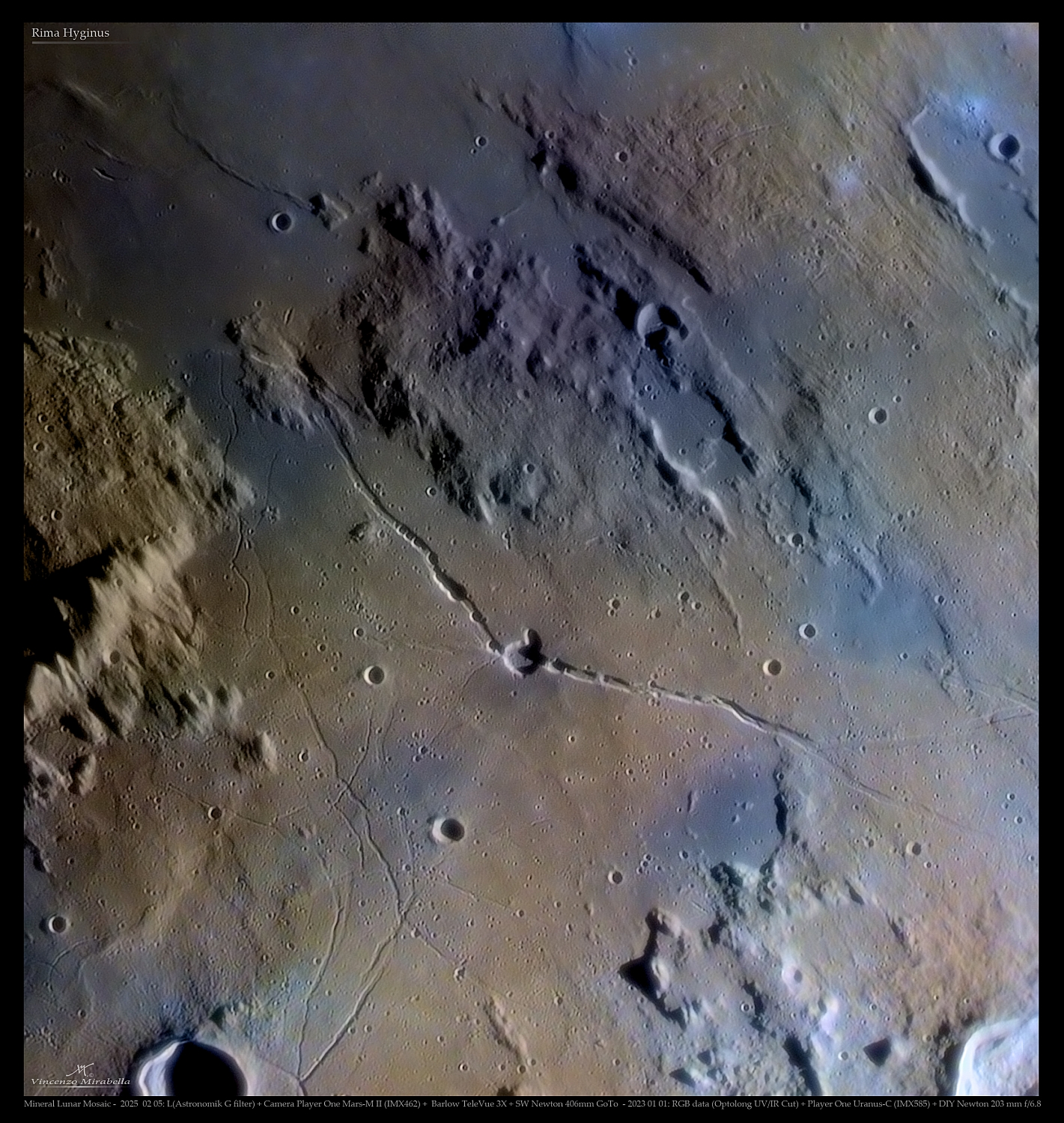
ASTRONOMY - Rima Hyginus
2025 February 22
Image Credit & Copyright: Vincenzo Mirabella
Explanation: Rima Hyginus is a spectacular fissure, some 220 kilometers long, found near the center of the lunar near side. Easy to spot in telescopic views of the Moon, it stretches top left to bottom right across this lunar closeup. The image was made with exaggerated colors that reflect the mineral composition of the lunar soil. Hyginus crater lies near the center of the narrow lunar surface groove. About 10 kilometers in diameter, the low-walled crater is a volcanic caldera, one of the larger non-impact craters on the lunar surface. Dotted with small pits formed by surface collapse, Hyginus rima itself was likely created by stresses due to internal magma upwelling and collapse along a long surface fault. The intriguing region was a candidate landing site for the canceled Apollo 19 mission.
21/02/2025
ORNITHOLOGIE - Guit-guit : sucrier à pattes rouges
SANTé/MEDECINE - Le râle agonique - Un son troublant mais naturel
Astronomy - EAGLE NEBULA PILLARS IN INFRARED FROM HUBBLE
2026 May 31 Eagle Nebula Pillars in Infrared from Hubble Image Credit: NASA , ESA , Hubble , HLA ; Processing: Luis Romero Ventura Explanat...
-
2026 January 1 Auroral Corona Image Credit & Copyright : Roi Levi Explanation: Cycle 25 solar maximum made 2025 a great year for ...
-
Imaginez un monde où le cancer n’est plus une sentence, mais une simple étape à franchir. Grâce à une découverte révolutionnaire, ce rêve es...