Nombre total de pages vues
27/05/2025
SANTé/MEDECINE - Cancer rare : ces 2 symptômes passent souvent inaperçus - (1/2)
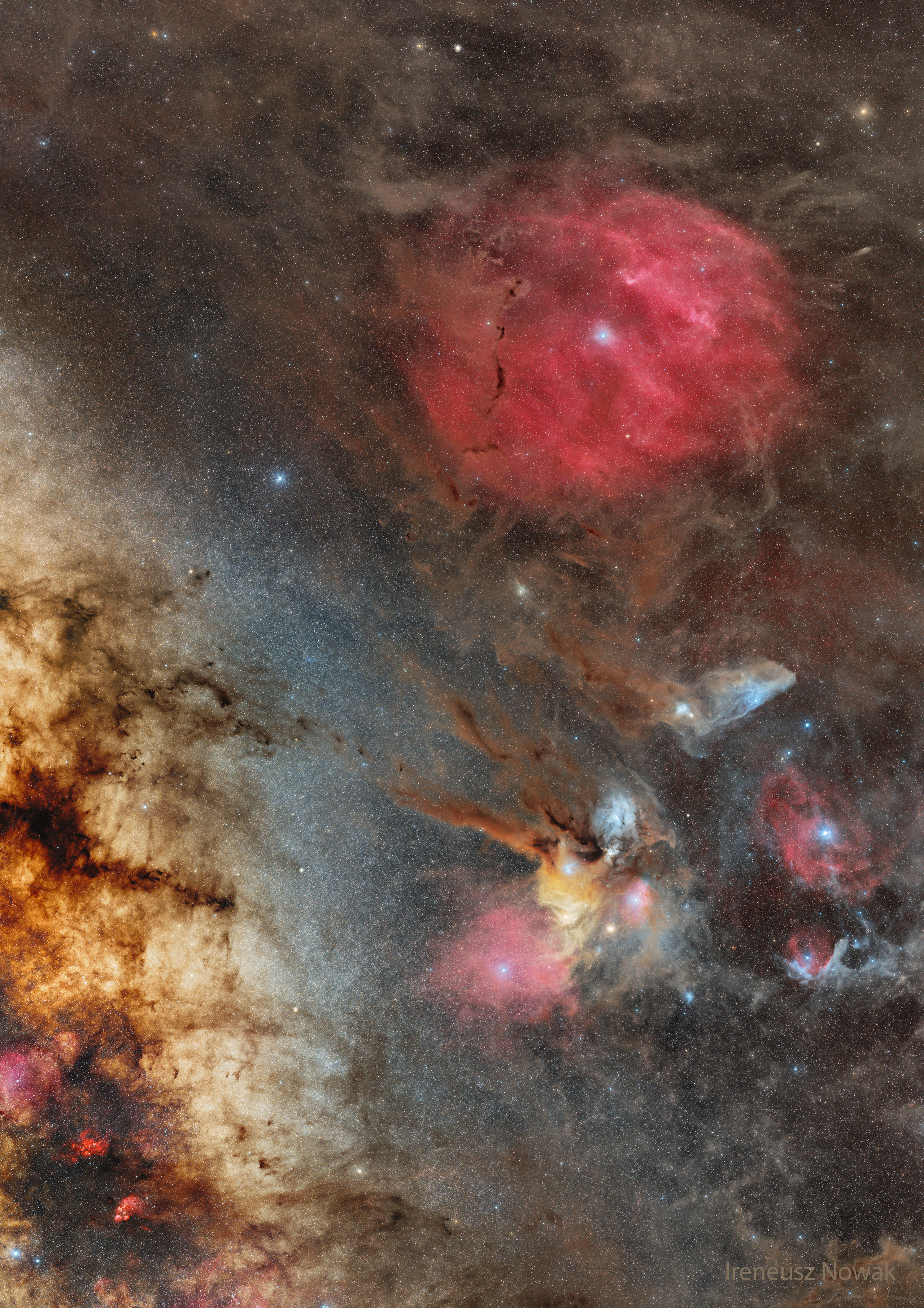
ASTRONOMY - Zeta and Rho Ophiuchi with Milky Way
2025 May 27
Image Credit & Copyright: Ireneusz Nowak
Explanation: Behold one of the most photogenic regions of the night sky, captured impressively. Featured, the band of our Milky Way Galaxy runs diagonally along the bottom-left corner, while the colorful Rho Ophiuchi cloud complex is visible just right of center and the large red circular Zeta Ophiuchi Nebula appears near the top. In general, red emanates from nebulas glowing in the light of excited hydrogen gas, while blue marks interstellar dust preferentially reflecting the light of bright young stars. Thick dust usually appears dark brown. Many iconic objects of the night sky appear, including (can you find them?) the bright star Antares, the globular star cluster M4, and the Blue Horsehead nebula. This wide field composite, taken over 17 hours, was captured from South Africa last June.
26/05/2025
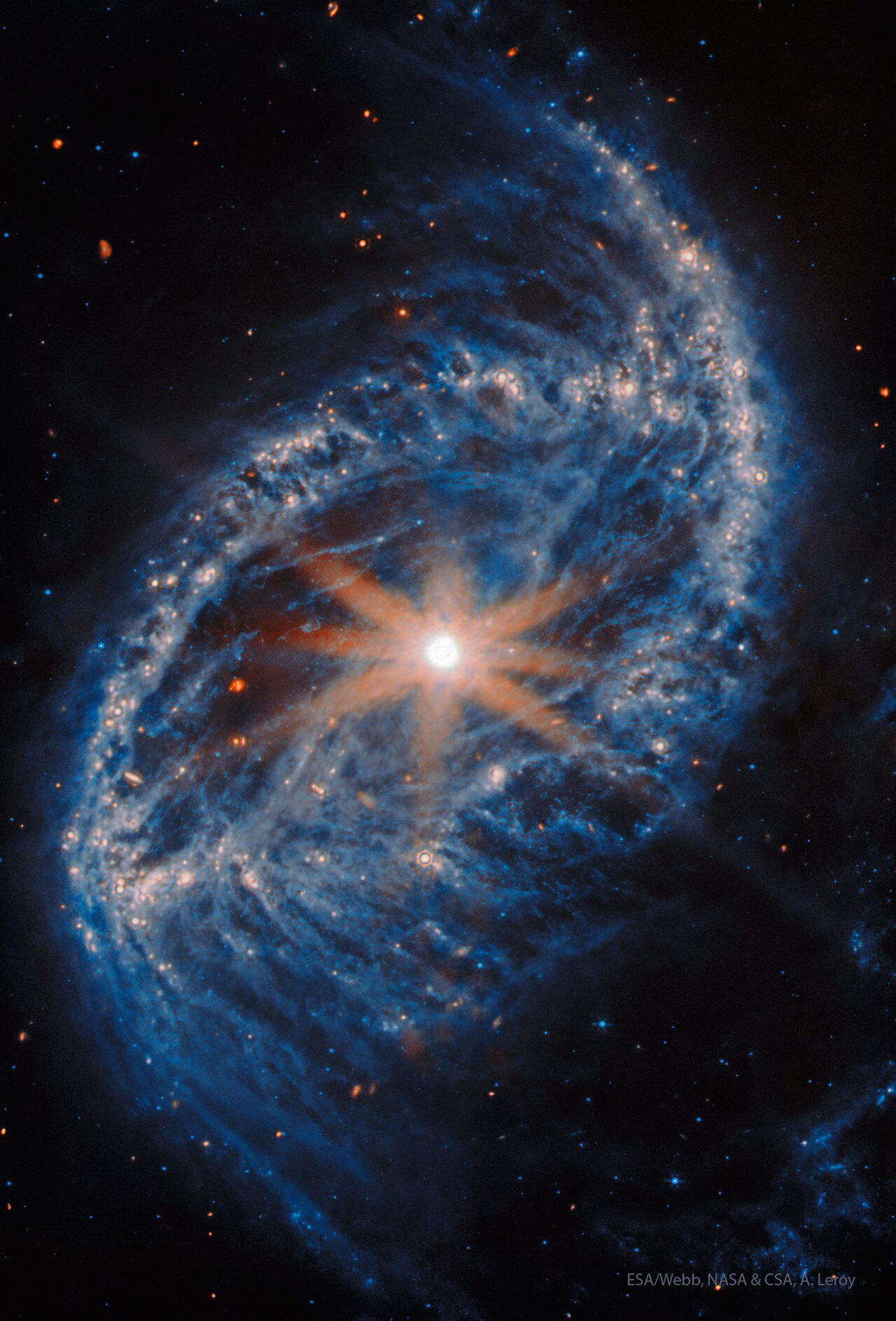
ASTRONOMY - Spiral Galaxy NGC 2566 from Webb
2025 May 26
Image Credit: ESA/Webb, NASA & CSA, A. Leroy
Explanation: What’s happening in the center of spiral galaxy NGC 2566? First, the eight rays that appear to be coming out of the center in the featured infrared image are not real — they are diffraction spikes caused by the mechanical structure of the Webb space telescope itself. The center of NGC 2566 is bright but not considered unusual, which means that it likely contains a supermassive black hole, although currently not very active. At only 76 million light years away, the light we see from NGC 2566 today left when dinosaurs roamed the Earth. The picturesque galaxy is close enough so that Earthly telescopes, including Webb and Hubble, can resolve the turbulent clouds of gas and dust where stars can form and so allows study of stellar evolution. NGC 2566, similar in size to our Milky Way Galaxy, is notable for its bright central bar and its prominent outer spiral arms.
25/05/2025
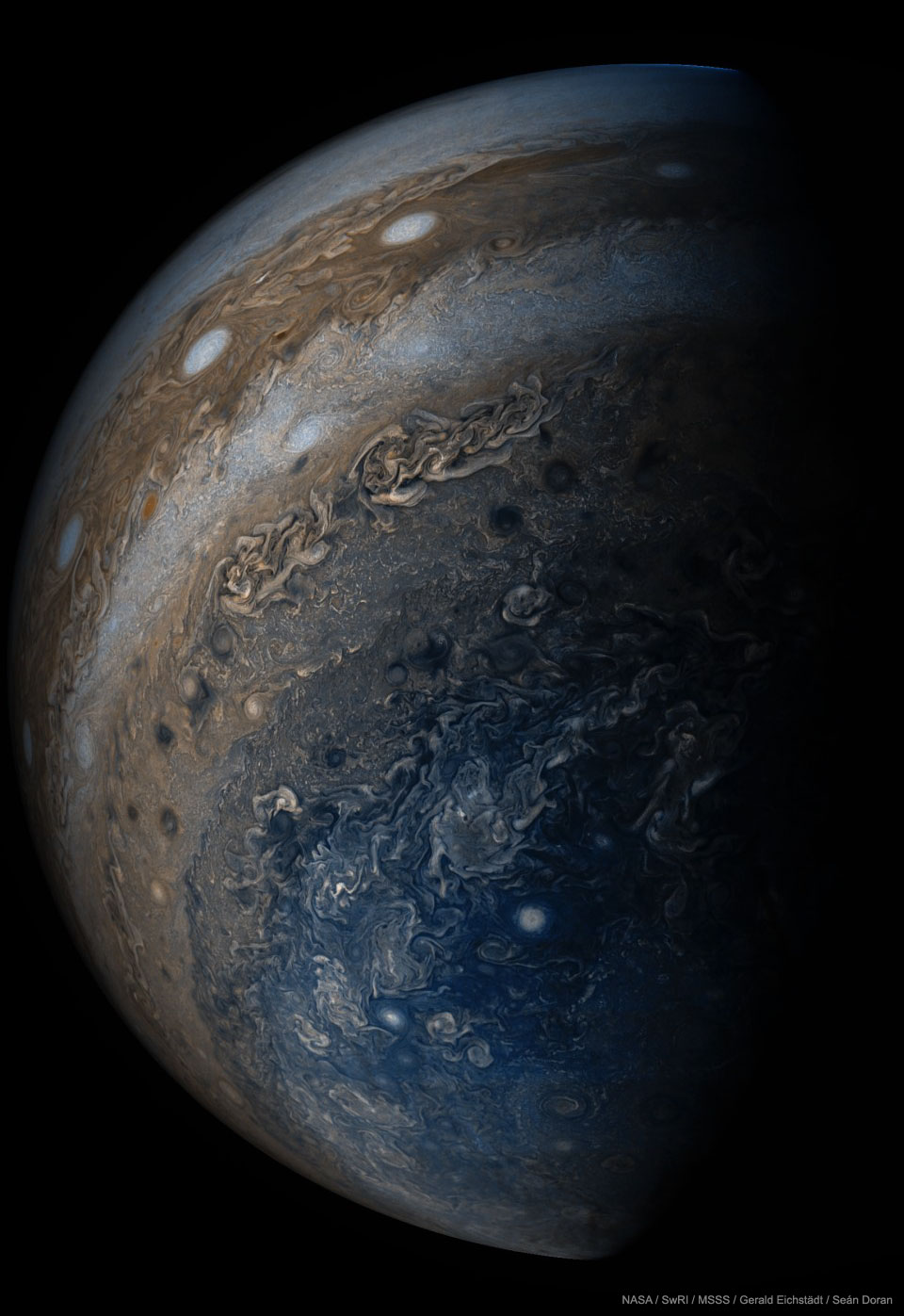
ASTRONOMY - Beneath Jupiter
2025 May 25
Image Credit & Copyright: NASA, Juno, SwRI, MSSS; Processing & License: Gerald Eichstädt & Seán Doran
Explanation: Jupiter is stranger than we knew. NASA's Juno spacecraft has now completed over 70 swoops past Jupiter as it moves around its highly elliptical orbit. Pictured from 2017, Jupiter is seen from below where, surprisingly, the horizontal bands that cover most of the planet disappear into swirls and complex patterns. A line of white oval clouds is visible nearer to the equator. Impressive results from Juno show that Jupiter's weather phenomena can extend deep below its cloud tops, that Jupiter's center has a core that is unexpectedly large and soft, and that Jupiter's magnetic field varies greatly with location. Although Juno is scheduled to keep orbiting Jupiter further into 2025, at some time the robotic spacecraft will be maneuvered to plunge into the giant planet.
24/05/2025
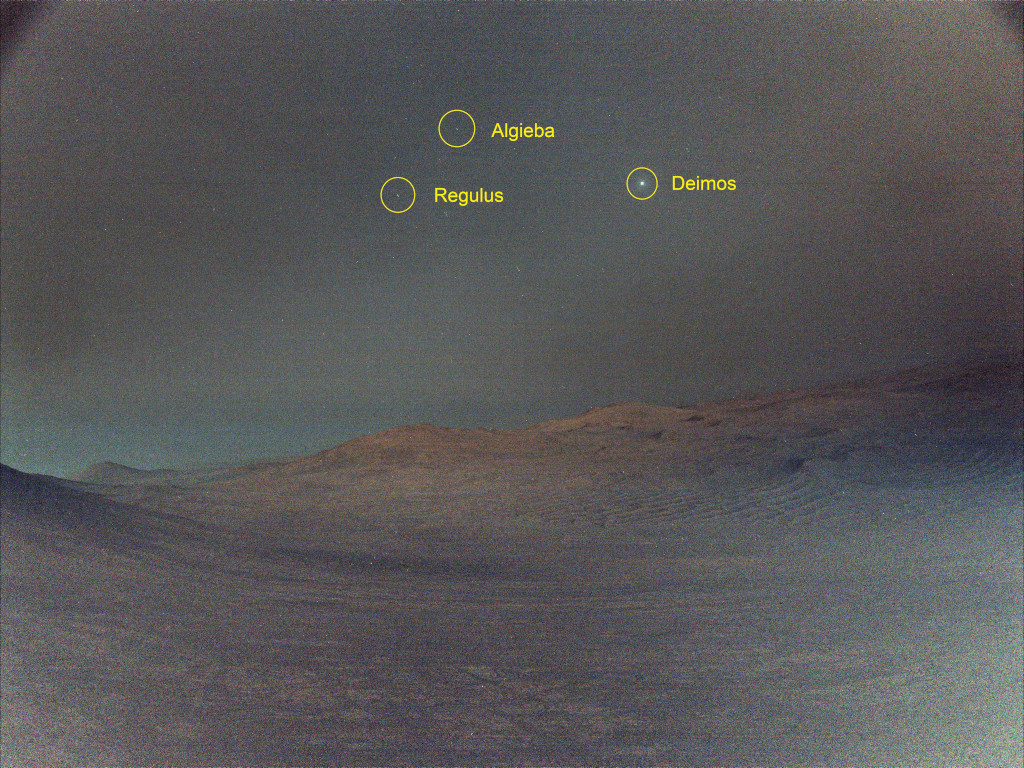
ASTRONOMY - Deimos Before Sunrise
Image Credit: NASA, JPL-Caltech
Explanation: Deimos takes 30 hours and 18 minutes to complete one orbit around the Red Planet. That's a little more than one Martian day or sol which is about 24 hours and 40 minutes long, so Deimos drifts westward across the Martian sky. About 15 kilometers across at its widest, the smallest of Mars' two moons is bright though. In fact Deimos is the brightest celestial object in this Martian skyscape captured before sunrise by Perseverance on March 1, the 1,433rd sol of the Mars rover's mission. The image is a composed of 16 exposures recorded by one of the rover's navigation cameras. The individual exposures were combined into a single image for an enhanced low light view. Regulus and Algeiba, bright stars in the constellation Leo, are also visible in the dark Martian predawn sky.
23/05/2025
SANTé/MEDECINE - Fruits chargés de pesticides - 1/2
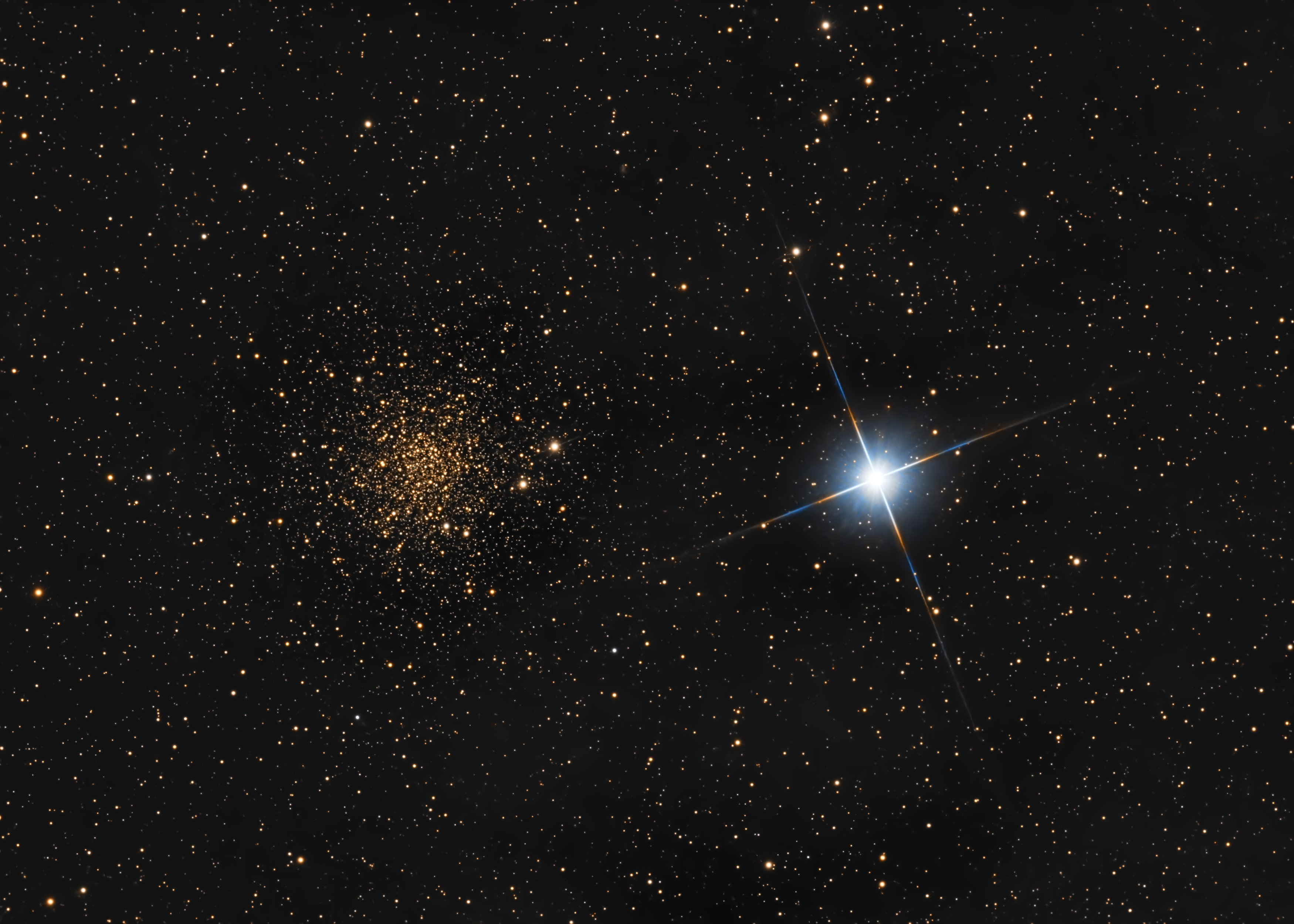
ASTRONOMY - NGC 6366 vs 47 Ophiuchi
2025 May 23
Image Credit & Copyright: Massimo Di Fusco
Explanation: Most globular star clusters roam the halo of our Milky Way galaxy, but globular cluster NGC 6366 lies close to the galactic plane. About 12,000 light-years away toward the constellation Ophiuchus, the cluster's starlight is dimmed and reddened by the Milky Way's interstellar dust when viewed from planet Earth. As a result, the stars of NGC 6366 look almost golden in this telescopic scene, especially when seen next to relatively bright, bluish, and nearby star 47 Ophiuchi. Compared to the hundred thousand stars or so gravitationally bound in distant NGC 6366, 47 Oph itself is a binary star system a mere 100 light-years away. Still, the co-orbiting stars of 47 Oph are too close together to be individually distinguished in the image.
22/05/2025
LA TERRE VUE DU CIEL - La structure de Richat : l'œil de l'Afrique dans le désert de Mauritanie
ASTRONOMY - Curly Spiral Galaxy M63
2025 May 22
Image Credit & Copyright: Alberto Pisabarro
Explanation: A bright spiral galaxy of the northern sky, Messier 63 is nearby, about 30 million light-years distant toward the loyal constellation Canes Venatici. Also cataloged as NGC 5055, the majestic island universe is nearly 100,000 light-years across, about the size of our own Milky Way. Its bright core and majestic spiral arms lend the galaxy its popular name, The Sunflower Galaxy. This exceptionally deep exposure also follows faint loops and curling star streams far into the galaxy's halo. Extending nearly 180,000 light-years from the galactic center, the star streams are likely remnants of tidally disrupted satellites of M63. Other satellite galaxies of M63 can be spotted in the remarkable wide-field image, including dwarf galaxies, which could contribute to M63's star streams in the next few billion years.
21/05/2025
LA TERRE VUE DU CIEL - Lever de Lune au-dessus du Pacifique par la sonde Rosetta
News en Images - ARTEMIS II ET LA FACE CACHéE DE LA LUNE
C’est un profil qu’on ne voit pas souvent. Sur cette image diffusée par la Nasa, notre Lune dévoile son bassin oriental et certaines parties...
-
2025 May 11 The Surface of Venus from Venera 14 Image Credit: Soviet Planetary Exploration Program , Venera 14 ; Processing & Copyri...
-
2026 January 1 Auroral Corona Image Credit & Copyright : Roi Levi Explanation: Cycle 25 solar maximum made 2025 a great year for ...