Le jour de l'An 1995, une vague scélérate de 24 mètres (80 pieds) s'est abattue sur la plate-forme pétrolière Draupner en mer du Nord, tordant les garde-corps en acier et projetant du matériel lourd à travers le pont.
©Getty Images
2025 September 25
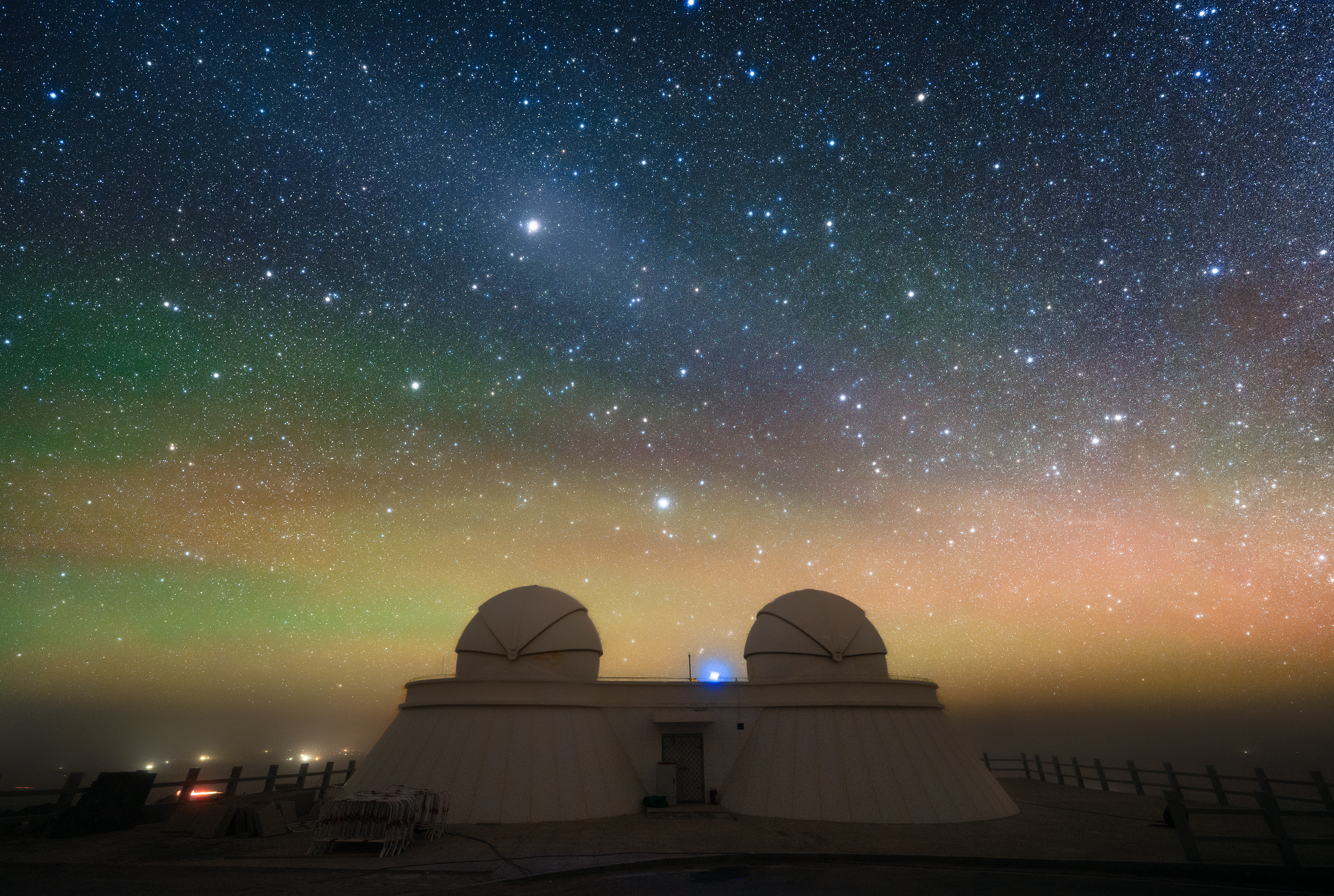
Explanation: This year Saturn was at opposition on September 21, opposite the Sun in planet Earth's sky. At its closest to Earth, Saturn was also at its brightest of the year, rising as the Sun set and shining above the horizon all night long among the fainter stars of the constellation Pisces. In this snapshot from the Qinghai Lenghu Observatory, Tibetan Plateau, southwestern China, the outer planet is immersed in a faint, diffuse oval of light known as the gegenschein or counter glow. The diffuse gegenschein is produced by sunlight backscattered by interplanetary dust along the Solar System's ecliptic plane, opposite the Sun in planet Earth's sky. Like a giant eye, on this dark night Saturn and gegenschein seem to stare down on the observatory's telescope domes from their antisolar perspective. Strong, atmospheric airglow forms a colorful background along the horizon.
2025 September 24

Explanation: It was the strongest gravitational wave signal yet measured -- what did it show? GW250114 was detected by both arms of the Laser Interferometer Gravitational-wave Observatory (LIGO) in Washington and Louisiana USA earlier this year. Analysis showed that the event was created when two black holes, each of mass around 33 times the mass of the Sun, coalesced into one larger black hole with a mass of around 63 solar masses. Even though the event happened about a billion light years away, the signal was so strong that the spin of all black holes, as well as initial ringing of the final black hole, was deduced with exceptional accuracy. Furthermore, it was confirmed better than before, as previously predicted, that the total event horizon area of the combined black hole was greater than those of the merging black holes. Featured, an artist's illustration depicts an imaginative and conceptual view from near one of the black holes before collision.

2025 September 23
Explanation: How massive can a normal star be? Estimates made from distance, brightness and standard solar models had given one star in the open cluster Pismis 24 over 200 times the mass of our Sun, making it one of the most massive stars known. This star is the brightest object located in the central cavity near the bottom center of the featured image taken with the Webb Space Telescope in infrared light. For comparison, a rollover image from the Hubble Space Telescope is also featured in visible light. Close inspection of the images, however, has shown that Pismis 24-1 derives its brilliant luminosity not from a single star but from three at least. Component stars would still remain near 100 solar masses, making them among the more massive stars currently on record. Toward the bottom of the image, stars are still forming in the associated emission nebula NGC 6357. Appearing perhaps like a Gothic cathedral, energetic stars near the center appear to be breaking out and illuminating a spectacular cocoon.

2025 September 22

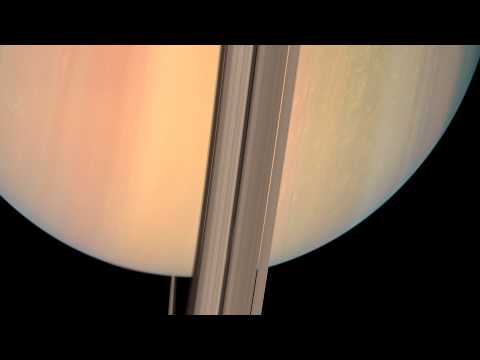
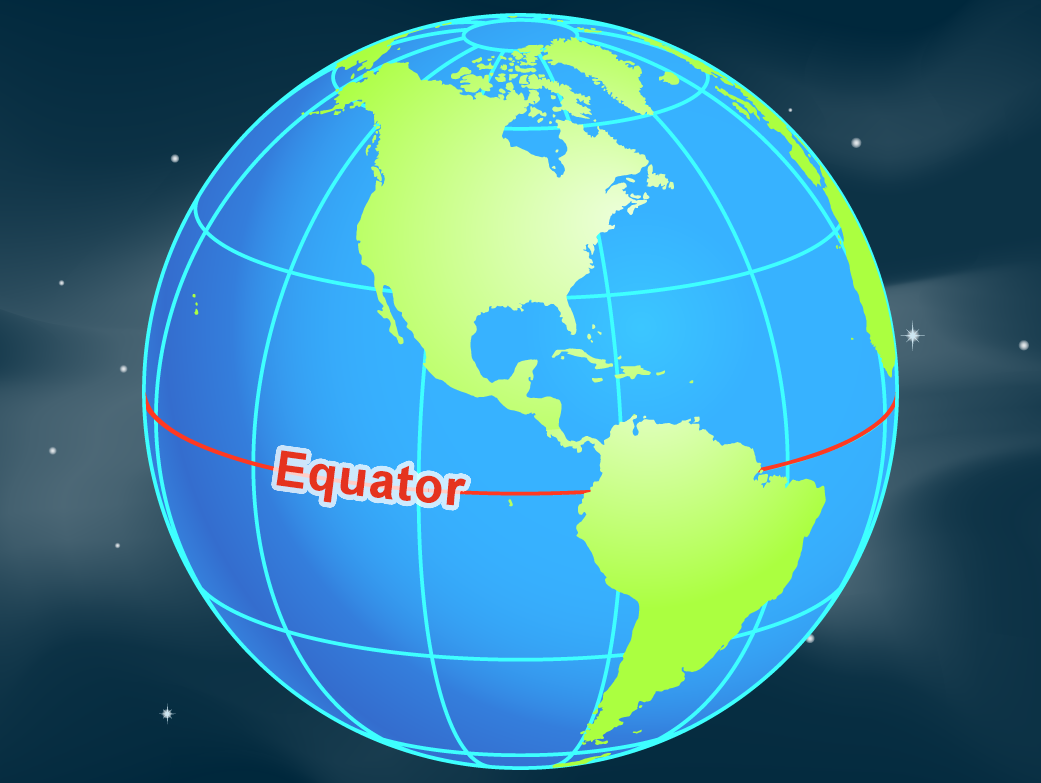
Explanation: On Saturn, the rings tell you the season. On Earth, today marks an equinox, the time when the Earth's equator tilts directly toward the Sun. Since Saturn's grand rings orbit along the planet's equator, these rings appear most prominent -- from the direction of the Sun -- when the spin axis of Saturn points toward the Sun. Conversely, when Saturn's spin axis points to the side, an equinox occurs, and the edge-on rings are hard to see from not only the Sun -- but Earth. In the featured montage, images of Saturn between the years of 2020 and 2025 have been superposed to show the giant planet passing, with this year's equinox, from summer in the north to summer in the south. Yesterday, Saturn was coincidently about as close as it gets to planet Earth, and so this month the ringed giant's orb is relatively bright and visible throughout the night.
2025 September 21
Explanation: Does the Sun set in the same direction every day? No, the direction of sunset depends on the time of the year. Although the Sun always sets approximately toward the west, on an equinox like tomorrow the Sun sets directly toward the west. After tomorrow's September equinox, the Sun will set increasingly toward the southwest, reaching its maximum displacement at the December solstice. Before tomorrow's September equinox, the Sun had set toward the northwest, reaching its maximum displacement at the June solstice. The featured time-lapse image shows seven bands of the Sun setting one day each month from 2019 December through 2020 June. These image sequences were taken from Alberta, Canada -- well north of the Earth's equator -- and feature the city of Edmonton in the foreground. The middle band shows the Sun setting during an equinox -- in March. From this location, the Sun will set along this same equinox band again tomorrow.

Cassini Approaches Saturn Video Credit & Copyright: Cassini Imaging Team , ISS , JPL , NASA , ESA , S. Van Vuuren et al.; Music: Ada...