Nombre total de pages vues
11/09/2024
POISSONS EXOTIQUES - Le baliste clown
ASTRONOMIE NEWS - L’éclipse partielle de Lune du 18 septembre 2024
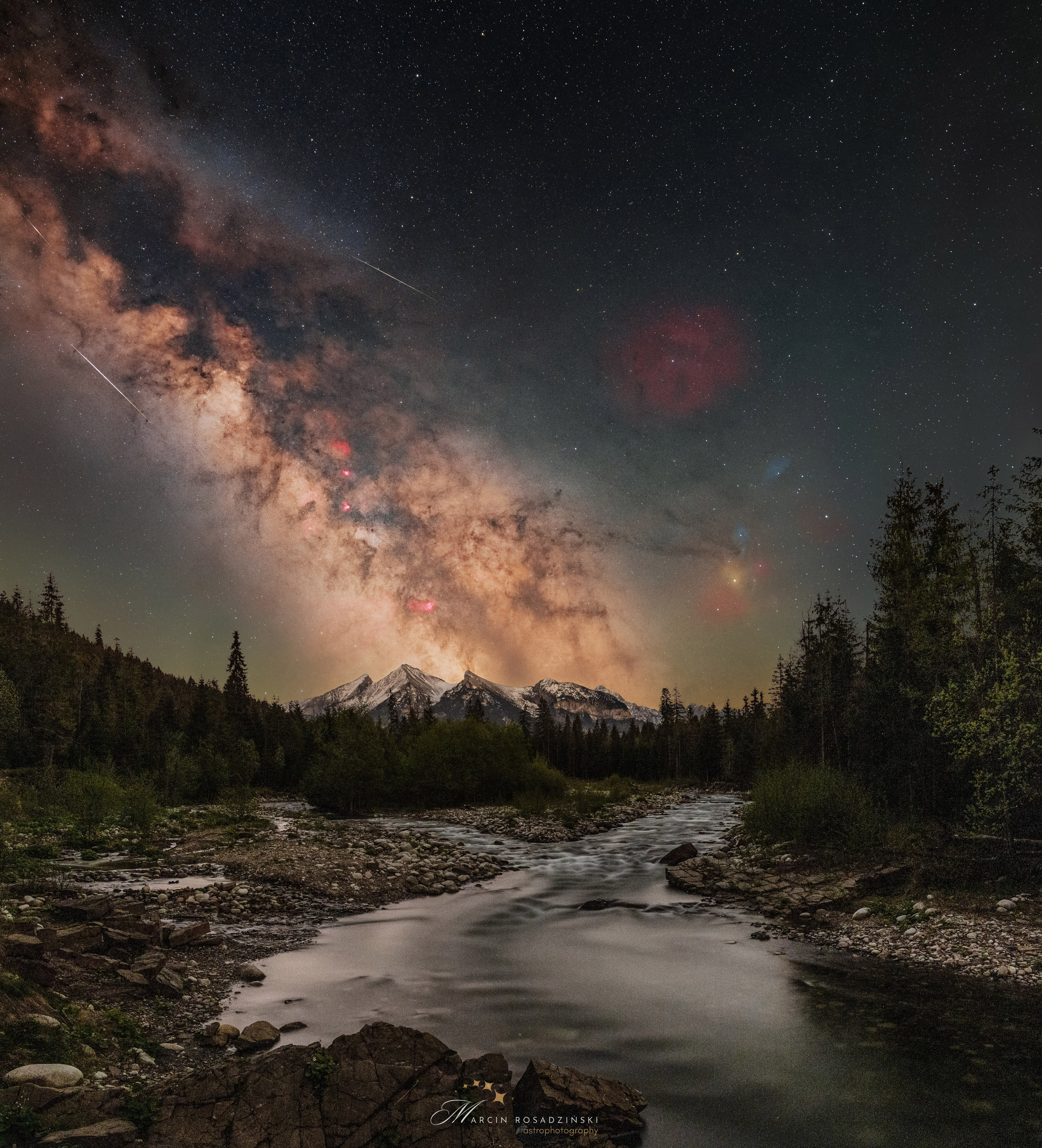
ASTRONOMY - A Night Sky over the Tatra Mountains
2024 September 11
Image Credit: Marcin Rosadziński; Text: Natalia Lewandowska (SUNY Oswego)
Explanation: A natural border between Slovakia and Poland is the Tatra Mountains. A prominent destination for astrophotographers, the Tatras are the highest mountain range in the Carpathians. In the featured image taken in May, one can see the center of our Milky Way galaxy with two of its famous stellar nurseries, the Lagoon and Omega Nebula, just over the top of the Tatras. Stellar nurseries are full of ionized hydrogen, a fundamental component for the formation of Earth-abundant water. As a fundamental ingredient in all known forms of life, water is a crucial element in the Universe. Such water can be seen in the foreground in the form of the Bialka River.
10/09/2024
PLANTES FASCINANTES - Hoya carnosa
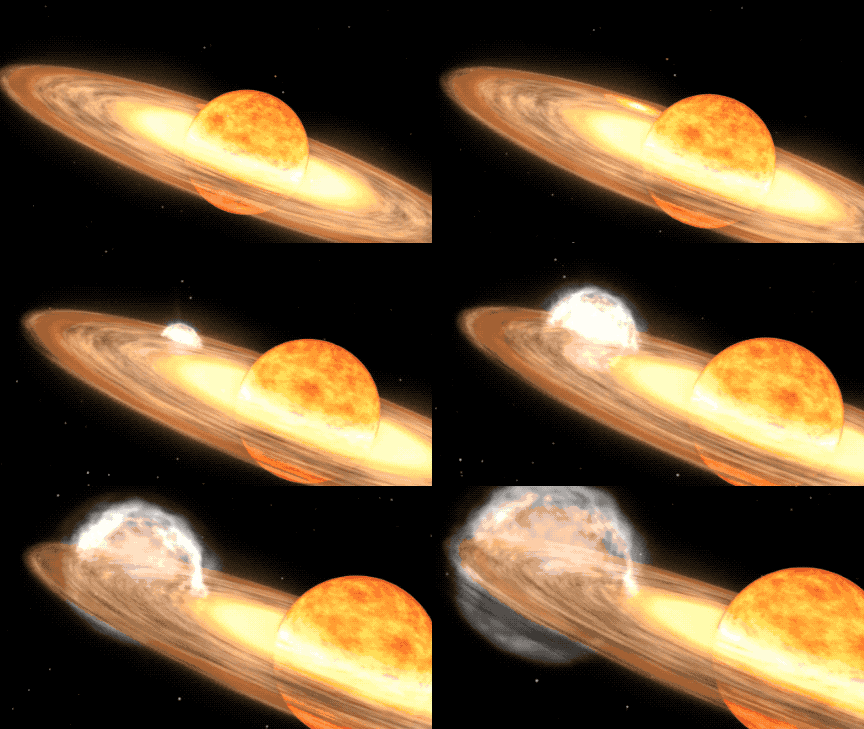
ASTRONOMIE - Préparez-vous : une nouvelle étoile va apparaître dans le ciel d'un jour à l'autre !
ASTRONOMY - Horsehead and Orion Nebulas
2024 September 10
Image Credit & Copyright: Antoine & Dalia Grelin
Explanation: The dark Horsehead Nebula and the glowing Orion Nebula are contrasting cosmic vistas. Adrift 1,500 light-years away in one of the night sky's most recognizable constellations, they appear in opposite corners of the above stunning mosaic. The familiar Horsehead nebula appears as a dark cloud, a small silhouette notched against the long glow of hydrogen -- here shown in gold -- at the lower left. Alnitak is the easternmost star in Orion's belt and is seen as the bright star to the left of the Horsehead. Just below Alnitak is the Flame Nebula, with clouds of bright emission and dramatic dark dust lanes. The magnificent emission region, the Orion Nebula (aka M42), lies at the upper right. Immediately to its left is a prominent reflection nebula sometimes called the Running Man. Pervasive tendrils of glowing hydrogen gas are easily traced throughout the region.
09/09/2024
INVENTIONS A L'HORIZON 2050 - Des aliments sur mesure
ASTRONOMY - Mars: Moon- Craters and Volcanos
2024 September 9
Image Credit: ESA, DLR, FU Berlin, Mars Express; Processing & CC BY 2.0 License: Andrea Luck; h/t: Phil Plait
Explanation: If you could fly over Mars, what might you see? The featured image shows exactly this in the form of a Mars Express vista captured over a particularly interesting region on Mars in July. The picture's most famous feature is Olympus Mons, the largest volcano in the Solar System, visible on the upper right. Another large Martian volcano is visible on the right horizon: Pavonis Mons. Several circular impact craters can be seen on the surface of the aptly named red planet. Impressively, this image was timed to capture the dark and doomed Martian moon Phobos, visible just left of center. The surface feature on the lower left, known as Orcus Patera, is unusual for its large size and oblong shape, and mysterious because the processes that created it still remain unknown. ESA's robotic Mars Express spacecraft was launched in 2003 and, among many notable science discoveries, bolstered evidence that Mars was once home to large bodies of water.
08/09/2024
ASTRONOMY - M31: The Andromeda Galaxy
Image Credit: Subaru (NAOJ), Hubble (NASA/ESA), Mayall (NSF);
Processing & Copyright: R. Gendler & R. Croman
Explanation: The most distant object easily visible to the unaided eye is M31, the great Andromeda Galaxy. Even at some two and a half million light-years distant, this immense spiral galaxy -- spanning over 200,000 light years -- is visible, although as a faint, nebulous cloud in the constellation Andromeda. A bright yellow nucleus, dark winding dust lanes, and expansive spiral arms dotted with blue star clusters and red nebulae, are recorded in this stunning telescopic image which combines data from orbiting Hubble with ground-based images from Subaru and Mayall. In only about 5 billion years, the Andromeda galaxy may be even easier to see -- as it will likely span the entire night sky -- just before it merges with, or passes right by, our Milky Way Galaxy.
07/09/2024
INVENTIONS A L'HORIZON 2050 - Des arbres lampadaires pour éclairer les rues
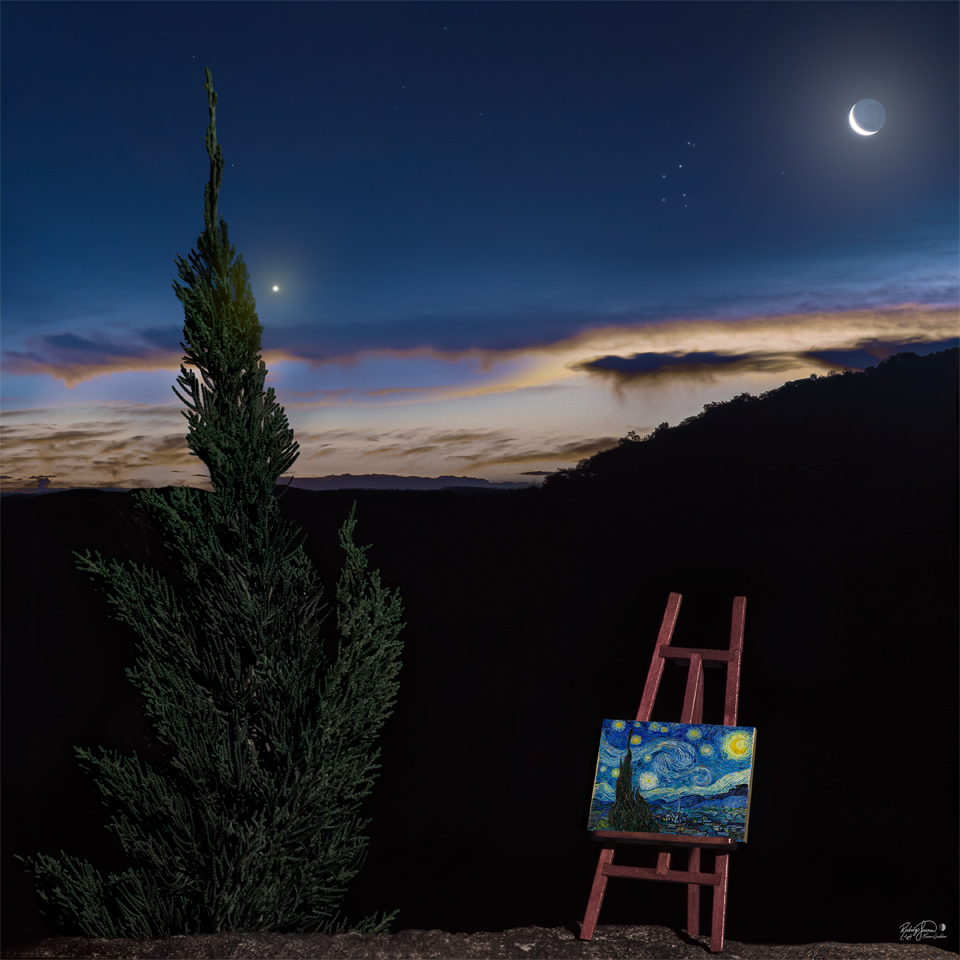
Astronomy - STARRY NIGHT II
2026 June 19 Starry Night II Image Credit & Copyright: Rodrigo Guerra , Original Painting: Vincent van Gogh Explanation: Does this scen...
-
2026 January 1 Auroral Corona Image Credit & Copyright : Roi Levi Explanation: Cycle 25 solar maximum made 2025 a great year for ...
-
2026 January 2 NanoSail-D2 Image Credit & Copyright : Ralf Vandebergh Explanation: In 2011, on January 20, NASA's NanoSail-D2 ...