Nombre total de pages vues
01/06/2025
DEGUSTATION EXOTIQUE DE FRUITS RARES - La main de Bouddha
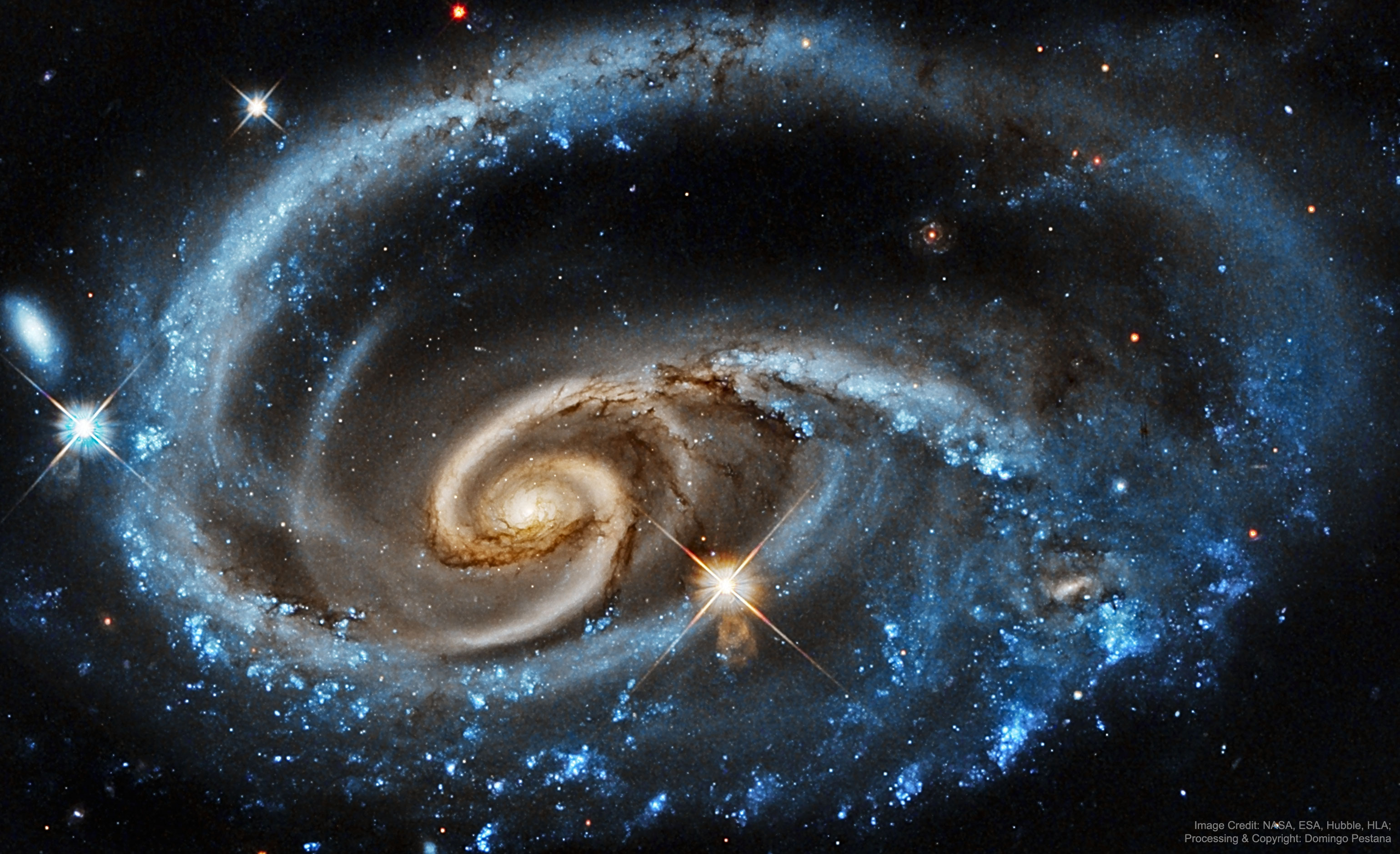
ASTRONOMY - UGC 1810: Wildly Interacting Galaxy from Hubble
Image Credit: NASA, ESA, Hubble, HLA; Processing & Copyright: Domingo Pestana
Explanation: What's happening to this spiral galaxy? Although details remain uncertain, it surely has to do with an ongoing battle with its smaller galactic neighbor. The featured galaxy is labelled UGC 1810 by itself, but together with its collisional partner is known as Arp 273. The overall shape of UGC 1810 -- in particular its blue outer ring -- is likely a result of wild and violent gravitational interactions. This ring's blue color is caused by massive stars that are blue hot and have formed only in the past few million years. The inner galaxy appears older, redder, and threaded with cool filamentary dust. A few bright stars appear well in the foreground, unrelated to UGC 1810, while several galaxies are visible well in the background. Arp 273 lies about 300 million light years away toward the constellation of Andromeda. Quite likely, UGC 1810 will devour its galactic sidekick over the next billion years and settle into a classic spiral form.
31/05/2025
ASTRONOMY - Afterimage Sunset
2025 May 31
Image Credit & Copyright: Marcella Giulia Pace
Explanation: On May 7, the Sun setting behind a church bell tower was captured in this filtered and manipulated digital skyscape from Ragusa, Sicily, planet Earth. In this version of the image the colors look bizarre. Still, an intriguing optical illusion known as an afterimage can help you experience the same scene with a more natural looking appearance. To try it, find the sunspots of active region AR4079 grouped near the bottom of the blue solar disk. Relax and stare at the dark sunspot group for about 30 seconds, then close your eyes or shift your gaze to a plain white surface. In a moment an afterimage of the sunset should faintly appear. But the afterimage sunset will have this image's complementary colors and a more normal yellow Sun against a familiar blue sky.
METEOROLOGIE - Qu’est-ce que la galerne ? Chute spéculaire des températures dans le Sud-Ouest
30/05/2025
ASTRONOMY - Mars in the Loop
2025 May 30
Mars in the Loop
Explanation: This composite of images spaced a weather-permitting 5 to 9 days apart, from 2024 September 19 (top right) through 2025 May 18 (bottom left), faithfully traces ruddy-colored Mars as it makes a clockwise loop through the constellations Gemini and Cancer in planet Earth's night sky. You can connect the dots and dates with your cursor over the image, but be sure to check out this animation of the Red Planet's 2024/25 retrograde motion. Of course Mars didn't actually reverse the direction of its orbit. Instead, the apparent backwards motion with respect to the background stars is a reflection of the orbital motion of Earth itself. Retrograde motion can be seen each time Earth overtakes and laps planets orbiting farther from the Sun, the Earth moving more rapidly through its own relatively close-in orbit. In this case Mars' apparent eastward motion began to reverse around December 8, when it seemed to linger near open star cluster M44 in Cancer. After wandering back to the west, under Gemini's bright stars Castor and Pollux, Mars returned to pose near M44 by early May. At its brightest near opposition on 2025 January 16, Mars was a mere 96 million kilometers away.
29/05/2025
SANTé/MEDECINE - Cancer rare : ces 2 symptômes passent souvent inaperçus - (2/2)
ASTRONOMY - Irregular Dwarf Galaxy Sextans A
2025 May 29
Image Credit & Copyright: Franz Hofmann, Gemsbock Observatory
Explanation: Grand spiral galaxies often seem to get all the attention, flaunting young, bright, blue star clusters and pinkish star forming regions along graceful, symmetric spiral arms. But small galaxies form stars too, like irregular dwarf galaxy Sextans A. Its young star clusters and star forming regions are gathered into a gumdrop-shaped region a mere 5,000 light-years across. Seen toward the navigational constellation Sextans, the small galaxy lies some 4.5 million light-years distant. That puts it near the outskirts of the local group of galaxies, that includes the large, massive spirals Andromeda and our own Milky Way. Brighter Milky Way foreground stars appear spiky and yellowish in this colorful telescopic view of Sextans A.
ASTRONOMY - Herbig-Haro 24
2025 May 28
Image Credit: NASA, ESA, Hubble Heritage (STScI / AURA) / Hubble-Europe Collaboration
Acknowledgment: D. Padgett (GSFC), T. Megeath (University of Toledo), B. Reipurth (University of Hawaii)
Explanation: This might look like a double-bladed lightsaber, but these two cosmic jets actually beam outward from a newborn star in a galaxy near you. Constructed from Hubble Space Telescope image data, the stunning scene spans about half a light-year across Herbig-Haro 24 (HH 24), some 1,300 light-years or 400 parsecs away in the stellar nurseries of the Orion B molecular cloud complex. Hidden from direct view, HH 24's central protostar is surrounded by cold dust and gas flattened into a rotating accretion disk. As material from the disk falls toward the young stellar object, it heats up. Opposing jets are blasted out along the system's rotation axis. Cutting through the region's interstellar matter, the narrow, energetic jets produce a series of glowing shock fronts along their path.
27/05/2025
SANTé/MEDECINE - Cancer rare : ces 2 symptômes passent souvent inaperçus - (1/2)
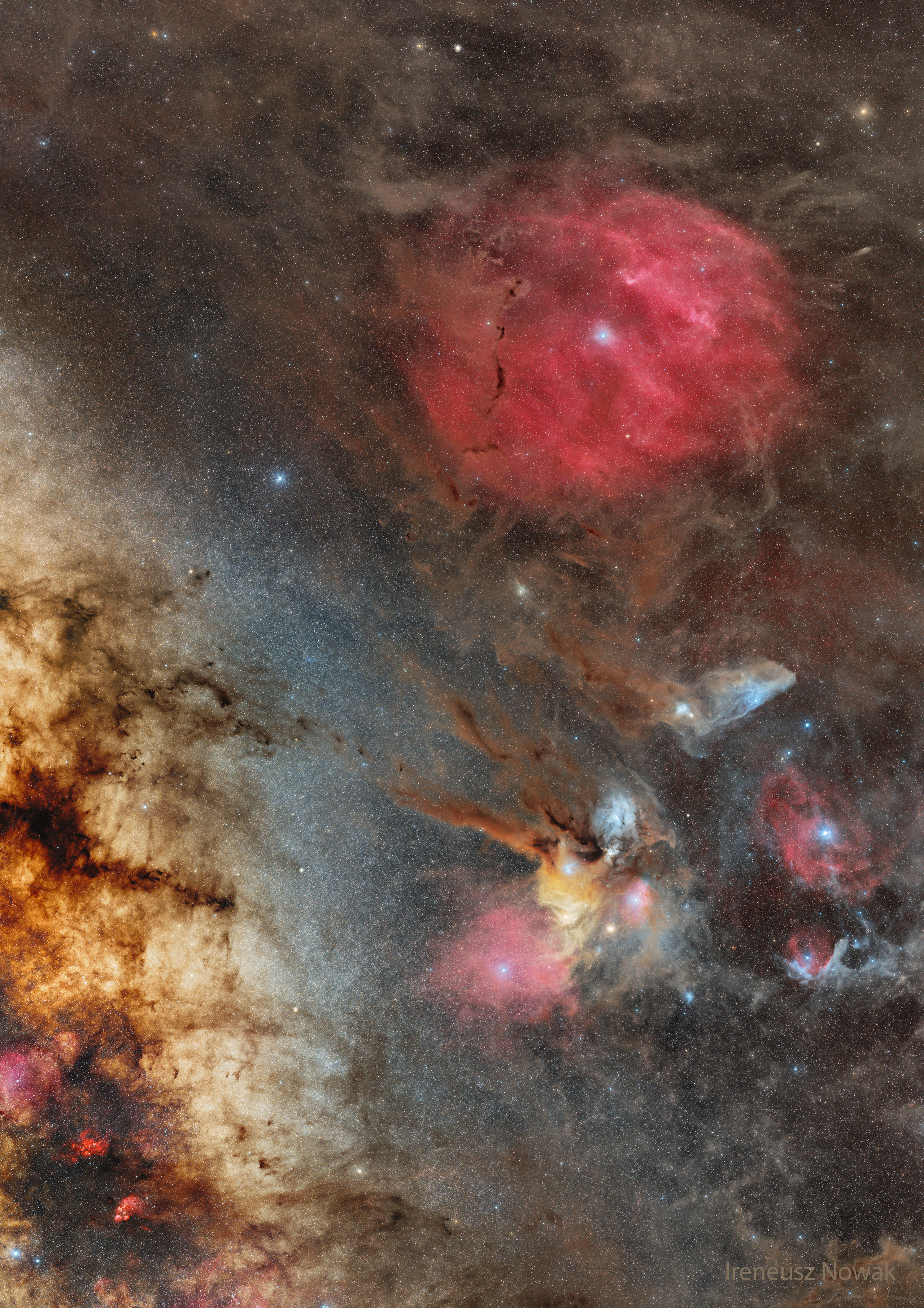
ASTRONOMY - Zeta and Rho Ophiuchi with Milky Way
2025 May 27
Image Credit & Copyright: Ireneusz Nowak
Explanation: Behold one of the most photogenic regions of the night sky, captured impressively. Featured, the band of our Milky Way Galaxy runs diagonally along the bottom-left corner, while the colorful Rho Ophiuchi cloud complex is visible just right of center and the large red circular Zeta Ophiuchi Nebula appears near the top. In general, red emanates from nebulas glowing in the light of excited hydrogen gas, while blue marks interstellar dust preferentially reflecting the light of bright young stars. Thick dust usually appears dark brown. Many iconic objects of the night sky appear, including (can you find them?) the bright star Antares, the globular star cluster M4, and the Blue Horsehead nebula. This wide field composite, taken over 17 hours, was captured from South Africa last June.
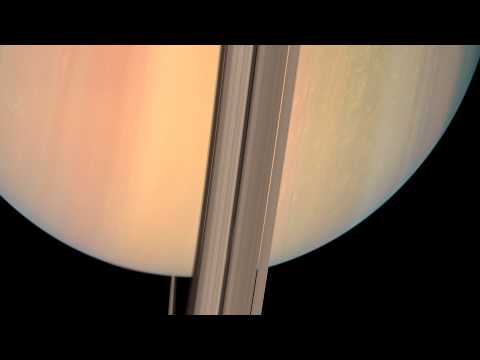
Astronomy - CASSINI APPROACHES SATURN
Cassini Approaches Saturn Video Credit & Copyright: Cassini Imaging Team , ISS , JPL , NASA , ESA , S. Van Vuuren et al.; Music: Ada...
-
2026 January 2 NanoSail-D2 Image Credit & Copyright : Ralf Vandebergh Explanation: In 2011, on January 20, NASA's NanoSail-D2 ...
-
2026 January 1 Auroral Corona Image Credit & Copyright : Roi Levi Explanation: Cycle 25 solar maximum made 2025 a great year for ...