Nombre total de pages vues
25/01/2026
SANTé/MEDECINE - Tout savoir sur le coeur humain - 3 - Coupe dans le ventricule gauche
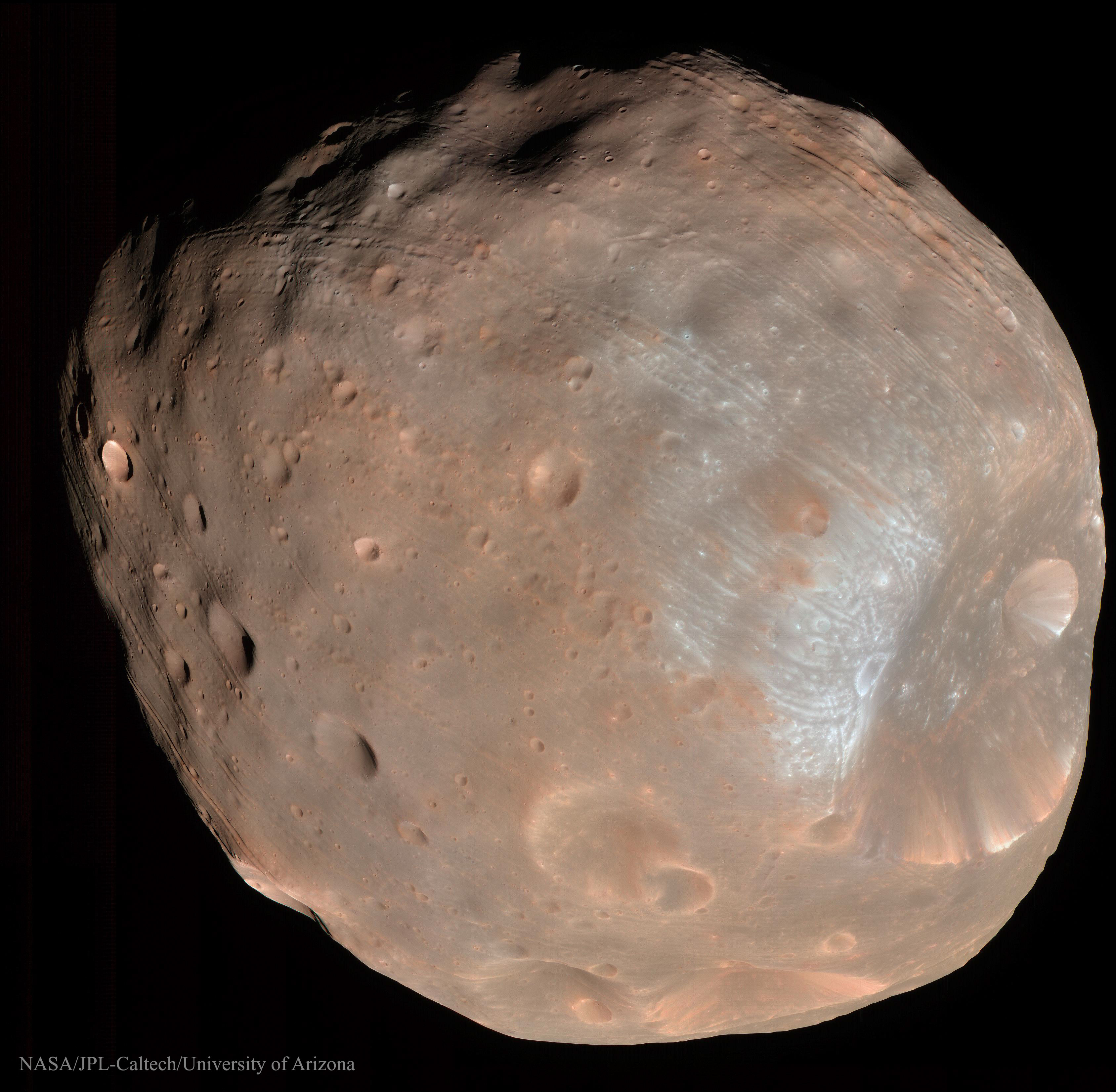
ASTRONOMY - Phobos: Doomed Moon of Mars
2026 January 25
Image Credit: NASA, LPL (U. Arizona), MRO, HiRISE
Explanation: This moon is doomed. Mars, the red planet named for the Roman god of war, has two tiny moons, Phobos and Deimos, whose names are derived from the Greek for Fear and Panic. These Martian moons may well be captured asteroids originating in the main asteroid belt between Mars and Jupiter or perhaps from even more distant reaches of our Solar System. The larger moon, Phobos, is indeed seen to be a cratered, asteroid-like object in this stunning color image from the robotic Mars Reconnaissance Orbiter, which can image objects as small as 10 meters. But Phobos orbits so close to Mars - about 5,800 kilometers above the surface compared to 400,000 kilometers for our Moon - that gravitational tidal forces are dragging it down. In perhaps 50 million years, Phobos is expected to disintegrate into a ring of debris.
Explication : Cette lune est condamnée. Mars , la planète rouge nommée d'après le dieu romain de la guerre , possède deux petites lunes, Phobos et Deimos , dont les noms dérivent du grec et signifient respectivement « peur » et « panique » . Ces lunes martiennes pourraient bien être des astéroïdes capturés , provenant de la ceinture d'astéroïdes principale située entre Mars et Jupiter , voire de régions encore plus éloignées de notre système solaire . Phobos , la plus grande lune , apparaît effectivement comme un objet cratérisé, semblable à un astéroïde, sur cette magnifique image en couleur prise par la sonde Mars Reconnaissance Orbiter , capable d'imager des objets aussi petits que 10 mètres. Mais Phobos orbite si près de Mars – à environ 5 800 kilomètres au-dessus de sa surface, contre 400 000 kilomètres pour notre Lune – que les forces de marée gravitationnelles l'attirent vers le bas. Dans environ 50 millions d'années, Phobos devrait se désintégrer en un anneau de débris.
24/01/2026
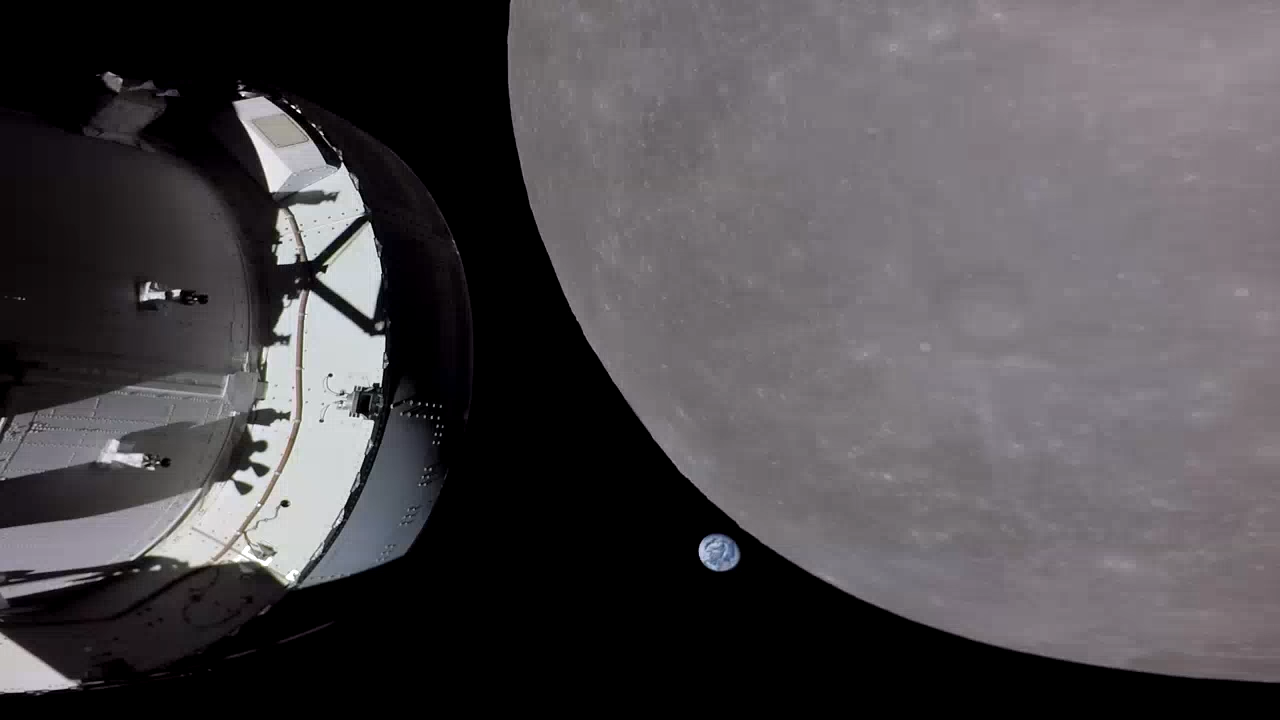
ASTRONOMY - Earthset from Orion
2026 January 24
Image Credit: NASA, Artemis 1
Explanation: Eight billion people are about to disappear in this snapshot from space taken on 2022 November 21. On the sixth day of the Artemis I mission, their home world is setting behind the Moon's bright edge as viewed by an external camera on the outbound Orion spacecraft. Orion was headed for a powered flyby that took it to within 130 kilometers of the lunar surface. Velocity gained in the flyby maneuver was used to reach a distant retrograde orbit around the Moon. That orbit is considered distant because it's another 92,000 kilometers beyond the Moon, and retrograde because the spacecraft orbited in the opposite direction of the Moon's orbit around planet Earth. Swinging around the Moon, Orion reached a maximum distance (just over 400,000 kilometers) from Earth on 2022 November 28, exceeding a record set by Apollo 13 for most distant spacecraft designed for human space exploration. The Artemis II mission, carrying 4 astronauts around the moon and back again, is due to launch as early as February 6.
23/01/2026
SANTé/MEDECINE - Tout savoir sur le coeur humain - 2 - Anatomie du cœur humain
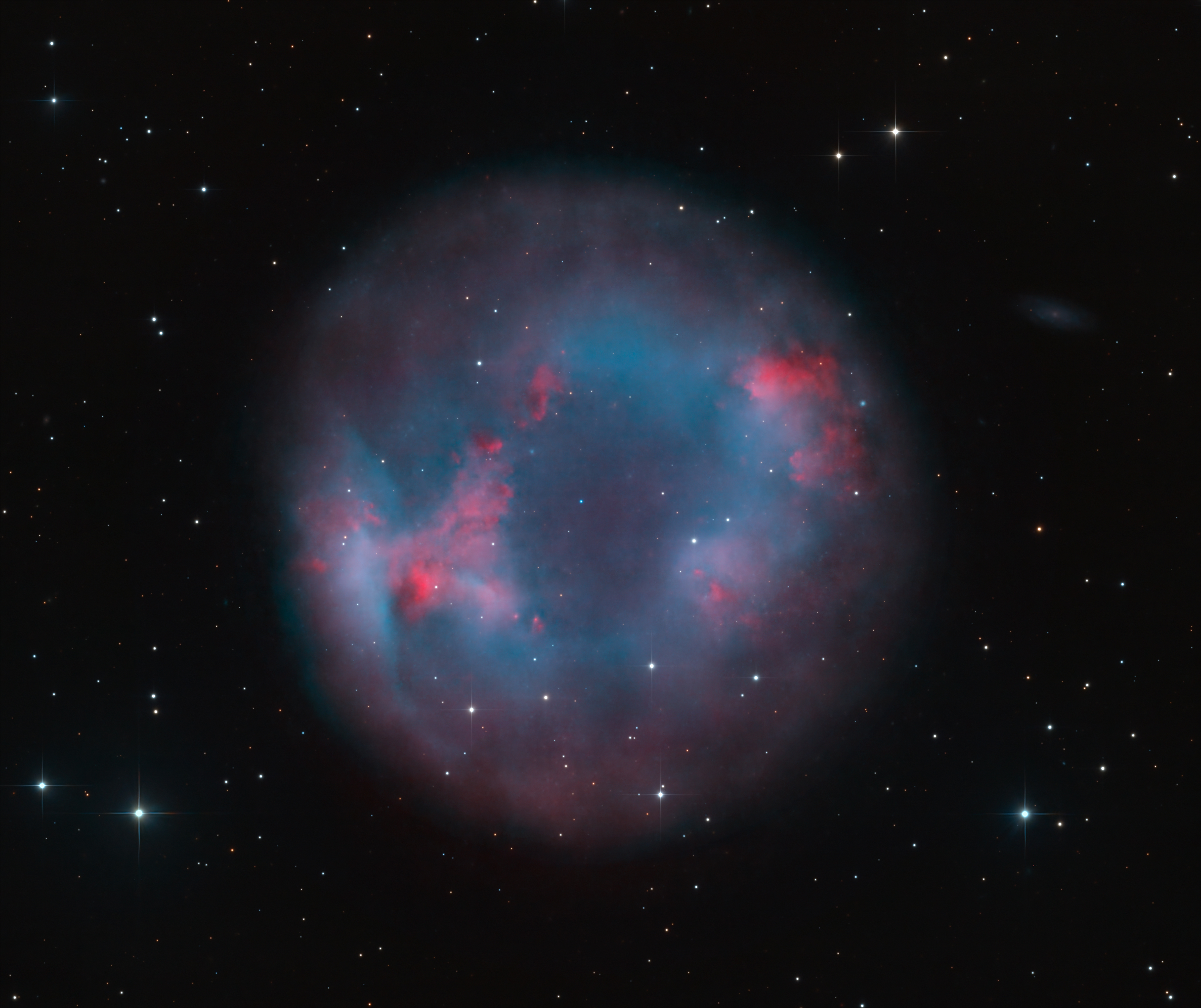
ASTRONOMY - Planetary Nebula Abell 7
2026 January 23
Image Credit & Copyright: Martin Pugh
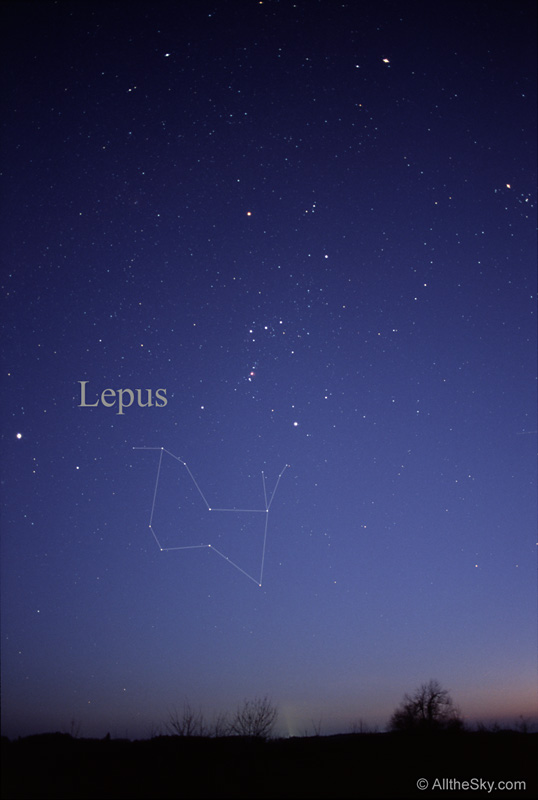
Explanation: Very faint planetary nebula Abell 7 is about 1,800 light-years distant. It lies just south of Orion in planet Earth's skies toward the constellation Lepus, The Hare. Posing with scattered Milky Way stars, its generally simple spherical shape about 8 light-years in diameter is revealed in this deep telescopic image. The beautiful and complex shapes seen within the cosmic cloud are visually enhanced by the use of long exposures and narrowband filters that capture emission from hydrogen and oxygen atoms. Otherwise Abell 7 would be much too faint to be appreciated by eye. A planetary nebula represents a very brief final phase in stellar evolution that our own Sun will experience 5 billion years hence, as the nebula's central, once sun-like star shrugs off its outer layers. Abell 7 itself is estimated to be 20,000 years old. But its central star, seen here as a fading white dwarf, is some 10 billion years old.
22/01/2026
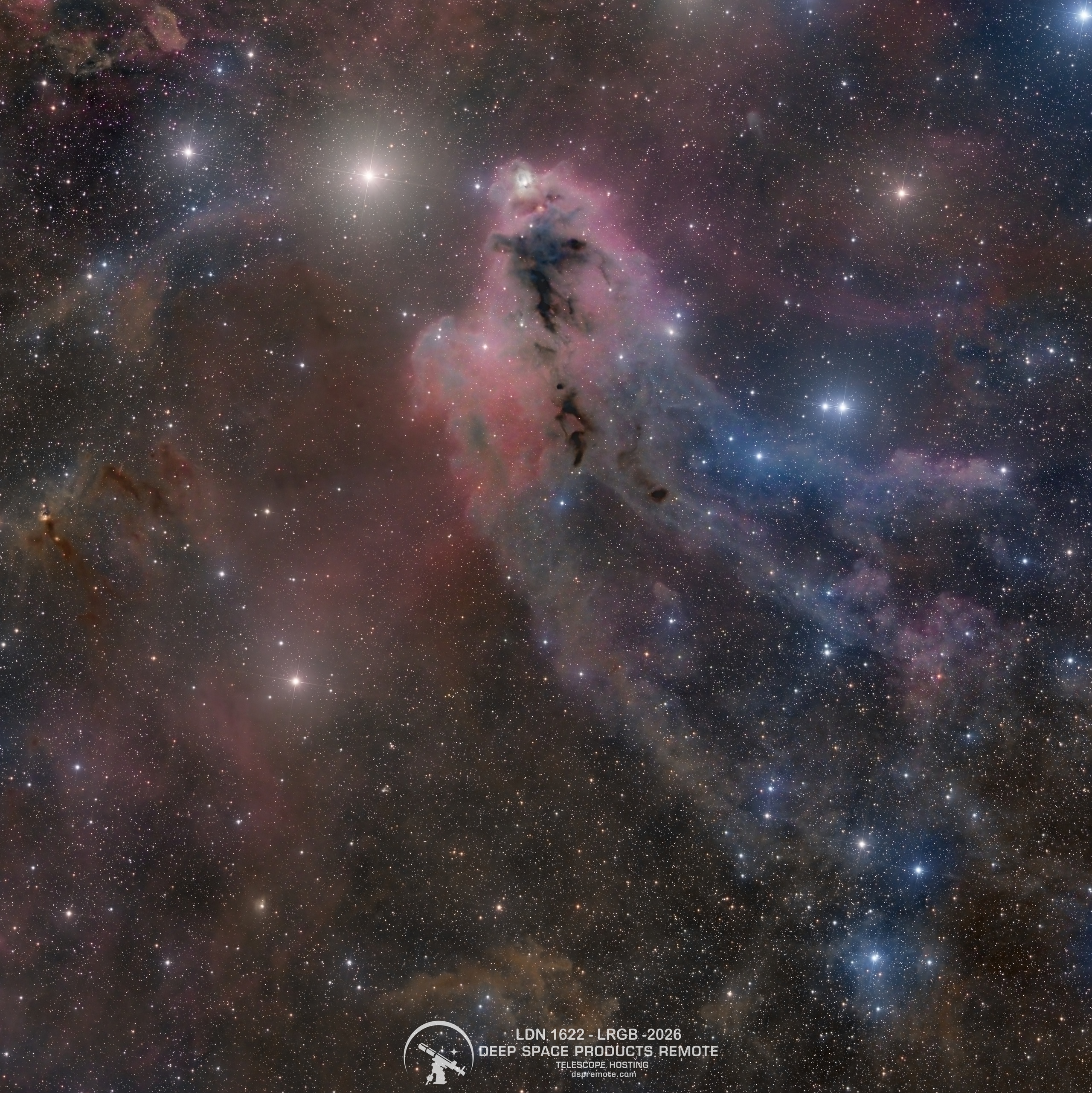
ASTRONOMY - LDN 1622: Dark Nebula in Orion
2026 January 22
Image Credit & Copyright: Chris Fellows
Explanation: The silhouette of an intriguing dark nebula inhabits this cosmic scene. Lynds' Dark Nebula (LDN) 1622 appears against a faint background of glowing hydrogen gas only visible in long telescopic exposures of the region. In contrast, a brighter reflection nebula, vdB 62, is more easily seen just above the dusty dark nebula. LDN 1622 lies near the plane of our Milky Way Galaxy, close on the sky to Barnard's Loop, a large cloud surrounding the rich complex of emission nebulae found in the Belt and Sword of Orion. With swept-back outlines, the obscuring dust of LDN 1622 is thought to lie at a similar distance, perhaps 1,500 light-years away. At that distance, this 3 degree wide field of view would span about 100 light-years. Young stars do lie hidden within the dark expanse and have been revealed in Spitzer Space telescope infrared images. Still, the foreboding visual appearance of LDN 1622 inspires its popular name, the Boogeyman Nebula.
21/01/2026
SANTé/MEDECINE - Tout savoir sur le coeur humain - 1
ASTRONOMY - Barred Spiral Galaxy NGC 1365 from Webb
2026 January 21
Image Credit: NASA, ESA, CSA, Janice Lee (NOIRLab) - Processing: Alyssa Pagan (STScI)
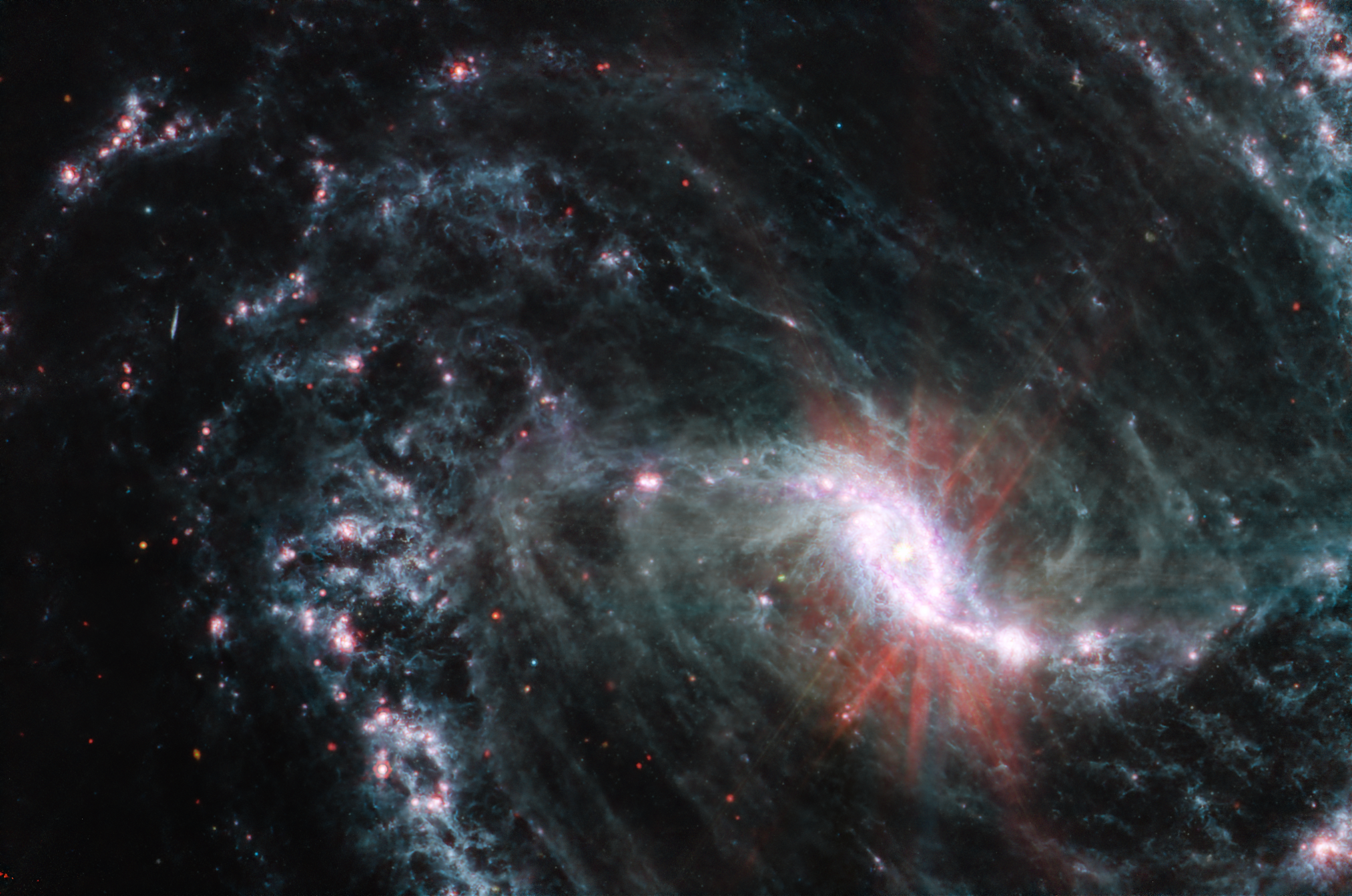
Explanation: A mere 56 million light-years distant toward the southern constellation Fornax, NGC 1365 is an enormous barred spiral galaxy about 200,000 light-years in diameter. That's twice the size of our own barred spiral Milky Way. This sharp image from the James Webb Space Telescope's Mid-Infrared Instrument (MIRI) reveals stunning details of this magnificent spiral in infrared light. Webb's field of view stretches about 60,000 light-years across NGC 1365, exploring the galaxy's core and bright newborn star clusters. The intricate network of dusty filaments and bubbles is created by young stars along spiral arms winding from the galaxy's central bar. Astronomers suspect the gravitational field of NGC 1365's bar plays a crucial role in the galaxy's evolution, funneling gas and dust into a star-forming maelstrom and ultimately feeding material into the active galaxy's central, supermassive black hole.
20/01/2026
ASTRONOMY - Io in True Color
2026 January 20
Image Credit: NASA, JPL, Galileo Project
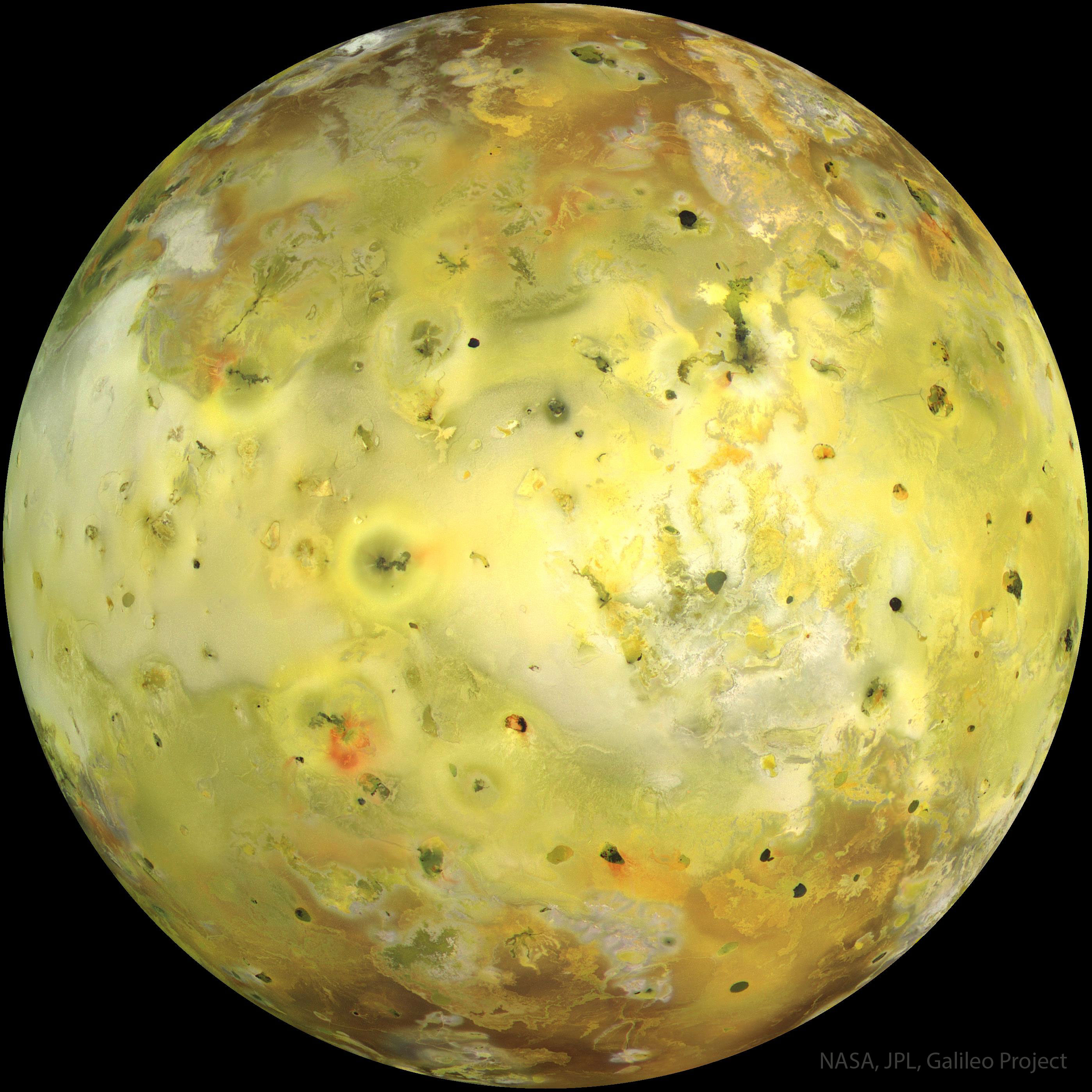
Explanation: The strangest moon in the Solar System is bright yellow. The featured picture, an attempt to show how Io would appear in the "true colors" perceptible to the average human eye, was taken in 1999 July by the Galileo spacecraft that orbited Jupiter from 1995 to 2003. Io's colors derive from sulfur and molten silicate rock. The unusual surface of Io is kept very young by its system of active volcanoes. The intense tidal gravity of Jupiter stretches Io and damps wobbles caused by Jupiter's other Galilean moons. The resulting friction greatly heats Io's interior, causing molten rock to explode through the surface. Io's volcanoes are so active that they are effectively turning the whole moon inside out. Some of Io's volcanic lava is so hot it glows in the dark.
19/01/2026
LES BELLES INVENTIONS DE LEONARD DE VINCI - La scie hydraulique et sa roue à godets
Astronomy - SELFIE AT VERA RUBIN RIDGE
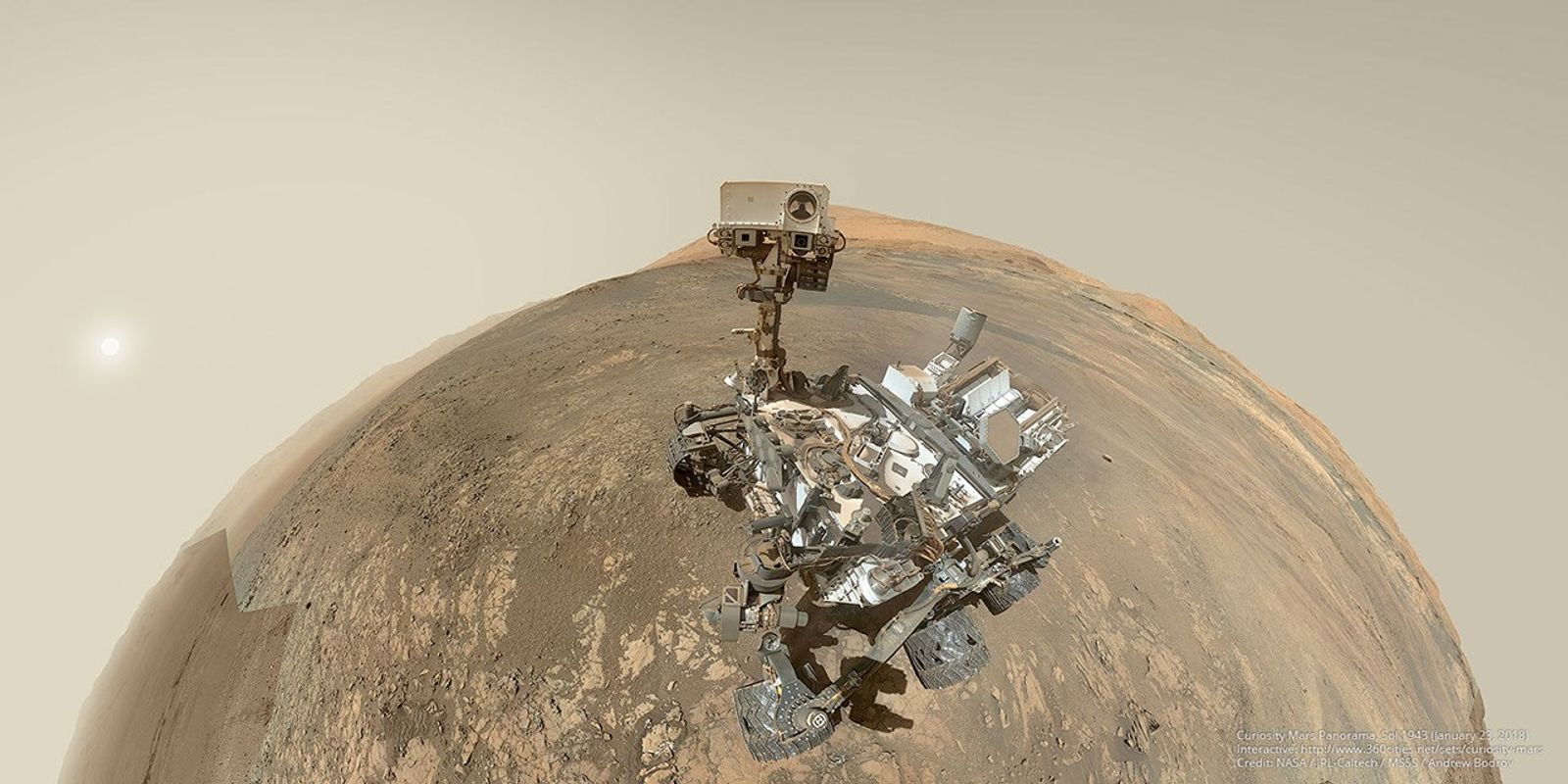
Explanation: On sol 1943 of its journey of exploration across the surface of Mars, the Curiosity Rover recorded this selfie at the south ...
-
2026 January 2 NanoSail-D2 Image Credit & Copyright : Ralf Vandebergh Explanation: In 2011, on January 20, NASA's NanoSail-D2 ...
-
2026 January 1 Auroral Corona Image Credit & Copyright : Roi Levi Explanation: Cycle 25 solar maximum made 2025 a great year for ...